
Showing posts with label James Whale. Show all posts

February 4, 2020

Hell's Angels.


Review #1332: Hell's Angels.

Cast: 
Ben Lyon (Monte Rutledge), James Hall (Roy Rutledge), Jean Harlow (Helen), John Darrow (Karl Arnstedt), Lucien Prival (Baron Von Kranz), Frank Clarke (Lt. von Bruen), Roy Wilson ("Baldy" Maloney), Douglas Gilmore (Capt. Redfield), Jane Winton (Baroness Von Kranz), Evelyn Hall (Lady Randolph), William B. Davidson (Staff Major), and Wyndham Standing (RFC squadron commander) Directed by Howard Hughes, James Whale (#069 - The Invisible Man, #071 - Frankenstein, #394 - Bride of Frankenstein, and #465 - The Old Dark House) and Edmund Goulding.

Review: 
Jean Harlow was a star that burned just as twice as bright as others that burned half as long as others for the 1930s during her short career. This was her first breakthrough film happened just appeared in bit roll since 1928 (when she was 17) before being noticed by James Hall while on production on this film which was in transition (having started in October of 1927). The film needed a new lead actress in order to be a talkie since Greta Nissen was being replaced in the lead role because of her Norwegian accent. The man behind the film as producer and director was Howard Hughes, business magnate/engineer who had produced films since 1926 most notably with Two Arabian Knights (1927). He spent nearly three million dollars on this film, sparing no expense in making his epic air story. The film went through multiple directors (Marshall Neilan, Luther Reed), multiple pilots being killed in airplane crashes, and a lawsuit by Hughes in order to provide to try and prevent another pilot film with The Dawn Patrol (1930) from beating it to theaters. The film was not a major success on upon original release, in part because of the large production costs, but it is now known as one of the earliest standout action films. Of note is the dialogue direction by James Whale, who had done direction for the stage production of Journey's End  (which coincidentally would be turned into a film by Whale that same year); there was also some direction done by Goulding, now known for his cultured dramas like Grand Hotel (1932) and The Razor's Edge (1946). There were two writers for the film - Marshall Neilan (story) and Joseph Moncure March (story and dialogue). The film certainly works better on the sum of its action sequences more so than its acting but it is generally interesting to sit through then as now. I will admit though that one film that definitely came to mind when watching this film was Wings (1927), which also featured a love triangle within a World War I plot alongside of notable flashes of color during sequences (although this does that through tinting and an eight minutes Multicolor filmed sequence). While Wings is definitely the better film in its composition, it shouldn't hinder the enjoyment of Hell's Angels - an imperfect but interesting experience that fits for some worthy escapism, albeit one that is a bit long at 131 minutes, but it sure is dreary enough for an epic aviation war film, I suppose.

The highlights of the film are the air sequences and Harlow, undeniably. It is a joy to see scenes done in the air, where one can always seem to sense riveting danger (whether for the character or for the actual pilot) without becoming bored by seeing plane flying and shooting at each other, probably because of how well crafted it is in filming and in execution. Hughes knows what he likes to see in the air come out on screen - this was the first of two films he directed (with the other taking just as long to come out in The Outlaw). The main two actors in Lyon and Hall do not fare as well with attention. Simply put: they are flat, and they barely even seem like siblings at all, with their interactions being the kind of wooden that plague films that know they can't be just action all the time but needs to pad themselves out anyway. Even though Harlow doesn't have as much screen experience as her two male stars, she excels in presence in each scene she appears in. She has that "it" factor like others before her, a bombshell that fits her era handily. Darrow is almost easy to forget, since his dilemma (a German Oxford student conscripted into the nation's Air Force) disappears halfway through (namely by dropping him from the sky) without much to say. Prival makes for an adequate adversary (he even gets to do a duel!), at least. If one is here for air action, you will get that will no trouble, with one even having blue tint to go with its night setting for wondrous effect (with the highlight being a plane crashing right into a blimp). The rest doesn't quite measure up, but it will prove adequate enough for entertainment for its era without trouble.

Overall, I give it 7 out of 10 stars.

October 13, 2013

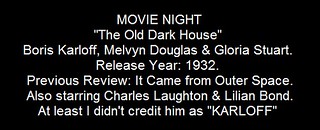
Movie Night: The Old Dark House.


Review #465: The Old Dark House.

Cast
Boris Karloff (Morgan), Melvyn Douglas (Roger Penderel), Gloria Stuart (Margaret Waverton), Charles Laughton (William Porterhouse), Lilian Bond (Gladys Perkins), Ernest Thesiger (Horace Femm), Raymond Massey (Philip Waverton), Eva Moore (Rebecca Femm), Elspeth Dudgeon (Roderick Femm), and Brember Wills (Saul Femm) Directed by James Whale (#069 - The Invisible Man, #071 - Frankenstein and #394 - Bride of Frankenstein)

Review
Naturally, this was based off a novel, Benighted by J. B. Priestly, this film being made just after Whale's success with Frankenstein, with Karloff also in this film, as a mute butler, and while this isn't his strongest performance, it is an effective one. The film sets itself quickly, probably due to the short length, or to not delay the inevitable, and while most of the visitors of the house aren't really memorable by any means, save for Charles Laughton, who seems to try and liven the film up. The film has its scares and excellent lighting, which all boils down to the climax involving Douglas and Wills, with Karloff joining in briefly. Elspeth Dudgeon, despite her short screen time, helps contribute to the film and the suspense. The film is tense and while it struggles to overcome its feeble minded characters, it certainly is a breeze to get through and Whale does a fine job, house and all.

Overall, I give it 7 out of 10 stars.
June 7, 2013

Movie Night: Bride of Frankenstein.


Review #394: Bride of Frankenstein.

Cast
Boris Karloff (The Monster), Colin Clive (Henry Frankenstein), Ernest Thesiger (Doctor Pretorius), Valerie Hobson (Elizabeth Lavenza), Elsa Lanchester (The Monster's Bride and Mary Wollstonecraft Shelley), Una O'Connor (Minnie), E.E. Clive (Burgomaster), O.P. Heggie (The Hermit), Douglas Walton (Percy Bysshe Shelley), and Lucien Prival (The Butler), Directed by James Whale (#069 - The Invisible Man, #072 - Frankenstein)

Review
This is a film I've wanted to review ever since I reviewed the first film 567 days ago. I wanted to review this because this sounded really intriguing, with Whale directing once again, and Karloff back in the role that made him famous. After watching this, there's doubt about it, this is a good film. Better than the first? Possibly. Karloff is given more to do with the character, The Monster gets to have a new level of depth to him, which adds to the film. Clive does well, even if his role is considerably downsized, which is understandable. Ernest Thesiger does a memorable job as Doctor Pretorius, having a level of morbid charm, especially when he dines in a cemetery, and he's a good villain. There are too many memorable scenes to count, but one that I find to be brilliant is the scene involving Karloff and O.P. Heggie, which both develops Karloff's character and is a well made and entertaining scene, with a bit of irony included, as the only person who doesn't scream at the sight of the Monster is the only who can't physically see him. The Bride pops up about...10 minutes before the film ends, played by Elsa Lanchester, who also plays Mary Shelley in the opening scene, which is a somewhat ludicrous scene. The Bride looks memorable, thanks to the effects by Jack Pierce, but honestly I think more time was spent on making the character than the time the character has on screen, which is a bit odd given the film is called Bride of Frankenstein. The supporting cast is alright, even if Una O'Connor is a bit annoying. Not as much as in The Invisible Man, but just a bit. But nevertheless, the film has good moments combined with brilliant directing, which work really well to make a film that arguably could be up to the level of the first film. Countdown to 400 Reviews: 10, 9, 8, 7, 6...

Overall, I give it 10 out of 10 stars.

November 17, 2011

Movie Night: Frankenstein (1931)

Review #072: Frankenstein.

Cast
Colin Clive (Henry Frankenstein), Mae Clarke (Elizabeth Lavenza), John Boles (Victor Moritz), Boris Karloff (Frankenstein's monster), Edward Van Sloan (Dr. Waldman), Frederick Kerr (Baron Frankenstein), Dwight Frye (Fritz), and Lionel Belmore (Herr Vogel, the Burgomaster) Directed by James Whale (#069 - The Invisible Man)

Review
This film is the first (feature length) adaption of the Mary Shelley book, Frankenstein. It was released in November 1931, the same year as Dracula, so these films are essentially a double feature (separated by months, but still connected nonetheless) Anyway, this film is great. It has good atmosphere, especially the lab and the opening sequence. This film would have many adaptations from many places, from Hammer (Which would make many sequels to it) to Kenneth Branagh's version. The acting is great, especially from Colin Clive. I of course will mention the Monster's design by Jack Pearce. It looks terrifying and menacing, especially with Karloff in the role. A good film that spawned a franchise...

Overall, I give it 10 out of 10 stars.

November 4, 2011

Movie Night: The Invisible Man.

Review #069: The Invisible Man.

Cast
Claude Rains (Dr. Jack Griffin / The Invisible Man), Gloria Stuart (Flora Cranley), William Harrigan (Dr. Arthur Kemp), Henry Travers (Dr. Cranley), Una O'Connor (Jenny Hall), Forrester Harvey (Herbert Hall), Dudley Digges (Chief Detective), and E. E. Clive (Constable Jaffers) Directed by James Whale.

Review
This is the first film I've covered from the 1930s, and it is a good one to cover. This film is a good adaptation (by H.G Wells) of the book and it entertains the viewer in a 71 minute span. The acting is good (save for Una O'Conner, who screams just a bit too much for my taste) for 1933. Rains is a fine main character. The special effects are great for its time. Actually, they still look great, even for today. The film is dramatic, smart, and a bit cunning. On the whole, this is a fairly capable horror film.

Overall, I give it 9 out of 10 stars.