Showing posts with label Keenan Wynn. Show all posts

July 4, 2025

The Great Race.

Review #2396: The Great Race.

Cast: 
Jack Lemmon (Professor Fate and Prince Friedrich Hapnick), Tony Curtis (Leslie Gallant III, aka The Great Leslie), Natalie Wood (Maggie DuBois), Peter Falk (Maximillian Mean), Keenan Wynn (Hezekiah Sturdy), Arthur O'Connell (Henry Goodbody), Vivian Vance (Hester Goodbody), Dorothy Provine (Lily Olay), Larry Storch (Texas Jack), Ross Martin (Baron Rolf von Stuppe), Hal Smith (the Mayor of Boracho), Denver Pyle (the Sheriff of Boracho), and Marvin Kaplan (Fisbee) Directed by Blake Edwards (#329 - The Pink Panther, #481 - The Party, #899 - A Shot in the Dark, #1461 - 10)

Review: 
Every couple of years, some folks try to do a homage to the old favorites. But when you are Blake Edwards, why the hell not? The Oklahoma native grew up with a stepfather that was the son of a silent movie director (J. Gordon Edwards). Sure, he didn't become a film production manager like him, but Edwards did jobs as an actor before serving in the United States Coast Guard before becoming a director in the television-friendly 1950s. He became a director worth watching closely with films such as Operation Petticoat (1959), Breakfast at Tiffany's (1961), Days of Wine and Roses (1962), and, well, The Pink Panther series, obviously. With The Great Race, it took a few years to get things rolling. Apparently, the idea for the film was conceived by Edwards in 1960 that took inspiration from the 1908 automobile race from New York City to Paris, France. Arthur A. Ross was brought in to develop a story to present that eventually saw him hired to do a more substantial script. While Maurice Richlin was recruited to polish the script, only Ross got credit for the screenplay to go with a story that was credited to Ross and Edwards. Amidst bad weather and overrun that meant a budget of $12 million, the movie was not exactly a considerable success at the time of release in July of 1965*, but at least Edwards kept busy (his next film came with What Did You Do in the War, Daddy? the following year), and he kept going with his slapstick interests with such films as The Party (1968).

The last few years brought folks to view people pop in for a potential chuckle with Around the World in 80 Days (1956) and It's A Mad, Mad, Mad, Mad World (1963). So, we have a pretty neat Lemmon, a worthy sidekick to accompany him in Falk, and even a decent time to spend with Wood (to a point). Hell, and then there is Curtis, our hero to try and hold along a wobbly story, fine gags, and plenty of time to consider the scope of movies, I suppose. In short, Great Race is either on par with Around the World or a bit lower. Apparently, there were quite a few names considered for the role ranging from Paul Newman to Charlton Heston. Pity. For whatever reason, Curtis and his performance is akin to someone saying the lines bit-by-bit for a silent movie. Maybe his blandness is supposed to be the point, but my God, his presence is practically eaten by everyone else in the film. The clash between him and Wood that comes up every now and then does not really gel for anything other than cheap gags (get it, get it, a woman trying to stick up for herself). Apparently, Wood only did the film so she could get to play the lead for Inside Daisy Clover (1965). At least she has the grace and chops to try and have fun with the material in all of the bumps on the road for a character that might be thought of as a chore with a lesser actor (for starters, having a character try and rid us of Keenan Wynn's character for even just a bit of time is a foolhardy mistake if we're talking about comparing timing) in a movie with really just five people to see for more than a few minutes of a 160-minute movie. Falk (a regular supporting presence in movies at the time**) is wonderful of course, tagging with Lemmon for worthwhile hijinks, particularly in his expressions and only men of stone find ways to not like Wynn and his timing. The assortment of people who show up are fine for small bits (Provine gets a song while Martin gets to look from afar). The slapstick as a whole is fine, albeit in that dragging sense where you just have to have so much little gags to even get the actual race rolling (it starts with our dastardly villain popping balloons, for example). And then the movie goes into doing an imitation of The Prisoner of Zenda. Sure. The movie wanted to have a great big pie fight akin to, well, you know. It apparently was the longest pie fight sequence in terms of staging and whatever (basically, it took five days and thousands of pies). The quibble I have is that the one person who deserves to be pie'd is Curtis, and he barely gets hit at all. Keep in mind, Lemmon gets double duty with playing two characters as an acceptable ham, but the bland hero? Barely anything, god forbid. Call me a nut for picking and choosing to obsess over plot motivations, but getting from Point A to Point B in the resolution (i.e. the race doesn't end in a true finish because I guess it shows his love or whatever and it couldn't wait until five minutes later) is a bit hokey for a movie called "great race". As a whole, Lemmon and company hold the movie together in what could've just been a crash-out into just making the finish line with the best of intentions. You'll get some chuckles, some interesting visuals and a little bit of everything that could make a worthy candidate among the long-winded epics of its time, if you dare.

Overall, I give it 7 out of 10 stars.
*Evidently at some point in time, the movie made $25 million. The big winner at any rate would be Treg Brown, who won an Academy Award for Best Sound Effects for this film.
**Falk was an Academy Award nominated actor by then, for Murder, Inc. (1960) and Pocketful of Miracles (1961). Of course, Columbo loomed a few years later.

November 27, 2024

Laserblast.

Review #2316: Laserblast.

Cast: 
Kim Milford (Billy Duncan), Cheryl Smith (Kathy Farley), Gianni Russo (Tony Craig), Roddy McDowall (Dr. Mellon), Keenan Wynn (Colonel Farley), Dennis Burkley (Deputy Pete Ungar), Barry Cutler (Deputy Jesse Jeep), Mike Bobenko (Chuck Boran), Eddie Deezen (Froggy), and Ron Masak (Sheriff) Directed by Michael Rae.

Review: 
Admittedly, willingly watching this movie is low-hanging fruit on the levels of say, Trog (1970). But you have to have a palate cleanser when it comes to wondering what kind of crap exists for sci-fi, so here's one for the books. You might wonder about the director of the film in Michael Rae. Well, there isn't much to really say, because it is the most notable movie he directed. However, it is a production produced by Charles Band (son of Albert Band, who himself had directed movies such as I Bury the Living), who at least some people know for a variety of low-budget films directed and produced over the years, which started with Last Foxtrot in Burbank (1973); his brother Richard even worked on the music for the film (alongside Joel Goldsmith). The movie had alien effects from David W. Allen, who did a variety of movie effects that spanned from Equinox (1970) to puppet/effects work in Young Sherlock Holmes (1985; he received an Academy Award nomination) to several Band productions prior to his death in 1999. Franne Schacht and Frank Ray Perilli wrote the movie, and the latter (also a writer on that Burbank film) actually did manage to write something better in that he was a co-writer with John Sayles on...Alligator (1980). 

Admittedly, I do check around to see how certain movies are rated when it comes to picking out ones with reputations in the tank. With this one...eh, I don't get it, the movie is merely just a hokey dud that is pretty strange to try and sit through for 80 minutes. One minute you'll see a bit featuring an old pro getting a quick buck in Wynn and then if you turn around for a bit you'll see "Character Actor Pro" Burkley playing a silly cop before you see the guy from The Godfather and a young (if there ever was a time to say that) Eddie Deezen. All of this goes with an amusing looking laser device, a not quite-so thought-out outline and effects that only work best when looking at aliens only. The fact that the film has a sequence where one is seen blasting a Star Wars sign is probably the biggest chuckle the film has to offer (intentionally or not), since I assumed the film was too cheap to afford a Close Encounters of the Third Kind sign. Milford had appeared in the theatre from a young age, later appearing in the original Broadway productions of Hair and The Rocky Horror Show. This was the first of his three most prominent film appearances in 1978, where he appeared in Corvette Summer and Bloodbrothers. Sadly, Milford suffered with heart defects throughout his life that saw him die at the age of 37 in 1988. The movie doesn't give him the plight one would expect from a Dr. Jekyll and Mr. Hyde knockoff to, well, actually drive drama to where it needs to go for meaningful tragedy (he may have a girl but sticking his hand up the silly weapon so he can use his other hand to fire it is clearly worth more because....). One just sees the routine of making him look like a ghoul and just sighs. The best part might as well being the pot-smoking cops played by Burkley and Cutler (folks might recognize the former as having voiced Principal Moss in King of the Hill), since they merely are shooting the breeze in a way that inspires chuckles more than quizzical stares; naturally, the film has to let one of them get lasered, so of course it has to be done when taking a bathroom break. Russo merely inspires a chuckle in trying to play the agent type for a film that barely has any cohesive structure when it comes to "pursuit", particularly when you have Wynn there to briefly exchange words about totally relevant stuff. Smith has nothing of presence to actually say, which is funny for a film where McDowall is given the bare minimum to do for what I'm sure what was a lark. The fact that Deezen is playing a nerd that actually gets in on bullying the lead is actually more amusing than the performance itself that came out before I Wanna Hold Your Hand and Grease. The movie has little to really offer beyond a few moments spent with the aliens (which naturally works out to set up a convenient ending), which seem more at home for the film than some of the actors. The movie ends just as weirdly as it starts, featuring convenience to wrap itself just as amusingly as it had set itself (aliens blasting people and stuff). The movie is dopey but a curiosity that I could at least see had something worth looking into beyond calling it one made on liquor and stupidity. In that regard, it might be worth a sit to gawk at the results.

Overall, I give it 4 out of 10 stars.
Next up: For Thanksgiving, have a lump of coal with Uwe Boll and BloodRayne.

October 10, 2024

Piranha (1978).

Review #2270: Piranha (1978).

Cast: 
Bradford Dillman (Paul Grogan), Heather Menzies (Maggie McKeown), Kevin McCarthy (Dr. Robert Hoak), Keenan Wynn (Jack), Dick Miller (Buck Gardner), Barbara Steele (Dr. Mengers), Belinda Balaski (Betsy), Melody Thomas Scott (Laura Dickinson), Bruce Gordon (Colonel Waxman), Barry Brown (Trooper), Paul Bartel (Dumont), and Shannon Collins (Suzie Grogan) Directed by Joe Dante (#007 - Looney Tunes: Back in Action, #096 - Gremlins, #097 - Small Soldiers, #1494 - Gremlins 2: The New Batch, #1744 - The Howling, #2026 - Twilight Zone: The Movie)

Review: 
"We got a lot of bad comments about Piranha because we killed off all those summer campers and it wasn’t even the end of the movie, which was black humor then and kind of shocking. Today, I don’t think that would shock anybody. I think you are now dealing with an audience that is so much more sophisticated and aware of the cliches and tricks and tropes of the genre and you have to be on your toes in order to keep their interest."

Sure, any big film can inspire a few homages, and who better to get that through the line with Roger Corman? New World Pictures? Among other things, this was filmed around the same time as. Avalanche. Apparently, the budget for Piranha was reduced by $200,000 (essentially making it a production made for roughly under $700,000) prior to production in order to help give more resources to the disaster film Avalanche (which ended up being forgotten by audiences). The film had two credited writers: Richard Robinson and John Sayles. Sayles was brought in to re-write the film for its perceived failings as a script (according to one Dante interview, the original script showed a problem in getting people to actually get in the water). It was the first feature credit for Sayles, who had graduated from Williams College in the 1970s and quickly went to work writing articles and his own novel in Pride of the Bimbos before finding work with New World Pictures (one year after the release of this film, funds used from Corman paying Sayles to write scripts saw him direct/write Return of the Secaucus 7 on his way to a further career as writer/director, which included Dante's The Howling (1981). This was the second feature effort for director Joe Dante, who had gone from editing trailers for New World to co-directing Hollywood Boulevard (1976) with Allan Arkush. He went for the film when offered it as opposed to Rock 'n' Roll High School (1979), since Arkush expressed passion for wanting to do that. Dante would also co-edit Piranha, which he described as being extensive in his dedication to editing. The movie was released in August of 1978, nearly two months after Jaws 2. Apparently, Universal Pictures tried to file an injunction against the release of the film, but they dropped it when Steven Spielberg stated his approval of the film, one that he called "the best of the Jaws rip-offs". While the film was a relative success, Corman did not express interest in doing a sequel, but he sold the rights to people who were interested in doing so, which resulted in the 1982 US-Italian production of Piranha II: The Spawning, which had a young James Cameron for a film with only a hint of a cult audience. The original film has been remade twice, once for television in 1995 and the other with Piranha 3D, released in 2010 (which in turned had a sequel two years later).

There had been plenty of horror films involving killer creatures of the sea before, whether they tried to call themselves parodies such as Creature from the Haunted Sea (1961) or ecological threats such as Frogs (1972) or "Jaws ripoffs" such as Orca (coincidentally, Wynn was in that film, released in 1977). But Piranha makes its own mark in delight. It straddles the line between horror and amusement without straining itself in overwrought expression that can be credited to Dante and the company he had with him that wanted to make it more than just a "nature gone wild" movie. You don't really see that much of the piranhas in the film, but it has enthusiasm from a director who clearly grew up on Corman and monster movies and wanted to make one with as much fun as those (complete with name actor enjoyment from McCarthy, Wynn, and the always-on-point Miller). Dillman and Menzies prove to make an interesting pair together. I particularly like the haggard expressions that come from Dillman (amusingly, Dillman was picked because Peter Fonda rejected it because he wouldn't do the film unless it had good effects and it was taking too long). He just has the confidence to just roll with the lines given out involving little killer fish and being thrust into a conspiracy where maybe the real monsters are on the surface. Gordon and Steele provide quality presence in terms of scuzzy behavior on and off the surface, although Miller amuses the most in scuzzy nature for such a brief amount of screentime. The creature effects were done with a mix of mostly rubber piranhas (and some with a few metal teeth, as done by Phil Tippett, while Chris Walas and Rob Short did prosthetic limbs for biting. The movie could've just been a silly one with little commitment from its actors in creature features, but instead they managed to have one with energy, where even a little scene involving a stop motion creature (not a piranha) shows curiosity. The terror involving piranhas (who in real life have a varied diet beyond rare attacks on humans) is handled patiently for 95 minutes (I especially like the sound of the piranhas in their attacks) in carefully executed carnage and danger. The film serves as a representation of just what Dante has to offer in directing and moving around scenes with real belief present. It is a warm fun movie for the movie-lover in all of us that appreciate horror wherever they can find it.

Overall, I give it 8 out of 10 stars.
Coming up in the next few days: Terrifier, 50s stuff, 70s stuff, 10s stuff...

June 29, 2024

Point Blank.

Review #2224: Point Blank.

Cast: 
Lee Marvin (Walker), Angie Dickinson (Chris), Keenan Wynn (Yost), Carroll O'Connor (Brewster), Lloyd Bochner (Frederick Carter), Michael Strong (Stegman), John Vernon (Mal Reese), Sharon Acker (Lynne), James B. Sikking (hired gun), and Sandra Warner (waitress) Directed by John Boorman (#565 - Zardoz, #975 - Deliverance, #1210 - Excalibur, #1915 - Exorcist II: The Heretic)

Review: 
"I don't think it does, but what it is, is what you see." - John Boorman

There was a time where a star could just say to let the director get his privileges right then and there. John Boorman had made his film debut with Catch Us If You Can (known as Having a Wild Weekend in the U.S.). That movie was a vehicle for the band The Dave Clark Five that had a few good notices. Anyway, Boorman was sent by who else but Irwin Winkler (producer of Double Trouble, soon to be released in 1967 and, well, the Rocky films) to meet Lee Marvin when the latter was in the midst of filming of The Dirty Dozen (also released in 1967) because Winkler was interested in having Marvin read for a script he had seen. Boorman (who was interested in making more ambitious films in Hollywood) and Marvin didn't really care for the script but were intrigued by the lead character. Anyway, Marvin bargained for approval of the script and cast in order to want to star in the film, which would be done by MGM and with those privileges granted to him, he immediately deferred it to Boorman. Officially the script was credited to Alexander Jacobs (future writer of one more Boorman film with Hell in the Pacific), David Newhouse, and Rafe Newhouse, but Boorman and Marvin essentially cultivated their own vision of what is basically a loose adaptation of the 1962 novel The Hunter, as written by Donald E. Westlake (writing under the name Richard Stark). Westlake would write two dozen books with the lead character (referred to as "Parker") prior to his death in 2008. It actually wasn't the first adaptation of a Westlake novel, as Jean-Luc Godard did a loose unauthorized adaptation of one of Westlake's other novels to mash up with The Big Sleep (1946) for what was called Made in U.S.A (1966). In 1999, a loose remake was done (i.e. a second adaptation of the book that renamed the character to Porter) that had Mel Gibson play the lead in what was called Payback, which has two distinct versions (as provided by its director in 2006). Boorman made a crack about how the script for that film seemed to resemble the one he and Marvin threw out.

There is an alluring quality to be found in its elusive energy within a clearcut revenge thriller. It is the kind of film where dream and memory really could be more than meets the eye. It is a sleek feature packed with a grimly captured atmosphere with a lead actor clearly ready to meet the challenge in basically playing a myth of a figure. The movie was a modest success with audiences and has since become a cult classic with plenty of admirers, theories and studies about it. Of course one could ask Marvin about what he thought about seeing it on screen around the time of the 1980s: he found it "very unpleasant", one made "for the violence" that saw him shocked at what was shown, particularly from himself, with him ending that thought by stating, "See, there is the fright; and this is why I think guys back off eventually. They say, 'No, I'm not going to put myself to those demons again.' The demon being the self." I probably should see more Marvin films, but even I know his hard-lined appeal from the jump of a film where he practically glides in violence, and it perhaps best comes out in the sequence (involving where the money went) where he doesn't talk (as guided to that point by Marvin) and instead lets Acker essentially ask and answer the questions herself. The fact that he is surrounded by a tremendous supporting cast helps matters in a way that one could only, well, dream, particularly with the grace of Dickinson and the magnetic slime of both Vernon and O'Connor (each had varying level of experience in films and theater, but the former is given the "Introducing" credit) to go with Wynn and his own type of foreground expressive presence. This is a 92-minute film that is uptight to the core that has boiling dedication seen within distinct sounds and color (take a look at the scene of Marvin just walking and see what I mean). By the time the film departs, one knows they have watched a worthwhile noir drenched in commitment from cast and crew for a pretty good time.

Overall, I give it 9 out of 10 stars.

August 12, 2021

The Patsy (1964).

Review #1710: The Patsy.

Cast: 
Jerry Lewis (Stanley Belt), Everett Sloane (Caryl Fergusson), Phil Harris (Chic Wymore), Keenan Wynn (Harry Silver), Peter Lorre (Morgan Heywood), John Carradine (Bruce Alden), Ina Balin (Ellen Betz), and The Four Step Brothers. Directed by Jerry Lewis (#963 - The Nutty Professor [1963] ,#1404 - The Bellboy)

Review: 
The working title of the film was Son of Bellboy, and I suppose it makes sense to do a loose connection with The Bellboy (1960), since each featured Lewis playing a bellboy named Stanley that got into hijinks. Of course, the previous film was in black & white while having Lewis speak minimally while this feature has quite an interesting main set filled with color (green carpeting, for example). At any rate, what we have here is a movie that dares to aim for amusement with a character that will occasionally bubble into that light of painful awkwardness without becoming fodder to grouse about. It just so happens to involve a patsy surrounded by yes men that might as well be still prevalent today with regards to carefully packaged entertainers fit for the masses (whether through television or video screen). Sure, times have changed in the past five decades when it comes how they come out onto our attention…think about it: in a time of influencers and products made for folks eager to consume product before next product, there is something interesting about seeing a movie where all the steps don't necessarily have to come together to make something people want to watch in public. I think in that regard it makes for a fairly decent movie, albeit one with a slightly less smooth hit-and-miss ratio of gags to time when compared to some of other films with Lewis, who also co-wrote the film with Bill Richmond (a frequent co-writer for films with Lewis as director, as Richmond, a musician-turned gagman, would work on seven of the twelve completed films); this was the fifth film that Lewis directed. But hey, if 101 minutes seem useful enough to go with a mix of guests with notable character presences, this will be right up your alley.

The toadies certainly make it count in pulling strings handily enough without over-reaching, although I am skewed positively because of my familiarity with Wynn, Lorre, and Carradine (even though the latter two basically are there to play yes-man and watcher, respectively). At any rate, this was the last film appearance for Lorre, who died five months before the release of the film along with the penultimate film appearance of Sloane. Of course, a film with a bit to say about show business has a few cameos (much as a star vehicle about Vegas just happens to have George Raft). They mostly come and go without seeming too ragged, at least when your list goes from Scatman Crothers to Hedda Hopper to Ed Sullivan - the middle cameo probably gets the most mileage, probably because of a silly hat that ties with artifice. I respect Lewis and his commitment to the bit when it comes to a character that isn't necessarily meant to be funny all the time but can still generate worthy curiosity without artifice (and no, it isnt just "being himself", it just means he plays his hand without standing to cliches). Balin plays okay as the straight toady that has some sensibility and makes a fair match for Lewis. The bit involving a makeshift tie, done without dialogue, is a fairly neat little sequence to help round the film down, clicking. The last gag is probably my favorite, since it takes down the last bit of artifice when it comes to making entertainment with awareness, and apparently it came about because Lewis couldn't think of a good ending. The film has touched of biting humor in poking at the star system within promoters and the very artifice of Hollywood without becoming a spiteful piece to shudder at. Folks familiar with the timing of Lewis in his execution of directing and acting will find it worthy for a look, and this also extends to those not as familiar with Lewis. Life goes on with or without a star or patsy to kick around, so enjoy as many pieces of entertainment with them, I suppose.

Overall, I give it 8 out of 10 stars.

May 29, 2020

Once Upon a Time in the West.

Review #1429: Once Upon a Time in the West.

Cast: 
Henry Fonda (Frank), Charles Bronson ("Harmonica"), Claudia Cardinale (Jill McBain), Jason Robards (Manuel "Cheyenne" Gutiérrez), Gabriele Ferzetti (Mr. Morton), Paolo Stoppa (Sam, the Coachman), Marco Zuanelli (Wobbles), Keenan Wynn (the Sheriff of Flagstone), Frank Wolff (Brett McBain), Lionel Stander (The Barman), Woody Strode (Stony, first gunman), Jack Elam (Snaky, second gunman), and Al Mulock (Knuckles, third gunman) Directed by Sergio Leone (#015 - The Good, the Bad and the Ugly, #017 - A Fistful of Dollars, and #019 - For a Few Dollars More)

Review: 
"I had never thought of making a western even as I was making it. I think that my films are westerns only in their exterior aspects. Within them are some of my truths, which happily, I see, belong to lots of parts of the world. Not just America. My discussion is one that has gone all the way from Fistful of Dollars through Once Upon a Time in America. But if you look closely at all these films, you find in them the same meanings, the same humor, the same point of view, and, also, the same pains."

Who better to make an epic Western of the last days of the gunfighter than a man well-known for making capable Westerns with their own kind of style and complexity in Sergio Leone? He was the son of a family of film (father Roberto Roberti was a silent actor and director while mother Bice Valerian was an actress), and he worked in filmmaking from an early age as an assistant to directors such as Vittorio de Sica (Bicycle Thieves) to William Wyler (Ben Hur) that were working in Italy, with his second unit work on the latter going un-credited. He also turned his hand at writing, collaborating with others for his first screenplay credit with Slave Women of Corinth (1958, one of numerous sword-and-sandal works). While working on The Last Days of Pompeii (1959), he was asked to help with direction after the director fell ill. Leone would go un-credited for this, but he would subsequently get his chance to direct with The Colossus of Rhodes (1961). It was a fair success, but his next film proved far more memorable with A Fistful of Dollars (1964), the first of a trilogy of Western films with Clint Eastwood as "The Man with No Name" known as the Dollars trilogy. The films were known for their distinctive visual and thematic style in contrast to the Westerns of the time abroad in the United States (with these three being designated as Spaghetti Westerns). Akira Kurosawa felt that it was a fine film, but that it was his film, since it had taken inspiration from his 1961 film Yojimbo. Regardless of this, Leone would be noted for his extreme close-up shots with long shots that made for a worthwhile career that was comprised of seven directed efforts from 1961 to 1984 before his death of a heart attack in 1989.

The film was an Italian-American production, with Leone being coaxed into making a Western by Paramount because they allowed him a fair budget and the one star he always wanted to direct: Henry Fonda, who was convinced to do the film by friend Eli Wallach (stating that he would have the time of his life). Shooting was mixed between Italy, Spain, and America (notably with Rome and Monument Valley), with considerable preparation made by Leone and his writers in constructing a story with ties to American Westerns of the past, such as The Iron Horse (1924) and The Searchers (1956). Leone co-wrote the screenplay with Sergio Donati, while the story was done by him, Dario Argento, and Bernardo Bertlucci (the latter two would become noted directors in their own right). The touches to other films work themselves out nicely where a lesser film would've seemed too slavish to the past with no ambition forward. The film runs at 166 minutes, although it was changed for American release by cutting twenty minutes (conversely, it was a flop here while a hit abroad). What a marvelous film this is. This is a grand Western to potentially end all Westerns for its era, one with its own vision about the Old West and a pondering nature and scope to back it up with class. Longtime collaborator and famed Italian composer and orchestrator Ennio Morricone is especially important to making this a beauty to listen to, with such distinct and devastating power that reaches for the soul like an opera. The interesting thing is that the music was actually done before shooting started, and Leone would play the music in the background for the actors on set. It takes time to set itself up with its core four of focus, but once it starts rolling down the hill with tension, it never seems to stop in making gritty poetry with somberness to make a revenge story with contemplation over the past and future of the Old West sweep through with the blaze of a railroad engine.

Fonda, generally known for appealing roles over the prevailing four decades, is exactly on point in conviction for such a ruthless lead role, with no ham or any other tricks needed; Leone liked Fonda's blue eyes to reflect his cold character (as opposed to Fonda utilizing contact lenses and a mustache), which would prove quite a shock upon his first appearance on screen with those striking eyes. It should make sense to see Bronson here in a Leone film, since he had rejected the chance to appear in the first film of the Dollars trilogy. Now, with Clint Eastwood rejecting this role for fear of typecasting, it fell to Bronson, who makes the best of it with a hardened stance that invites one in to curiosity that simmers without needing to say (or play the harmonica) much, which proves particularly true for the showdown in the end, a masterful climax to show Fonda and Bronson face each other with skill (after the latter helps the former escape betrayal from within, an interesting scene in of itself). Cardinale, a Italian Tunisian of numerous Italian, French and American productions, shows inner strength and passion that drives the film well, whether when dealing with moving the West forward or a brusque Fonda. Robards (a man of film, television and stage that could do historical roles as well as common ones) rounds the cast out with rough charm and a few zinging moments that make for a colorful rogue to the end. Ferzetti makes for a restrained but welcome presence that encircles the ranging conflicts of greed and lust. In the end, it all proves worth a viewing as a lasting achievement for the Western that utilizes a dynamic cast and music to go with somber tone and pacing for one grand adventure worth the time to view in all of its gritty glory.

Overall, I give it 10 out of 10 stars.

April 7, 2020

Phone Call from a Stranger.

Review #1380: Phone Call from a Stranger.

Cast: 
Gary Merrill (David Trask), Shelley Winters (Binky Gay), Michael Rennie (Dr. Robert Fortness), Keenan Wynn (Eddie Hoke), Evelyn Varden (Sally Carr), Warren Stevens (Marty Nelson), Beatrice Straight (Claire Fortness), Ted Donaldson (Jerry Fortness), Craig Stevens (Mike Carr), Bette Davis (Marie Hoke), and Helen Westcott (Jane Trask) Directed by Jean Negulesco.

Review: 
Have you ever felt a connection with a human being that you didn't see coming? It happens every day, often in unexpected places all around the world, whether one is at home or not, so it only makes sense to have a film about strangers becoming fast friends at an airport, complete with name actors to try and spruce up interest for moments required to fill 105 minutes. It should figure that the responsibility to direct such name actors fell to Jean Negulesco. Although he isn't a particular household name for directors, the Romanian-born painter-turned-filmmaker directed his first feature film at the ripe age of 36. with Crash Donovan (1936). He had started in Hollywood as a sketch artist and technical advisor for The Story of Temple Drake (1933), and he would soon move up to second-unit director to associate to eventually directing shorts, which he would do for over a decade (even after moving his way to features). He had a few notable standout films, such as The Mask of Dimitrios (1944), Johnny Belinda (1948), where he received a nomination for Best Director at the Academy Awards while directing his leading lady Jane Wyman to a Best Actress award, and How to Marry a Millionaire (1953), the first feature to be entirely filmed in CinemaScope. In total, Negulesco directed films in five decades before his death in 1993 at the age of 93.

The film was written by journalist-turned-writer/director Nunnally Johnson and writer I. A. R. Wylie (who had thirty of her works turned into films in her lifetime). The end product is a casual yarn, appropriate for a rainy day as the random choice in the pile of drama/noir-ish movies that will prove adequate for entertainment. Merrill leads the film with a relaxed presence, one will a by-the-numbers plotline to follow with seeming like an observer in his own feature, since one will get to know the actors around him with more than a batted eye. After all, each of the main three besides him had distinguished careers, such as the bombshell-turned character actress star in Winters or the dignified British-turned-Hollywood star in Rennie or the character player-in-demand talent of Wynn, and each get a sliver for themselves to express themselves, which works out mostly for Rennie, although Wynn does deliver a clownish chuckle and Winters proves diverting. The supporting cast is headlined by Davis, who shows up in the last twenty minutes (having asked for the role since she felt it was a good part to play) and is just as sturdy a presence as she ever was, supporting role or not. One knows what they are in for after the film eliminates three of its main four it had focused on, where it now becomes a series of vignettes about each of the departed's home life before leading up to the inevitable conclusion (departing your wife and kids for an unstated reason? Take one guess of how that plays out) that will leave the crowd pleased if not shrugging their shoulders in saying how it may be average, but it's their kind of average film to go to, where you can find something in yourself with at least one of these four strangers and find yourself satisfied in the long run.

Overall, I give it 7 out of 10 stars.

November 22, 2019

Dr. Strangelove.


Review #1301: Dr. Strangelove or: How I Learned to Stop Worrying and Love the Bomb.

Cast: 
Peter Sellers (Group Captain Lionel Mandrake / President Merkin Muffley / Dr. Strangelove), George C. Scott (General Buck Turgidson), Sterling Hayden (Brigadier General Jack D. Ripper), Keenan Wynn (Colonel Bat Guano), Slim Pickens (Major T. J. "King" Kong), Peter Bull (Soviet Ambassador Alexei de Sadeski), James Earl Jones (Lieutenant Lothar Zogg), Tracy Reed (Miss Scott), and Shane Rimmer (Capt. Ace Owens) Directed and Producted by Stanley Kubrick (#044 - Full Metal Jacket, #065 - The Shining, #093 - 2001: A Space Odyssey, and #1046 - Barry Lyndon)

Review: 
When it comes to satire and black comedies, Dr. Strangelove sure comes to mind as one of the best. It should come as no surprise that it is the work of masters in terms of cast headlined by Peter Sellers and its director in Stanley Kubrick, who are each at their prime in a film that is razor-sharp in every aspect. The film was based off the novel Red Alert by Peter George, a thriller novel that treated its scenario of nuclear accident seriously. In his attempts to write a screenplay based on the book, he found that their was comedy present involving the absurd or paradoxical when it came to the balance of terror that was the arms race between the two superpowers of the world of the time, the United States and the Soviet Union. There certainly was plenty of inspiration involving Cold War tensions for Kubrick to make light of, with the Cuban Missile Crisis, the closest the two powers came to nuclear war, having occurred just two years prior. The "doomsday / mine-shaft" gaps are parodies of the missile gap, which had been popularized for political effect in the late 1950s. As such, the screenplay was credited to Kubrick, Terry Southern (an American novelist known for his dark absurdist style), and Peter George.

On the surface, one might wonder humor could be found with the scenario of an accident that could lead to nuclear warfare. The answer comes out pretty quickly with a film that captures an atmosphere where such a ghastly thing could happen in eccentric hands with subtlety. This for a film with plenty of interesting to go around, such as a general who believes in a Communist plot involving water fluoridation prior that threaten one's precious bodily fluids, or a crazed scientist resisting the urge to have his hand rise to a familiar position, or even a cowboy style wearing pilot that provides the most famous image from this film for its climax involving a missile and him. Sellers is the star of the show, playing three roles with such brilliance that could only come from a comically unique actor, for which he had already showcased with his various disguises in Kubrick's previous film Lolita (1962). He just blends into his two surrounding sets and actors (one being Hayden and the other being Scott and Bull) with perfect ease, each having their own distinct mannerisms and voices without seeming like a distraction from artistic depth. Scott is just as excellent in his role, where over-the-top isn't so much a guild-line as it was a case of Kubrick utilizing takes that were thought to be warm-ups for less ridiculous takes with the actor (for which he swore to never work with Kubrick again, although he later came to appreciate his performance). One can see him give his all with unapologetic grace and bluster that is keen to the moment needed. This goes just as well for the gritting Hayden, who is absolutely the one needed for a madman general like this, needing only a cigar and some talk about the water to make him captivating to view in humor. Pickens (a rodeo performer who also appeared in Westerns), told to play the role straight, is just as fine a highlight in part because his natural cadence shines through to make for laughs without seeming inauthentic. The rest of the cast have their small moments, such as Wynn and his deadpan delivery for his last line that lands perfectly, or Bull and his expressive nature when he first comes into the war room with a small camera, or Jones (who had acted on stage for nearly a decade) with a short but capable way to make a film debut, or Reed and her one-scene show with Scott.

The film is a funny one about such serious things because it knows how to utilize its surroundings without playing everyone for complete fools while having plenty of style to go around in terms of cinematography (Gilbert Taylor, with that wonderful look) and its set design (Ken Adam, with that wonderful war room), where one can see a thriller alongside the satire without seeming like two different films. After all, a serious rendition of potential nuclear warfare through accident would be shown that same year with Fail Safe (itself based off the novel of the same name from Eugene Burdick and Harvey Wheeler), which ended up being released ten months after this film from the same studio after Kubrick and George had sued for copyright infringement. In any case, this is a wonderfully dark comedy that plays on the fears and culture of the time with zest and prime work from its cast and crew to make this an easy winner for everyone, having a bittersweet climax that seals everything up quite nicely (changed from the original intent of having it end with a massive pie fight). It still stands true today because its basic framework of human error and the attitudes of warfare when the chips all seem to be in place for it.

Overall, I give it 10 out of 10 stars.

August 29, 2019

The Mechanic (1972).


Review #1267: The Mechanic.

Cast: 
Charles Bronson (Arthur Bishop), Jan-Michael Vincent (Steve McKenna), Keenan Wynn (Harry McKenna), Jill Ireland (The Girl), Linda Ridgeway (Louise), Frank de Kova (The Man), and Takayuki Kubota (Yamoto) Directed by Michael Winner.

Review: 
Sometimes you need a good thrill. If there is enough action and interesting moments, you have a sure winner on your hands. Too bad this is a film that can't quite push itself to being a complete success. The teaming up of an seasoned veteran and a brash willing newcomer is a familiar one if you watch enough movies, so the real game is in the execution. The original script by Lewis John Carlino implicitly had the main two actors have a relationship. However, it became difficult to find a lead actor or financing for the film, with one notable rejection coming from George C. Scott. Carlino expressed disappointment with having to change the script, stating "I wanted a commentary on the use of human relationships and sexual manipulation in the lives of two hired killers. It was supposed to be a chess game between the older assassin and his young apprentice. The younger man sees that he can use his sexuality to find the Achilles heel that he needs to win." Honestly, if you did this with a man and woman, nobody would've objected. But this was 1972, so c'est la vie. The resulting film does tend to seem like a James Bond film at times (as reflected on by Carlino), with the dynamic between Bronson and Vincent seeming neutered to look like a father-son dynamic instead. I do wonder if the sequence with Ireland doing a girlfriend experience for Bronson was there originally, since it doesn't really seem to matter to the actual plot in the long run. Actually the whole film seems like a scattershot experience, having a plot that never completely gels to anything meaningful. It isn't tense enough nor diverting enough, with the only notable sequence being an opening that is without dialogue for sixteen minutes (in an elaborate death sequence), which goes off fine I suppose. This is a film where our main assassin is a loner who likes classical music, squeezes a ball on occasion, and  someone racked with anxiety and depression. In that sense, Bronson is okay with the role. He has a fine rugged charm that rolls with action without too many smirks or outbursts. Vincent seems to need something more to this role, where he only seems there to give a quip and bare moments of actual brash confidence. It should be a cat-and-mouse game, but it seems more of two cats clawing lazily at cardboard that looks like cheese. The other actors have little presence either, with Wynn leading out the scene count with two (all in the first half, naturally). What's the point of making an action thriller if there isn't an interesting hero or villain? Even with the re-writes, you could still have had an okay movie if provided a real sense of stakes. The best this film has to offer is a swift ending involving the main characters before its 100 minutes are up, which is actually pretty amusing. As one can expect from mining the depths of films to revitalize for "new audiences", this film has had a remake, released in 2011 starring Jason Statham and its own sequel five years later in Mechanic: Resurrection (creative title, for the 1990s). On the whole, this is just a very okay action film that seems a bit too fixed-up in the wrong places to really generate the right kind of entertainment. It has some explosions, moments of gritting teeth, but not much else.

Overall, I give it 6 out of 10 stars.

January 31, 2017

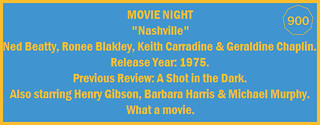
Nashville.


Review #900: Nashville.

Cast:
David Arkin (Norman), Barbara Baxley (Lady Pearl), Ned Beatty (Delbert Reese), Karen Black (Connie White), Ronee Blakley (Barbara Jean), Timothy Brown (Tommy Brown), Keith Carradine (Tom Frank), Geraldine Chaplin (Opal), Robert DoQui (Wade), Shelley Duvall (L. A. Joan), Allen Garfield (Barnett), Henry Gibson (Haven Hamilton), Scott Glenn (Pfc. Glenn Kelly), Jeff Goldblum (Tricycle Man), Barbara Harris (Albuquerque), David Hayward (Kenny Frasier), Michael Murphy (John Triplette), Allan F. Nicholls (Bill), Dave Peel (Bud Hamilton), Cristina Raines (Mary), Bert Remsen (Star), Lily Tomlin (Linnea Reese), Gwen Welles (Sueleen Gay), Keenan Wynn (Mr. Green), and Thomas Hal Phillips (Hal Phillip Walker) Directed by Robert Altman

Review:
Nashville is quite an experience, that much is for sure. It takes place over the course of five days, and yet it still manages to have one of the biggest assemblages of cast that work together to make for such an interesting movie of expression. There is no real main character, nor is there ever a moment where the film loses balance over what it wants to be: a film with people as diverse in nature and as interesting as the city it sets itself in. Even some of the settings (such as the Grand Ole Opry and the Parthenon in Nashville that is used for the climax) seem to reach out as their own character, with their own kind of blemishes just like these characters. For me, my favorites in the film were not so much because of likable they were, but because of how interesting they managed to be, with Beatty, Blakley, Chaplin, Gibson, and Tomlin being the big standouts who really have their own noticeable traits and flaws that one can see in themselves or others. The scene where Tomlin and Beatty are with their (deaf) children is especially telling in making these characters significant with a good degree of subtlety. The characters don't veer too much into cliches in part because they seem so real and seem so authentic to the vision of the film.

Even minor characters (like Welles or Black) are ones that we can still relate to, even if they aren't as high up on the success trail. Goldblum (in a voiceless but constant role) is also pretty memorable, in part because of the tricycle he rides throughout the film. DoQui and Welles certainly make a good pair together in the time they share together on screen. Phillips (and the dialogue that his voice is heard from for a good part of the film) is good in conveying the reach of his character without having to show him. There are so many scenes with their own range of emotion and feeling, where even a scene where Chaplin is talking poetic about buses in a junkyard is great. The film has a great deal of quality music (all done live, and by the actors themselves), all of the songs working intricately with the scene it goes with, such as with "I'm Easy"a key standout, sung by Keith Carradine, who carries the song with the right sense of tension and emotion (fun fact: this song won the Oscar for Best Original Song that year). The film doesn't try to resolve the plot threads in a concise manner, letting it up to the viewer to see where the path of these characters go from there, especially with a climax that is great in its surprise and its final beat with the last song ("It Don't Worry Me"). Nashville is a movie that does not try to bait and switch the realities of the time it was made in, and its impact can still be felt and related to over four decades after its release.

I hope you enjoyed this review, the 900th review done since this show began 2,234 days (over six years) ago. It is obvious (to me anyway) that Movie Night has progressed significantly in terms of quality and the kind of film that gets a shot at being covered. Though the show has gone on its own kind of pace, I hope that Movie Night continues to evolve in a positive way and that you all continue to enjoy this, even if in a small way. This is still a good hobby of mine, but it is also an excellent hobby to do every so often. Thank you all.

Overall, I give it 10 out of 10 stars.

November 29, 2016

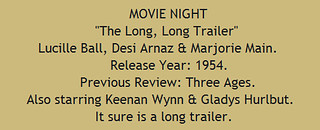
The Long, Long Trailer.


Review #878: The Long, Long Trailer.

Cast:
Lucille Ball (Tacy Bolton-Collini), Desi Arnaz (Nicholas 'Nicky' Collini), Marjorie Main (Mrs. Hittaway), Keenan Wynn (Policeman), Gladys Hurlbut (Mrs. Bolton), Moroni Olsen (Mr. Tewitt), Bert Freed (Foreman), and Madge Blake (Aunt Anastacia) Directed by Vincente Minnelli (#405 - The Reluctant Debutante, #510 - Father of the Bride, and #620 - Lust for Life)

Review:
Honestly, I'm not a big fan of I Love Lucy. If you've known me over the years I've done this show, you are aware that I tend to veer towards older movies (in fact, 510 (including this one) of the films reviewed by me were before 1990), but Lucy was never one of my go-to shows growing up, though I know of its reputation and of its long lasting length as reruns on television. The Long, Long Trailer was one of only three films released during the time it was on (with The Magic Carpet and Forever, Darling being the other films), and the story goes that MGM believed the film wouldn't be much of a success because of the fact audiences could see the duo on TV. However, the film turned out to be a success, in part due to the slapstick that is (somewhat) endearing to me and no doubt endearing to the audiences of the time as well. There is something about the movie that manages to feel so real, with location shots (such as Yosemite), and adequate enough timing without being too canned. The part with the rocks inside the trailer is one highlight for me, in part due to the timing of the right moment of when everything culminates. The other cast members are pretty decent, though it really is all about
Ball and Arnaz, whose chemistry helps the movie out. The trailer is an interesting set in it of itself, and it certainly is sizable enough to contribute to some fine gags. As a whole, it's a decent little movie that is endearing enough for at least one watch. It's not a hallmark of comedy by any means, but it is at least entertaining.

Overall, I give it 7 out of 10 stars.

July 20, 2013

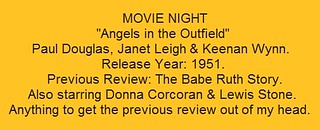
Movie Night: Angels in the Outfield (1951).

Review #433: Angels in the Outfield.

Cast
Paul Douglas (Guffy McGovern), Janet Leigh (Jennifer Paige), Keenan Wynn (Fred Bayles), Donna Corcoran (Bridget White), Lewis Stone (Arnold P. Hapgood), Bruce Bennett (Saul Hellman), and James Whitmore. Directed by Clarence Brown (#423 - A Woman of Affiars)

Review
Baseball films have been shown prominently (mostly), such as Cobb, The Jackie Robinson Story, 42, The Natural, The Babe, Major League, ...and The Babe Ruth Story. After I saw the heinously overly sweet "The Babe Ruth Story", I needed something, anything to watch to get it out of my head. And so I decided to watch Angels in the Outfield, and as the film kept going, I realized that while this film wasn't exactly jumping out of the cliche monsters that sometimes plague sports films, this has enjoyment written all over it. It's a kids film at heart yes, but the baseball action is fine, with the players not swinging awfully as Bendix, and this film does have its moments, such as when Douglas' character meets Leigh's, where Douglas gives a reply on a note card with "Boo!" after Leigh criticises his team. I don't know why, but that's what gets to me, and it's a unknown sort of spirit that makes this a passable film. 

Overall, I give it 7 out of 10 stars.