Showing posts with label Joe Sawyer. Show all posts

December 15, 2025

A Double Life (1947).

Review #2485: A Double Life (1947).

Cast: 
Ronald Colman (Anthony "Tony" John), Signe Hasso (Brita), Edmond O'Brien (Bill Friend), Shelley Winters (Pat Kroll), Ray Collins (Victor Donlan), Philip Loeb (Max Lasker), Millard Mitchell (Al Cooley), Joe Sawyer (Pete Bonner), Charles La Torre (Stellini), and Whit Bissell (Dr. Roland Stauffer) Directed by George Cukor (#479 - Travels with My Aunt, #974 - A Star is Born, #1355 - The Philadelphia Story, #1416 - My Fair Lady)

Review: 
Hey, you like movies about actors? You like movies that are basically noirs? You like a movie that basically ended up being a showcase for its lead star? Well, here's a movie for you. A Double Life, originally titled Imagination, was actually meant for Laurence Olivier but when he proved unavailable, it fell to asking Ronald Colman. You might recognize Colman (who moved over from England to America in the 1920s) from a wide variety of features such as Lost Horizon (1937) and Random Harvest (1942); Colman was coached by Walter Hampden in the Othello sequences. Apparently, George Cukor told a reluctant Colman (not exactly experienced in acting the works of Shakespeare) it would be the movie that might get him an Academy Award. The movie was written by Ruth Gordon and Garson Kanin as the first of six collaborations with Cukor as director, which included such films as Adam's Rib (1949) and Born Yesterday (1950). The film was a family affair in production, as it was produced by Michael Kanin (who in himself was known for script-writing such as Woman of the Year). First released in the holiday season of 1947 (in limited form first just to get it ready for the awards circuit), the film was a decent hit with audiences and garnered Academy Award wins for its music score and yes, an award for Colman as well. Colman spent the remaining years of his career doing a few appearances for radio & television alongside appearances in three feature films; Colman died in 1958 at the age of 67.

It is nice to have a film that can be both a showcase for a solid actor who had the voice and the timing to make a film basically work where a lesser actor could just make it feel like a strange joke (an actor getting too involved their craft does sound like it could be comedy). Sure, maybe it isn't as dark as it may wish to be to really stick its landing, and sure, it maybe has a bit of a struggle in making all of its 104-minute runtime work in making it really spooky in actual terror of losing oneself, but it is pretty neat to see anyway. Colman slips further and further into the muck of madness in a way that just seems so fascinating because of how unnerving it is to see the lines blur, and it helps that he sells the Shakespeare sequences (which are in the film quite a bit, as one expects) in the way one would hope to see in worthwhile devastation. The others in the cast are eccentric in parts when the pop in and out, most notably with Winters (eight years earlier, it was Cukor, hearing auditions for Gone with the Wind*, that told an auditioning teenaged Winters to go to acting school). She just has a certain type of spitfire charm that you could clearly see had potential to be more than just an object of curiosity, particularly since Hasso is merely just fine. O'Brien is at least dependable wherever he lurks, although again, you would think he would have a bit more to really play for tension when it comes to a movie that hangs onto a play involving a trio of tragedy, but so it goes. The film has a fascinating execution in the sights (editing, the lighting, pick one) and sounds one experiences at times involving Colman and the growing drumbeat in one's viewpoint. As a whole, A Double Life is a solid enough movie for those who like a film with a murky enough atmosphere and a solid lead to make the entire affair compelling for those who like to check out noirs every now and then.

Overall, I give it 8 out of 10 stars.

*Cukor was the original director in mind for the film before being replaced. By sheer coincidence, today is the 86th anniversary of its premiere in Atlanta.

April 27, 2022

Great Guy.

Review #1834: Great Guy.

Cast: 
James Cagney (Johnny Cave), Mae Clarke (Janet Henry), James Burke (Patrick James Aloysius Haley), Edward Brophy (Pete Reilly), Henry Kolker (Abel Canning), Bernadene Hayes (Hazel Scott), Edward McNamara (Captain Pat Hanlon), Robert Gleckler (Marty Cavanaugh), Joe Sawyer (Joe Burton), and Edward Gargan (Al) Directed by John G. Blystone (#926 - Our Hospitality)

Review: 
I don't think you need to say many words about a semi-obscure 1930s movie, but why the hell not? Even an average movie from the era could be interesting, provided it does not bore the senses, if only because sometimes you can find something quizzical when doing a quick look for an "old-fashioned" movie. Besides, there is more to films of the 1930s than just looking at the year of 1939 and all of those classic times. At any rate, James Cagney started his film career during this particular decade. He had a decade of vaudeville and stage work behind him before Warner Bros. signed him to a contract (one that went from short-term to long-term extension), and The Public Enemy (1931) cemented him as a star. The film was based on the stories of James Edward Grant, who had written several stories involving the character played by Cagney that appeared in The Saturday Evening Post in 1933 and 1934. Henry McCarty and Henry Johnson wrote the screenplay while Henry Ruskin contributed additional dialogue (Horace McCoy apparently had been listed in earlier reports as a contributor but was dropped). The film was released by Grand National Films, who managed to snag James Cagney because he had sued Warner Bros. for breach of contract, owing to conflicts about top billing and monetary disputes. Grand National was a newly formed independent studio led by Edward L. Alperson. Cagney starred in two films for the studio: this film and Something to Sing About (1937), but neither were particularly successful for the studio, which would liquidate in 1939 after releasing a hundred films in its time, with many of the films being available in the public domain. Cagney returned to Warner Bros. after getting a substantially better deal. In the end, Cagney acted regularly in films until the 1960s that thrived in a variety of roles that ranged from "tough guy" to comedic. The film was directed by John G. Blystone, who directed dozens of films in both the silent and sound eras (after starting as a shorts director in the 1910s) before his death in 1938 at the age of 45.

So yes, this is a film...drama (calling it a noir is a bit too far) involving a fight against systemic cheating, with a man from the New York Department of Weights and Measures. Technically, there is a bit of light tone present here, since Cagney isn't the violent lead here (instead, he plays someone who just happens to have been a prizefighter before becoming a department man). Instead, it is a light film of 66 minutes that moves on one beat of a likably rigid lead fighting against the dangers of...shopkeepers that give you less product for their weight and gasoline guys that don't give you the proper gallon of gas. To be honest, I actually didn't know the Weights and Measures Department was actually real, because it sounds like the line to a cheeky joke one makes involving making a super-serious movie that is actually time for deadpan, but it actually is a real thing. In that sense, maybe it makes sense that this is a light film, one that can be watched with mild curiosity that doesn't have too many pretensions about being tightly packed suspense. Of course, it isn't anybody's idea of a great Cagney film to start with, but he is still game for what is needed in terms of drawing charisma where it is needed in confidence that carries the film through the potential leaky holes for a reasonable winner. It becomes a winner because of Cagney rather than in spite of him, since he elevates material that is borderline serviceable and makes it work just enough. Of course, the others aren't too bad themselves, with Clarke getting a few little moments with Cagney to make diverting chemistry together in differing approaches to the "racket" of things in life. Burke provides a few little moments with light humor as the momentary partner with Cagney (which mainly involves Irish references). The film does lack a suitable threat, since shifty aldermen (an okay Kolker and an ornery Gleckler) and heavies (Burton) could probably be utilized a bit more usefully. The only substantial fight scene is at the end, if only because having a scene where a cop "looks to smoke all of his cigar before intervening" is different from the usual showdown. As a whole, Great Guy is brisk and mildly involving that may be curious enough to just slip through as a win depending on the viewer and their attention to seeking out the films of James Cagney. To me, it is fine enough to work, for which one can thank Cagney and his confident swagger for making one want to stick through and keep the eyes open for what could happen next.

Overall, I give it 7 out of 10 stars.

March 17, 2020

The Outlaw.


Review #1363: The Outlaw.

Cast: 
Jack Buetel (Billy the Kid), Jane Russell (Rio McDonald), Thomas Mitchell (Pat Garrett), Walter Huston (Doc Holliday), Mimi Aguglia (Guadalupe), and Joe Sawyer (Charley) Directed by Howard Hughes (#1332 - Hell's Angels)

Review: 
We live in an age of relentless promotion, don't we? Whether it is self promotion or social influencing, it can be a bit easy to become cynical about how a film can permeate our attention. Earlier decades aren't free of such statements, particularly when it comes to Howard Hughes, noted business magnate, investor, and engineer who also dabbled in films (he of course was known for purchasing RKO Pictures later in the decade). On the one hand, Hughes had plenty of highlights in thirty years of productions, with Hell's Angels (1930), The Front Page (1931), and Scarface (1932). On the other hand, his career also had films like His Kind of Woman (1951, which had two directors), The Conquerer (1956, known for inferior quality and being filmed 137 miles from nuclear testing), and Jet Pilot (1957, which Hughes tinkered with for four years). It was him who had brought Buetel and Russell for their debut performances, but their contracts to Hughes affected their careers, with the former not appearing in another film until 1951 and the latter was off the screen until 1946. Of course the film itself had plenty of trouble on and off filming. Hughes (who took over for Howard Hawks after he had griped about interference) had designed a special underwire bra for Russell to wear to emphasize her bosom. Interestingly enough, Russell didn't actually wear the bra for the film, discarding it secretly. You might notice the copyright of 1941 for the film, since production had finished in February. Hughes had plenty of trouble in releasing the film because of the Hollywood Production Code Administration. Simply put, they objected to Hughes' emphasis of Russell's features, wanting cuts made. The film was initially released for one week in February 1943 before objections were raised that led to shelving until 1946.

Of course with all that in mind, how's the actual film? It doesn't take a cynical eye to note that despite all of its daring attempts to stoke curiosity, it still comes in a film that is a tremendous bore, a deliberate insult to history that can't even stoke interest in the senses besides occasional glances to see how much is left in the tank (116 minutes, no less). While the film attempts to have back up with established stars in Mitchell and Huston (past and future winners of an Academy Award for Best Supporting Actor), one does not really seem to feel too particularly interested in what is actually going on, beyond its attempts at humor and stoking excitement of passion. Sure, Russell does seem like she could be a star of some sort with raw presence, but Hughes does not seem quite the one to do so (this of course could have been said for Jean Harlow when she made her appearance in Hughes' other directorial effort). These are flat lines, ones that only barely register in entertainment no matter who says them. Buetel looks especially lost, looking like he wants to be in some other Western than this. Everybody looks like they are acting in completely different films, and Mitchell and Huston seem no different. In a better film, one could forgive some of the flailing attempts of re-telling legends of the Old West. But with this one, it seems almost intentional to irritate the fact-checkers. Did Doc Holliday ever meet Billy the Kid? Did he get killed in an accident with Pat Garrett? Did Billy the Kid escape death? Who cares?! You might as well have made a fictional composite while you are at it, or find another way to use your time, like social isolation or snarky Internet posting. On the whole, The Outlaw is a film more known for its attempts at promotion that were objectionable for the time rather than the true finished product, and it definitely shows in an aged ridiculous spectacle that flails as a Western in the worst ways.

Next Review - Onward, unless something stops it.

Overall, I give it 5 out of 10 stars.

October 12, 2013

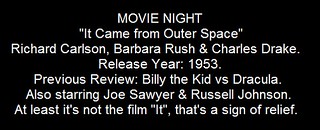
Movie Night: It Came from Outer Space.


Review #464: It Came from Outer Space.

Cast
Richard Carlson (John Putnam), Barbara Rush (Ellen Fields), Charles Drake (Sheriff Matt Warren), Joe Sawyer (Frank Daylon), Russell Johnson (George), Dave Willock (Pete Davis), and Robert Carson (Dugan) Directed by Jack Arnold (#420 - The Incredible Shrinking Man)

Review
With a title like that, expecting a monster/alien is expected, without a doubt, and that certainly is accomplished, but the film manages to be more than just an "alien invades the earth" story, and though it's not a great science fiction film, it certainly is a very passable one. The actors aren't bad, given their characters. The film was originally released in 3-D, which is incredibly obvious even 60 years later, with some shots from the 1st person POV of the aliens, which even without 3-D is actually kind of creative. The film is alright to look at, and the makeup isn't that bad. The story (By Ray Bradbury) and the screenplay (by Harry Essex) are finely written, a film not easy to ignore, and it doesn't run too long, so it's easy to watch without being bored. I'd recommend this for anybody looking for some classic 50's science fiction (or sci-fi, whatever name sounds better to say) to watch.

Overall, I give it 8 out of 10 stars.