Showing posts with label Harry Cording. Show all posts

October 16, 2023

The Black Cat (1934).

Review #2111: The Black Cat (1934).

Cast: 
Boris Karloff (Hjalmar Poelzig), Béla Lugosi (Dr. Vitus Werdegast), David Manners (Peter Alison), Julie Bishop (Joan Alison), Lucille Lund (Karen Poelzig), Egon Brecher (The Majordomo), and Harry Cording (Thamal) Directed by Edgar G. Ulmer (#797 - People on Sunday, #803 - Detour, #943 - The Man from Planet X, #1364 - Bluebeard, #2058 - Strange Illusion)

Review: 
Well, if you can make a movie loosely (loosely) based on the "Murders in the Rue Morgue", why not another? Universal did that in 1932 with Bela Lugosi as the star in a "mad doctor" role, and while the reception was not particularly favorable at the time, here we are anyway. The movie shares the title of an Edgar Allan Poe short story "The Black Cat". Edgar G. Ulmer co-wrote the story with Peter Ruric, which was one of the pen names for pulp writer George Sims (who also used Paul Cain as a name); they were inspired by psychiatry and the eccentricities of occultist Aleister Crowley; Ulmer apparently was quoted later as saying that the Poe story is "not a story you can dramatize". It is probably one of Ruric's better known efforts, since his other film credits include films such as, uh, Mademoiselle Fifi (1944). This was the first and only film Ulmer (who had one noted film with the co-directed People on Sunday to his name) made for a major studio, as he was soon blacklisted from the major studios after it was found that he had an affair with a woman (the script assistant on this film and later his wife) that happened to be married to the nephew of Carl Laemmle, the co-founder and owner Universal Pictures. As such, he would be relegated to a litany of lower-budget studios that saw him direct films that ranged from ethnic dramas to melodramas. It wasn't the first film to use the Poe story in loose inspiration, as evidenced by Unheimliche Geschichten (1919, 1932). By coincidence, Maniac (the exploitation film) was released the same year as this film that used the Poe story for loose inspiration. Seven years after the release of the film, Lugosi would star in a comedy horror remake that turned it into a mystery house feature. The next attempt at covering the Poe story came with Tales of Terror (1962). This was the first film to feature both Boris Karloff and Lugosi (both previously featured in Universal horror films as Frankenstein and Dracula, respectively) together, and they would appear in five further films for Universal (along with two others), such as The Raven (1935), which was an even looser inspiration from the Poe story of the same name.

Somehow, one finds a film (66 minutes) about revenge of genocide, preserved dead people, offscreen skin shedding, odd music cues, and a would-be cult ritual in a very modern looking house. On the middle of the clash is Manners and Bishop (who went by Jacqueline Wells until the 1940s). One only cares about the straight men (the former was in both Dracula and The Mummy) for about the length it takes to write a sentence when it comes to Universal horror films. Evidently, Ulmer felt the best way to deal with Lugosi and his apparent tendency to overact (combined with his accent) was to "cut him down" when it came to focusing to reaction shots with him on screen. Karloff (playing a character named after Hans Poelzig, who worked on The Golem like Ulmer did) on the other hand is let loose to do his impression of evil, which results in a tightwire act that makes for fairly useful struggle, even if the film itself is built on the loosest of motivations. It is an odd film that can't really decide whether to be a revenge film or a weirdo cult film, and the way they shoehorn the film title is especially amusing, as it is revealed that Lugosi's character is deathly afraid of cats and the main mansion (with its distinct architecture and strange choices and history) has a pack of black cats around. It is Lugosi and Karloff who carry the film (because it certainly isn't going to come from the two squares), a calm cat and mouse game waiting to fester that works best depending on which style of acting works best in bluster, since Lugosi seems to act with his eyes just as much as when you let the camera stay on him to contrast with Karloff having that cold stare of devilish intent. There of course can be credit for the weird stuff that is present (on screen or not) for a film released in 1934 while also noting that it is a weirdly constructed film. It has an odd runtime / pace comparison that might as well serve right for an odd film where the villains are more interesting than the heroes (you've got one blatant one and basically a co-conspirator waiting to strike). In general, it's a weird delight that sounds about right for an Ulmer film or for those interested further in the Universal line of wired horror films. 

Overall, I give it 7 out of 10 stars.
Next up: 20 years later, what lies beneath The Texas Chainsaw Massacre (2003)?

May 22, 2021

Dressed to Kill.

Review #1681: Dressed to Kill.

Cast: 
Basil Rathbone (Sherlock Holmes), Nigel Bruce (Dr. John H. Watson), Patricia Morison (Hilda Courtney/Charwoman), Edmund Breon ("Stinky" Emery), Frederick Worlock (Colonel Cavanaugh), Carl Harbord (Inspector Hopkins), Patricia Cameron (Evelyn Clifford), Holmes Herbert (Ebenezer Crabtree), Harry Cording (Hamid), Leyland Hodgson (Tour Guide), and Mary Gordon (Mrs. Hudson) Directed by Roy William Neill (#846 - Frankenstein Meets the Wolf Man, #873 - Sherlock Holmes and the Secret Weapon, #925 - Sherlock Holmes in Washington, #936 - Sherlock Holmes Faces Death, #1021 - The Spider Woman, #1040 - The Scarlet Claw, #1056 - The Pearl of Death, #1161 - The House of Fear, #1216 - The Woman in Green, #1262 - Pursuit to Algiers, #1620 - Terror by Night)

Review: 
It has been said that Basil Rathbone wondered aloud on the set with one vocal question: "Why am I doing this?" Dressed to Kill is the fourteenth and final installment of the Rathbone-Bruce Sherlock Holmes series. If one had to play a character for seven years that had three notable phases, one can probably see where Rathbone's quandary comes in. At least the shift from to B-movie didn't hinder the look of these movies, because even when Universal Pictures aimed them for the war-time crowd, the movies managed to retain a basic sense of enjoyable mystery. Four of the twelve Universal films had managed to fall into the public domain (with this being one of them, although searching for the others isn't too hard) because of a lack of copyright renewal, and they were even released with digital restoration and colorization (by computers). It is only in recent years that one can enjoy these movies in proper DVD/Blu-Ray releases, for which can credit the UCLA Film and Television Archive (who restored the movies from 1993 to 2001, with funding coming from UCLA, Hugh Hefner, and later Warner Bros). Prints don't always survive in great condition, so imagine having to come up with something where the best possible prints are from 16-millimeter transfers. At any rate, this movie was written by Frank Gruber and Leonard Lee, with the former writer responsible for the previous film with Terror by Night. This time around, the plot involves music boxes with printing plates put in them that are...ripe enough for murder. It basically is a cat-and-mouse game to figure out what the boxes and plates mean before one side can get all three boxes. It might seem a bit familiar to The Pearl of Death (1944), which involved a thief putting a stolen pearl into one of a select group of Napoleon busts that hired a killer to find the bust at the cost of the folks with the busts, and that movie credited the 1904 story The Adventure of the Six Napoleons as its inspiration. It also borrows an aspect used in previous movies with a femme fatale as one of the key adversaries. One can credit the fact that these movies don't become a parody of themselves and have a remarkable consistency that while not exactly better than average is at the very least one to respect with craftsmanship. 

It all helps to have a few offbeat moments. Rathbone gets to fall under danger with a whole thing about gas that seems quite silly when paired with an earlier scene about comparing notes of the music box with a friend (of course hearing that box over and over doesn't help) and Bruce gets to make duck noises...somehow there is a context to that (i.e. a girl getting beat up for a music box that cries when found by the duo). Ah but that isn't quite fair to him, because they the exact chemistry needed to make this series roll as it needs to, and one only wonders how the radio series must have felt for folks back then. Honestly this is an okay way to end the series. It lacks a a proper climax, and it seems a bit familiar, but it maintains the consistency that this series has had without being a putrid way to close out what generally worked best in those little moments (i.e. like the ones I mentioned earlier). 72 minutes isn't too much to ask with a familiar group of actors fit for a familiar style of movie. Rathbone and Bruce play their parts with what is needed in the textbook style of detectives that are definitive without looking stiffly bored in the proceedings, no matter if you've watched one or all of these before seeing this. Morison leads the group of adversaries with worthy energy that makes a capable threat to match the heroes without looking like a copy of the folks from before, able to match in diverting energy, and this works best in a scene paired with Breon, in which they share a few lines with each other that ends with a quality ambush. Worlock plays the other part of the threat just fine (this was his fifth appearance in the series) while Harbord plays things with stock calmness of a character that actually had appeared in a few of the original stories (in this series, it is Lestrade that got the attention with six appearances). At any rate, there is a general causal quality that Neill has honed without trouble. This was the penultimate film he directed (Black Angel came out just two months after this film), as he died later that year at the age of 59, having directed over a hundred movies. If you've seen one, you've nearly seen all the other films, but Dressed to Kill maintains itself to serve as the logical conclusion to a series that more often than not generated useful mystery and workable performances to make it worthy enough for those who are curious for what it managed to do in the span of seven years and fourteen films.

Overall, I give it 7 out of 10 stars.

November 14, 2018

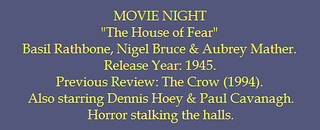
The House of Fear (1945).


Review #1161: The House of Fear.

Cast: 
Basil Rathbone (Sherlock Holmes), Nigel Bruce (Doctor Watson), Aubrey Mather (Bruce Alastair), Dennis Hoey (Inspector Lestrade), Paul Cavanagh (Dr. Simon Merivale), Holmes Herbert (Alan Cosgrave), Harry Cording (Captain John Simpson), Sally Shepherd (Mrs. Monteith), and Gavin Muir (Mr. Chalmers) Directed by Roy William Neill (#846 - Frankenstein Meets the Wolf Man, #873 - Sherlock Holmes and the Secret Weapon, #925 - Sherlock Holmes in Washington, #936 - Sherlock Holmes Faces Death, #1021 - The Spider Woman, #1040 - The Scarlet Claw, and #1056 - The Pearl of Death)

Review: 
The House of Fear is the tenth film of the Rathbone-Bruce series of Sherlock Holmes movies, released seven months after the previous installment in March 1945. It would prove to be the first of three Holmes features released in 1945 - the second (The Woman in Green) was released in July and the third (Pursuit to Algiers) was released in October. The credits state that the film was based off the 1891 story "The Adventure of the Five Orange Pips" by Sir Arthur Conan Doyle, although it seems the only thing the film took from it was the orange pips, which are present in letters sent to a group of men (all seven of which who have life insurance policies) living in a castle prior to their deaths, one by one. The mystery itself is a bit shaky, but at least there is some atmosphere present and a fairy game ensemble cast to push the film towards respectability, even with a collection of cliches (house on a cliff, spooky servants, secret passageways, odd villagers, etc). One wonders how to describe Rathbone playing a role that he played consistently for six years (in film and on radio) that defined him without feeling like a broken record; he does a fine job with the material he is given without feeling tired, and that's the best thing that can happen for this film. Bruce is at task to deliver the qualities expected from being the second banana to Rathbone, giving off some comic relief (most notably a bit with an owl), but at least he does play some part in the final deduction for the better. Mather plays the nervous one okay, and the other members of people in the castle are all okay, although there really isn't much of a villianous presence besides Shepherd creeping about while giving the men their letters. Hoey also does a bit of stumbling about as Lestrade in his fifth go at the role, of which he did six times, appearing in Terror by Night the following year. On the whole, it's not hard to see that the filmmakers were pretty comfortable with how they were making these mystery films as efficiently and quickly as possible (taking only a few weeks to make on cheap b-movie budgets) - with this one running at just 69 minutes. It isn't too ridiculous nor too boring to spend some time with. If you are a fan of the series of films with Rathbone and Bruce, this one will prove just fine for viewers and it works fine for anybody looking to pass some time with a film that has some good old-fashioned mystery cliches - right down to its title. The film isn't the best or worst of the series, being a middle-of-the-road kind of movie that is alright on its merits.

Next Review: Overlord (2018).

Overall, I give it 7 out of 10 stars.