Showing posts with label Perry Lopez. Show all posts

May 14, 2020

McLintock!

Review #1414: McLintock!

Cast: 
John Wayne (George Washington McLintock), Maureen O'Hara (Katherine McLintock), Patrick Wayne (Devlin Warren), Stefanie Powers (Becky McLintock), Jack Kruschen (Jake Birnbaum), Chill Wills (Drago), Yvonne De Carlo (Louise Warren), Jerry Van Dyke (Matt Douglas Jr), Edgar Buchanan (Bunny Dull), Perry Lopez (Davey Elk), Strother Martin (Agard), and Gordon Jones (Matt Douglas) Directed by Andrew V. McLaglen.

Review: 
“The only one who could stand up to my father, and stand toe-to-toe with my father, and match him in everything.”

It never hurts to make a film that fit into numerous genres. In this case, why not have both a Western and a comedy? With famed stars in Wayne and O'Hara, who could go wrong? At the helm for the film was Andrew V. McLaglen, a British-born American director that grew up with his father Victor (a prolific character actor in numerous John Ford films, where he won an Academy Award for The Informer in 1935) around films, and he eventually found work for himself such as production assistance and assistant directing, with one notable film credit being The Quiet Man (1952, where he did the latter category). In 1956, he started his career in directing, doing Gun the Man Down while also starting work in television with programs such as Gunsmoke and Have Gun - Will Travel, and he directed over 90 episodes of each show over the course of nine and six years respectively. McLaglen would direct a variety of subjects over the course of 35 years in film and television (ranging from Western to war films) with a variety of stars like Wayne (who he would work with five times), James Stewart (four times), and Roger Moore (three times). Familiarity is the name of the game when it comes to this film, since James Edward Grant (who wrote several films with Wayne in them, such as The Alamo) served as writer for a film that was inspired by William Shakespeare's The Taming of the Shrew; Wayne acts alongside his third son while having his eldest son serve as producer and this was the fourth of five Wayne-O'Hara films, which were noted for their clear chemistry between their stars. One shouldn't forget about O'Hara in all of this, a figure of the Hollywood Golden Age that came from Ireland and theater acting at a young age to stardom in a variety of genres such as Westerns, melodramas, and adventure films. Speaking of actors nicknamed the "Queen of Technicolor", De Carlo (star of film and future star on television) was given a role in the film because of Wayne's sympathy in light of her husband being permanently crippled while doing stunt-work on How the West Was Won (1963, which had Wayne as star).

While the film is certainly a bit different from the usual Wayne fare, he also made this film as a way to express his belief (and disapproval) on certain topics, where his character yearns to tame both his wife and the West at the same time. There are quite a few moments of amusement within a story that moves at its own careful pace of 127 minutes, one with a casual story rather than tension that takes a familiar story to make a controlled film that sticks out from the usual Wayne experience without becoming a parody of itself. This is a film with a climax involving a paddling with a coal scuttle shovel, after all. The mud brawl proves to be a big highlight, one with plenty of fist-fighting and amusement, complete with the usage of bentonite (a type of clay that looks like syrup) for mud. Wayne seems to be having a fine time here, a clear-cut blunt performance that has a sense of honesty and humor without becoming too obvious about it. One can see the chemistry between him and O'Hara even when he's drunkenly falling down the stairs with her, really. O'Hara makes for a fiery presence with her own sense of humor that makes for plenty of smiles with those expressive eyes. The younger Wayne and Powers prove a fair pairing with others and themselves, while Kruschen, Wills and De Carlo provide capable careful chuckles that resonate with the trappings of the plot. There isn't the usual villain to make a showdown, but at least there are adversarial presences to drive things (however obvious things get). In the long run, this is a fair little mixture of Western and comedy, buoyed by Wayne, O'Hara and company to make a useful time worth having, particularly since it is readily available in the public domain (bless those failures to copyright) for anyone to stoke their curiosity in familiar territory for all in the 1960s.

Overall, I give it 8 out of 10 stars.

October 30, 2019

Creature from the Black Lagoon.


Review #1290: Creature from the Black Lagoon.

Cast: 
Richard Carlson (Dr. David Reed), Julie Adams (Kay Lawrence), Richard Denning (Dr. Mark Williams), Antonio Moreno (Dr. Carl Maia), Nestor Paiva (Captain Lucas), Whit Bissell (Dr. Edwin Thompson), Bernie Gozier (Zee), Henry A. Escalante (Chico), Perry Lopez (Tomas), Rodd Redwing (Luis), Sydney Mason (Dr. Matos), Ben Chapman (Gill-man - land), and Ricou Browning (Gill-man - underwater) Directed by Jack Arnold (#420 - The Incredible Shrinking Man and #464 - It Came from Outer Space)

Review: 
It should come as no surprise to encounter yet another Universal monster film for the season. There are plenty of films classified under horror in their catalog, where one can't go wrong with many of their efforts, such as The Phantom of the Opera (1925), or The Invisible Man (1933), where even the lesser ones are worthy of curiosity. The 1950s was the decade of television along with the decade of expanded kinds of horror. Whether it was space aliens, giant monsters, radiated mutants, or some sort of offbeat horror, it certainly must've proved a fun time to make something to try and get some sort of entertainment (or perhaps a cheap buck). Universal persisted with their own horror films as well during the decade, with the obvious standout being the Gill-man. Although he did not appear in as many films as say Frankenstein or Dracula, the creature was the only one with its own trilogy of films in the decade for Universal (unless one counts the Abbott and Costello series, which had three horror comedy features in this decade), with its sequels released in the following two years (Revenge of the Creature and The Creature Walks Among Us). In any case, the Gill-man is the last great Universal monster, an ancient amphibious creature of the sea that certainly draw a small bit of sympathy and interest. The monster was designed by former Disney illustrator Milicent Patrick, whose work was overshadowed by makeup artist Bud Westmore for decades; the costume was made by airtight molded sponge rubber for $15,000. It was filmed in 3D, with polarized light projection, which meant gray polarizing filters (as opposed to red-blue), with producer William Alland having originally being inspired by a story told to him by Gabriel Figueroa about a half fish/human myth in the Amazon, writing notes about a "Sea Monster", which was expanded on by writers Harry Essex and Arthur A. Ross, with story by Maurice Zimm. It is safe to say that this is a well-done classic, worthy of being in anyone's horror curiosity. The monster effects look pretty good, with an eerie quality about the way it looks that makes for such an interesting creature to spend time with, particularly with all those bumps and gills along with that face. The acting is fine, with Carlson and Adams carrying the ship okay in the sense that while not completely full-fledged, they each manage to fulfill the necessary things to give the film something other than a big water monster attacking random folks entering its domain. No one goes too off the deep end in camp nor too much seriousness, with the film generally having a reasoned atmosphere, where the monster looms for two environments and seems pretty formidable for 79 minutes, with Chapman and Browning proving well with portraying the monster when needed. The climax is pretty swift, with a little time spent involving the creature and his thing for the leading lady that goes over just fine, and it proved an inspiration for Guillermo del Toro that eventually resulted in The Shape of Water (2017). All in all, this is a pretty entertaining movie, capable of giving off a few scares and thrills with a solid creature and premise (while not falling apart in clichés) that has a sturdy foundation in its other aspects to make something useful in horror from the deep.

Overall, I give it 8 out of 10 stars.

August 17, 2014

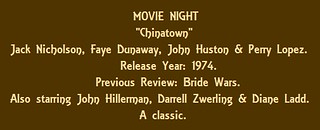
Movie Night: Chinatown.


Review #631: Chinatown.

Cast
Jack Nicholson (J.J. "Jake" Gittes), Faye Dunaway (Evelyn Cross Mulwray), John Huston (Noah Cross), Perry Lopez (Lieutenant Lou Escobar), John Hillerman (Russ Yelburton), Darrell Zwerling (Hollis I. Mulwray), Diane Ladd (Ida Sessions), and Roy Jenson (Claude Mulvihill) Directed by Roman Polanski.

Review
Chinatown is a movie that basks in the past with much originality, with a high crafted story by Robert Towne. Nicholson is fun to watch here, he makes for a interesting character that is fun to watch in any scene. Dunaway seems like she's playing a femme fatale, but in reality she plays anything but that, and her emotions are very expressive, you get to feel for this character, and in a way also pity her as well. It's amazing how John Huston (a director who I've covered a few times before) can be so effective as a villain when you realize his soft demeanor hides his dark side, which is evident in the end scene. Speaking of which, the end scene is probably the most memorable aspect of this movie (that, and Nicholson's bandaged face), Towne originally had written a happier ending, but it was changed by the director to make for a more cynical, but still a better ending. It's a perfectly sad ending, a way to make the movie more than just a detective story, and more importantly, a classic story. The movie has its thrills and most importantly its chills, which make for a very well-rounded movie that's heartbreaking, but also very entertaining. Take the ending for what it's worth, or don't, whatever you want.

Overall, I give it 10 out of 10 stars.