Showing posts with label Jack Warden. Show all posts

July 12, 2025

Used Cars.

Review #2398: Used Cars.

Cast:
Kurt Russell (Rudy Russo), Jack Warden (Roy L. Fuchs / Luke Fuchs), Gerrit Graham (Jeff), Frank McRae (Jim), Deborah Harmon (Barbara Jane Fuchs), Joe Flaherty (Sam Slaton), David L. Lander (Freddie Paris), Michael McKean (Eddie Winslow), Michael Talbott (Mickey), Harry Northup (Carmine), Alfonso Arau (Manuel), Cheryl Rixon (Margaret), Al Lewis (Judge H. H. Harrison), Woodrow Parfrey (Mr. Chertner), and Dub Taylor (Tucker)

Directed by Robert Zemeckis (#317 - The Polar Express#352 Who Framed Roger Rabbit, #581 - Forrest Gump, #648 Beowulf, #701 - Back to the Future#747 Back to the Future Part II#748 - Back to the Future Part III, #1527 - Cast Away, #2229 - I Wanna Hold Your Hand)

Review: 
 “This movie is structured on a classic Frank Capra movie except that everybody lies.”

Look, sometimes movies don't get the right type of luck in reaching audiences. Or they just don't get it, who the hell knows. You might remember that Robert Zemeckis had his directorial debut with I Wanna Hold Your Hand (1978), that 1964 comedy involving teens and The Beatles that flopped on initial release. But Zemeckis continued on with Bob Gale on another production together two years later with Used Cars, which now had John Milius and Steven Spielberg serve as executive producers. Apparently, Milius was the one who came up with the idea of the movie with Spielberg that had thoughts of a Las Vegas used-cars salesman, which at one point had George Hamilton floated as a possible lead. Gale and Zemeckis did research at used car lots, as one does. The movie was shot around the Arizona area in the span of a month in 1979. On July 11, 1980, Used Cars was released in theaters and was a marginal success (it was made for substantially more money than Hand, for example). Apparently, the release was bumped up a month by Columbia Pictures (as led by a man that had sold cars at one point in his life) due to good test screenings, and yes, I said *good* screenings. As as a result, the movie came out just barely after the release of movies such as Airplane! (1980). The next movie directed by Zemeckis was Romancing the Stone (1984), which lit the match for his eventual breakthrough as a director. Incidentally, Used Cars (1980) was the only R-rated Zemeckis movie until Flight (2012).

I don't do car dealerships, but good god, I do love ensemble comedies. It is the kind of old-fashioned hokum that would've fit right at home in the days of Old Hollywood (as if it was an inverted A Wonderful Life), even if others might shudder at the thought of "crass" characters for a comedy. The thing is that they are *fun* and crass characters for a delightfully exploitative movie. What, have you never thought about a used car salesman going into politics? (as opposed to 70-year-olds running for president again and again) It wasn't like the previous decade was a normal one, what with people becoming president without the voters being involved. It is a barrage of crude brilliance that could only come from people who wanted to blaze a trail of humor at all costs and played it extremely cool in the process. Sometimes I wonder what makes Kurt Russell so good that he could've had his own fan club. I think it just is the fact that he seems to have the swagger to pull off nearly any performance with no sense of bullshitting you. He can do the action movie hero type (as one loves), he could do drama (I see Miracle [2004] every year), and most importantly, he can do comedy. Of course, this was his first film in five years, having moved away from Disney productions after The Strongest Man in the World (1975) that saw him do television and even play Elvis. With this movie, you need someone with a cocksure attitude, and you get that in spades with Russell, who is tremendously devious and tremendously funny for what clearly should've been the role to help see Russell as a legitimate talent*. He just rolls the hustle on his mind with no hesitation and the confidence that arrives in slippery likability, where one loves to watch what harebrained idea that he wants to peddle next. His time spent with Harmon is probably the only time he tries to really be honest (well, as much as one can when being around a dead person for a good chunk of the film), and even then it is still funny to see him squirm in chicanery. But the real focus is on folks you see around Russell like the superstitious (and funny) Graham or the slippery McRae or the lesser-shown McKean & Lander (who at that time were paired together on TV with Laverne & Shirley) in tech hijinks. But of course, Warden and his double role (for a time, one of them dies and is buried in an Edsel that is both touching and amusing) helps to seal the film as a real treat. He practically seems like the kid in a candy store in grousing humor that plays off the whole "one guy looks like this, the other guy acts like this" thing that makes me smile every time I see him on screen (one line in particular stands out about the "country going to the dogs" because when a politician was bought, they would stay bought). The cut-in sequences (where the boys decide the best way to raise awareness for their dealership is illegal cut-in commercials) are special standouts in ludicrous energy and audacity*, but the real show-stopper is the climax involving plenty of cars that might as well have been a cattle drive like Red River (1948) with such rousing spectacle and lunacy on display. In total, one doesn't see a cop out in a movie that looks at people and sees grifters all in line. As a whole, the screwy logic on display in salesmanship and outright lies to fill a hustle has managed to age spectacularly well for a movie that definitely deserved better in its time. But four decades (and a half) is still plenty of good milage for a director who got even better from here, so check it out.

Overall, I give it 8 out of 10 stars.
*He also tried to have a baseball career but suffered an injury. Is this the third film of the trinity of movies that people didn't get in the 1980s with The Thing and Big Trouble in Little China? Or would Tango & Cash make it a square? At least Escape from New York got him to righteous status.
*One scene has a naked lady in it, as one does when packed with an R-rating. Just be ready for breasts, as they say.

May 15, 2025

The Bachelor Party.

Review #2380: The Bachelor Party.

Cast: 
Don Murray (Charlie Samson), E. G. Marshall (Walter), Jack Warden (Eddie Watkins), Philip Abbott (Arnold Craig, the Bachelor), Larry Blyden (Kenneth), Patricia Smith (Helen Samson), Carolyn Jones (The Existentialist), and Nancy Marchand (Mrs. Julie Samson) Directed by Delbert Mann (#136 - Marty)

Review: 
"My method of working is to try to rehearse before filming if we can. It's not often possible with filmmaking, but I try to get a big of rehearsal. Even just sitting around a table talking a day or two with the actors and writer saves an enormous amount of time when you're on the set and the costs are mounting."

You might remember that Delbert Mann became a feature film director with Marty (1955), which you might the "Little Best Picture winner that could". Mann actually had studied political science at Vanderbilt (at the time, there was no dramatic arts curriculum there, but he did community playhouse) before serving with the Army Air Corps as a bomber pilot; after the war, he attended the Yale School of Drama and got a master's degree in directing. He worked in community theater and later television, whereupon he directed hundreds of live television dramas in the golden age of television. Anyway, with Marty (1955), it came around as an adaptation of the teleplay of the same name that had been broadcast on The Philco-Goodyear Television Playhouse in May 1953 as written by Paddy Chayefsky with the intent of making "the most ordinary love story in the world" (among other things); it was Chayefsky who insisted Mann come along with him in making the movie. Chayefsky wrote a number of scripts for television, and wouldn't you know it, the one that came out after Marty was the one that would be adapted by Mann for a movie: The Bachelor Party.* Originally broadcast in October of 1953, The Bachelor Party featured a quintet of men in Eddie Albert, Bob Emmett, James Westerfield, Joseph Mantell, and Douglas Gordon. Harold Hecht and Burt Lancaster, who had formed their own production company that had been involved with the aforementioned Marty, served as producers here (alongside James Hill). With the film adaptation, apparently the character played by Jones was among the striking additions done. Apparently, folks at the time thought the movie was just as incisive (if not more) than Marty, but folks seem to remember Marty best nowadays. Mann would maintain consistent work in directing for both movies and television all the way into the 1990s, which included works such as Separate Tables (1958), Lover Come Back (1961) and Fitzwilly (1967). Chayefsky would be busy in writing, following Bachelor Party with The Goddess (1958) before doing one more collaboration with Mann (albeit without Hecht as a producer) with Middle of the Night (1959).

Admittedly, it is a starkly strange movie. Sure, it might be a bit glib in its overall message when driving the movie down in the end, but it is the kind of movie you could believe in more often than not in the wayward road of revelry that comes with people who are weird as you or me at night. Sure, I wouldn't know the first thing about a bachelor party**, but I do know that there are plenty of foolish decisions that lurk within insecurities with people, whether that involves guys who think the grass really is greener on the other side or people who dwell on what lies ahead or, well, self-realization. Incidentally, this was the second feature film for Murray, an actor who honed his work in television before making his film debut with Bus Stop (1956), which garnered him an Academy Award nomination. Bachelor Party was the movie he made right after this one (along with one of two movies he did in 1957 next to A Hatful of Rain). His worries and doubts do make for a fairly balanced performance to hold a good chunk of the ship together, one that doesn't aim for pity but rather the understanding that comes in the cloying trouble that could be summarized as "is that all?" Abbott makes for an adequate shell to play the doubts as the, well, bachelor in the story that seems lighter in troubles when one considers the party might as well resemble a dirge. Marshall plays the worry in his middle-aged doubts with resolute effectiveness that you would expect from him, but it is Warden who likely shows his might in terms of illusionary bluster that sure drives a hard sell when you last see him in the heat of another chase, where any girl with a pulse is fair game because of what could be up next. The darndest thing is that the one award-nominated role[***] came from Jones, with a performance that comes out to less than ten minutes. But she sure makes it count in the pit of loneliness and ones with their own illusions in what it means to want and to be wanted. Even just hearing words is better than hearing nothing at all (crowded room or not). Apparently, Chayefsky was quoted later as saying later that he is unsure just where the "basic approach was wrong" with the film, and the climax does strain a bit in actually justifying itself to landing where it believes it has to land, where it is just a bit too easy, but that can be just enough for some people anyway, especially when one is merely peeling the curtain a bit at a specific set of people (call it people with not enough to do in the city). Overall, this is a decent ensemble piece that will fit nicely within the confines of looking at a sobering movie about people trying to make sense of their surroundings at night in the guise of a party that works in parts with its staging for a relatively fine time.

Overall, I give it 7 out of 10 stars.

*Funny enough, the next of his scripts to be adapted in a movie after Marty was actually with The Catered Affair, where he was nearing the end of TV scriptwork - it was televised in May 1955 and turned into a film the following year with a script by Gore Vidal that had the star from Marty in it: Ernest Borgnine.
**I either know (read: associate with non-betrayers) people who are already married or aren't getting married anytime soon. This isn't a sidenote to anything meaningful, I thought it was funny.
***That year, Jones lost to Miyoshi Umeki for Sayonara. 

December 11, 2022

The Verdict (1982).

Review #1935: The Verdict.

Cast: 
Paul Newman (Frank Galvin), Charlotte Rampling (Laura Fischer), Jack Warden (Mickey Morrissey), James Mason (Ed Concannon), Milo O'Shea (Judge Hoyle), Lindsay Crouse (Kaitlin Costello Price), Edward Binns (Bishop Brophy), Julie Bovasso (Maureen Rooney), Roxanne Hart (Sally Doneghy), James Handy (Kevin Doneghy), Wesley Addy (Dr. Towler), Joe Seneca (Dr. Thompson), and Lewis J. Stadlen (Dr. Gruber) Directed by Sidney Lumet (#035 - 12 Angry Men, #036 - Network, #404 - The Anderson Tapes, #1065 - Deathtrap#1446 - Murder on the Orient Express#1450 - Dog Day Afternoon, #1545 - Before the Devil Knows You're Dead)

Review: 
A combination of a director known for his crafting of actors into diverting character dramas and a powerhouse star and script surely would work out for a fair classic, you might say. The movie is an adaptation of the 1980 novel of the same name by Barry Reed. In addition to writing for American Bar Association Journal alongside novels, Reed had his own legal practice in Boston, Massachusetts and he had a reputation for specializing in medical malpractice, personal injury, and civil litigation. Interestingly, one of his proteges was Jan Schlichtmann, a lawyer noted for his own case that became a book and film about a lawyer taking on a big name (in this case, two companies sued for leukemia deaths), which you might know as A Civil Action (1998). Right before publication of The Verdict, producers David Brown and Richard D. Zanuck purchased the film rights. The two hired David Mamet to write a screenplay based on the book. By this point, Mamet was noted for his array of off-Broadway plays in the 1970s such as American Buffalo. The first produced screenplay by Mamet was the 1981 adaptation of The Postman Always Rings Twice. It shouldn't be too surprising that there were numerous choices for directors and main stars: James Bridges was the initial choice for director and Robert Redford was the first-pick star, but when Bridges became busy with Urban Cowboy (1980), the producers went with Arthur Hiller as the potential director...before a disagreement with Mamet saw him depart (of course, Zanuck wasn't particularly big on the ending of the original script, which ended before the jury came back with the verdict). Jay Presson Allen came in to try and deliver a new script, and when Bridges had time at last to do a project, he also seeped his fingers into writing for the film, but it all went for naught when Redford and Bridges had disagreements over the nature of the main character (Redford irked at the idea of playing the character with the flaws as written). Not long after, Lumet was asked to do the film, and he elected to go back to the original Mamet script, complete with Paul Newman as star. 

Admittedly, the legal aspects of the film aren't completely on the level, as I suspected from a cursory bout of research. For the record, if you are suing a hospital and they offer you a settlement, your lawyer cannot simply reject the offer (without even consulting the clients), and the opposing council doesn't go around telling the client about offers either. But I suppose if you can buy a film that hinges its big finish on having the jurors challenge their doubts in their beliefs, institutions, and the law itself, you can do almost anything. But the movie as a whole is pleasant as a stone-cold thriller of possible redemption as baptism by fire, utilizing its 129 minutes to general effectiveness. It relies heavily on the performance of Newman, in his only appearance in a feature film with Lumet as director. He pulls off a great performance, plundering the depths of redemption in an understated and powerful manner that never blusters or hits a false note from start to finish, one where burying the case is not the end of his own road. Sure, one could put the highlight as the last scene in the courthouse or even the final shot with a rejected call, but the best one might be a sequence where Newman is taking photos of his client (a comatose victim) before he processes what he is doing when the photo is developing and snaps himself to action without having to say a word. It isn't so much as chewing the scenery as it is just a case of a damn good actor being accompanied by pretty decent support in the cast besides him. Rampling makes a quality counterpart to Newman, since each are wayward spirits to begin with, and the last sequence where they share time together (i.e., not just stare at each other) is quite effective in its shock, while Warden accompanies Newman as the long-suffering lawyer pal in useful character presence. Mason (in the twilight of his career) is the ideal foil to Newman, bringing dignity to a role of slime, which goes just as well for O'Shea in steely impatience. As a whole, it is more of a thriller of the lead character rather than a straight-boiled court drama, which results in a slow burn experience that ultimately shows Lumet and Newman in their proper environments: rehearsed excellence, one that has endured well for itself after four decades. 

Overall, I give it 9 out of 10 stars.

August 28, 2020

Bulworth.


Review #1518: Bulworth.

Cast: 
Warren Beatty (Senator Jay Bulworth), Halle Berry (Nina), Oliver Platt (Dennis Murphy), Don Cheadle (L.D.), Paul Sorvino (Graham Crockett), Jack Warden (Eddie Davers), Isaiah Washington (Darnell), Christine Baranski (Constance Bulworth), and Amiri Baraka (Rastaman) Directed by Warren Beatty (#205 - Dick Tracy)

Review: 
"I think it’s crazy to take what aspires to be a work of art and loquaciously expand on what you think about it. Ideally you’d like a movie to speak for itself. It’s like giving subtitles to one, two or three years of work. But nowadays it’s such a mass medium you have to. Especially if you make very few films."

It is hard to state how much responsibility one can really have on a film if they have enough self-confidence and control in oneself to back themselves up. Warren Beatty certainly belongs in that category. By the time the New Hollywood era rolled around in the late 1960s, he had already worked with numerous respected directors while eventually growing an interest in becoming more than just a star in a production, such as producing the hit Bonnie and Clyde (1967). In a film career that started in 1961, he has starred in 23 films (with considerable time spent in other interests such as family), while also serving as producer on ten of them, directing six of them (starting with Heaven Can Wait in 1978) and writing for five (he does all three for this film). He has made his films his own way to his own interests like a good director does that has received quite a deal of attention, such as an Academy Award for Best Director with Reds (1981) and an Irving G. Thalberg Award (meant to honor creative producers such as him) in 1999.

One can only imagine what kind of film can be made on the pitch Beatty had for the film: "A man is depressed, makes a deal for life insurance, takes a hit out on his life, then falls in love with a girl, changes his mind and tries to call the whole thing off.” It only was after he was given the green light to go with it that led to what he wanted beyond that pitch (in other words, a lost idealist finding the words to what he really wants to say to everybody that involve race relations and class disparity). Beatty sought others who helped him in the past with ideas, such as James Toback (writer on Bugsy) and Jeremy Pikser (previously a historical consultant on Reds and credited co-writer on this film with Beatty) while Aaron Sorkin reportedly did a re-write on the script, and the approach of hip-hop came about because of Beatty favoring it as a "great comic contrast." In a way, I had to resist my first instincts when it came to approaching the film. It definitely is a strange film in terms of tone that will either seem really dated or somehow fairly prescient in what it means to society as a message film that verges away from others of its type by going off the rails at certain points with humor. It is an acrid film, one that argues for one to find the spirit in them to rise above market research and go against the grain to speak the straight truth - no matter how it may come out to some in its clash of ideal and compromise. Is it a prescient film about the nature of straight-talking politicians? I don't know if I would go that far (because just saying "It's the film for [current year] politics" is complete hokum), but it definitely has a bit of meaningful sting as a wakeup call of sorts for what matters most: Stick to the issues and just money compromises (whether Democrat or not). It certainly isn't perfect by any means, but I did find myself soon enjoying its attempts at satire that hit more often in striking lines with a beat towards the present without becoming too dated in outlandish histrionics.

One might come to see Beatty have his share of dialogue in rap, but they will generally also stay to see him engage in some straight charisma that will rally some insight alongside some decent timing that never seems too buffoonish, although the romance is debatable. His little jabs at everyone along the way in talking facts (or at least straight-edge ones for 1998, like supporting single-payer healthcare), for better or worse. Berry provides some intrigue, although really they seem more suited as a counteract than anything involving romance mostly because it also just happens to be interlocked with this assassin stuff very disjointedly - she has a good sense of careful charm while playing against a beleaguered (or perhaps strange) Beatty. Platt plays the sniveling type that surely was meant to be an amusing supporting counterpart to management, which he does fine despite not really being that funny (one almost would rather see a criminally underused Warden in that role instead). Cheadle makes fragmented appearances that likely deserves more to really do, which can be reflected with a just as quiet Sorvino in their deep presences within certain interests. On the whole, its first half seems more suited to more interesting moments of farce and perhaps some insight moreso than the stranger (if not still curious) second half that trades in a suit for contemporary clothing and becomes perhaps a bit more hollower than it really believes it should be. I can't say it really kicks in for all of its 108 minutes to be anything more than a passing curiosity of its time, because it really does dwell a bit all over the place, but the rails can go off and still click fine. The ending yearns to inspire a lasting thought about being a ghost with a song to sing for when it comes to saying (and being) what you believe in, and whether the film succeeds in actually generating a push for curiosity about certain aspects of society (race, and I mean more than just asking if you can solve racism by having everybody mix in as one race) is up to how much of it really resonates in the final margin call.

Overall, I give it 7 out of 10 stars.

September 3, 2014

Movie Night: Being There.


Review #636: Being There.

Cast
Peter Sellers (Chance the Gardener/Chauncey Gardiner), Shirley MacLaine (Eve Rand), Melvyn Douglas (Ben Rand), Jack Warden (The President), Richard Dysart (Dr. Robert Allenby), Richard Basehart (US Soviet Ambassador), David Clennon (Thomas Franklin), Fran Brill (Sally Hayes), and Ruth Attaway (Louise) Directed by Hal Ashby.

Review
What we have here is a movie based around a simple man who may have secrets that even he probably doesn't know about. The best quote to describe this movie is also the quote used to end the movie: "Life is a state of mind." My thought on this is that life is merely our mood at the time, if we feel a certain emotion, then that is how life is to us at that point. It varies, like our moods. But Chance is a different case. He's a man who spent years gardening and watching television. That's all he had done, until he was kicked out. His life evolves purely out of accidents out of his control, the movie's implications are still hilarious though. This was Peter Sellers' last movie released when he was alive, and he makes the most of it with a perfect performance for a character as strange as him. His walking, his face and most of all his delivery make for a really interesting performance. The rest of the cast is also good, MacLaine works best with Sellers, and Douglas nearly steals the show from Sellers, the main three cast members all manage to be intriguing characters, yet they also manage to feel so real. The movie has its moments of drama, though it also manages to be a very good comedy. It has its subtle moments, such as the music that plays when Chance leaves the house and cross the street for the first time. The end scene is yours to interpret, much like how it's your decision to interpret exactly who Chance is. This is a movie with a great deal of quirks, the biggest one being its biggest strength, and that just happens to be Peter Sellers.

Overall, I give it 10 out of 10 stars.

July 1, 2013

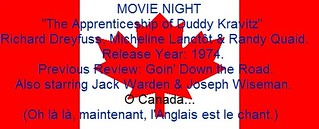
Movie Night: The Apprenticeship of Duddy Kravitz.

Review #409: The Apprenticeship of Duddy Kravitz.

Cast
Richard Dreyfuss (Duddy Kravitz), Micheline Lanctôt (Yvette), Jack Warden (Max Kravitz), Randy Quaid (Virgil Roseboro and Lenny Kravitz), Joseph Wiseman (Benjy Kravitz), Denholm Elliott (Peter Friar), Henry Ramer (Dingleman), Joe Silver (Farber), and Zvee Scooler (Grandfather) Directed by Ted Kotcheff (#025 - First Blood)

Review
To close out Canada Day, I decided to review this film from 1974 (have decided that reviewing Prom Night [1980] would be nonsensical), with familiar actor Richard Dreyfuss as the main lead. I already have watched Dreyfuss in American Graffiti and Close Encounters of the Third Kind, which were both good. This film is where Dreyfuss gets to shine even more, perfectly acting a character who (at least I hope) is perfectly unlikable (though ironically, he believed his performance was terrible), in someways a parallel to Goin' Down the Road, both films cover the spirit of people trying to succeed in a cold-hearted world, with its small benefits and its disasters. Lanctot is alright, but Randy Quaid (Who I last saw in Independence Day, which wasn't exactly good) is better, he manages to blend well into the film, not going over the top, a subdued but fine performances as two characters. The rest of the cast are good, and it is always nice to see Denholm Elliott, no matter what he does. This is a well-made film that manages to have really good scenery but even better filmmaking, a sad film that has biting comedy at times, but it does not veer from its course, keeping itself in check, and managing to be an excellent film.  

Overall, I give it 9 out of 10 stars.

And that is the last film for Canada Day, I hope you enjoyed my attempt to give Canadian films some spotlight, because at least I did.

Original image: 


April 29, 2013

Movie Night: The Replacements.


Review #370: The Replacements.

Cast
Keanu Reeves (Shane Falco), Gene Hackman (Jimmy McGinty), Brooke Langton (Annabelle Farrell), Jon Favreau (Daniel Bateman), Rhys Ifans (Nigel Gruff), Orlando Jones (Clifford Franklin), Brett Cullen (Eddie Martel), Faizon Love (Jamal Jackson), Michael Taliferro (Andre Jackson), Jack Warden (Edward O'Neil), and Ace Yonamine (Jumbo) Directed by Howard Deutch.

Review
This is at heart...an epitome of generic sports movie. This is a movie filled with sports cliche on top of more sports cliches. In fact, you could count the amount of cliches and play Cliche Bingo. What is Cliche Bingo? Think of the cliches that make up sports movies, such as:

The washed up player who is trying to redeem himself.
The grumpy coach.
The romance subplot between a player and cheerleader/person.
The crazy owner.

The big man.
The crazy guy who has a lot of power.
A speech about needing heart/determination/the guts to win.
Playing a strong team and being the underdogs yet somehow winning.

The antagonist who could also be one of their own.
The comic relief character.
Being down at halftime/near the end of the game.
Dramatically diving/slding/slapshooting/moving by a player.

I realize that's only 12 and you would need 12 more to make an actual bingo card, but let me tell you a secret: You can find the rest if you look hard enough. The acting is decent enough, though I do wonder what exactly motivated Hackman to do this movie. I know what you're thinking is the reason, which might be the reason for Welcome to Mooseport, but that's neither here or there. The football action is at least watchable, the movie's not horrible, it's just a typical sports movie that is sickeningly sweet to the point where by the end of it you just want to watch actual football, at least that isn't acted out. Most of the time.

Overall, I give it 6 out of 10 stars.

April 21, 2011

Movie Night: 12 Angry Men.

Review #035: 12 Angry Men.

Cast
1. Martin Balsam
2. John Fielder
3. Lee J. Cobb
4. E. G. Marshall
5. Jack Klugman
6. Edward Binns
7. Jack Warden
8. Henry Fonda
9. Joseph Sweeny
10. Ed Begley
11. George Voskovec
12. Robert Webber
Directed by Sidney Lumet.

Review
Review to be updated at a later point in time - hopefully by the end of 2018 or 2019. 

This movie is the first covered of the 1950s on this show, and it is just pure greatness. It shows a lot of talent all in one set (And for a movie that took less then three weeks and $325,000 to make). Henry Fonda is the big star, and he is the best person in this movie. I like how it seems you are the Juror, you are feeling like you are one of them. The theories are deconstructed over time as the tension builds until the conclusion. It shows a lot of heart, and it can and will, make your heart beat.

Overall, I give it 10 out of 10 stars.