Showing posts with label Harry Carey Jr. Show all posts

October 8, 2023

The Exorcist III.

Review #2101: The Exorcist III.

Cast: 
George C. Scott (Lieutenant William F. Kinderman), Ed Flanders (Father Joseph Dyer), Jason Miller (Patient X / Damien Karras), Scott Wilson (Dr. Temple), Brad Dourif (James Venamun / The "Gemini Killer"), Grand L. Bush (Sergeant Mel Atkins), Nicol Williamson (Father Paul Morning), Nancy Fish (Nurse Emily Allerton), Tracy Thorne (Nurse Amy Keating), Barbara Baxley (Shirley), and Harry Carey Jr (Father Tom Kanavan) Written and Directed by William Peter Blatty.

Review: 
"It was always meant to be a psychological thriller, not a special-effects horror film...I can say that it would make me very happy indeed if some day people were able to see my original version of Legion, which was rather different from the one now in release as The Exorcist III."

In 1983, William Peter Blatty wrote a follow-up book to his famous novel The Exorcist (1971). He found inspiration for his "Gemini Killer" with the real-life Zodiac Killer, who apparently called it "the best satirical comedy" he ever saw in one of his letters that he wrote to the San Francisco Chronicle. While it is a horror book, it is an investigative case kind of book, since it involves the character Lieutenant Kinderman (as seen at times in the original book) on the trail of a string of murders (involving mutilation) that have the resemblance to ones done by a murderer that had been thought to be dead years ago (one thing that apparently differs from film to book is the lack of the Gemini Killer's father, a preacher). Apparently, Blatty wrote it with the intent to do a film with William Friedkin as they had done with the aforementioned Exorcist in 1973, but when Friedkin passed on it, Blatty went forward in writing it as a novel. The resulting success led to shopping around for a director to do a film, and while people like John Carpenter (oh hey, wondered if he thought an exorcism would be needed for the film?) were considered, it ultimately went to Blatty, who had previously directed The Ninth Configuration (1980), an adaptation of his 1978 novel. Ironically, a book that came about at the hands of a serial killer loving the film adaptation enough to call it satire would have its film adaptation cited as inspiration for a serial killer upon its release.

I'm sure that the changes instituted from the original intent must have hurt Blatty badly, but a Director's Cut of the film, utilizing as much recovered footage as possible (which include video tape footage), does exist for people to look over. I imagine more than anything that the fact the film was called "III" rather than the book title is probably what hindered the film from being more than the mild hit that it was, and Blatty stated as much in the years that followed. Morgan Creek Entertainment (who Blatty went with because Carolco suggested a story where Regan from the first film gives birth to possessed twins) felt that the film needed an exorcism rather than the lower-key ending that Blatty envisioned (I'm not kidding, he just walks in and shoots the possessed Karras, which apparently is higher key than the novel, in which the Killer, having decided to explain to the detective the whole thing and seeing his dad die, wills himself to death), and the director's cut features more of Dourif as the Gemini Killer, as opposed to the jumping around between Miller and Dourif, because as you will know from the film, the character of Karras did not in fact die die in 1975 (well, the film was released in 1973 but here we are talking about 1975), he just happened to wind up in the loony bin and was left unrecognized by the staff while the spirits festered; Williamson is the one who shows up as a result of these changes, specifically for the climax. Honestly, the thing that probably sticks with me is the gradual pacing. It reminds me of a procedural, slowly getting to the point with a mostly game Scott that talks a big game more than anything before the part with Dourif (i.e., one consisting of long speeches) makes the film have some life in it. This is the kind of movie that likes to tell rather than show that seems to believe it is honing the spirit of the original...while in fact it only reminds you of the exact opposite. Sure, it is an entertaining film at times, but the 110-minute runtime asks quite a bit from the viewer. Scott gets to chew the scenery a bit, where one minute he is giving someone a stuffed penguin and then all of a sudden, he is going "We're FINE!" to a nurse; his "slime and stink" line at the end when it comes to belief probably is the best part of his whole time. One wishes for more time spent with Scott and Flanders, because they sure have the whole bit down for gruff amusement, but I suppose the shock is what is meant to matter (or something). Honestly, the reason to see the film is for Dourif, because, well, he really is the kind of actor to pull off derangement well, particularly since he doesn't get interrupted (just don't think about the fact that the audience is seeing him as opposed to the body that the spirited killer is in, which is Miller to a sprinkle of lines). The fact that Williamson doesn't have much to say is amusing when considering his importance for the climax (well, aside from those little moments where he is seen), and he most writhes around when it actually does happen. The climax, well, it does help the film more than it hurts it. A little bit of fire and dismemberment does lend the film some juice beyond the attempts at calm dwelling horror, because screw it, there's nothing one can do to compare to the original Exorcist anyway, giving the folks a show is at least a worthwhile proposition, considering the fact that crawling on the ceiling seems more of a "oh" kind of moment. The shadow of the one and true Exorcist film never really leaves one's sight when it comes to watching this movie, which is a mildly involving film through and through. If one has the patience for it, you might find something really curious, and that is more than enough in the midnight hour of good and evil.

Overall, I give it 7 out of 10 stars.
Next: Saw II.

December 26, 2021

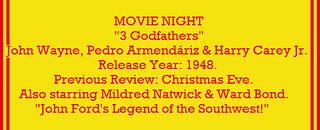
3 Godfathers (1948).

Review #1778: 3 Godfathers.

Cast: 
John Wayne (Robert Marmaduke Hightower), Pedro Armendáriz (Pedro Encarnación Escalante y Rocafuerte), Harry Carey Jr. (William "The Abilene Kid" Kearney), Mildred Natwick (Dying Mother), Ward Bond (Sheriff Buck Sweet), Mae Marsh (Mrs. Sweet), Jane Darwell (Miss Florie), Guy Kibbee (Judge), Hank Worden (Deputy Curly), Dorothy Ford (Ruby Latham), Charles Halton (Oliver Latham), Jack Pennick (Luke), Fred Libby (Deputy), Ben Johnson (Posseman #1), Michael Dugan (Posseman #2), and Francis Ford (Drunken Old-Timer at Bar) Directed by John Ford (#398 - The Last Hurrah, #1324 - 3 Bad Men, #1349 - Stagecoach, #1372 - Fort Apache, #1392 - The Searchers, #1409 - The Man Who Shot Liberty Valance

Review: 
Well, if you need a Western with a Christmas bent, here you go? Of course, this also happens to be yet another John Ford and John Wayne collaboration, albeit one that is probably not as well-noted as the others (such as Fort Apache, released around the same time). The film is adapted from the 1913 novel The Three Godfathers, which was written by Peter B. Kyne. That novel had been adapted into a film five times: The Three Godfathers (1916), Marked Men (1919), Action (1921), Hell's Heroes (1930, directed by William Wyler), and Three Godfathers (1936); Ford had directed the 1919 and 1921 films, while Harry Carey Sr had starred in the first two adaptations (I'm sure you are all familiar with the next adaptation of the book in Tokyo Godfathers (2003))As such, when Ford decided to do another version of this tale, he dedicated it to Carey (who had died in 1947), with the opening title card describing him as the "Bright Star of the early western sky..."). At any rate, this was the fifth starring role for Wayne in a John Ford film, coming off the heels of Fort Apache (1948) that would be followed by She Wore a Yellow Ribbon (1949) and a handful of others, although this might be the lightest of the Westerns they did together. This was the third and final collaboration of Ford and Armendariz (who decided to take on roles besides Mexican cinema in the mid 1940s), while Harry Carey Jr is given an "introduction" despite having done a handful of appearances in film prior to this one, which would be part of a solid run in character roles. The film had three screenwriters in Laurence Stallings, Frank S. Nugent, and Robert Nathan.

You have to understand that the tale is basically a re-telling of the religious tale of the Three Wise Men, so it shouldn't be surprising that there were varying levels of sentimentality in those feature films I just mentioned. The result is a movie that turns out to be just fine, one that will give a fair smile to one's face without turning it into a gloppy mess. For the most part, anyway (106 minutes), since it is sort of a family film that has a bit more chuckles than action (case in point about the adaptation differences, earlier versions featured a bloody gunfight). Well, that and plenty of sand (for Death Valley...doubling as Arizona, anyway), which means that this results in a nice-looking feature that you would expect from Ford. Wayne does fine with what is required from the role in stiff chiseling, one that isn't meant to toe too much into the sentimentality pool that is mostly believable in the long run. Armendariz and Carey Jr make worthy supporting presences in terms of snappy charm that make a useful triangle of pseudo-wise men in a makeshift family feature. Bond is the other key presence, doing exactly what is needed in light casual charm. The sacrifice at the end can only work if one believes it. In two of the previous adaptations (i.e. the 1930/1936 versions), attempts to find suitable water were a key part. Here, it is a bit more tied down, syrupy and curious at the same time. Well, since this is one of the John Wayne features where he isn't engaged in a duel at the end, that shouldn't be too surprising. As long as one stomachs where it goes, all should work out. As a whole, it is a light and charming Western that serves itself well in adapting familiar material with a useful spin and a solid trio that make for a curious Ford selection that follows the holiday tradition well enough without becoming stuck in comparisons. Instead, one takes its message of hope and cheer and runs with it.

Overall, I give it 8 out of 10 stars.

December 18, 2021

Red River.

Review #1773: Red River.

Cast: 
John Wayne (Thomas Dunson), Montgomery Clift (Matthew "Matt" Garth), Walter Brennan (Nadine Groot), Joanne Dru (Tess Millay), Coleen Gray (Fen), Harry Carey (Mr. Melville), John Ireland (Cherry Valance), Noah Beery Jr. (Buster McGee), Harry Carey Jr. (Dan Latimer), (Two Jaw Quo), and Paul Fix (Teeler Yacey) Produced and Directed by Howard Hawks (#951 - The Big Sleep, #1352 - His Girl Friday, #1399 - Rio Bravo, #1687 - O. Henry's Full House), with co-direction by Arthur Rosson.

Review: 
I'm sure we all know the name Howard Hawks as a director. At least, I would hope so, in part because how diverse he managed to be within his filmmaking that spanned four decades within all of the major studios and multiple genres. He did films in his particular way that inspired plenty of future directors even after his death. Red River (1948) was the first of five Westerns that he would direct in his career, and it also would be the first of five films Hawks directed with Wayne as star. The film is adapted from Blazing Guns on the Chisholm Trail, a 1946 novel originally serialized in The Saturday Evening Post (albeit without the "Blazing Guns" part of the title, which was added for the hardcover publication) that was written by Borden Chase. When Chase chafed at changes to the story (one that resembled Mutiny on the Bounty, albeit with a fictionalized angle at a cattle drive), Charles Schnee was brought in to do the screenplay as well, with the two not actually writing together. Chase would write a variety of screenplays and stories, such as with Winchester '73 while Schnee would write and produce for films such as The Bad and the Beautiful. By this point in time, Arthur Rosson had moved from featuredirecting to do work as a second unit director, most notably for Cecil B. DeMille, but for this film he was given credit as a co-director, as he had shot some of the cattle drive and action sequences (as such, he gets credit here as a director, instead of using that weasely "co-director" label that is still present with certain animated features). The film was shot in 1946 but was delayed for two years, with a great deal of editing done by Christian Nyby. Somehow, right as the film had premiered in 1948, Howard Hughes claimed similarities between this film and The Outlaw (1943) with its climatic fight, and you may remember Hawks had been fired from the earlier film. This resulted in a few seconds being cut out in order to fast-track the film for the studio rather than deal with a frivolous lawsuit they would have won handily over Hughes and the content of his alleged Western. There existed two different versions of the film: The pre-release cut lasted 133 minutes while featuring shots of a diary for transition shots; the cuts forced by the lawsuit resulted in a 127 minute film (Hawks also commissioned Brennan to provide a voiceover instead of those shots). When interviewed late in his life (specifically an interview with Peter Bogdanovich), Hawks stated his preference for the shorter version, but it has not stopped the debate over just what version seems better.

You have to remember that Wayne is a movie star bigger than life, an icon that certainly stood differently in presence depending on just who was directing him. The lasting quote about him in this film comes from long-time collaborator John Ford, who famously stated (whether facetious or not) that he didn't know he could act. Well, Wayne does what he does in terms of handling the frontier front and center, only this time with an imitation of Captain Ahab with a granite foundation that works quite well with a look at a different Wayne (if only slightly): middle age. 1948 was the first year folks could see Clift on screen as an actor (he had starred on the stage for over ten years), with this coming out after The Search. He does quite well here, standing well against Wayne in conviction in not getting lost within such presence. You see the conflict within him about the measure of what being a man is, especially after being part of a makeshift family only to leave and comeback from it. It may be a Western, but it also could be thought of as a family tragedy too, since this involves the inevitability of what has to happen between father and son when it comes to being a man. Brennan accompanies the two with the expected supporting presence that matches with both with resourceful chemistry (as would be expected from a semi-regular on Hawks films). When Dru finally comes onto the screen, she brings an added edge needed when either paired with Clift or Wayne in a scene (the best one is the first though, involving her mood during a fight before casually taking an arrow to the arm). The rest of the character presences make their parts count well, whether that means a casual Ireland or the various associates that stand starkly to the granite-laced Wayne in terms of drive, which only makes the build to the climax all the more interesting. Apparently, Clift didn't care much for the overall conclusion (or his overall acting), which is strange, because it actually is quite interesting in sticking out from just being a fistfight. It doesn't seem like the "farce" that he thought it was in my mind - besides, Chase's story has one of them die, and we are talking about a film involving both family conflict amid a clash of relentless drive and youth along with moving cattle (Hawks and Chase did not exactly get along anyway). It seems quite foolish to learn a lesson right before they die anyway, and the film is called "Red River", not "Showdown at Red River", so there. The movie isn't perfect, but the ending isn't a letdown in the long run. It is an odyssey, pure and simple.

At any rate, Hawks created a worthy epic that isn't weighed down by needing a large scope or folks to try and reach over the presence of Wayne, because he has the skills of editor Nyby to go with Dimitri Tiomkin as a driving music composer and Russell Harlan in sweeping cinematographer to go with a dynamic cast that does what is needed in worthy entertainment. It is the classic imperfect Western for its time, one that moves steadfast for what Hawks wants to display about the nature of being a man that couldn't have been done by anyone else but him. In that sense, he did it exactly to his standards.

Overall, I give it 10 out of 10 stars

January 16, 2021

The Long Riders.

Review #1625: The Long Riders.

Cast: 
David Carradine (Cole Younger), Keith Carradine (Jim Younger), Robert Carradine (Bob Younger), James Keach (Jesse James), Stacy Keach (Frank James), Dennis Quaid (Ed Miller), Randy Quaid (Clell Miller), James Whitmore Jr (Mr. Rixley), Kevin Brophy (John Younger), Harry Carey Jr (George Arthur), Christopher Guest (Charlie Ford, Nicholas Guest (Robert Ford), Shelby Leverington (Annie Ralston), Felice Orlandi (Mr. Reddick), and Pamela Reed (Belle Starr) Directed by Walter Hill (#1072 - 48 Hrs, #1091 - Last Man Standing, #1139 - Supernova)

Review: 
"I'd been dying to do a Western for years. I just like 'em. There's a kind of an idyllic quality that surrounds the shooting of them, it seems like a more fundamental film process, more to me what movies are about than clearing crowds off a city street."

The legend of outlaws has spanned a variety of media for over a century, and it is the intrigue of seeing the Old West and all the storytellers that can come from it that make it an interesting curiosity. Whether it is the ballad, or the dimestore novel, or the Western, there always seems to be an interesting idea waiting at the barrel for someone to make seem fresh. There had been various perspectives on the James legend, with one of the more recent films done before this one being The Great Northfield Minnesota Raid (1972), so it would only make sense for yet another adaptation of the James legend (of which there were at least fifteen prior to 1980), albeit with a twist - brothers playing brothers. The idea for the film came about after James and Stacy Keach had starred in a production on television together nine years prior, in which they had played the Wright brothers. James had the idea to play Jesse, while Stacy came up with financing as producer and financer for the play that James wrote. It was briefly staged in New Jersey and Off-Broadway, but they eventually decided to make it into a film for each of them to be involved, and they enlisted the help of Bill Bryden and Steven Phillip Smith to develop the screenplay (the Keaches would also serve as producer alongside Tim Zinnermann). Enlisting the Carradines came in the form of J.Keach approaching Robert Carradine during their time in the production of the TV film The Hatfields and the McCoys in 1974 about being involved with the film, and they soon approached David and Keith with the prospect of doing it, which they eventually agreed. The Quaids came after that, but finding the fourth group came after a bit of turnover, as the Bridges brothers (Jeff and Beau) could not do the film due to schedule conflicts, and it later fell to the Guests (incidentally, the Bottoms family of Joseph, Timothy, and Sam wanted to star as the Youngers). Interestingly enough, a Carradine had already been involved in an adaptation about the legend of Jesse James and Robert Ford, as the eldest Carradine in John (who had four of his sons become actors) had played the latter subject in two films with Jesse James (1939) and The Return of Frank James (1940). That particular film was noted by Walter Hill as the best film made about the Younger-James brothers in terms of character truth, even if the historical accuracy was low.

United Artists agreed to help produce the film if they found a suitable director. Walter Hill certainly fit the mold of a man wanting to tell a good story. The Long Beach native grew up with an interest in film from a young age, although he once thought of being a comic book illustrator before he went into writing and eventually directing in order to tell his own stories. He has described his films as "rather retro", with his genre films generally trying to capture a serious framework within action that take inspiration from Sam Peckinpah among others - after all, he had worked with the director with The Getaway (1972); the clearest influence seems to be The Wild Bunch (1969), particularly with its use of slow motion for certain sequences of violence. Most (but not all) of his films can be argued to have elements of the Western genre, since Hill has noted his liking of complexity with a foundation on simple stories (Hill has argued they are essentially Old Testament morality tales), and this is the fourth feature film that Hill directed. It is a pretty good effort, one that does well with trying to capture a mosaic of the time and landscape that came with folks in the Old West that happen to engage in moral choices involving robbery and murder. In other words, it isn't just a straight action Western, nor one that gives focus to any one individual, instead being just a balanced film with a midwestern feel that makes its 99 minutes count with usefulness. There have been adaptations of the James story since this film (most notably with The Assassination of Jesse James by the Coward Robert Ford), but this film still stands for itself after four decades because of its capable charm, although it wasn't a big hit with audiences upon release (Keach has maintained that the film made a profit, although United Artists was likely thinking about the other Western they released that year that nearly sunk the studio - Heaven's Gate), making just a bit under double its $9 million budget.

When it comes to the first group of brothers, one can say that David proves the best in relative interest, as he is the most adept in charisma without having to strain for it. This seems most apparent during a sequence involving Reed and a new love interest, which naturally ends in a knife fight with a rope for them to chew on and duel. Keith and Robert do fine with a little less time to show, although the sequence with the Pinkertons and an unfortune cousin is a good one. The Keaches do well in their balance of laconic steel (mostly with J.Keach), one that doesn't aim for straight sympathy for the James brothers but instead lets them paint the picture for one to judge - their scene on horseback jumping through the window is likely the best image and moment from the film. The Quaids have a reserved amount of time on screen (most likely due to cutting from the studio), but they do well with being members of chaos (chained or not) that don't fall into the background, mostly with Randy. The Guests lurk right where they need to be in terms of calm sniveling, while Reed and Whitmore Jr fill out the edges in terms of allure and lingering authority that make for a off-kilter balance of a film, revisionist in its approach without seeming like a film relying just on a gimmick. It hits with a worthy punch in its look upon the landscape and the outlaws that became names to remember, no matter the efforts of authority like the Pinkertons or even the firing of a barrel to stop it. While it may not be Hill's best effort, it serves as an interesting start to a productive decade of work that packaged plenty of thrills within some of the confines that made the Western what it was without being chained to it exclusively, and it is a curiosity worth looking into today.

Overall, I give it 8 out of 10 stars.

July 30, 2020

Breaking In (1989).

Review #1492: Breaking In.

Cast:
Burt Reynolds (Ernie Mullins), Casey Siemaszko (Mike Lafeve), Lorraine Toussaint (Delphine), Sheila Kelley (Carrie / Fontaine), Albert Salmi (Johnny Scot, Poker Player), Harry Carey (Shoes, Poker Player), Maury Chaykin (Vincent Tucci, Attorney), and Stephen Tobolowsky (District Attorney) Directed by Bill Forsyth.

Review:
"There's always something you want to say. I would not want to make a film that did not say anything, I'm not interested in getting into something that's just a piece of entertainment, a James Bond or an adventure film. I don't enjoy filming that much, in fact I don't enjoy filming at all and to go through all that for the sake of money would just not interest me."
"I'm not sure if I can swagger anymore, but I can limp with the best of them."

It's easy to forget about a director when Burt Reynolds is your star in a comedy. For example, Scottish-born Bill Forsyth first got into films through an advertisement out of high school and ended up doing short documentary films for eight years, notably founding Tree Films with Charles Gormley in 1970. He wrote his scripts for That Sinking Feeling and Gregory's Girl years in advance, but attempts at getting funds did not take hold with the BFI Production Board. He forged on anyway in making the former film, doing so in 1979 on a cheap budget with actors from the Glasgow Community Theatre. Some of the actors from that film would return for his next film, Gregory's Girl (1981), which resulted in positive notices as the film he is best known for (his next film, Local Hero, also received praise), and he received a British Academy Film Award for each film (the former for screenplay and the latter for direction). This was his second and last film done in North America, with the other being Housekeeping (1987). The film was written by John Sayles (behind films such as Return of the Secaucus 7 and Eight Men Out), whose script had been laying around for a few years that Sayles did not think was something he could direct, and Forsyth updated the script. And then of course there is Burt Reynolds, the one shining reason one might pick this film out in the first place (particularly if you are sentimental towards seeing him in something that could be good). Whether the film is good or not, he remained a fascinating actor to watch be a part of the action for over five decades, with this being at the tail end of his popularity, and he took part in the film for very little money due to his interest in the character role (Forsyth had desired someone like John Mahoney for the role, but a push by Act III Communications for someone with a bit of star power eventually led him to approach Reynolds).

It's a shame that this wasn't a success with audiences on release (making less than two million dollars on a budget of over five million), because it is a decent little movie, even if it isn't exactly the most well-known film for either Forsyth or Reynolds (I happened to have come across this on the Internet and went with it on a guess, although a DVD would obviously be a better quality bet). Sometimes you just have to enjoy a shaggy dog robbery story. In a retrospective article about the film, Forsyth himself described it as "an awkward little movie. It’s not an American film and it’s not a European film; it’s ungraspable what it is." There is definately an interesting sort of tone that Forsyth takes to the material, one that doesn't really go for all of the caper cliches that come with a heist film, instead taking an approach to fleshing out two quirky people that find themselves into this certain business with their own distinct mannerisms and approach. One has probably seen the traditional old pro teaches the hotshot story before, but if one presents it with honesty, it usually works out for a decent time. There isn't anything remotely spectacular about it, but there are bits and pieces that are charming, and the main duo also helps out while also having a few little moments of heists that favor moments of dialogue over anything too explosive (which can work out for those patient for it). Siemaszko, having started appearing in films for six years with bit roles and supporting turns (such as Back to the Future) proves lively enough for the film's liking, carefree yet never lacking when on-screen with various situations of charm. Reynolds, with a hitch in his step and a quieter tone than usual, holds to the challenge quite well, still managing to capture a wise world-weary presence without needing to rely on anything hammy (the makeup on him to make him look older looks fine) that we gravitate to pretty well (of course one could gravitate to Siemaszko too, at least when it comes to brash impulse decisions) with comfort. Seeing these folks try to make a living within a strange world of compromise and duplicity makes for a careful movie, not exactly a laugh-out-loud caper, but also not too plaid for curious enjoyment. It certainly is a curious film for both Forsyth and its two stars in Reynolds and Siemaszko, and if you happen to come across it looking for something diverting, you may be fairly satisfied with what you recieve, getting a few chuckles alongside a decent time.

Overall, I give it 7 out of 10 stars.

July 16, 2020

Mask (1985)

Review #1475: Mask.

Cast: 
Cher (Florence "Rusty" Dennis), Sam Elliott (Gar), Eric Stoltz (Roy L. "Rocky" Dennis), Estelle Getty (Evelyn Steinberg), Richard Dysart (Abe Steinberg), Laura Dern (Diana Adams), Micole Mercurio (Babe), Harry Carey, Jr (Red), Dennis Burkley (Dozer), Barry Tubb (Dewey), Lawrence Monoson (Ben), and Ben Piazza (Mr. Simms) Directed by Peter Bogdanovich (#1000 - The Last Picture Show)

Review:
"Directing is really creating an atmosphere, a particular kind of atmosphere and usually one that is very peculiar to the director. It doesn't necessarily have to be. Some directors have no personality and it shows. But one way or another, what the actors are doing or the crews are doing, they're trying to please the director."

Peter Bogdanovich has had a long and varied life, with plenty of it spent in some way around film, a subject he loved starting in his youth. He studied acting at the Stella Adler Conservatory in his twenties before taking up work at the Musuem of Modern Art as a film programmer. He wrote his first book at the age of 22 in The Cinema of Orson Welles, the first of numerous books about seminal directors of cinema (which later included another book about his friend Welles along with an appearance in The Other Side of the Wind), with further works involving Howard Hawks, John Ford (which he did a documentary of years later), and Allan Dwan. He later desired to make his own films (inspired by the directors he loved along with the French critics-turned-directors like Francois Truffaut), and an encounter with Roger Corman led to his first work with The Wild Angels (1966). 1968 was the year of his first directorial efforts, with Corman having him shoot footage for a English-dubbed version of Planeta Bur that became Voyage to the Planet of the Prehistoric Women (which he did not take credit for). His first true directorial debut came with Targets (1968), as Corman had two days of Boris Karloff to use (Bogdanovich would also have a small part in the film while writing the script with help by Samuel Fuller). The 1970s were both his rise and fall from prominence: The Last Picture Show (1971), What's Up, Doc? (1972), and Paper Moon (1973) each recieved tremendous praise and attention, while Daisy Miller (1974), At Long Last Love (1975), Nickelodeon (1976), and Saint Jack (1979) recieved middling-to-negative notice. By the time of Mask (1985), he had already filed for bankruptcy, having self-distributed They All Laughed (1981) to financial failure (the story of that film and its stars is best for another time). His career has lessened in recent years, but he has kept himself busy within films (which also included work in television and documentaries) alongside acting, teaching directing at the University of North Carolina School of the Arts, and a podcast about his life released this year.

He was inspired to do the film because of his late partner's fascination with The Elephant Man with the similarity of alienation whether beautiful or ugly. There is two versions of the film, with the key difference being in music along with a few additional scenes. The Director's Cut (which I viewed) includes the music of Bruce Springsteen, which was noted as the favorite of Rocky Dennis, and the singer had wanted the music in the film, but catalogue disputes led to the usage of Bob Seger instead (Bogdanovich later sued the studio over this as a breach of contract). The film is based on the brief life of Roy Dennis (1961-1978), who lived with craniodiaphyseal dysplasia, in which calcium builds up in the skull that affects facial features and life expectancy. Wracked with a disease that gradually made him legally blind alongside headaches and troubles, Dennis nevertheless tried to live a normal life with family and school. The film was written by Anna Hamilton Phelan, which took certain liberties with the life of Dennis and his mother (born Florence Tullis), who described the film as a "fairly tale" while liking Cher's depiction of her. It isn't hard to see why one could like this film, since it proves quite interesting in its honesty and care for its depiction of its main subject without needing to wallow in melodramatic cliches. Stoltz, wearing award-winning makeup Michael Westmore and Zoltan Elek, is immeadiately someone we follow along with no need to focus on what he looks like but instead by how we judge others without such a task: through what we hear and see in his actions through the film, whether that involves trying to make the best of his life within school or with the people that accept him for who he is, which Stoltz handles with charm. Cher proves to be an interesting presence, expressive and provocative whenever in view for us with others or up close that makes an organic performance. Elliott shows up from time to time as a collected presence of coolness, proving a worthwhile time without having to say much beyond that distinct voice. The others in the cast make their moments count, such as a bright Dern in one of her first breakthrough roles, or Getty and Dysart in their distinct difference when interacting with Stoltz and Cher, or the warm rough presences of Carey Jr and Burkley. The film utilizes its two hours wisely, making its key moments count with dignity in warmth or tension without suffocation, whereas a lesser director would have turned it into something to cry incessantly at without grace. On the whole, it is a bittersweet achievement of entertainment, one that pulls plenty of emotion for its subject with balance and a game cast to serve as a fair achievement for its director and for its decade as a whole.

Overall, I give it 8 out of 10 stars.

April 17, 2020

The Searchers.

Review #1392: The Searchers.

Cast: 
John Wayne (Ethan Edwards), Jeffrey Hunter (Martin Pawley), Vera Miles (Laurie Jorgensen), Ward Bond (Rev. Capt. Samuel Johnson Clayton), Natalie Wood (Debbie Edwards), John Qualen (Lars Jorgensen), Olive Carey (Mrs. Jorgensen), Henry Brandon (Chief Cicatriz - Scar), Ken Curtis (Charlie McCorry), Harry Carey, Jr. (Brad Jorgensen), Antonio Moreno (Emilio Gabriel Fernández y Figueroa), and Hank Worden (Mose Harper) Directed by John Ford (#398 - The Last Hurrah, #1324 - 3 Bad Men, #1349 - Stagecoach, and #1372 - Fort Apache)

Review: 
Every director surely wants to have one masterpiece in their lifetime, or at the very least wants to have their name or films endure even after their death. John Ford is certainly one man who achieved both with making numerous classics, particularly with John Wayne. It should prove no surprise that this film has endured as a classic in the eyes of many, with Wayne calling it his favorite role and one of his favorite films, and numerous directors have been inspired by the film that ranged from David Lean to Jean-Luc Godard. The film was adapted from novelist/screen-writer Alan Le May's 1954 novel of the same name by Frank S. Nugent. There had been cases where Native American had abducted children and raised them as members of their tribe only to be rescued later, most notably with the Fort Parker massacre in 1836 Texas. This is a film that features familiar aspects of a Western for its director with Wayne and Monument Valley as a primary filming location to view throughout its 119 minute run-time.

This is an interesting film in the middle of Ford's penultimate decade of directorial work, one that grew considerably in reputation over the past six decades (going from receiving no award nominations to best-of lists), which can be attributed to a stellar cast and an injection of darker hues in terms of realism when it comes to telling its story in ways more complex than the usual standards for a Western were. We are intrigued by the characters that come across this vast barren landscape, particularly when it comes to Wayne. He excels with displaying such obsession over his pursuit for vengeance that burns with plenty of conviction that drives the climax in wondering just how far one man is willing to go to finish a quest as grisly as this one is. Hunter does just as well as a foil for this rough quest that we see plainly in his calm eyes, someone who grows as the film does that make him a key for how the tension is built so well for the climax, since our focus is on these two for most of the film and the child-turned-teenage star Wood has only so much time to be on screen (basically ten minutes) that she pulls off with resolve. Miles and Bond each lend a hand as counterparts to the main duo for moments on the lighter side, whether filled with a few wisecracks or something else. The other members of the cast (some of whom were part of numerous films with Ford) do their part in filling things out neatly, whether that means a sequence involving a marriage fight or the buildup to the climax with a nervous soldier. In any case, this is an entertaining film with plenty to say of the harsh realities of the Old West on numerous angles, where losses were suffered on both sides by innocents and warriors alike that went hand in hand with the attempts of trying to build a life for themselves in vast and dangerous territory. Life can be hard if one is not up to the challenge of standing up to what may come their way, whether that involves conflict with oneself or with prejudice from others or something else entirely when it comes a wanderer and coming home. In any case, The Searchers does fairly well with making an attempt at a darker Western with an intense Wayne at the helm to sell itself off beautifully by the time it gets to its enduring last shot. Six decades of time have left plenty to shine in this Western now more than ever as a rewarding film for the ages for all who take it upon themselves to get on the frontier and find themselves watching the film for themselves.

Overall, I give it 10 out of 10 stars.