Showing posts with label Murray Hamilton. Show all posts

October 23, 2026

The Amityville Horror (1979).

Review #2609: The Amityville Horror (1979).

Cast: 
James Brolin (George Lutz), Margot Kidder (Kathleen 'Kathy' Lutz), Rod Steiger (Father Francis 'Frank' Delaney), Don Stroud (Father Bolen), Murray Hamilton (Father Ryan), John Larch (Father Nuncio), Natasha Ryan (Amy Lutz), K. C. Martel (Greg Lutz), Meeno Peluce (Matt Lutz), Michael Sacks (Jeff), Helen Shaver (Carolyn), Amy Wright (Jackie), Val Avery (Sergeant Gionfriddo), Elsa Raven (Mrs. Townsend), and Irene Dailey (Aunt Helena) Directed by Stuart Rosenberg.

Review: 
In 1974, there was a terrible murder in a house on 112 Ocean Avenue in a neighborhood in Amityville on the shoes of Long Island, New York. The man killed six family members and ultimately was convicted to life in prison, where he resided until the day he died. One year after the murders in the house, the Lutz family moved into the house with their children and dog. 28 days later, they fled the house, claiming that strange things of the paranormal spooked them enough to leave and never return. The Lutzes were introduced soon after to a man named Jay Anson, who they decided to send many hours of recollections of what they apparently saw and heard on tape, for which Anson wrote a book published in 1977. Samuel Z. Arkoff of American International Pictures fame quickly bought the rights to the book from Anson, who actually wrote a teleplay for what was originally envisioned for a TV film before Sandor Stern was hired to write the eventual screenplay. For probably obvious reasons, the authorities did not allow the filmmakers to film at the actual Amityville residence, so they settled with a place in Toms River, New Jersey for location shooting. Perhaps lost in the shuffle is director Stuart Rosenberg, who had done a string of "okay" to middling movies since Cool Hand Luke (1967). Both Brolin and Kidder were asked by the studio to do promotions for the movie that basically had them see the actual house and talk about the claims made by the Lutz family, for which they later doubted the actual claims. The movie was a considerable hit with audiences, and there has been a few people who have noted their appreciation of the movie, most notably with Stephen King, who eventually saw the film as an "enduring classic of its kind" that argued for it serving as a parable for financial anxieties. Anson died the year after the film was released. Two months after the release of the film, the attorney of the murderer claimed that he and Lutz made up the tales of the house being haunted over a series of drinks. Various people went on to look at the house, most notably with Ed and Lorraine Warren (a pair of so-called "demonologists"*) while Mr. Lutz registered the phrase of the book as a trademark and later stated that the film producers embellished events in the movie. Both the actual house and the Toms River house have seen renovations (with the former having its address changed) and the people of Amityville would rather see people shut up about the house. Unlike other franchises that came around because people wanted to make some sequels, Amityville took the cake for shamelessness. Dino De Laurentiis oversaw Amityville II: The Possession [1982] (for which the Lutzes sued to have no affiliation) while the road to the gutter went to 3-D the following year that was the last theatrical release until the 2005 remake. Amidst all of the subsequent indie and direct-to-video slop* (of which there are dozens, with the most recent being "Christmas Vacation" in 2022), discussions for a re-imagining have occurred for years.

With all of that in mind, it gives me no pleasure to say that I loathed this utterly mediocre movie. It actually almost makes me irritated to see anyone try to hold it up as anything other than a mealy-mouthed, shambling, fraud of a film. Far from being one of the "scariest films ever", it will only inspire the viewer to bash their skull in the company of their own house because heaven forbid having to watch one more minute of a movie with no actual scares in it. Ahhhhh, the house we paid money for is turning into a money pit! Ahhhh, I'm having totally-real nightmares about a murder I never saw! Ahhhh, my phone keeps giving me static when the dopey priest is calling! Ahhhh, there's no real ending! I hope you get my perspective, because I'll be damned if I could understand Stephen King's perspective* or any perspective that doesn't call it a turgid, uninspired mess of fiction (besides, when having a fear of money troubles, my thoughts go to "get the calculator", not "how can I make this into a horror story?"). At least when The Blair Witch Project (1999) tried to play their horrors off with the mythology of being based in some sort of reality, there was the idea of an actual threat amidst all of the madness. Here, all the movie has is a few spooky images and the occasional Lalo Schifrin musical beat to carry a movie that is too irritating to take as either a joke or based in reality. Apparently, Brolin was approached about doing the movie, so he read the book with some pants over the door and somehow, when he was reading a "scary part" of the book, the pants fell off the floor that spooked him enough to laugh and also decide, yes, he had to do this film, one where he plays it with growing agitation and the appearance of a shaggy bum. He can only go so far in trying to lift this movie up with any semblance of terror and vulnerability as a patriarch that can only keep chopping wood. Kidder and Steiger basically took the film on for the same reason of wanting to accept any job offered (the latter in particular had been recovering from open-heart surgery). I think you can see the level of "commitment" on display from each person, with one basically giggling through the crap with Kidder (I sure wish I could laugh at this movie without checking how long it is to end the 118-minute runtime is) and the other trying their damndest to chew the entire screen with Steiger that actually borders on embarrassing after, what, the stigmata starts to show? It doesn't even matter if the movie had any sort of made-up explanation of why the house is what it is, what could possibly hold up such vaunted spooky things such as black ooze, exploding doors, malevolent sash windows, disappearing cash, and babysitters getting locked in closets while an imaginary being later revealed to be a pig is in the area. I could go on and on, but I think the best way to assess a horror movie is this: did I enjoy what I was watching? No, not really. Would I recommend it even with the acknowledgement that there have been just as many flawed movies involving spooky houses or the semblance of tension even with a lack of monster/explanation? No, because it personally annoyed me and didn't even have a payoff. Would I like to see just how the two subsequent "sequels" and remake turned things into an even bigger joke? Well, never say never. I think you get my point: The Amityville Horror is a dull, shambling mess that is mostly fit for those who know the fine line between doggerel and, well, dogshit.

Overall, I give it 4 out of 10 stars.


*There is probably some perspective that offers a good reason to check out direct-to-video stuff or "on-demand" stuff. For me, it just sounds like the biggest waste of time imaginable - I'm here for stuff that made a theater, what's the point?

*Yes, yes, The Conjuring became a franchise with the loosest characterizations of the Warrens. It should be noted that aside from being frauds that have no credibility in any shape or form (I do not engage with "ghost hunters", I would rather see them get a real job), Ed was accused of having a sexual relationship with a 15-year-old. Lorraine personally wrote into the contract of the film series that her and Ed would not be portrayed as "engaging in crimes, including sex with minors, child pornography, prostitution or sexual assault. Neither the husband nor wife could be depicted as participating in an extramarital sexual relationship". At least the Warrens are both dead now.

*What, was King still snorting cocaine when coming up with that perspective? 

July 4, 2025

Redux: Jaws.

Redux #480: Jaws.

Cast: 
Roy Scheider (Chief Martin Brody), Robert Shaw (Quint), Richard Dreyfuss (Matt Hooper), Lorraine Gary (Ellen Brody), Murray Hamilton (Mayor Larry Vaughn), Carl Gottlieb (Meadows), Jeffrey Kramer (Deputy Leonard Hendricks), Susan Backlinie (Chrissie Watkins), Lee Fierro (Mrs. Kintner), and Peter Benchley (Interviewer) Directed by Steven Spielberg (#126 - Close Encounters of the Third Kind, #168 - Raiders of the Lost Ark, #169 - Indiana Jones and the Temple of Doom, #170 - Indiana Jones and the Last Crusade, #302 - Indiana Jones and the Kingdom of the Crystal Skull, #351 - Schindler's List)

Review: 
You might wonder why I'm giving a revised review of a movie I covered before. Well, that review was nearly 12 years ago on November 11, 2013. Enjoy.

Like most great movies, it all started with taking a novel into one's hands. In early 1974, Peter Benchley's debut novel Jaws was published, which had seen him take inspiration from shark attacks and the exploits of Frank Mundus, a fisherman that once caught a shark weighing over 4,000 pounds off the New York shores. Benchley thought the book wasn't going to be a hit, mainly because it was a first novel and that it was "about a fish". The result was a novel that sold over five million copies in its first 18 months. Ironically, both Benchley and Mundus became conservationists in later years, with the former telling people that he could not write the book as it was in good conscience (for Mundus, he later called the movie "the funniest and the stupidest movie I've ever seen because too many stupid things happened in it.").  Benchley was tasked to write the first draft of the screenplay, and it was he would basically do the "mechanics" of the script more so than characterization, which most notably saw him excise the affair between Brody and Hooper (upon suggestion). Others delivered uncredited work such as Howard Sackler, John Milius, Matthew Robbins, and Hal Barwood; Carl Gottlieb, who was tasked to bring in "some levity", was given co-credit with Benchley on the screenplay. The director would be Steven Spielberg, who had two features to his credit at the time with the TV-film-turned movie Duel (1971) and The Sugarland Express (1974). 159 days of production were spent around Massachusetts and the Atlantic Ocean due to overruns that saw script refinement and a bit of cast strife. You probably already know Jaws was a phenomenon, but it still sounds fun to say it: Universal spent a good deal of money marketing the movie in a media blitz and a strategy that was still not as widely used now: releasing the movie on hundreds of theaters at once for opening week, with over 400 theaters seeing the movie on June 20. For two years, Jaws was the highest-grossing movie of all time and the TV premiere of the movie in 1979 saw over half of the total US audience watch it. Years later, Benchley was asked about a deal involving sequels to Jaws, with him stating, "I don't care about sequels; who'll ever want to make a sequel to a movie about a fish?" Jaws 2, with no Spielberg or Dreyfuss, came out in 1978 as directed by Jeannot Szwarc to mixed reviews. Jaws 3-D (1983) and Jaws: The Revenge (1987, with Gary returning because...) came out later to diminishing box office returns and little-to-no creativity. Benchley went on to write seven more novels, with a handful being adapted into films such as The Deep (1977) and The Island (1980); he died in 2006 at the age of 65.

I admit that I've seen Jaws roughly three times: once in 2013, another a few years later, and lastly just a few days ago with my mom. I wanted to re-live the experience of wondering what was so great about a movie like this, and what better time than in the summer and in July? Steven Spielberg is probably the seminal entertainer for direction in the past fifty years, but I really did want to figure out (at least, again) just how he did it. Whether thought of as an action thriller or as a horror movie (let's be honest, there are people who willingly choose to ignore the latter genre because of bias), there is just something so thrilling about how this movie pushes one's buttons so effectively in great adventure. Filmmakers could only dream to make a movie run as well as one can for two hours that has no bloat or demand for more that come across here, and this is for a film that wisely spaces out its tension until it absolutely becomes important to do what it has to do. To borrow from old me, there were plenty of "animals gone bad" movies before and after this movie such as say, Grizzly (1976), Piranha (1978; widely considered among the best of the Jaws ripoffs), Alligator (1980), and so on, but Jaws just has that enthusiasm and commitment to its tension. You have to remember that the movie characters are meant to be more likable than the book characters, which dealt with a subplot involving the Mayor being tied to the Mafia and the aforementioned affair between two characters. The funny thing is that it was easier to cast Brody with a perceived "tough guy" in Scheider than the other two key roles, which apparently were not cast until the last few days of pre-production that resulted in two people being cast with how good they were in other people's movies at the time: actor/writer Robert Shaw, who had worked on the recent Universal Pictures hit in The Sting (1973) for Quint and American Graffiti (1973) star Richard Dreyfuss for Hooper. They all are essentially perfect for what needs to happen for the film. Scheider in particular shines because he fits the everyman type like a glove, one with real worries and quibbles that sells for all who know the plight of being, well, a fish out of water.

Shaw was a man of the stage who happened to write on the side, so of course he can play the ultimate rugged captain (he was a Bond adversary, for heaven's sake, he could do anything). Every line of his has a certain type of timing and cadence that we find listening to intently that is rewarded with that one particular sequence in the "U.S.S. Indianapolis monologue" that he sells in such a soulful way that it almost doesn't matter just who (Shaw, Milius, Sackler, what have you) came up with what in writing it. Apparently, Dreyfuss thought that the movie was going to be a "disaster" because of the general boredom that came in waiting to film. There's the veneer of charm within a part that apparently was molded to be Spielberg's "alter ego" (debate on that), and Dreyfuss draws a few light chuckles even in the great admirer of, well, the routines in science. Bottom line: you care about these folks. It may interest you to know that this was the debut theatrical performance of Gary, who had done a handful of television performances. But it is Hamilton and his steely smarm in the art of evasiveness that probably sticks out the most now more than ever: a person in a position of power that hears of certain facts and doggedly moves forward with his own self-serving needs anyway. Evidently, there is actual footage of real sharks in the film, as Ron and Valerie Taylor shot footage in the waters of South Australia that had an actor in a mini shark cage. The look of the shark isn't what matters in the end, what matters is the fact that it could come when it comes to suspense that came from someone who honed their craft in suspense with Duel (1971) and plays with the audience just enough to where the climax will splatter in harrowing excellence. As a whole, Jaws is the phenomenon for monster movies one would hope to aspire to do. I'm not really sure exactly where it rests on the pantheon of entertaining Spielberg movies when considering his earlier work (and what's to come), but it sure has a hell of an argument for making a good time.

Overall, I give it 10 out of 10 stars.

June 14, 2020

The Way We Were.


Review #1444: The Way We Were.

Cast: 
Barbra Streisand (Katie Morosky), Robert Redford (Hubbell Gardiner), Bradford Dillman (J.J.), Lois Chiles (Carol Ann), Patrick O'Neal (George Bissinger), Viveca Lindfors (Paula Reisner), Allyn Ann McLerie (Rhea Edwards), Murray Hamilton (Brooks Carpenter), Herb Edelman (Bill Verso), and Diana Ewing (Vicki Bissinger) Directed by Sydney Pollack (#084 - Tootsie and #1441 - Jeremiah Johnson)

Review: 
“As a young woman, I wanted nothing more than to see my name in lights.”
Barbra Streisand dreamed of being an actress from childhood, and it is easy to say that she has followed through with considerable talent for six decades. The daughter of a teacher and a singer-turned-bookkeeper, she practiced singing from a young age while eventually spending additional time studying acting (such as stage actress biographies and acting theories). She made her way from nightclubs in 1960 to Broadway in 1962, with her first album being released the following year. Her appearance in the 1964 Broadway production of Funny Girl furthered her success, and when the musical was adapted into a film in 1968, she would make her film debut and reprise her role and win an Academy Award for Best Actress. By the time she was in line to do this film (her seventh), she had starred in a variety of genres such as musicals, comedies, and dramas.

Some movies are just schmaltzy, and this one nearly drowns because of it. Actually, one little barometer you can use to try and set the mood for if you may enjoy this film is how one reacts to the title song of the picture, sung by Streisand and written by Alan Bergman, Marilyn Bergman, and Marvin Hamlisch. It supposedly is a tearjerker kind of song, so if one really is swayed by melodramatic phrases like "Memories light the corners of my mind / Misty watercolor memories of the way we were", then by all means go for it. If I ever had a blindspot when it comes to music, sad love songs rank up there. Inspiration for the film came from the experiences of writer Arthur Laurents during his time at Cornell University, where he knew a student just as reactionary about events of the time as the main character present here, with an eventual turn to creating a love story (of sorts) with a talented writer without the strength to really apply themselves with writing. Laurents was a noted playwright who had directed Streisand in I Can Get It for You Wholesale back in 1962. The film may seem a bit jumbled with its plot, and the fact that there were numerous re-writes done to the script (from writers such as Dalton Trumbo) doesn't help, and Laurents had left (and returned) the production due to taking issue with Pollack with his handling of the main characters, since he felt that he needed to make Redford's character more equal to Streisand's character (since Pollack had promised Redford to make the character less of a strawman in order to get Redford to sign on). Laurents was obviously not too pleased with the resulting film, once stating that "To make a mantra of 'It's only a movie was as useless and foolish as feeling pain. No matter what I felt or thought, no matter what I tried to accomplish or how, Sydney Pollack would ultimately have his way. That was what I had to face and accept. They didn't cry 'Author! Author! in the movies, they never had. Now they cried 'Auteur! Auteur! -- even if the auteur fucked up the picture."

As a film about the evolving times into the Hollywood blacklist interlaced with a tragic romance, it isn't exactly a strongly put-together film, particularly when it comes to settling in the tragic parts of its climax, which seem too abrupt for a film that somehow seems too long and not long enough at the same time of 118 minutes. Your mileage may vary on what seems most interesting to you when it comes to the story, but I just couldn't get myself into all that this film wants to juggle, a snoozer in the political aspects (when not trying to preach to the choir). Everything one could praise for a film like this can soon be followed by the word however, as if this was a film of contradicted principles. Streisand and Redford seem to do well with each other, beaming as stars with distinct craftsmanship that can make for interesting magic when not arguing with each other. You know the type: the idealist with resilience and fire like a phoenix and the golden boy with his own sense of preservation (you can tell pretty quickly which one you might like better when it gets to the college speech scene, where she talks about her beliefs with Marxism before getting mocked with a "Any Peace But Katie's Piece" sign - which leads to her getting mad and calling them fascists, which is just as amusing as trying to take Marxism super seriously). In a sense it is like watching passionate waves crash onto a calming beach, which can work pretty well. On the other hand, the supporting characters seem to be a victim of the editing (particularly with a wasted Hamilton), where one only sees fleeting moments with folks like O'Neal that only serve to try to not drag things out to the inevitable pasture.  If one goes along with these characters, then all power to you - to me I couldn't help but think of them more as belonging to camp than true tragedy. For its failures to really set up a cohesive finish before its final manipulations with the climax, I can't find myself to give a positive shake for this film - its machinations to get to its tragic point are frenzied and not consistent enough to stick its landing, regardless of how much star power is present here. I do not care for tearjerker films like this because I know that it really isn't going to shake me the way it thinks it will, since this one nearly inspires laughter at its subject rather than pity. Maybe it is a reflection on what fits my tastes more than anything, since one knows Streisand and Redford have done far better films than this. This is an irritating mediocre movie, because you know that this annoying tearslop could do so much better, and yet here we are with a shaky principled mess that only serves as a late night rental for those who just want to see Streisand and Redford together once without having the highest of expectations. 

Overall, I give it 6 out of 10 stars.

April 18, 2015

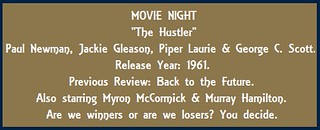
Movie Night: The Hustler.


Review #702: The Hustler.

Cast
Paul Newman (Eddie Felson), Jackie Gleason (Minnesota Fats), Piper Laurie (Sarah Packard), George C. Scott (Bert Gordon), Myron McCormick (Charlie), Murray Hamilton (Findley), and Michael Constantine (Big John) Directed by Robert Rossen.

Review
Winners are not always who we think they are. To some, it's the only thing, or the will to win for others. Alternatively, one might say it's not winning or losing that matters, it's how you played the game. But with this movie, being a winner and a loser is not based on how they compete, it is based on how they are as a person. If you want a movie that pulls no punches, a movie that shows both the grim realities of life and a game of pool, then this is the one for you. Newman does a wonderful job, showcasing his complexities of emotion and character depth along with some nice trick shots. His pairing with Laurie makes for an interesting splice with the pool action, and it makes the movie more whole because it gives the film more depth. Speaking of which, Gleason does a great job as well, and even though you don't see him for most of the film, his presence always seems to be felt, and it is welcome when you see him appear. Lastly, Scott is just great. Brutally effective while also playing his role as only Scott would play him: Efficient. This is a movie that may seem long, but it really makes for fine entertainment while also being a look into what makes one a winner, which this movie is.

Overall, I give it 10 out of 10 stars.

March 11, 2014

Movie Night: Jaws 2.


Review #555: Jaws 2.

Cast
Roy Scheider (Martin Brody), Lorraine Gary (Ellen Brody), Murray Hamilton (Mayor Larry Vaughn), Joseph Mascolo (Len Peterson), Jeffrey Kramer (Deputy Jeff Hendricks), Collin Wilcox (Dr. Lureen Elkins), Ann Dusenberry (Tina Wilcox), Mark Gruner (Michael Brody), Barry Coe (Tom Andrews), Susan French (Grace Witherspoon), Gary Springer (Andy Nicholas), Donna Wilkes (Jackie Peters), and Gary Dubin (Eddie Marchand) Directed by Jeannot Szwarc.

Review
It figues that even though the first movie wrapped itself up nicely and leaving no doubt that the shark was dead, the studio wanted a sequel. Scheider is back at least, along with Gary and Hamilton, which is alright (a shame there's no Dreyfuss though), but let's get to the point, the movie doesn't have much chance of replicating the scare of the original movie, and the movie acknowledges that by revealing the shark many times throughout the film. So yeah, how is the film? It's pretty mediocre. Scheider does his best, and to the film's credit, most of the cast do a pretty fine job...except the teens. After a while, you start rooting for the shark. I think the thing that irritates me the most is the fact that once again nobody agrees with Brody that there's a shark attacking. The original script made more sense for why they don't believe him, as the Mayor and Peterson are apparently in debt to the Mafia (don't ask), borrowing money from them to build resorts to help restore Amity after the shark attacks devastated the town's economy in the first movie (I wouldn't want to go to a place with shark attacks either), thus explaining why the two "disbelieve" him. But instead, due to rewrites, there's now no reason for the two to not believe Brody, the man who's hunted down a shark before. At least the shark effects look decent. The tagline "Just when you thought it was safe to go back in the water..." is really clever and invites you with such an irresistible line. The movie is okay, but compared to the first film, it's a inferior sequel. But...what about the sequels? Well, we-I mean I am going to find out.

Overall, I give it 6 out of 10 stars.

March 1, 2014

Movie Night: The Graduate.


Review #550: The Graduate.

Cast
Anne Bancroft (Mrs. Robinson), Dustin Hoffman (Benjamin Braddock), Katharine Ross (Elaine Robinson), William Daniels (Mr. Braddock), Murray Hamilton (Mr. Robinson), and Elizabeth Wilson (Mrs. Braddock) Directed by Mike Nichols (#175 - Who's Afraid of Virginia Woolf?)

Review
The Graduate is a cornerstone of the 1960's, a representation of the good and the bad of that era, a movie timelessly stuck in that era. But is the movie itself as great as some like to call it? Not quite. While it is a well made movie, the movie has one sad flaw that still would've happened with or without Hoffman: The flaw is Braddock himself. It is hard to care about this character, about what he does, or in this case, doesn't. Mrs. Robinson is both a timeless character and the best character to watch in the movie because her story is more interesting to watch, she's a character who basically represents someone who settled for someone she didn't love, and how it's too late for her, stuck in a loveless marriage, and that's where Ben enters the picture. He...is hard to care about due to his insecurities, the fact he stalks a girl all the way to college...and the fact his "I don't know what to do" is not exactly compelling as compared to Bancroft's character. Are the actors any good? Yea, they are. They are perfectly cast in their roles, and they work well together, even the supporting actors. The ending to the movie is both ironic yet poignant, with these two one-date characters together, not knowing of their future, and also stuck, much like Bancroft. Is this a classic? It could be argued that it is a classic, it certainly is entertaining at times (Especially with that soundtrack by Simon & Garfunkel), and the actors are good. It all depends on what you want, which I hope isn't plastics.

EDITORIAL: I'd like to note that this is the 550th review, which wasn't given the whole Countdown like other landmark reviews. You might be wondering why. I simply didn't care enough to want to do the whole Countdown stuff again, not after all I tried to do with the Metropolis (#500) stuff. I haven't had as much energy to care about doing countdowns, though my energy for this show is somewhat there, I feel like I'm doing this more for myself then for others, like I'm talking to an empty audience, and the lack of care for a Countdown was just my laziness. Am I taking a break from reviewing? No, though it wouldn't hurt to try and stop and think about why I do this show. It's not like I've been bogged down with little to review, I actually do have a backlog of films I want to watch and review, I just don't feel like these reviews have had much interest from anyone other then just me. Am I right, or am I just slightly delusional after watching a depressing film such as The Graduate? Is this just for my own enjoyment, or is do any of you readers enjoy these reviews? I'm not considering ending this show, I just feel that I wanted to ask this question, a little musing of mine. If you actually do read this and care, I'd like to see a comment or two, just so my musing proves incorrect.

Overall, I give it 8 out of 10 stars.