Showing posts with label Jack Webb. Show all posts

April 4, 2020

The Men.

Review #1377: The Men.

Cast: 
Marlon Brando (Ken Wilocek), Teresa Wright (Ellen), Everett Sloane (Dr. Brock), Jack Webb (Norm), Richard Erdman (Leo), Arthur Jurado (Angel), Virginia Farmer (Nurse Robbins), Dorothy Tree (Ellen's Mother), and Howard St. John (Ellen's Father) Directed by Fred Zinnemann.

Review: 
"If you want something from an audience, you give blood to their fantasies. It's the ultimate hustle."

We all have our own challenges to face in life. If one rises to the occasion with courage or dedication, they may find themselves with success or at the very least something to be proud of. In the case of Marlon Brando, it was opportunity that fell onto him, as he had a knack for mimicking since he was a youth. He eventually set out to study acting, the one thing he enjoyed and felt accepted with. He credited the teachings of Stella Adler and Elia Kazan in acting, more specifically the Stanislavski system, where one is encouraged to look into what makes the character they are playing inside and out with realism. He found himself on Broadway in 1944, but his big break came with Kazan's direction of the Tennessee Williams play A Streetcar Named Desire (1947) as Stanley Kowalski. He would later reprise the role for the film adaptation four years later, but his debut film came in this feature, where he accustomed himself to the role by remaining in a wheelchair on and off the set for filming. One should not be surprised to find Fred Zinnemann behind the director's chair for a film with stark realism that certainly seemed to take risks outside of the usual fare for dramas. He had grown up with ambitions of music before graduating with a law degree in his time in his native Austria, but he found himself interested in film and how they were produced, which is where he became a cameraman. One of his first films he worked on was People on Sunday (1930), but he soon moved to America, working a variety of film jobs such an extra or with Robert Flaherty, and his debut film came with Redes (The Wave) in 1936, a documentary-turned-drama about the plights of a small fishing community in Mexico. He eventually found films with darker reach such as The Seventh Cross (1944), which featured German refugees in some of the roles, and The Search (1948), which depicted the attempts at reuniting families separated by World War II. In a career that spanned over five decades, Zinnemann would make over 20 films, with two of them winning Best Picture (From Here to Eternity, A Man for All Seasons), while Zinnemann won a total of four Academy Awards (two for short subjects, two for directing).

One can always applaud the efforts to make a compelling social drama that strives for honesty, whether it involves adjustment back to society or adjusting romances, which both applies to this film, with paraplegic veterans trying to adjust back to society. The film was written by Carl Foreman, who had previously collaborated with producer Stanley Kramer with films such as Champion (1949). The film utilizes actual patients from the Birmingham General Hospital (located in the town of Van Nuys, California that closed down in 1950), which Brando lived for a month to study people there. He proves himself with a worthy debut, one that is tragic and absorbing, whenever dealing with his condition or with the world at large while having to act in either a bed or in a chair, which works to an actor like Brando. Wright makes for a fine show of professionalism and patience, reflected in the careful chemistry demonstrated with Brando that makes for a few quiet highlights. Sloane shines in a resounding patient role, while Webb (noted for creating and starring on Dragnet, which started on radio the previous year) shines with a mix of cynicism and humor, such as when he recites lines from Shakespeare. In any case, the film runs at a fair pace with 87 minutes, reaching most of the points it wants to make without seeming like an overreach when it comes to its message or seeming outdated. It is a film that approaches its subject with a sense of honesty and sensitivity, highlighted by a dynamic debut from a transcendent actor like Brando and capable directing from a maverick like Zinnemann to make a little gem of a film count now.

Overall, I give it 8 out of 10 stars.

June 14, 2017

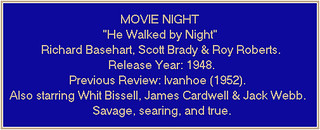
He Walked by Night.


Review #947: He Walked by Night.

Cast:
Richard Basehart (Roy Martin/Roy Morgan), Scott Brady (Sgt. Marty Brennan), Roy Roberts (Captain Breen), Whit Bissell (Paul Reeves), James Cardwell (Sgt. Chuck Jones), and Jack Webb (Lee) Directed by Alfred L. Werker (#676 - Shock and #721 - The Adventures of Sherlock Holmes) and Anthony Mann.

Review:
This is an interesting type of film noir in the fact that it is shot in a semi-documentary tone that is also loosely based off the crime spree of Erwin "Machine Gun" Walker, who like the character in the film was a former police employee and World War II veteran that committed thefts and burglaries with police in Los Angeles roughly three years before the film was made. In any case, this is a police procedural that does not waste much time in establishing its story along with its choices in how to film it, from the narration that occurs throughout the movie to the cinematography by John Alton (who I previously mentioned in The Big Combo - #934) to the group of police characters (and small supporting cast) that are given focus. Werker (along with an uncredited Anthony Mann) gives fine direction to the movie, delivering tension and violence without overshadowing the story.

Basehart gives the gritty kind of performance for a movie bounding itself in reality and having no sort of frills, and it works quite well in serving its purpose. Brady and Roberts are fairly decent police leads, working the movie in a serviceable way. Bissell does a fine job in making this character feel gullible but not outright annoyingly weaselly. One thing to note is that Jack Webb was inspired by a conversation with Detective Sergeant Mary Wynn (who served as police technical advisor for the movie) to create Dragnet, which is the most notable and most influential police procedural drama that had separate runs on radio and television.  Reed Hadley provides the narration in an uncredited role, and he does a capable job, doing a fair job in making the movie seem accessible. There is a consistent type of pace in this 79-minute movie, where nothing seems over-extended past a logical conclusion nor too short; one highlight is the scene where they attempt to identify the suspect via building a composite, with numerous changes before it is finally finished. The ending scene in the sewers is a riveting finale that has the right balance of sounds, shadows and lights, with Basehart's expressions and movements being quite helpful in seeing the climax to its bitter end (which is not exactly like the events in real life, but no matter). This is a fine little gem that does it by the book and succeeds.

To any readers, I am experimenting with using hyperlinks for anytime a previous review is mentioned. With any luck, this will work out without any problems. Hope you enjoy it.

Overall, I give it 8 out of 10 stars.
June 11, 2016

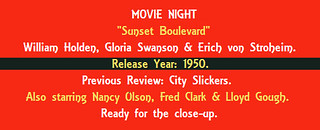
Sunset Boulevard.


Review #809: Sunset Boulevard.

Cast
William Holden (Joe Gillis), Gloria Swanson (Norma Desmond), Erich von Stroheim (Max von Mayerling), Nancy Olson (Betty Schaefer), Fred Clark (Sheldrake), Lloyd Gough (Morino), Jack Webb (Artie Green), and Cecil B. DeMille. Directed by Billy Wilder (#106 - Some Like It Hot, #194 - Ace in the Hole, #422 - The Fortune Cookie, and #641 - The Apartment)

Review
The inventive (if not quirky) device of narration by our freshly dead main character certainly sets the tone for what is at all counts a fairly well-made movie that was later added to the National Film Registry as a film noir. Nostalgia is something that we all encounter at least once in our lives, whether it be for a different past time or for our own past. Sunset Boulevard certainly expresses nostalgia in the form of Swanson's character, from her private movie theater that shows her silent movies to playing bridge with a few "waxworks" (played by three silent film stars of the era: Buster Keaton, Anna Q. Nilsson, and H. B. Warner). The transition from the silent era to sound led to new horizons but also the decline of a good deal of the silent stars that had graced the screen and the hearts of moviegoers as well. The cinematography by John F. Seitz is excellent, making the movie look very well shot, particularly the final scene, with Swanson seemingly fading into the glitz of the camera. There's a certain sort of allure that Swanson brings to her character that makes her irresistible to watch on screen - her banter with Holden is especially entertaining. Von Stroheim is also wonderful to watch in his attempts at appeasing this husk of a star, with all of the desperation and pity in full display. Holden does a good job at telling this yarn, with enough quips along the way. One of my favorite lines is about how people don't really know the writing it takes to make a movie, assuming that the actors make it up as they go along. There's a certain mythic quality to these actors of yesteryear that is hard to explain at times but is always present, with a presence as large as Norma Desmond. Sure, one could figure out who killed who soon enough, but it's the spectacle that gives the movie breath. It's a movie with much to remember, from the main trio to the dialogue ("I'm ready for my close-up" being one of them) that makes for a fine thing to watch.

Overall, I give it 10 out of 10 stars.