Showing posts with label Paul Weigel. Show all posts

October 2, 2026

The Invisible Ray.

Review #2587: The Invisible Ray.

Cast: 
Boris Karloff (Dr. Janos Rukh), Béla Lugosi (Dr. Felix Benet), Frances Drake (Diana Rukh), Frank Lawton (Ronald Drake), Violet Kemble Cooper (Mother Rukh), Walter Kingsford (Sir Francis Stevens), Beulah Bondi (Lady Arabella Stevens), Frank Reicher (Professor Meiklejohn), Paul Weigel (Monsieur Noyer), and Georges Renavent (Chief of the Sûreté) Directed by Lambert Hillyer (#297 - Dracula's Daughter)

Review: 
Now you might say, hey, this is one of those multi-genre movies, is it really that important to feature it for the sake of horror? With all of the "thrillers" that basically double as horror, I find nothing wrong with giving a bit of credit to one that dabbles in science fiction and horror, and, well, why not enjoy another team-up of Karloff and Lugosi? There were six team-up movies of importance between the two (okay actually it was eight, but who cares about a cameo in Gift of Gab [1934] or a comedy with You'll Find Out [1940]?), and here we are watching the one that came out after The Black Cat [1934] and The Raven [1935] (after plans to make something called "Bluebeard" stalled). Stuart Walker was the original intended director but had quibbles with the script that saw him drop out for Lambert Hillyer. Hillyer was a considerable veteran director who did westerns, crime movies and, most notably, the 1943 Batman serial (the very first time the character was on screen), going all the way to the advent of television before he died in 1969 at the age of 75. He made this movie for over $200,000 that apparently went over-schedule and budget. Universal paired Lugosi and Karloff twice more with Son of Frankenstein [1939] and Black Friday [1940]. John Colton is credited with the screenplay with Howard Higgin and Douglas Hodges was credited with the story. Stock footage from Frankenstein [1931] (specifically electrical machinery) apparently was utilized here to go along with select sets from the Flash Gordon serial that was filming at the same time (in turn, footage was later utilized in the 1939 Universal serial The Phantom Creeps). There were apparent plans to make another venture with the two with similar beats that apparently was abandoned for a few years before being re-purposed for what became Man-Made Monster [1941]. The movie starts with a foreword about scientific fact and how stuff of the current day once "burned as a fantastic fire in the mind of someone called mad" and how stuff presented here is basically a "theory whispered in the cloisters of science" that maybe someday could startle as a fact. Or something.

Okay, so there's a few scientists who hear about a meteor crash in Africa with a big mass (as told to us by exposition involving a telescope and looking back at a galaxy and such) that is in fact a real thing to go on expedition for (Karloff and five others, because obviously two wives had to come). Obviously, it means plenty of time spent in Africa (don't ask about the dated aspects when it comes to seeing the natives) before you get the realization of just how "Radium X" really is beyond, well, making stuff glow, and it is Karloff who gets to play the over-the-top adversary rather than Lugosi, go figure. The 79-minute adventure even has some time spent looking at a planetarium that actually is pretty neat to look at, possibly even more so than the actual effect (as coordinated by John P. Fulton) of making a luminous man (as done by just adding a glow). As a movie, it is pretty average, mainly because it can only go so far in actually showing mayhem involving glowing men and revenge (as represented by statues because god help us in showing more than one death by glowing - but did I forget to mention the exploding boulder?). But it's pretty neat to enjoy the company of Karloff anyway, particularly with the momentary time spent with his on-screen mother because, sure, why not? Karloff holds it together in the doomed story of a man who really can't get out of his own way with his neuroses and habits for the usual dignified type of performance. Lugosi basically had two types of performances: doctor or hammy villain, but at least here he makes for a capable man of reason who only wants to see science furthered (well, I mean besides curing blindness, which both characters do at one point) rather than quibble about paranoia. The rest of the people are fairly forgettable (who among us cares about a love story or people that either serve as side characters/dead meat?), suffice to say, with the newspaper exposition moments (who says people didn't get spoon-fed info even in the old days?) probably being the most interesting thing about them. That, or the death scene at the end where one dies before they even hit the ground (after being told off, naturally). So, you get a few neat moments of glow and paranoia to make up for a pretty standard affair, but since I enjoy the company of Karloff and Lugosi lurking around the corners of what folks loosely called horror, this is fine by me. If you liked the previous pairings of the two or just like to see either one with a fairly decent role to chew on, you'll be fine here.

Overall, I give it 7 out of 10 stars.

March 2, 2018

The Great Dictator.


Review #1054: The Great Dictator.

Cast: 
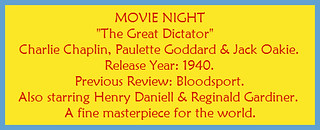
Charlie Chaplin (Adenoid Hynkel - Dictator of Tomania / A Jewish Barber), Paulette Goddard (Hannah), Jack Oakie (Napaloni - Dictator of Bacteria), Henry Daniell (Garbitsch), Reginald Gardiner (Schultz), Billy Gilbert (Herring), Maurice Moscovitch (Mr. Jaeckel), Grace Hayle (Madame Napaloni), Carter DeHaven (Bacterian Ambassador), Emma Dunn (Mrs. Jaeckel), Bernard Gorcey (Mr. Mann), Paul Weigel (Mr. Agar), and Chester Conklin (Barber's Customer) Directed by Charlie Chaplin (#353 - Monsieur Verdoux, #599 - The Kid, #600 - City Lights, #759 - The Gold Rush, #775 - Shoulder Arms, #820 - Modern Times, #923 - The Pilgrim, #1025 - The Circus, and #1041 - A Woman of Paris)

Review: 
The Great Dictator was Charlie Chaplin's first true sound film, along with his first without his character of "The Tramp", which he had utilized for his silent films. In any case, the film was released a year after the beginning of World War II, with Chaplin playing a parody of Adolf Hitler and Oakie playing a parody of Italian dictator Benito Mussolini, although it was noted by Chaplin in later years that had he knew about the horrors of the concentration camps, he wouldn't have made the film. The film manages to be brilliant in utilizing comedy, satire and drama without having either of its elements being lost in excess, being a funny but also brave movie that holds its principles together by finding a balance in its two environments, with credit going to Chaplin and his script. Chaplin also does a tremendous job in both of his roles, having a fine distinct nature that works well within the mistaken identity parts later on, with the dictator parts having numerous highlights with all of the gestures and posturing that definitely strikes a chord. The parts with the barber might remind you a bit of the Tramp, although he plays it more of a outsider type that certainly fits. Goddard does a fine job in her parts on screen, having fine chemistry with Chaplin at points. Oakie does a stand-out job, having the correct amount of bombast and stature that makes for amusing rapport with Chaplin when they are both on screen together, particularly one scene involving chairs. Daniell and Gardiner also do fine jobs in their parts, distinct in their roles within the dictatorship that leave room for amusement. The rest of the actors do fair jobs in their roles. There are numerous great sequences and gags involving both slapstick and language, with one of my favorites being the ballet with a globe, which is helped by the music by Meredith Willson and Charlie Chaplin, fairly brilliant in its own right that has a fine timing to them that helps contributes to the flow of the film effectively for several scenes. The cinematography by Karl Struss and Roland Totheroh (a regular for some of Chaplin's films) is acceptable for the movie and its look.

The film does run finely at 124 minutes, never feeling too long. I will state that the climax of the film feels a bit sudden, particularly since it ends with a speech, which is an inspiring piece at least, so I can't blame Chaplin for wanting to incorporate it in a film he had all control over. Since that serves as the last point for the film, it is strange to wonder what would've happened after that point in the film, although apparently a folk dance sequence was apparently going to serve as the finale, and there were also plans to include shots of people from all over the world that would accept the message of peace, but these were abandoned after a bit of shooting from Chaplin. In any case, the movie isn't ruined by the last part, so take his words for what you will. The film was nominated for five Academy Awards (Outstanding Production (now known as Best Picture), Best Actor, Writing (Original Screenplay), Best Supporting Actor (Oakie), & Best Music (Original Score), although it fell short each time. It has since been selected by the Library of Congress for preservation in the National Film Registry, and it is easy to see why. This is a brilliantly made movie that serves as a fine piece of entertainment for all ages that belongs with the rest of Chaplin's classics for a look.

Overall, I give it 9 out of 10 stars.

July 13, 2015

For Heaven's Sake.


Review #727: For Heaven's Sake.

Cast
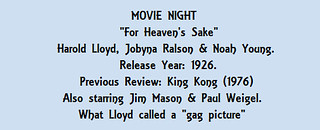
Harold Lloyd (The Uptown Boy), Jobyna Ralston (The Downtown Girl), Noah Young (The Roughneck), Jim Mason (The Gangster), and Paul Weigel (The Optimist) Directed by Sam Taylor.

Review
It's a quick movie described by Lloyd himself as a "gag picture", which as you can tell means that the movie was more about the comedy bits than his character pictures, like Grandma's Boy or The Freshman. Lloyd was reluctant to release this film due to his disappointment with it, but the movie was a success. As for the film itself, it's enjoyable enough. Is it as good as the previous two Lloyd films I mentioned? Not entirely, but it is nice. The movie sets itself quickly and leaves itself enough time to make gags, right down to the title cards. I especially like the entire sequence with Lloyd being "chased" all throughout the town, which turns from just a small gang into a big group, and it just has gag after gag, succeeding rapidly. The cast is effective enough with the gags in the movie, and Lloyd and Ralston do well together. The movie loads itself up with gags in a near-hour span, and it works well enough to be entertaining without needing too much plot. Comedy is the best medicine, and it can be big or small.

Overall, I give it 8 out of 10 stars.