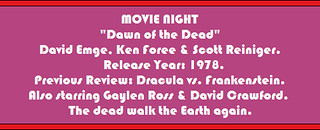
Cast:
Lori Cardille (Dr. Sarah Bowman), Joseph Pilato (Captain Henry Rhodes), Terry Alexander (John), Jarlath Conroy (William "Bill" McDermott), Richard Liberty (Dr. Matthew "Frankenstein" Logan), Anthony Dileo Jr. (Pvt. Miguel Salazar), Sherman Howard (Bub), Gary Howard Klar (Pvt. Steel), Ralph Marrero (Pvt. Rickles), John Amplas (Dr. Fisher), and Phillip G. Kellams (Pvt. Miller) Written and Directed by George A. Romero (#738 - Night of the Living Dead (1968) and #1155 - Dawn of the Dead (1978))
Review:
"I just wanted to make a film about something extraordinary that is happening and the people are unable to grasp it. They continue to argue about stupid things instead of recognizing that there’s something really awful going on. So that’s what I wanted, and I thought, ‘What if the dead don’t stay dead and what if they were going around eating people?’ That was my idea of something awful!”
When it comes to the first zombie film, the general argument is that White Zombie (1932) was the first one to be released, and the subsequent decade that followed resulted in other "zombie" films like I Walked with a Zombie (1943). However, the latter half of the 20th century found a new voice for zombie films, one that has generally led to him being nicknamed the "Father of the Zombie Film." That man was George A. Romero. Romero found an appreciation of film as a child growing up in New York City, with one film that shaped him being The Tales of Hoffmann (1951), which he appreciated for the power of visual media that could be experimented with a film like this (as done by the famed duo of Michael Powell and Emeric Pressburger). He attended and graduated from Carnegie Mellon University in 1960 and moved to doing projects in commercial work for the next few years (one of which being work with Mister Rogers' Neighborhood). Alongside his friend John Russo and Russell Streiner, they aspired to make a horror movie together, which they would do with various producers for a small budget in Pittsburgh. That film, written by Romero and Russo, was Night of the Living Dead (1968). Its grisly effects alongside its devastating story about human nature at the forefront of an apocalypse proved to be a classic of independent cinema and for horror as a whole. Ten years passed before the USA/Italy co-production of Dawn of the Dead (1978), which is thought to be as compelling as the earlier film from a decade prior if not better. Romero mixed horror with drama in the second gap between "Living Dead" films with Knightriders (1981) and Creepshow (1982, a film on the waitlist for quite some time) before his aspiration to make "the Gone with the Wind of zombie films" with this feature, which he wrote and directed.
Romero described this film as a tragedy involving lost communication and chaos within a small "pie slice of society." The tragedy besides that is the fact that Romero had to reduce his original intent when producers curtailed the budget that led to reduction of the script by Romero, who aspired for a unrated version while United Film Distribution Company balked at the idea of doing an estimated $7 million project even with an R-rating - this led to Romero cutting his script (reportedly around 200 pages) to make for a film that could be done on $3.5 million. With the 1968 film, it dealt with an assault on a farmhouse with a growing spread of un-dead, with the 1978 film dealt with a larger scale crisis that had an assault on a shopping mall. Here, we have a film where the humans really are on the run (estimated to be about 400,000 zombies for every one living person), barricading themselves in bunkers and trying to find some sort of possible solution to the pandemic of zombies before the other conflict bubbles onto the surface - the struggle of humans to get along and stick together. When it comes to comparisons between the films, Day of the Dead has been regarded as a lesser follow-up to Dawn of the Dead, but honestly it is still a pretty enjoyable effort in the art of panic within survival, and in some ways it could be thought of as a misunderstood classic. Romero wanted to make another film about panic with humankind and the undead with a certain type of actors involved, ones that while not exactly well known still make a useful effort to the growing sense of paranoia and fear that make a worthwhile time in nerves with its own kind of thoughtful ending (which could be argued to be the most hopeful or just as indefinite as the others); like the other two films, it also has been remade (twice, actually!), and a television series is reportedly in development. Romero would not return to the undead creatures until two decades later with Land of the Dead (2005).
The characters have been criticized in part for the varying level of unlikable aspects to them, but I find it pretty appropriate for such a tense movie, one that depicts a conflict of reason and aggression that is reminiscent of before from Romero without being a rehash. He wanted to make a tragedy and I think he succeeded pretty well with what he set out to do. Cardille (daughter of Bill Cardille, featured in the first Dead film) headlines the cast with well-done tolerance, handling her side of tension with useful timing that balances time spent in combat with strong assertive conviction that seems stronger as a lead than other before her, mostly because she makes a worthy double act with the other side of conflict with structure besides undead ghouls, which is where Pilato comes in. Pilato (whose first role as an actor was a bit part in Dawn of the Dead) is undeniably the highlight of the film, making a brash study of instability and stubborn nature come out with great interest that reflects the film in paranoia without seeming too privy to just being ham for the sake of it, an absolute perfect foil to grit the teeth with. Alexander makes a calm third rail in all the hubbub with a bit of soothing charm. Liberty does quite well here in parts, delivering ghoulish charm in the curiosity that befits what the film lightly presents with the making of a zombie, which naturally goes hand in hand with the instinct delivered by Howard that ranks as the one and best performance of a member of the undead in these films in warm curiosity. The other actors are average at best, but at least they don't trip over the overall tone of the film in bleak horror, where accusation and miscommunication is just as horrifying as the prospect of being ripped apart by members of the undead without any bullets present. The effects are just as effective in visceral power (even when having to deal with warm conditions that came with filming in a former mine shaft in Pennsylvania), with credit deservedly going to Tom Savini and his team for making a clever experience Romero reflected on the film in subsequent years as the one that was his favorite, stating that it accomplished the goal he set out to do with another Dead film in making it different from the previous film as one that is "very much me", which is generally reflected well in its 100 minute run-time. It's a bleak movie, but it's a worthwhile bleak movie that is engaging in its tone in surviving a land with lost structure with tense execution that fits upon the landscape in a distinct place among horror in the 35 years that have passed since its release. It isn't the best film from Romero, but it still serves as a well-done testament to his vision about showing the horror in both the living and undead of a society in its third different phase that maintains his place as a director deserving of one's curiosity in the horror genre.
Next Time: Hellraiser.
Overall, I give it 9 out of 10 stars.