Showing posts with label Gloria Swanson. Show all posts

July 10, 2021

Why Change Your Wife?

Review #1697: Why Change Your Wife?

Cast: 
Gloria Swanson (Beth Gordon), Thomas Meighan (Robert Gordon), Bebe Daniels (Sally Clark), Theodore Kosloff (Radinioff), Sylvia Ashton (Aunt Kate), Clarence Geldart (The Doctor), Mayme Kelso (Harriette), Lucien Littlefield (Butler), and Edna Mae Cooper (Maid) Directed by Cecil B. DeMille (#1245 - The Squaw Man (1914) and #1371 - Unconquered)

Review: 
“I love to take some vitally interesting theme and work it out according to life. That is what I am doing with Why Change Your Wife? These themes I am toiling on do a damn lot of good.”

Cecil B. DeMille made seventy feature films over the course of a four decade career, but one would probably be surprised to know that 52 of them were silent films. Sure, the sound features would play a key part in defining him as a crowd-pleasing director with scale and showmanship, but one can't get there without doing a few other kind of films in between for the Massachusetts native. This was the fourth film featuring Swanson directed by DeMille, which started with Don't Change Your Husband (1919) and ended with The Affairs of Anatol (1921). It happens to be part of a string of films that DeMille made involving marriage, although reading a description of the former film (prosaic husband, romantic wife) might make this seem a bit clearer. Of course, this film had a story done by William C. deMille (Cecil's older brother, who unlike his brother did not alter his name) while Sada Cowan and Olga Printzlau wrote the scenario. You may or may not be surprised that this is generally labeled as both a comedy and a drama. Consider the premise: a couple gets tired of each other and divorce each other before eventually falling in love again even with one of them being re-married. Of course, there are a few things that make this a bit interesting, starting with the character played by Swanson, described as someone whose "virtues are her only vices". By the sixth minute, a intertitle is shown that has her character gripe about her husband spending money on wine when one could be thinking about the starving millions in Europe. Her attempts at being a real goody goody extend to music choices, having a dog/not having a dog in the house, clothing, even sleeping next to each other in little separate halved beds. Amusingly, she is inspired to dress better not because of her divorced husband or because of a friend advising her to (we don't see anybody who looks like a friend to either of these folks, so one could just assume these people either don't have friends or they don't get involved in said stuff), but instead because she hears gossipers mocking her looking like her aunt. A myriad of weird events lead to a conclusion that I'm sure you already know, since this actually seems more like a DeMille instructional manual, but I suppose each lead learns a lesson about being a better spouse...well, I guess Swanson learns more than Meighan, but whatever.

So here we are with Swanson, Meighan, and Daniels. Really when you think about it, they seem to have an energy that could be seen as prescient to the screwball comedy that would come across a few years later, or even movies like Mr. & Mrs. Smith (1941, although that divorce movie involved a love triangle with two guys). Swanson gets to play a bit of a double act in terms of balancing "goodliness" with daring charm, which just means that one gets a few chuckles, such as when she is sitting at the pool turning suitors away or when she does the old dangerous substance-in-the-eye wash trick. Meighan pulls enough in the mild bewildered act of dopey straight man to make it work without too many hitches, making sure that one does not grow annoyed at the potential annoyed amusement at someone striking out twice in marriage. This was the third feature role for Daniels, who had moved on from doing short subjects to doing contract work for DeMille. She plays the contrast to Swanson fairly well, peppy in her own way with flaws just as the other two that are interesting when paired with Meighan for (somewhat obvious) moments; each share a scene where one is trying to shave but is foiled by interruptions (because hey, that one bathroom is big enough for the two of us), and it is a bit amusing on the second run). Basically, you get to see how romance can go when piety and superficiality loom over it; either one is a "think of the children!" type or a loose woman...with this film, the latter seems more interesting, but I'm probably more familiar with pious hypocrites than either stereotype here - this is 1920, so consider that along with it.

DeMille made plenty of movies considered to be crowd-pleasers, and this fits that description to a T, although one's mileage may vary depending on how much curiosity they have on the subject of folks learning a lesson about marriage. Honestly, it is the intertitles that might generate more chuckles, if only because of how strange their details get with describing things (one ends with "optically a pippin", really). that either range from being one sentence too long or other various words. I especially admire this one card in minute eight, talking about the "husband's eternal problem" that uses the "-" three times while going on about what he's going to do and the "bad luck of a married man" he has in picking the shop; consider minute 39 with the idea of a mysterious force that gets people together who think of one another that they say "fools call it coincidence"...yeah, I think the writer is messing with the viewer. I especially like the times during the dialogue where certain words are underlined, but the nail on the coffin is near the end when the main two are on a train, where one intertitle talks about if this was fiction, there would be a train wreck or a terrible car accident (!), but in real life ("if it isn't a woman", right), something like a banana peel will change a guy's destiny. Either one is thinking the writers have decided to act out some gripes with themselves or others (some sort of weird therapy or perhaps a predecessor to further personal movies years later), or they are in the mindset of details, details, details (of course, maybe slipping on a banana peel didn't seem quite familiar in 1920). In the end, it is a 90 minute tale that will either entertain your curiosity for what DeMille and company accomplished in its blend of amusement and romance, or one simply will let it pass them by. For me, it is an okay movie, a strangely entertaining movie for some of the right reasons that makes for a very curious affair, one that passes a bit better in the second half while the intertitles manage to befuddle the audience. At any rate, this is in the public domain, so one can see for themselves if they want to encounter this film and its director for a century-old time.

Well, this is technically part of a new project. In coverage of Movie Night from 1921 to 1949, there exists eighteen years in which there are not at least ten reviews for said year (i.e. with this review, 1920 now has ten reviews one can look at). As such, I will commit a small part of my time to picking films from that era to increase the year output over the next few months; for example, 1929 has just five films that were reviewed by me. This "Count to Ten Project" will run as long as I see fit (incidentally, the 1910s will have their own certain project at some point this year).

On the board for the Count to Ten Project:
1921: 5, 1922-23: 8 each, 1924: 9, 1926: 7, 1929: 5
1930: 6, 1931: 9, 1934: 4, 1935: 5, 1936-37: 6, 1938: 5
1940-41: 8 each, 1944: 7, 1948-49: 8 each

Overall, I give it 7 out of 10 stars.

May 7, 2021

Airport 1975.

Review #1675: Airport 1975.

Cast: 
Charlton Heston (Captain Alan Murdock), Karen Black (Chief-Stewardess Nancy Pryor), George Kennedy (Joe Patroni), Efrem Zimbalist Jr. (Captain Stacy), Gloria Swanson (Herself), Susan Clark (Helen Patroni), Helen Reddy (Sister Ruth), Linda Blair (Janice Abbott), Dana Andrews (Scott Freeman), Myrna Loy (Mrs. Devaney), Sid Caesar (Barney), Roy Thinnes (First Officer Urias), Ed Nelson (Maj. Alexander), Nancy Olson (Mrs. Abbott), Larry Storch (Glenn Purcell), Martha Scott (Sister Beatrice), Norman Fell (Bill), Jerry Stiller (Sam), and Conrad Janis (Arnie) Directed by Jack Smight.

Review: 
There are quite a few times that you see a sequel to a movie and wonder why there was a second one to begin with. Unfortunately, you know, and I know, the reason that there exists a sequel like Airport 1975 (1974): money. People really couldn't get enough of big stars to go with airplanes in trouble, complete with a title that I suppose was made to sound like it came from the future. It appears that the budget was reduced in the four years since the last film in 1970 (from ten to three million), but this one also managed to make over $100 million, and one can only wonder how rentals would go for this fellow turkey. To be fair, one probably can't blame Jack Smight for his direction here. He did his work in both television and film (starting with the former since its golden age in the 1950s), and this was the eleventh of seventeen films that he would direct from 1964 to 1989, with Harper (1966) generally being the one that stands out among his work. I'm sure you might remember Airplane! (1980) when it comes to its take on the disaster genre...and those little gags that might seem familiar to those who have seen both films, what with a kid that is awaiting a transplant as soon as they make an airplane trip (complete with a doctor calling beforehand to make sure they aren't startled), and a singing nun that plays to the kid. Now, technically Reddy was qualified to sing, because she was actually a singer (with one newspaper outlet describing her as the "Queen of '70s Pop", after all)...so keep that in mind in trying to figure out which one is a parody. That 1980 film also had Ethel Merman in a cameo appearance, while this feature has Gloria Swanson playing herself (if you really want to stretch this around into an oblong circle, Linda Harrison accompanies her...while using a second name as "Augusta Summerland"...yes). I am not playing you for a bit, because Airport 1975 actually features Dana Andrews in a brief appearance, and Andrews had starred in Zero Hour! (1957), which Arthur Hailey had adapted from his teleplay a few years prior while eventually writing the novel Airport...and Airplane! would lift lines from said movie. At least one will get to see the pair of Heston and Kennedy again, because they had co-starred in another disaster film with Earthquake (1974), which was also done by Universal Studios.

So yes, there are a few strange folks present here, whether that means a trio of odd drunks overshadowed by Myrna Loy playing a more eccentric drunk...or Swanson, who had apparently wrote all of her lines. Strangely enough, this may actually be better than the original film, mostly because of one thing: it manages to be so cheesy that it nearly defies reason. It is so self-serious at the weirdest times that one wonders how exactly this was the only film credit for screenplay man Don Ingalls, who specialized in television from Have Gun - Will Travel to Fantasy Island. It sometimes feel like a script that mutated from the bins of television hokum and engulfed any famous person they could find, who I hope managed to enjoy the monetary benefits of this sham spectacle. Heston is technically the star, in that he gets to ham the screen up from moment to moment while doing the bare minimum in charisma and minimal plane involvement. One wonders if he was worn out from the aforementioned film about the earthquake. Kennedy blusters through some shouting in a performance that is probably degraded from what one saw in the first film, although it can be said that in the earlier movie he was more of a helpful highlight (since if you remember, the airplane trouble was somewhere sidelined behind lots of gobbledygook about affairs and the airplane industry). Ah, but the real presence is Black, making her shift into commercial work after a string of noted supporting roles. While it isn't a great performance by any means, I'm sure I wouldn't fare much better at fumbling with the controls and not collapsing into panic with trying to fly a plane over mountains (the attempts at chemistry with Heston is a different story), although older fans might recognize that this isn't the first movie where a flight attendant is shown taking a plane to safety (Julie (1956) starred Doris Day in a noir, of all things). Zimbalist plays the unfortunate pilot that gets to spend half his time on a couch with his eyes closed to makeup, so there is that. Swanson, making her final film appearance before her death in 1983, certainly had to have a fine time here, since I imagine a role spent mostly in a chair talking about oneself would make anyone proud. It isn't exactly a parody of herself, but one can still keep their eyes open to wonder how this "interesting" pairing of famed star to alleged disaster movie came to be. Others have the energy of a broomstick when it comes to really sticking out, most notably with a bored-looking Andrews, or a bedridden Blair, or an oddly complacent Caesar to go with Storch (who might as well have been chosen out of a hat), and it is Loy who really seems to stand out best when it comes to pairing eccentricity to the level of cheese needed. At least there is some sort of inherent danger present here, since the chances of even one important character biting the dust is at 1% rather than the level done from the first film, although it hasn't meant the movie has increased its levels of thrill from before. One wonders exactly how the other two Airport movies turn out in raising (or keeping) the standards of disaster movie excitement, really. Airport 1975 (1974) isn't really an accomplishment in anything, but technically being better than its predecessor in being less boring has to account for something. If one desires a movie packed with ridicule and name actors, one might not go wrong here.

Overall, I give it 6 out of 10 stars.

June 11, 2016

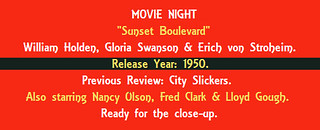
Sunset Boulevard.


Review #809: Sunset Boulevard.

Cast
William Holden (Joe Gillis), Gloria Swanson (Norma Desmond), Erich von Stroheim (Max von Mayerling), Nancy Olson (Betty Schaefer), Fred Clark (Sheldrake), Lloyd Gough (Morino), Jack Webb (Artie Green), and Cecil B. DeMille. Directed by Billy Wilder (#106 - Some Like It Hot, #194 - Ace in the Hole, #422 - The Fortune Cookie, and #641 - The Apartment)

Review
The inventive (if not quirky) device of narration by our freshly dead main character certainly sets the tone for what is at all counts a fairly well-made movie that was later added to the National Film Registry as a film noir. Nostalgia is something that we all encounter at least once in our lives, whether it be for a different past time or for our own past. Sunset Boulevard certainly expresses nostalgia in the form of Swanson's character, from her private movie theater that shows her silent movies to playing bridge with a few "waxworks" (played by three silent film stars of the era: Buster Keaton, Anna Q. Nilsson, and H. B. Warner). The transition from the silent era to sound led to new horizons but also the decline of a good deal of the silent stars that had graced the screen and the hearts of moviegoers as well. The cinematography by John F. Seitz is excellent, making the movie look very well shot, particularly the final scene, with Swanson seemingly fading into the glitz of the camera. There's a certain sort of allure that Swanson brings to her character that makes her irresistible to watch on screen - her banter with Holden is especially entertaining. Von Stroheim is also wonderful to watch in his attempts at appeasing this husk of a star, with all of the desperation and pity in full display. Holden does a good job at telling this yarn, with enough quips along the way. One of my favorite lines is about how people don't really know the writing it takes to make a movie, assuming that the actors make it up as they go along. There's a certain mythic quality to these actors of yesteryear that is hard to explain at times but is always present, with a presence as large as Norma Desmond. Sure, one could figure out who killed who soon enough, but it's the spectacle that gives the movie breath. It's a movie with much to remember, from the main trio to the dialogue ("I'm ready for my close-up" being one of them) that makes for a fine thing to watch.

Overall, I give it 10 out of 10 stars.