Showing posts with label Lee J. Cobb. Show all posts

April 30, 2025

Boomerang! (1947)

Review #2372: Boomerang! (1947)

Cast: 
Dana Andrews (State's Attorney Henry L. Harvey), Jane Wyatt (Madge Harvey), Lee J. Cobb (Chief Harold F. "Robby" Robinson), Cara Williams (Irene Nelson), Arthur Kennedy (John Waldron), Sam Levene (Dave Woods), Taylor Holmes (T. M. Wade), Robert Keith ("Mac" McCreery), Ed Begley (Paul Harris), and Karl Malden (Det. Lt. White) Directed by Elia Kazan (#104 - East of Eden, #109 - A Streetcar Named Desire, #110 - On the Waterfront, #1375 - Panic in the Streets, #1406 - Splendor in the Grass)

Review: 
"I really will be able to do this picture the way I think pictures should be made. It was our neo-realism."

Sure, it's easy to forget that some movies really can play fast and loose with facts. Here we have Elia Kazan's third feature film as a director, which came in the wake of his debut two years prior in A Tree Grows in Brooklyn (1945). 1947 actually brough three different movies for Kazan as a director: The Sea of Grass (1947) was an MGM Western featuring Spencer Tracy and Katherine Hepburn that for some reason managed to have Kazan express his dislike in later years. Gentleman's Agreement, released in November of 1947, wound up winning Kazan an Academy Award for directing. But Boomerang! (which as with Gentleman was released by Fox) was the second movie to come through for audiences, being released in March of 1947. The movie took its material from a 1945 article in The Reader's Digest called "The Perfect Case", which had been written by Fulton Oursler based on an actual crime that happened in 1924; Richard Murphy wrote the film script. In that year, in the city of Bridgeport in Connecticut, after eight days of anguish over the murder of Father Hubert Dahme, Harold Israel, a vagrant, was arrested and charged for the murder. Israel had given a confession and had been found with a revolver, but through the efforts of state attorney in Fairfield County Homer Stille Cummings, Israel was found innocent, and the indictment was dropped*. Cummings in general was a fascinating person: the Yale graduate actually had served as Mayor of Stamford, Connecticut for four years in the 1900s and he later served in committee work with the national Democratic Party. And, true to the end of the movie, Cummings actually did become U.S. Attorney General, serving six years from 1933 to 1939 (among the things he did in office was make bank robbery a federal crime). Israel essentially faded away into history, dying in the mid 1960s, although he was reported as having been married with children years after being freed, although the case was never solved. He wasn't particularly big on the first two movies he did when it came to their production style (done entirely on sound stages), but the chance to do shooting in Stamford, Connecticut interested him, since Kazan stated that at the time, he "shared the appetites" of neorealist filmmakers (such as Vittorio De Sica with Shoeshine, for example); a few non-professional actors are present in some shots. Kazan's next movie would be Pinky (1949); of his first five films, apparently, he was only big on A Tree Grows in Brooklyn.

Technically the movie is cited as being a "semi documentary", which is probably helped by the narration heard every so often from Reed Hadley, who had been used to narrate prior films such as The House on 92nd Street (1945) (the narrative touch was big with producer Louis de Rochemont, who was involved with documentary stuff). This is the kind of movie that probably would be interesting to compare with Kazan's subsequent Panic in the Streets (1950) in straight to the bone procedurals. Kazan wasn't as fond of Boomerang! in his later years, basically calling it "the same studio machine - brought outdoors", but he at least stated his learned certain little tricks and techniques because of making the movie (he also once stated he could do a film anywhere and didn't need sets or movie stars). Sure, maybe the actors are still "movie actors", but at least there is an interesting atmosphere of doubts and failings, where a murder investigation turns itself into a city-wide infection that leaves only the reporters with any sort of satisfaction at the end of things. The police** don't win in the end and even the people that knew the victim don't win any sense of peace in the end, suffice to say. Andrews is pretty reliable in uncomplicated feelings that arise in not rolling with just being a cog in the machine of others around them, which works out for the usual reliable presence you would hope for. Cobb probably sticks out just as much in what he gets from his routines, one who shows the weary nature that comes from pressure that probably works the best among the cast, although Kennedy makes for a useful near-sacrificial lamb in worried nature. Of course, the 88-minute runtime does mean there are moments spent with other people about stuff tangentially related to the murder, specifically with Begley and the conniving nature that comes in bits and parts before it literally shoots itself for the climax. Sure, it doesn't have as much power as it likely could have (Williams comes to mind in that regard), but the routines with the ins and outs of the world of people is interesting enough to hold the movie down to at least some fascination. Sure, Kazan may be a bit hard on himself with his own assessment, but it is at least a solid movie to recommend for those who like an old-fashioned yarn.

Overall, I give it 7 out of 10 stars.
*Strangely, I am reminded of another actual case involving coerced confessions and Connecticut with Peter Reilly, who in 1973 was convicted of murder at the age of 18 when cops essentially lied to and coerced him to confess by refusing to let him sleep in a long interrogation - this was a case that happened in the 1970s, mind you.
**Remember: don't fuck around if in the web of a cop, whether that means knowing your rights and asking for a lawyer. Peter Reilly became a reform advocate, particularly for a bill in his state named SB1071. This was a bill trying to curb on deceptive tactics by cops for people under the age of 18, and go figure, not every state has this on their books, but Connecticut now does. See, I don't hate cops, I just know they can give you bad juju if something is in the wrong place.

July 12, 2024

How the West Was Won.

Review #2228: How the West Was Won.

Cast (i.e. who features most prominently in each segment)
"The Rivers" segment: James Stewart (Linus Rawlings), Carroll Baker (Eve Prescott), Debbie Reynolds (Lilith Prescott), Karl Malden (Zebulon Prescott), Agnes Moorehead (Rebecca Prescott), Walter Brennan (Col. Jeb Hawkins), and Brigid Bazlen (Dora Hawkins) Directed by Henry Hathaway (#1314 - True Grit and #1687 - O. Henry's Full House)
"The Plains" segment: Debbie Reynolds (Lilith Prescott), Gregory Peck (Cleve Van Valen), Robert Preston (Roger Morgan), Thelma Ritter (Agatha Clegg), and David Brian (Lilith's attorney) Directed by Henry Hathaway.
"The Civil War" segment: George Peppard (Zeb Rawlings), Andy Devine (Corporal Peterson), Harry Morgan (Gen. Ulysses S. Grant), John Wayne (Gen. William Tecumseh Sherman), Russ Tamblyn (Confederate deserter), Carroll Baker (Eve Prescott Rawlings), and Raymond Massey (President Abraham Lincoln) Directed by John Ford (#398 - The Last Hurrah, #1324 - 3 Bad Men, #1349 - Stagecoach, #1372 - Fort Apache, #1392 - The Searchers, #1409 - The Man Who Shot Liberty Valance, #1778 - 3 Godfathers, #1827 - Tobacco Road)
"The Railroad" segment: Henry Fonda (Jethro Stuart), George Peppard (Zeb Rawlings), and Richard Widmark (Mike King) Directed by George Marshall (#650 - The Ghost Breakers)
"The Outlaws" segment: George Peppard (Zeb Rawlings), Lee J. Cobb (Marshal Lou Ramsey), Eli Wallach (Charlie Gant), Carolyn Jones (Julie), Debbie Reynolds (Lilith Prescott van Valen), and Mickey Shaughnessy (Deputy Stover) Directed by Henry Hathaway

With Spencer Tracy (Narrator).

Review: 
Yes, there was a union between Metro-Goldwyn-Mayer and Cinerama. MGM had plenty of success with making epics that attracted folks to not just go with television such as, say, Ben-Hur (1959), so it makes sense to say that there was two films distributed by MGM involving another big-related process in film. The Wonderful World of the Brothers Grimm was released in the three-strip Cinerama process in August of 1962 before November saw the release of How the West Was Won, which apparently took inspiration from a series of articles by Life magazine (take one guess what the title of those articles was) that was first published in 1959. As one might remember, Cinerama (as invented by Fred Waller) was a process involving widescreen with a considerably distinct presence: three projectors projecting images onto a curved screen (the panoramic image on a screen curved 146 degrees around the front of an audience. This Is Cinerama (1954) was the showcase that rocked folks as a grand travelogue; as one might notice, trying to shoot actors with this setup was tough when it comes to sightlines and requiring plenty of detail dressing of clothing for sets. Hathaway was quoted famously as calling it "Goddamn Cinerama" (along with calling it "nothing but a big window display") when noting the fact that the closest as one could get with the process was a waist shot; because of the wide view, one apparently couldn't watch the actors without somehow being in the shot. Bottom line, one would see various films done in varying levels of camera lenses such as Ultra Panavision 70 to Super Panavision 70, as Cinerama became single camera for later films such as It's a Mad, Mad, Mad, Mad World (1963). At any rate, here we have a big Western covering various moments of the Old West for MGM, with directors chosen specifically because they were "old pros" (as opposed to "no young geniuses", as quoted by producer Bernard Smith); Ford and Marshall had directed films since the late 1910s while Hathaway started in 1932 before each director eventually ended their careers by the turn of the 1960s into 1970. Going by the word of Hathaway, production was semi-rough, owing to both the Cinerama filming process and (in his words), "an idiot for a producer" to the point where production almost ended before the filming of the fifth and final segment; he also claimed to write the second segment of the film, as he was originally brought in to help with scripting problems, although the final print listed James R. Webb as the only screenwriter. The movie was a roaring success and has a pretty good reputation for itself among epics, particularly since one can watch it on home video (since the 21st century) with pretty good restoration (as one must do when it comes to making screens look whole).

There are plenty of peaks and valleys with this film, most of which come from the fact that the quality of enjoyment comes and goes depending on which segment one is on in the 164-minute epic. The opening segment has a near sixty-year-old Stewart playing a guy meant to be 28, while Reynolds and Peppard are the only actors in the most segments (three) to go with borrowing footage from The Alamo [1960] and needing four cinematographers. You get plenty to see in this endurance round of anthology action: river pirates, rapids, wagon attacks, a John Wayne cameo, stampedes, and a railroad attack all in one. It is pretty much Hathaway's film to hold court involving drive and desire in the frontier, as the Civil War and railroad segments (as done by Ford and Marshall) don't exactly rise too far above stagy scenario-making (apparently, Hathaway did re-shots for the railroad segment). The first two segments are probably the strongest in terms of general construction, even if one is always seeing the strain of trying to make a worthwhile epic that has to rely on plenty of pictorial views and a bit of bombastic acting (as one might see coming when having to deal with weird cameras) to go with the motions. The third segment is mostly set around the aftermath of the Battle of Shiloh that has brief moments in the start and finish involving the Rawlings family farm. Most of it though...is a couple of folks listening to a conversation of two U.S. generals (William Tecumseh Sherman and Ulysses S. Grant). Apparently, Spencer Tracy was once tapped to play Grant, but this eventually washed away to just have him provide the narration from time to time. As tempting as it is to wonder how cool it would've been to see Tracy and Wayne on the same screen...it probably wouldn't have made it any less stagey, because really it isn't as involving as it could've been. Regardless of the detail taken for costuming (again, one had to be careful and not skimp in front of those Cinerama cameras), it just comes up feeling hollow for actual interest because you know you've seen (and heard) Wayne and Morgan in better Westerns. The fourth segment and fifth are pretty mild on each count, but at least the latter segment has the railroad spectacle to let the film coast on a good note despite the fact that I can barely remember Peppard as a lead presence here. It is a hard thing to do for a film that has him (by his idea) do a Stewart impersonation in the middle of things because hey, do you remember that Stewart played the character's dad for one segment? The highlights are the sequences involving action because of the staging that allows for things to just move on their own, as opposed to acting that is mostly just fine (it is hard to really pick a favorite), but you have a cadre of character actors to go with name guys doing a fraction of the work that straddles just above being accused of phoning it in and settling right into "stagey but comfortable". As a whole, it is a grand old epic that is good enough in the categories that matter in spectacle to make a serviceable recommendation for those interested in what the film tries to show within a distinct camera setup and approach.

Overall, I give it 8 out of 10 stars.

September 30, 2023

Redux: The Exorcist.

Redux #037: The Exorcist.

Cast: 
Ellen Burstyn (Chris MacNeil), Max von Sydow (Father Lankester Merrin), Lee J. Cobb (Lieutenant William F. Kinderman), Kitty Winn (Sharon Spencer), Jack MacGowran (Burke Dennings), Jason Miller (Father / Dr. Damien Karras, S.J.), Linda Blair (Regan MacNeil; Eileen Dietz as stand-in), Father William O'Malley (Father Joseph Dyer), Barton Heyman (Dr. Samuel Klein), Peter Masterson (Dr. Barringer), with Rudolf Schündler (Karl, House Servant), and Mercedes McCambridge (The Voice of Pazuzu) Directed by William Friedkin.

Review: 
From my review on April 22, 2011: 
To be honest, I found this film to be a little underwhelming. The first hour is just talking, and building up to the Exorcism. It finally comes, and we do see the scariness in the Devil. I felt underwhelmed for the first half, but the second half helped. The acting is decent, with some scare from Regan and special effects that hold up to this day.
"When [William Peter Blatty] wrote this book he knew that I had a background in documentary films as well, and he wanted the story to be filmed as realistically as possible, and so did I. We did not want to make a scary horror film or a fantasy film. At that time as well as today, the public knows very little about exorcism, little to nothing. Everything that is known about it is sensationalized in the public, and certainly the film I made contributed to that; there is no question about it. Because people regarded it as a horror film. But I made the film as a believer." - William Friedkin.

Admittedly, there are a handful of reasons one could do to look back upon The Exorcist in 2023. For one thing, the film (released in late December) is celebrating its 50th anniversary this year. Another thing is that 2023 is also the beckoning of a new "Exorcist film", specifically one that is serving as the first of a new trilogy that follows just the original film, complete with a returning cast member from before that makes its premiere on the very first Friday of October. Another is the fact that it seems appropriate to look back upon the career of its director William Friedkin, who passed away in August. But for me, I think the best reason of all is the fact that Movie Night's very first review of a film in the horror genre way back over a decade ago, was this very film. Granted, it wasn't the first horror film I ever saw, because in addition to those R-rated action films, I watched a few horror films before I was even 15, as one might do, but it certainly was a big film that one can hold up within the horror genre...and I guess I really set it up so highly in my head that it only seemed good enough for an 8/10 rating. The quantity and quality of the review is obvious, so here is a chance to re-write that wrong. The film is adapted from William Peter Blatty's 1971 novel of the same name, which was inspired by events that had allegedly been occurred in 1949 with a boy named only "Roland Doe". Blatty had heard about it when studying at Georgetown University (studying in English, which he also did for a master's degree at George Washington University), but what set him on the path to write it was seeing the film adaptation of Ira Levin's novel in Rosemary's Baby (1968), which pleased him right until the ending involving the resolution of the unborn child. Once a comic novelist and a screenwriter for comedies, the resulting success of the novel was tremendous, to put it lightly, and he got his wish to have William Friedkin serve as director with the success of The French Connection (1972). Friedkin was raised in the Jewish faith, but he found himself more welcoming of the teachings of Jesus as a declared agnostic. As such, when it came to influences, one film cited was Carl Theodor Dreyer's Ordet (1955). As such, Friedkin hired actual priests to appear in the film along with serve as technical advisors. Over four decades later, he would direct a documentary titled The Devil and Father Amorth (2017), which featured Father Gabriele Amorth, an exorcist for the Diocese of Rome that had mentioned Friedkin's film in his first book (An Exorcist Tells His Story). Friedkin worked closely with Blatty on the screenplay (the latter served as both screenwriter and producer). Blatty would write two further novels involving faith with The Ninth Configuration (1978) and Legion (1983), for which the latter served as the sequel to the aforementioned Exorcist; Blatty spearheaded the film adaptations of both novels as director in 1980 for Configuration and 1990 for the now retitled Exorcist III. Forty years after publishing the novel, Blatty did a revising of the novel that added a new chapter.

The original cut of the film lasted 122 minutes after Warner Bros. suggested cuts in order to fit more screenings, which Friedkin did. However, in 2000, a "The Version You've Never Seen" version was released that features a handful of cut sequences from before, most notably with the final scene that seems more in line with the book, which results in a runtime of 132 minutes. The mysteries that matter most to the film, true to Friedkin's word, are ones of faith, goodness, and the one of inexplicability. It is is a carefully built film on intense scale that is best enjoyed with great patience. Calling it the first of anything in horror is perhaps a too bit lofty to use, because of previous great horror films such as Psycho (1960), but I'm sure you can see the importance of a film like this beyond just calling it a film about possession, because it is a film of sacrifice and finding one's faith. The power of that comes with the cast to hold up such tremendous production values, for which I'm sure you would already guess. There were a variety of actors considered for key roles in terms of the desires of Warner Bros., such as asking Audrey Hepburn first about the leading role (she declined, as did a few others) or the late switching of Stacy Keach for Jason Miller (playwright of That Championship Season). Both Burstyn and Miller were big on doing these roles (the former was quoted as believing it to be destiny to play the role and the latter, who had studied for the priesthood, felt that he was Karras). Friedkin got his way with the casting of both actors and the rest eventually fell into place, which even included a critic of the book in O'Malley. Each of the core cast succeed in drawing a film of dread within atmosphere that is homed in realism as much as one can expect when seeing vomit or a cerebral angiography or whatever strikes a nerve in the realm of anxiety, moral or otherwise. The film is as much Miller's film as it is one of Burstyn & Blair when it comes to the driving point because of how he draws you with such intensity that comes from a great array of guilt and wavering spirit. Don't get me wrong though, Burstyn and Blair do just as well, with the former's sense of fear for her loved one shining through with the scattered innocence/corruption of Blair providing great terror. True, there is a certain voice quality in dubbing that can only come from an Academy Award winner in McCambridge and a minimal use of a double for intense scenes, but I think you know what I mean when I say that Blair went through the whirlwind and survived with a useful performance. Von Sydow and Cobb provide grizzled support that you greet for those familiar with those actors or voices (the former in aged makeup, of course). It is a film that builds in the terror of what enfold before you get to that exorcism, and it probably stands to reason that any film since this one involving exorcisms or possession has considerable ground to cover when it comes to trying to play distinct from this one. None have probably stokes half of the controversy that comes with its tone of haunting qualities or religious fervor, for better or worse. The sacrifice made at the end, now combined with the revised ending, makes it all the more involving as a film fit for its age and genre, a useful lesson for horror through and through.

In the end, what is about The Exorcist that makes it endure so vividly in reputation? There are a variety of factors, but the most important is that Friedkin and company had the faith required to craft a film as straight to the line as they wished to do that struck a nerve within the viewer of the time that works just as well now because it respected its viewer with patience and craftsmanship to make for a worthy unsettling time. It is probably hard to figure just which Friedkin film ranks among his best, but it is perhaps The Exorcist that endures most when it comes to the realm of looking forward to the season of horror or perhaps the time to look upon one's faith, and that is perhaps worth more than anything in the material sense.

Overall, I give it 10 out of 10 stars.
Well, the clock is soon to strike 12 on October, so why not get a head start? October will be quite the showcase to show a wide variety of horror films from the past such as The Monster to the current year within The Exorcist: Believer. We shall see how many films get a spotlight here and what finds its way for the first week of November.

December 31, 2014

Movie Night on New Years Eve: In Like Flint.


Review #686: In Like Flint.

Cast
James Coburn (Derek Flint), Lee J. Cobb (Lloyd Cramden), Jean Hale (Lisa), Andrew Duggan (President Trent), Anna Lee (Elisabeth), Hanna Landy (Helena), Totty Ames (Simone), and Steve Ihnat (General Carter) Directed by Gordon Douglas (#663 - Them!)

Review
Well, it's New Year's Eve once again, and I'm continuing my tradition of reviewing a movie on the date, like I've done for the last three years, which had reviews of Duck Soup (#085), Jailhouse Rock (#327), Spies Like Us (#513) & Our Man Flint (#514). As such, I'm reviewing the sequel to Our Man Flint, released a year later, reportedly the "favorite movie" of Austin Powers. And how is it? It's alright. To say that it's an okay sequel is the perfect statement for this movie, as it is just okay, nothing too awful or too great. Coburn is here again, though maybe it's just me, but he was a lot more interesting in the first movie, he had an exotic charm there, especially with all the tricks he did. Now it just seems more played down, though the part about dolphin speaking is funny. The movie has some decent action and some decent dialogue, but it feels like it goes on and on before it ends on a...high note, I suppose. It just doesn't have the same punch as Our Man Flint, though at least it is a strange little capsule for the late 60's, even if it was the last Flint film, as Coburn rejected an offer to star in a third film, ending the short run of Mr. Flint. But at least it was a good run, I suppose, so I'll be a bit generous with the rating.

Happy New Year to everyone around the world, as it is 2015 in some places of the world already, such as Japan, Australia, and New Zealand. It's going to be a weird year, filled with new movies, such as The Force Awakens, the Avengers sequel, the new Peanuts movie, Spectre, Antman, and the Cubs win the World Series (according to Back to the Future Part II, anyway. BTW, I'm reviewing the trilogy in the new year), so everyone get happy. Or not. I hope you liked this last review of what I call "Season 4", because the new "Season" will start tomorrow. Get ready for another year of reviews!

Overall, I give 6 out of 10 stars.

December 31, 2013

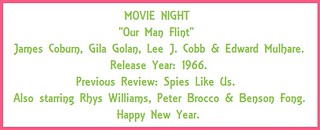
Movie Night: Our Man Flint.


Review #514: Our Man Flint.

Cast
James Coburn (Derek Flint), Gila Golan (Gila), Lee J. Cobb (Lloyd Cramden), Edward Mulhare (Malcolm Rodney), Rhys Williams (Doctor Krupov), Peter Brocco (Doctor Wu), Benson Fong (Doctor Schneider), and Michael St. Clair (Hans Gruber) Directed by Daniel Mann.

Review
James Coburn certainly looks the part, he's tall, suave, and cool, and he seems to mesh well with everyone. The film attempts to parody James Bond (There were a few parodies like Get Smart and films released to get in on the spy craze, such as The Silencers, with Dean Martin), and it does so rather successfully, and this was years before Austin Powers tried to do this (That film series would later use the telephone ring tone from this film), and Coburn is interesting to watch, and Lee J. Cobb also has his moments, especially when trying to comprehend all of this madness. The story isn't bad and the comedy has its moments (I like that the acronym for the organization Flint works for is ZOWIE), it's a film that also seems to showcase its locations, rather quite well. It may be debatable on if this is any better then Austin Powers, nut what's not debatable is that this is a fun film that is certainly the best way to end the year. Happy New Years to all, and I will see you in 2014.

Overall, I give it 8 out of 10 stars.

March 14, 2012

Movie Night: On the Waterfront.

Review #110: On the Waterfront.

Cast
Marlon Brando (Terry Malloy), Karl Malden (Father Barry), Lee J. Cobb (Michael J. Skelly aka "Johnny Friendly"), Rod Steiger (Charley "the Gent" Malloy), Eva Marie Saint (Edie Doyle), Pat Henning (Timothy J. "Kayo" Dugan), John F. Hamilton ('Pop' Doyle), Ben Wagner (Joey Doyle), and James Westerfield (Big Mac) Directed by Elia Kazan (#104 - East of Eden and #109 - A Streetcar Named Desire)

Review
This film is truly a classic, with great acting from Brando, Saint, and Malden, along with Cobb (who I've already talked about a little in 12 Angry Men). The film is dramatic in tone, never letting go and making you think along with being interested. It shows the lesson to not give in due to suspicions of being left out or possibly death. The film's most famous scene has a reason to be famous, and I feel the last scene is a bit memorable in it's drama and other such things. It's funny how I was slated to review this early, back in February (February 11th to be exact), but I didn't get to personal reasons. But now, I have watched the film in its entirity. And I don't regret it.

Overall, I give it 10 out of 10 stars.

April 21, 2011

Movie Night: 12 Angry Men.

Review #035: 12 Angry Men.

Cast
1. Martin Balsam
2. John Fielder
3. Lee J. Cobb
4. E. G. Marshall
5. Jack Klugman
6. Edward Binns
7. Jack Warden
8. Henry Fonda
9. Joseph Sweeny
10. Ed Begley
11. George Voskovec
12. Robert Webber
Directed by Sidney Lumet.

Review
Review to be updated at a later point in time - hopefully by the end of 2018 or 2019. 

This movie is the first covered of the 1950s on this show, and it is just pure greatness. It shows a lot of talent all in one set (And for a movie that took less then three weeks and $325,000 to make). Henry Fonda is the big star, and he is the best person in this movie. I like how it seems you are the Juror, you are feeling like you are one of them. The theories are deconstructed over time as the tension builds until the conclusion. It shows a lot of heart, and it can and will, make your heart beat.

Overall, I give it 10 out of 10 stars.