Showing posts with label Harold Gould. Show all posts

August 2, 2021

The Master of Disguise.

Review #1705: The Master of Disguise.

Cast: 
Dana Carvey (Pistachio Disguisey), Jennifer Esposito (Jennifer Baker), Harold Gould (Grandpa Disguisey), James Brolin (Fabbrizio Disguisey), Brent Spiner (Devlin Bowmna), Edie McClurg ("Mama" Disguisey), Michael Bailey Smith (Bald Henchman), Austin Wolff (Barney Baker), Kenan Thompson (Himself), Jay Johnston (Rex), and Maria Canals (Sophia) Directed by Perry Andelin Blake.

Review: 
You would be surprised to know that this was released on August 2, 2002 if you saw the film, because, well, it really seems to be the first film-void to ever exist. Just remember, this film was written by Dana Carvey. Well, actually he wrote the story and co-wrote the screenplay with Harris Goldberg, but the point is still true. Of course we all know that Carvey wasn't exactly a slouch for comedy. Born in Montana but raised in San Francisco, he had become interested in comedy after graduating with a degree in broadcast communications from San Francisco State University; he made a few appearances in film and television in supporting roles, but his break came with joining the cast of Saturday Night Live in 1986, and he would work on the show for seven years with a mix of original characters and impressions of various personalities of the day. Of course, not every SNL cast member went on to just be a major film star, but he did dabble in film with features such as Opportunity Knocks (1990) and Clean Slate (1994) alongside a short-lived variety project with The Dana Carvey Show (1996, which lasted eight episodes). This is the first and so far only film directed by Blake, who had gotten into film as a production designer in the 1990s after graduating from Harvard University in architecture. Incidentally, his first feature was Billy Madison (1995), and he continued his association with Adam Sandler as part of his film crew for years. The film managed to make back its $16 million budget twice over, but I suppose some things like directing aren't meant to be. This was produced by Happy Madison Productions, which Sandler had co-founded in 1999; Carvey was the third SNL collaborator that had worked with Sandler to have his own film with the company, which naturally included Rob Schneider and David Spade in illustrious works such as Joe Dirt (2001) that clearly got better in later years. At any rate, this is the last film that Carvey served as the star and the last feature he did for nearly a decade, which he stated was because he wanted to spend time with his family.

Honestly, their was a sliver of cynical guessing that this was meant to be some sort of joke on the audience, as if Carvey was trying to take your curiosity and your mood at the same time, which only makes sense if you realize that this really isn't an 80 minute movie either (owing to minutes of credits that filler a movie with no soul). One scene has him ripping a dude's nose off before spitting it back onto his face...so that's one way to do it. Heck, go even farther, you might as well have shown him go for more than 20 impressions, you could have him try to impersonate the other actors and make it an offbeat one-man show. Carvey tries to coast on mimicry and can't quite get there, as if one is watching a premature rendition of MacGruber (2010) but without the "cult audience". By the time one gets to him trying to "disguise" himself as a turtle, one has already checked out, as if being irritated is too much effort; one instead turns to indifference and hope it doesn't turn to pity over an attempt at boyish charm for a near 50-year old actor. Esposito evokes a small smile in that she doesn't become overwhelmed by the void of boredom that arises from no chemistry between her and Carvey. One has seen Gould in far better material, particularly since he spends a good part of his time playing insult man to Carvey. It is strange to see Brolin here, if only because the makeup here makes him look like he has morphed into Burt Reynolds, one that is bemused in standing around and occasionally doing a gag from time to time (hence the cameos, because they basically do the same one three times with the guest star going around and stealing an item before the mask comes off for Brolin). When asked about his favorite film that wasn't liked by critics, Spiner once responded with this film...that is probably the nicest thing I can say about a performance that has in a loop, one that sees him cackle before he farts. I don't need to pile on, do I? Perhaps it was a coincidence that Austin Powers in Goldmember (2002) was released just a week before this feature. Think about it: that was also a movie where the lead actor (in this case, a SNL cast-mate with Mike Myers) played a bunch of roles, and it also featured a strange amount of cameos (although this feature's best idea of a cameo is Bo Derek). I guess the quality of the impression goes on how much one doesn't think of Peter Sellers when it comes to assuming the persona of a role. Of course, I say this because Sellers had a variety of classics to go along with quite a handful of missteps when it comes to impressions with the rhythm of humor (in other words, there is a reason one thinks of Being There rather than The Fiendish Plot of Dr. Fu Manchu as the last hurrah for Sellers). You see where I am going with the impressions, do you? You can do a whole bunch of impressions, but if it comes in a movie that has the bare minimum when it comes to timing or gags besides "look, he went from a faux-Italian accent to makeup", the biggest loser is the sucker who has to watch it, and they sure do get to look at the background a bit after a while. As a whole, the movie is blah, filled with rote gags that only a bored juvenile person might appreciate. Actually, watching a film develop into a void could make for a terrible curiosity for those who really, really, really want to see cheap gags and nothing else.

Overall, I give it 2 out of 10 stars.
Next batter up.

June 16, 2020

The Sting.


Review #1445: The Sting.

Cast: 
Paul Newman (Henry "Shaw" Gondorff), Robert Redford (Johnny "Kelly" Hooker), Robert Shaw (Doyle Lonnegan), Charles Durning (Lt. William Snyder, Joliet P.D.), Ray Walston (J.J. Singleton), Eileen Brennan (Billie), Harold Gould (Kid Twist), John Heffernan (Eddie Niles), Dana Elcar (FBI Agent Polk), Dimitra Arliss (Loretta), Robert Earl Jones (Luther Coleman), and Jack Kehoe (Erie Kid) Directed by George Roy Hill (#962 - A Little Romance, #1178 - Slap Shot, and #1289 - Butch Cassidy and the Sundance Kid)

Review: 
"I find publicity is distasteful and I don't think it does the picture any good to focus on the director. I think it's only a very small group of the public that really pays attention to the director. Lately it's come around to that the director is more of a star than he was, but I've never wanted that."

There are just some movies that are destined to become great works to endure, whether for their style, or for their execution in writing, directing, or the actors. This is a film that has all of those attributes to make for one of the most well-crafted experiences for the 1970s. It should only figure that a well-crafted film would come from a craftsman like George Roy Hill. He had served as a pilot in both World War II and the Korean War as a Marine while having studied at Yale and Trinity College (studying music and literature, respectively). He made his debut in the stage of Ireland before moving to Broadway, where he would later shift his attention to directing. After nearly a decade of writing/directing for anthology television and Broadway (on and off), he made his debut in motion pictures with Period of Adjustment (1962, an adaptation of the Tennessee Williams play that Hill directed). Although Hill did not garner as much respect as other directors of his time (perhaps in part because of his reluctance for self-promotion), he would direct fourteen films in 26 years (retiring to teach at Yale) through his firm style of directing that made him a favorite for actors in films with varying success such as Thoroughly Modern Millie (1967), Butch Cassidy and the Sundance Kid (1969), and Slap Shot (1977, now considered a cult classic). The script came from David S. Ward, graduate of both UCLA and USC film schools, whose only writing credit at the time was Steelyard Blues (1973). He was inspired to make a film about confidence men because he had never saw one about them before, having researched pickpockets (despite this, David Maurer, writer of The Big Con - a 1940 book that detailed real life grifters such as Fred and Charley Gondoroff, sued for plagiarism, which was settled after the film's release to the disappointment of Ward).

One doesn't need to say how much power Newman and Redford have in chemistry together, both having come from Broadway to film to become icons by the time of this film, their second of two films together. They are quality stars that bask into a quality script that gives them room to engage in some amusement alongside setting up the audience in confidence for the big con that resonates as a wonderful emulation of 1930s films with great style. It is escapism of the highest order for all to see and hear. Redford proves as capable as ever in exuding confidence and care for a role worth having so much self assurance and timing to go with it, a set-up man with plenty of charm to go around. Newman proves just as alluring in traditional confidence that can be just as amusing as Redford with plenty of ways of building people up, such as when he engages in a poker game with Shaw while pretending to be drunk and getting the better of him through a few jokes and careful handling. Shaw (who also was a novelist and playwright when not in the theater or films) proves resilient as the heavy for the film, having a striking quality to him that makes him a perfect mark and contrast to the others in the film that lurks in our attention without turning into a caricature. Durning (a prolific character actor of stage, television, and film) proves the perfect foil authority, one with brute convictions that makes a perfect mark. Walston and Gould (both prolific character actors) make for quality acts to help set up the background of making the con go with class, while Brennan rounds out the focus points with care, whereas others get brief but meaningful moments (such as an allusive Arlisss or a warm Jones for the first con of the film). One never finds anything they see or hear to be a distraction, playing a long game in delivering entertainment for its audience with a mix of humor and caper style to tremendous effect, where the 129 minutes slip away with no trouble in following it all the way with details. It is interesting that the film works so well as a film attempting to look like the 1930s with its cinematography by Robert Surtees, editing from William Reynolds and costuming by Edith Head that goes with a music score (done by Marvin Hamlisch) that adapts early 20th century ragtime music from Scott Joplin (ragtime, although outdated by the 1930s actually experienced a revival in the 1970s, with "The Entertainer" being a great tune to listen to) to make for such an involving experience. Perhaps it isn't surprising that this film received numerous accolades as a tremendous hit for the time, with Hill, Ward, Reynolds, Head, Hamlisch each winning Academy Awards for their work (along with wins for Best Production Design and Best Picture). In the long run, this is one of the most entertaining films of its time, one that serves as a gem for Hill, Redford, and Newman in captivating a sharp winner that holds true in great craftsmanship and planning after over four decades to make for a grand legacy worth checking out.

Overall, I give it 10 out of 10 stars.

January 24, 2015

Movie Night: Seems Like Old Times.


Review #692: Seems Like Old Times.

Cast
Goldie Hawn (Glenda Parks), Chevy Chase (Nick J. Gardenia), Charles Grodin (Ira J. Parks), Robert Guillaume (Fred), Yvonne Wilder (Aurora), Harold Gould (Judge John Channing), George Grizzard (Stanley), and T. K. Carter (Chester) Directed by Jay Sandrich.

Review
I admit, it's been a while. But hey, nobody's perfect. What movie do I have in store this time? A good old fashioned comedy that manages to juggle its gags and story on the weight of its main three actors. Hawn and Chase manage to be so fun together, and they both are enjoyable to watch, especially Hawn, who is really good at timing. I don't know why, but my favorite scene with Grodin is him trying to get into a cab with a bunch of dogs already in it, amusing because I love his frustration, especially when I think back to Beethoven (#577), and how he can just have the right expression. It had been a while since I had seen a film written by Neil Simon (#244 - The Sunshine Boys), and he does a good job with the interactions of the characters along with the situations, complimented well by Sandrich, a television director who directed this, his first and so far only film. The movie keeps itself in check just long enough to make for a good time along with being a charming film.

Overall, I give it 8 out of 10 stars.

August 1, 2014

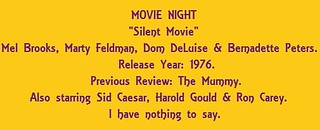
Movie Night: Silent Movie.


Review #623: Silent Movie.

Cast
Mel Brooks (Mel Funn), Dom DeLuise (Dom Bell), Marty Feldman (Marty Eggs), Bernadette Peters (Vilma Kaplan), Sid Caesar (Studio Chief), Harold Gould (Engulf), and Ron Carey (Devour) Directed by Mel Brooks (#061 - Blazing Saddles, #198 - Spaceballs, #248 - Robin Hood: Men In Tights, #361 - The Producers, and #364 - High Anxiety)

Review
Silent Movie is a spoof on slapstick films of the silent film era, and it even has a cameo from Harry Ritz, one part of the classic Ritz Brothers, one of many associated with the silent film era. The visual gags in this movie are entertaining, even the fact that some of the sounds in this movie are "shown" is hilarious. The actors are fun to watch interact with, especially with Marty Feldman, whose eyes really just follow you even when the focus isn't on him, and that comes to a head when Anne Bancroft's eyes start crossing each other. The guest appearances (Burt Reynolds, James Caan, Liza Minnelli, Anne Bancroft, Paul Newman, Marcel Marceau) add to the charm of the movie because the stuff that happens with them is really hilarious, such as the electric wheelchair chase, Marceau's response to Funn's offer is probably the best response a mime could give to a offer to be in a silent film. The slapstick is fun to watch, especially the weird quirks that go on in this movie, especially the coke machine. The movie may not run long, but it more than makes up for it being a really entertaining film with a good deal of charm and love for its subject matter.

Overall, I give it 9 out of 10 stars.

July 27, 2012

Movie Night: Freaky Friday (2003)

Review #204: Freaky Friday.

Cast
Jamie Lee Curtis (Dr. Tess Coleman), Lindsay Lohan (Anna Coleman), Chad Michael Murray (Jake), Mark Harmon (Ryan, Tess's Fiance), Harold Gould (Grandpa Alan), Stephen Tobolowsky (Mr. Elton Bates), Christina Vidal (Maddie), and Ryan Malgarini (Harry Coleman) Directed by Mark Waters (#151 - Mean Girls)

Review
This film is a remake of another film from 1976 (which already had a TV remake in 1995). Anyway, Curtis and Lohan are a good pair in this film, Curtis especially (proving once again that she can work in a comedy) and Lohan do fine jobs. The film has its moments that at least make you chuckle in a relatively decent run time (97 minutes). It's weird to think this film is almost nine years old (at least I'm reviewing it on a Friday, so there ya go), and yet it still is a decent film.

Overall, I give it 7 out of 10 stars.