
Review #965: Downhill.
Cast:
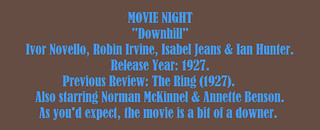
Ivor Novello (Roddy Berwick), Robin Irvine (Tim Wakely), Isabel Jeans (Julia Fotheringale), Ian Hunter (Archie), Norman McKinnel (Sir Thomas Berwick), Annette Benson (Mabel), Sybil Rhoda (Sybil Wakely), and Lilian Braithwaite (Lady Berwick) Directed by Alfred Hitchcock (#219 - Rope, #223 - North by Northwest, #446 - Spellbound, #447 - Psycho, #450 - Vertigo, #455 - Rear Window, #553 - Strangers on a Train, #800 - Shadow of a Doubt, #910 - Notorious, #963 - The Lodger: A Story of the London Fog, and #964 - The Ring (1927))
Review:
Downhill (with the alternative title in the United States being When Boys Leave Home) was Hitchcock's fifth feature film along with his third and last released in 1927 (released the same month as The Ring - all three being United Kingdom productions), and while it may be the weakest of the three in that year, this is at least a fairly watchable experience. This was adapted by Eliot Stannard from the play Down Hill by Novello and Constance Collier, and it is clearly evident to see how stagey the movie looks at times, though Hitchcock doesn't resort to too many title cards throughout this silent film, using imagery and color tint (as mentioned before in the previous reviews) in order to help convey the story, along with some memorable shots. It is through and through a melodrama, showcasing themes of guilt and "the real world", with one particular highlight being a title card that says "The world of make-believe", while revealing the main character's tuxedo to actually be attire for a waiter. The scene where he sees the ravenous nature of the people he works for near the ending is also pretty interesting to watch. I found the movie to be pretty decent, but I just didn't find it to hold up entirely well, maybe because of Novello and his character; he doesn't do a bad job, but sometimes it gets tiresome watching him and his descent. The rest of the cast is alright, but there isn't anybody too memorable in it to make mention of (obviously there isn't a villain, unless you count Benson); the ending feels a bit tacked on, ending the movie pretty quickly though at least it somewhat seems to come full circle. It feels clunky at times (and Novello doesn't exactly resemble a schoolboy), but its cynical portrayal of the seedy nature of the main character's downhill does have some standing power. It isn't one of his best films, but this is still a fairly coherent Hitchcock film.
It's weird that I reviewed three consecutive Alfred Hitchcock films from 1927, but I guess it never hurts to have an unofficial "trilogy" of reviews, especially for a master of film like Hitchcock.
Overall, I give it 7 out of 10 stars.