

Review #1773: Red River.
Cast:
John Wayne (Thomas Dunson), Montgomery Clift (Matthew "Matt" Garth), Walter Brennan (Nadine Groot), Joanne Dru (Tess Millay), Coleen Gray (Fen), Harry Carey (Mr. Melville), John Ireland (Cherry Valance), Noah Beery Jr. (Buster McGee), Harry Carey Jr. (Dan Latimer), (Two Jaw Quo), and Paul Fix (Teeler Yacey) Produced and Directed by Howard Hawks (#951 - The Big Sleep, #1352 - His Girl Friday, #1399 - Rio Bravo, #1687 - O. Henry's Full House), with co-direction by Arthur Rosson.
Review:
I'm sure we all know the name Howard Hawks as a director. At least, I would hope so, in part because how diverse he managed to be within his filmmaking that spanned four decades within all of the major studios and multiple genres. He did films in his particular way that inspired plenty of future directors even after his death. Red River (1948) was the first of five Westerns that he would direct in his career, and it also would be the first of five films Hawks directed with Wayne as star. The film is adapted from Blazing Guns on the Chisholm Trail, a 1946 novel originally serialized in The Saturday Evening Post (albeit without the "Blazing Guns" part of the title, which was added for the hardcover publication) that was written by Borden Chase. When Chase chafed at changes to the story (one that resembled Mutiny on the Bounty, albeit with a fictionalized angle at a cattle drive), Charles Schnee was brought in to do the screenplay as well, with the two not actually writing together. Chase would write a variety of screenplays and stories, such as with Winchester '73 while Schnee would write and produce for films such as The Bad and the Beautiful. By this point in time, Arthur Rosson had moved from featuredirecting to do work as a second unit director, most notably for Cecil B. DeMille, but for this film he was given credit as a co-director, as he had shot some of the cattle drive and action sequences (as such, he gets credit here as a director, instead of using that weasely "co-director" label that is still present with certain animated features). The film was shot in 1946 but was delayed for two years, with a great deal of editing done by Christian Nyby. Somehow, right as the film had premiered in 1948, Howard Hughes claimed similarities between this film and The Outlaw (1943) with its climatic fight, and you may remember Hawks had been fired from the earlier film. This resulted in a few seconds being cut out in order to fast-track the film for the studio rather than deal with a frivolous lawsuit they would have won handily over Hughes and the content of his alleged Western. There existed two different versions of the film: The pre-release cut lasted 133 minutes while featuring shots of a diary for transition shots; the cuts forced by the lawsuit resulted in a 127 minute film (Hawks also commissioned Brennan to provide a voiceover instead of those shots). When interviewed late in his life (specifically an interview with Peter Bogdanovich), Hawks stated his preference for the shorter version, but it has not stopped the debate over just what version seems better.
You have to remember that Wayne is a movie star bigger than life, an icon that certainly stood differently in presence depending on just who was directing him. The lasting quote about him in this film comes from long-time collaborator John Ford, who famously stated (whether facetious or not) that he didn't know he could act. Well, Wayne does what he does in terms of handling the frontier front and center, only this time with an imitation of Captain Ahab with a granite foundation that works quite well with a look at a different Wayne (if only slightly): middle age. 1948 was the first year folks could see Clift on screen as an actor (he had starred on the stage for over ten years), with this coming out after The Search. He does quite well here, standing well against Wayne in conviction in not getting lost within such presence. You see the conflict within him about the measure of what being a man is, especially after being part of a makeshift family only to leave and comeback from it. It may be a Western, but it also could be thought of as a family tragedy too, since this involves the inevitability of what has to happen between father and son when it comes to being a man. Brennan accompanies the two with the expected supporting presence that matches with both with resourceful chemistry (as would be expected from a semi-regular on Hawks films). When Dru finally comes onto the screen, she brings an added edge needed when either paired with Clift or Wayne in a scene (the best one is the first though, involving her mood during a fight before casually taking an arrow to the arm). The rest of the character presences make their parts count well, whether that means a casual Ireland or the various associates that stand starkly to the granite-laced Wayne in terms of drive, which only makes the build to the climax all the more interesting. Apparently, Clift didn't care much for the overall conclusion (or his overall acting), which is strange, because it actually is quite interesting in sticking out from just being a fistfight. It doesn't seem like the "farce" that he thought it was in my mind - besides, Chase's story has one of them die, and we are talking about a film involving both family conflict amid a clash of relentless drive and youth along with moving cattle (Hawks and Chase did not exactly get along anyway). It seems quite foolish to learn a lesson right before they die anyway, and the film is called "Red River", not "Showdown at Red River", so there. The movie isn't perfect, but the ending isn't a letdown in the long run. It is an odyssey, pure and simple.
At any rate, Hawks created a worthy epic that isn't weighed down by needing a large scope or folks to try and reach over the presence of Wayne, because he has the skills of editor Nyby to go with Dimitri Tiomkin as a driving music composer and Russell Harlan in sweeping cinematographer to go with a dynamic cast that does what is needed in worthy entertainment. It is the classic imperfect Western for its time, one that moves steadfast for what Hawks wants to display about the nature of being a man that couldn't have been done by anyone else but him. In that sense, he did it exactly to his standards.
Overall, I give it 10 out of 10 stars

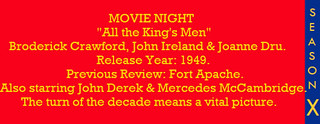 Review #1373: All the King's Men.
