Showing posts with label John Ireland. Show all posts

December 18, 2021

Red River.

Review #1773: Red River.

Cast: 
John Wayne (Thomas Dunson), Montgomery Clift (Matthew "Matt" Garth), Walter Brennan (Nadine Groot), Joanne Dru (Tess Millay), Coleen Gray (Fen), Harry Carey (Mr. Melville), John Ireland (Cherry Valance), Noah Beery Jr. (Buster McGee), Harry Carey Jr. (Dan Latimer), (Two Jaw Quo), and Paul Fix (Teeler Yacey) Produced and Directed by Howard Hawks (#951 - The Big Sleep, #1352 - His Girl Friday, #1399 - Rio Bravo, #1687 - O. Henry's Full House), with co-direction by Arthur Rosson.

Review: 
I'm sure we all know the name Howard Hawks as a director. At least, I would hope so, in part because how diverse he managed to be within his filmmaking that spanned four decades within all of the major studios and multiple genres. He did films in his particular way that inspired plenty of future directors even after his death. Red River (1948) was the first of five Westerns that he would direct in his career, and it also would be the first of five films Hawks directed with Wayne as star. The film is adapted from Blazing Guns on the Chisholm Trail, a 1946 novel originally serialized in The Saturday Evening Post (albeit without the "Blazing Guns" part of the title, which was added for the hardcover publication) that was written by Borden Chase. When Chase chafed at changes to the story (one that resembled Mutiny on the Bounty, albeit with a fictionalized angle at a cattle drive), Charles Schnee was brought in to do the screenplay as well, with the two not actually writing together. Chase would write a variety of screenplays and stories, such as with Winchester '73 while Schnee would write and produce for films such as The Bad and the Beautiful. By this point in time, Arthur Rosson had moved from featuredirecting to do work as a second unit director, most notably for Cecil B. DeMille, but for this film he was given credit as a co-director, as he had shot some of the cattle drive and action sequences (as such, he gets credit here as a director, instead of using that weasely "co-director" label that is still present with certain animated features). The film was shot in 1946 but was delayed for two years, with a great deal of editing done by Christian Nyby. Somehow, right as the film had premiered in 1948, Howard Hughes claimed similarities between this film and The Outlaw (1943) with its climatic fight, and you may remember Hawks had been fired from the earlier film. This resulted in a few seconds being cut out in order to fast-track the film for the studio rather than deal with a frivolous lawsuit they would have won handily over Hughes and the content of his alleged Western. There existed two different versions of the film: The pre-release cut lasted 133 minutes while featuring shots of a diary for transition shots; the cuts forced by the lawsuit resulted in a 127 minute film (Hawks also commissioned Brennan to provide a voiceover instead of those shots). When interviewed late in his life (specifically an interview with Peter Bogdanovich), Hawks stated his preference for the shorter version, but it has not stopped the debate over just what version seems better.

You have to remember that Wayne is a movie star bigger than life, an icon that certainly stood differently in presence depending on just who was directing him. The lasting quote about him in this film comes from long-time collaborator John Ford, who famously stated (whether facetious or not) that he didn't know he could act. Well, Wayne does what he does in terms of handling the frontier front and center, only this time with an imitation of Captain Ahab with a granite foundation that works quite well with a look at a different Wayne (if only slightly): middle age. 1948 was the first year folks could see Clift on screen as an actor (he had starred on the stage for over ten years), with this coming out after The Search. He does quite well here, standing well against Wayne in conviction in not getting lost within such presence. You see the conflict within him about the measure of what being a man is, especially after being part of a makeshift family only to leave and comeback from it. It may be a Western, but it also could be thought of as a family tragedy too, since this involves the inevitability of what has to happen between father and son when it comes to being a man. Brennan accompanies the two with the expected supporting presence that matches with both with resourceful chemistry (as would be expected from a semi-regular on Hawks films). When Dru finally comes onto the screen, she brings an added edge needed when either paired with Clift or Wayne in a scene (the best one is the first though, involving her mood during a fight before casually taking an arrow to the arm). The rest of the character presences make their parts count well, whether that means a casual Ireland or the various associates that stand starkly to the granite-laced Wayne in terms of drive, which only makes the build to the climax all the more interesting. Apparently, Clift didn't care much for the overall conclusion (or his overall acting), which is strange, because it actually is quite interesting in sticking out from just being a fistfight. It doesn't seem like the "farce" that he thought it was in my mind - besides, Chase's story has one of them die, and we are talking about a film involving both family conflict amid a clash of relentless drive and youth along with moving cattle (Hawks and Chase did not exactly get along anyway). It seems quite foolish to learn a lesson right before they die anyway, and the film is called "Red River", not "Showdown at Red River", so there. The movie isn't perfect, but the ending isn't a letdown in the long run. It is an odyssey, pure and simple.

At any rate, Hawks created a worthy epic that isn't weighed down by needing a large scope or folks to try and reach over the presence of Wayne, because he has the skills of editor Nyby to go with Dimitri Tiomkin as a driving music composer and Russell Harlan in sweeping cinematographer to go with a dynamic cast that does what is needed in worthy entertainment. It is the classic imperfect Western for its time, one that moves steadfast for what Hawks wants to display about the nature of being a man that couldn't have been done by anyone else but him. In that sense, he did it exactly to his standards.

Overall, I give it 10 out of 10 stars

April 21, 2020

Gunfight at the O.K. Corral.

Review #1395: Gunfight at the O.K. Corral.
Cast:
Burt Lancaster (Marshal Wyatt Earp), Kirk Douglas (Doc Holliday), Rhonda Fleming (Laura Denbow), Jo Van Fleet (Kate Fisher), John Ireland (Johnny Ringo), Lyle Bettger (Ike Clanton), Frank Faylen (Sheriff Cotton Wilson), Earl Holliman (Deputy Sheriff Charlie Bassett), Ted de Corsia (Shanghai Pierce), Dennis Hopper (Billy Clanton), Whit Bissell (John Clum), George Mathews (John Shanssey), John Hudson (Virgil Earp), DeForest Kelley (Morgan Earp), Martin Milner (James 'Jimmy' Earp), Lee Van Cleef (Ed Bailey), and Jack Elam (Tom McLowery) Directed by John Sturges (#427 - The Magnificent Seven)

Review: 
"Take one for spontaneity."

Everyone needs an entertaining picture. John Sturges could do an entertaining picture when given the chance to do so. He had started in the film business with RKO through a connection to his brother in their Art department, gradually rising from bluebrints to editor in a period of seven years. He subsequently served in World War II under the US Army Air Corps (where he did direction on training films and documentaries with William Wyler such as Thunderbolt) before returning to Hollywood with Columbia Pictures, who gave him his shot at directing with The Man Who Dared (1946), the first of a bunch of b-movies for them, with The Walking Hills (1949) being his first Western. A move to MGM in 1949 led to films with a bit more prominence, where he continued to make dramas, noirs, and Westerns. His most significant film through the studio before he turned independent was Bad Day at Black Rock (1955). Ultimately, Sturges (who favored just one take to get a scene done) would direct over 40 films in a 30-year career before his death in 1992 at 82 years old.

Making a film about the Old West can be an interesting time when there is some historical precedent to it, which has been the case for numerous Westerns about the legend of Tombstone, although most of those films probably didn't have a ballad to them. Of course one isn't going to particularly learn all there is to know about a famed gunfight in a movie like this (particularly an event that in reality lasted less than a minute and had just three people killed), where even an acclaimed Western on the subject like My Darling Clementine (1946) had tinges of inaccuracy (which also featured Ireland), with the formerly considered factual novel Wyatt Earp: Frontier Marshal having risen the late Earp into a famed Old West icon. While this film is not as particularly good on the subject as say Tombstone (1993), this is a solid Western for its era, building itself with quiet ambition and a capable duo in Lancaster and Douglas for a useful climax. Lancaster, the circus performer-turned-war veteran-turned actor (along with occasional producer) resonates with calm authority, which goes well when acting alongside Douglas, as they worked together on several films together. Douglas (another fellow war veteran turned actor, albeit with a rough childhood) commands attention each time he is on screen, a forceful presence even when coughing as the film goes on that showcases plenty of discipline that he was known for. They click the most together, with scenes of the Earp family together being second and everything else being okay at best. Fleming (who had "Queen of Technicolor" as a nickname by others) does okay, but a film with a fictional character to make a romance (Earp married three times, each common-law) doesn't prove to have much structure anyway since she doesn't have as much screen-time anyway, while Van Fleet delivers a few weary wicked moments. Ireland and the other adversaries do fine with stoking tension, which includes a young Dennis Hopper in just his fourth film role. On the whole, while the film can sometimes seem a bit too pedestrian at 122 minutes, there is a fine quality to follow along with its two leads and the conflict which work to serve an action-stuffed climax just the same. It isn't a great Western by any means, but it will serve its purpose of entertainment just the same with its own particular grip of a legend of the Old West for its time.

Overall, I give it 7 out of 10 stars.

April 14, 2020

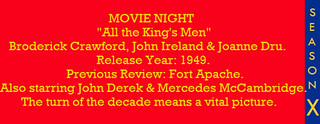
The Fast and the Furious (1954).

Review #1388: The Fast and the Furious.
Cast: 
John Ireland (Frank Webster), Dorothy Malone (Connie Adair), Bruce Carlisle (Faber), Iris Adrian (Wilma Belding - Waitress), Marshall Bradford (Mr. Hillman - Race Marshal), Bruno VeSota (Bob Nielson - Truck Driver), Byrd Holland (Doctor), and Larry Thor (Detective Sergeant) Directed by John Ireland and Edward Sampson.

Review: 
"You can make a movie about anything, as long as it has a hook to hang the advertising on."

When it comes to film entertainment, one cannot deny the attracting power of American International Pictures. The company was formed on April 2, 1954 by James H. Nicholson and Samuel Z. Arkoff as American Releasing Corporation with the intent to distribute films on an independent level. There would be numerous people that found themselves involved in AIP, such as cinematographer Floyd Crosby, screenwriter Lou Rusoff, producer Herman Cohn alongside Roger Corman. They were given their first chance to distribute with this film, picked by Corman over other companies while also being offered money to help Corman make further films. This was the third film that Corman was involved with, having made his contributions to Highway Dragnet and Monster From the Ocean Floor with story and producing the previous year. Along with producing, he also work as a bit actor and stunt driver while also making deals with a local dealer for Jaguar cars and utilizing stock and filmed footage from the Monterrey racetrack. Shot in nine days at a cost of $50,000, it is no wonder that this was a fair hit for audiences of the time, who must've been big on jailbirds on the run with fast cars and women to go with a thin plot directed by its star Ireland and Edward Sampson, an editor in his lone directorial credit. It was the work that Corman did here that made him want to become a director, which he would soon get the chance to do with Five Guns West the following year.

It sure is a shame that this is such a plain affair, one that moves with a quiet roar for 73 minutes that seems fitting of being put on the back end of a double bill than anything. Ireland and Malone don't really seem to have much chemistry with each other beyond a few quips that beg for more vulnerability and charm, since these characters seem thinner than a fuel gauge in characterization. Most of the time is spent on them with only a few glimpses into the chase for them alongside the race they happen to come across, as if trying to be a crime film isn't enough to latch onto. One needs a third presence stronger than someone like Carlisle to really counteract the main duo to make things seem more urgent to care about. By the time the film races to its conclusion, it doesn't even seem like a real ending, reminding me more of Quicksand (1950) than anything, and one might not even remember that the main character is supposedly innocent to begin with because of how casual things seem. The racing aspects are decent, but nothing too special to follow along with. On the whole, while this movie isn't particularly good by most standards, it is at least a modest curiosity that could  pique interest on a boring day with access to the public domain, filled with quick thrills that could reach an audience that could then inquire further into the library of American International Pictures for further, better features to look into.

Overall, I give it 6 out of 10 stars.

March 31, 2020

All the King's Men (1949).

Review #1373: All the King's Men.

Cast: 
Broderick Crawford (Willie Stark), John Ireland (Jack Burden), Joanne Dru (Anne Stanton), John Derek (Tom Stark), Mercedes McCambridge (Sadie Burke), Shepperd Strudwick (Adam Stanton), Ralph Dumke (Tiny Duffy), Anne Seymour (Mrs. Lucy Stark), Katharine Warren (Mrs. Burden), Raymond Greenleaf (Judge Monte Stanton), and Walter Burke (Sugar Boy) Directed, Written and Produced by Robert Rossen (#702 - The Hustler)

Review: 
One can hope to make at least one great film or at least hope to be part of a prestige picture worth talking about. This is a film to be proud of in terms of its directing and acting. Robert Rossen directed just ten films before his death at the age of 57, but he managed to make films in a variety of genres successfully, such as noir, drama and thriller. He had gone from hustling pool as a youth to being a stage manager, with the passage of time leading to him writing and directing his own plays. He went to Hollywood as a screenwriter after being discovered by Mervyn LeRoy of Warner Brothers in 1936. In the eleven years that followed before his directorial debut, he served as a writer for a few films along with being chair of the Hollywood Writers Mobilization during World War II. He jumped around a few studios before finding himself with Columbia Pictures. If you can believe it, Crawford was not the first choice for the main role. It was actually John Wayne who was offered the role first. He angrily rejected the role in a letter, calling the script an acidic one on the "American way of life" (among other statements that make me roll my eyes). The son (and grandson) of vaudevillians, Crawford found himself on stage and film by the time he was in his twenties, with usual roles being in B-moves or in supporting roles. It was this film that he became a star, and he would later find himself with further notability with Highway Patrol in the following decade. The film was based off the 1946 novel of the same name by Robert Penn Warren, which had won the Pulitzer Prize for Fiction the following year. There has been considerable discussion about the novel over its themes and inspirations, with the most notable being over the resemblance of its main character to governor/senator Huey Long, since Warren had taught at Louisiana State University at the time of Long's unexpected death, although Warren once said that book was never intended to be a book about politics, since to his eyes it merely served as a provider to the framework story to work out the deeper concerns. The book has had two further adaptations, in terms of an opera (named after the lead character), and a 2006 adaptation from Steven Zaillian that attempted to be more faithful to the general structure of the novel while changing the setting to the early 1950s.

One is swept into the film fairly quickly, a drama that plays like a noir with a sense of urgency and furor that sweeps a viewer away in making compelling entertainment. Crawford proves to be a master of intimidation, one who leaves an imprint on you every time he appears, a presence that strikes at you with all of his might that has the right mix of brashness alongside insecurity. Ireland follows along just fine, an observer of the noir kind that we follow through his brooding eyes. Dru and Derek accompany him just as carefully. McCambridge (a noted radio actress in her debut) proves to be quite electrifying, a hardboiled presence that resonates with rough versatility. The others prove to be worthy supporting presences that seem like pawns in the hands of material that desires as such. It is an urgent film, wrapped in cynical honesty that still works in relevancy for the most part after seven decades. The biggest achievement is that the film came out the way it did at all. There were problems in whittling the film to salvageability because of how much footage Rossen shot. Editor Al Clark could only edit it down to 250 minutes (in part because of Rossen's reluctance to really cut anything), so it fell to the hands of Robert Parrish to help with edits. Together, Rossen and Parrish agreed to edit the film like a series of impressions, where they would roll the film on the synchronizer and find the center of each scene and cut arbitrarily 100 feet before and after each center, regardless of dialogue or music. The result is a 110 minute quickfire winner. The film was certainly a deserving hit, and it later won for Best Picture at the Academy Awards the following year, beating out such films like A Letter to Three Wives (which won director-writer Joseph L. Mankiewicz awards over Rossen for directing and writing) for the main prize alongside Crawford and McCambridge. On the whole, this is a film that has plenty of blunt force in terms of what it wants to say about the nature of power and how one can find themselves ensnared in the same traps they held others to if they reach that point, headlined by Crawford and his domineering presence that makes this a fair one to recommend.

Overall, I give it 9 out of 10 stars.

And now, the list for next month. Several faces join the crowd for the 1950s, a mix of directors and stars that have either been covered before or haven't before, complete with a rollout of world cinema debuts.

July 1, 2014

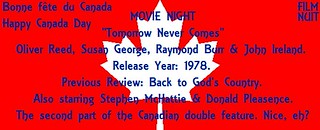
Movie Night: Tomorrow Never Comes.

Review #608: Tomorrow Never Comes.

Cast
Oliver Reed (Jim Wilson), Susan George (Janie), Raymond Burr (Burke), John Ireland (Captain), Stephen McHattie (Frank), Donald Pleasence (Dr. Todd), Paul Koslo (Willy), John Osborne (Robert L. Lyne), Cec Linder (Milton), and Richard Donat (Ray) Directed by Peter Collinson.

Review
One of my favorite scenes from this movie is when Oliver Reed's character randomly asks for a table and some beer in the middle of a hostage situation, and at one point, he's just sitting in the shade, taking his time as tourists watch him. I don't know why, but it's just hilarious, maybe it's the random nature of the scene, or the fact that Reed's just sitting there outside as a hostage situation goes on. Anyway, this is the second part of the Canadian double feature, and this was a Canadian-UK production, with a few Canadian actors (Burr, Ireland, McHattie) and a few British actors (Reed, George, Pleasence), in the cast, along with a rare acting appearance by playwright John Osborne. The movie was at filmed in Quebec, with the majority of the movie taking place in a hotel, or near a hotel for that matter. The movie has its moments of tension and actual suspense, and the real fun is wondering what will happen next, or who'll appear next. I was actually surprised Pleasence was in this movie, but he is, briefly and he is at least entertaining. Reed is fun to watch, he looks like a kid who didn't get a toy he wanted 40 years ago and just remembered the event, especially with those glasses (but I'm the last person who should make jokes about wearing glasses). He is enjoyable though, and the rest of the cast (save for Paul Koslo, who comes off as a thrill-seeking dunce) work well, especially McHattie, who is good at delivering tension. The movie is well made, and surprisingly dark especially at the end, but it is overall a good movie that is recommended for a day like this. 

Happy Canada Day, northern neighbor.

Overall, I give it 8 out of 10 stars.

original image: