
Showing posts with label Frankie Faison. Show all posts

October 25, 2024

Cat People (1982).

Review #2290: Cat People (1982). 

Cast: 
Nastassja Kinski (Irena Gallier), Malcolm McDowell (Paul Gallier), John Heard (Oliver Yates), Annette O'Toole (Alice Perrin), Ruby Dee (Female), Ed Begley Jr (Joe Creigh), Scott Paulin (Bill Searle), Frankie Faison (Detective Brandt; dubbed by Albert Hall), Lynn Lowry (Ruthie), and John Larroquette (Bronte Judson) Directed by Paul Schrader.

Review: 
"Cat People wasn’t successful. It really fell between two stools: it was an attempt to have things both ways, which is to have a classy film and a horror film. Well, the horror audience went and said, ‘Hey, this doesn’t look like a horror film, it’s not for us’, and the sophisticated audience went and said, ‘Hey, this is just a horror film.’ So it wasn’t really satisfying to the audience."

Sure, give a few decades and you can just remake a movie right then and there. The 1942 Cat People had been a team effort that had DeWitt Bodeen write the screenplay as based in collaboration with producer Val Lewton, director Jacques Tourneur, and editor Mark Robson. The process of remaking the film was first brought up by Milton Subotsky before Universal Pictures eventually got the rights and made their own push that took several years of the 1970s (Robert Vadim was interested to direct at one point). You might recognize the screenwriter in Alan Ormsby, the co-director and writer of Deranged (1974) and a variety of other writing projects. Universal tapped Paul Schrader (who once labeled the 1942 rendition as one that he didn't find very good) to direct the film, with most knowing him for his work on scripts such as Taxi Driver (1976) before becoming a director with Blue Collar (1978); he claimed that he had contributed to the writing of the film in terms of its prologue and the ending to make it more distinct from the original, although Ormsby claims otherwise. The movie was a mild success with audiences at the time, or at the very least managed to accomplish the goal of not inspiring a filmmaker to try and do their own remake of a remake four decades later. Schrader has been quoted as saying that in his attempts to do a genre film as a "very salutary exercise" in not being about himself, he ended up making a movie that ranked up there as among his most personal.

The funny thing about the films is that it accomplishes one thing in particular: it sure is distinct on its own merit from the original that you won't mistake it as a copy because of its erotic elements within the perils of flesh. You might remember that the original dealt with a woman (played by Simone Simon) who thought they were descended from a tribe of, well, cat people that may or may not turn into black panthers when aroused (it basically had elements of the noir); the lady in that movie went the whole road to marriage without getting kissed. Here we have a woman who must confront the peril of really having a family tradition of were-cats that must kill in order to turn back. It just so happens to involve a few bits of skin and the mix of effects and cats in a movie best described as lurid curiosity for 118 minutes. If you asked me which movie called Cat People is the better among the two, I think I would throw my hands in the air and shrug at it basically being a dead heat because each are from accomplished filmmakers that represent their era quite well in overall enjoyment vs. rewarding the patience of those who are into what it is selling. Kinski practically lifts the film almost entirely to the realm of curious because of how she acts in the film without really even acting that much to begin with (apparently, she seemed to felt manipulated when it came to her assessment of the resulting film). Her grace really does have the instincts of a cat in frenzied timing that sells the plight of flesh. Whether you compare the two films or not, she sure exceeds Simon when it comes to worthwhile lead performances by a handy margin. McDowell may not be in the movie too long, but he sure is loopy enough to belong in weirdo enjoyment that he sells from the word "go", but I say that as someone who went with the film's peddling of ideas right then and there (you really should just see it right then and there rather than skimming the plot). Heard and O'Toole are fine, albeit on a smaller scale that only works some of the time in trying to do a would-be love triangle that only works for those who like the actors enough in the first place; Heard just happens to be the ideal guy to chase a girl like Kinski in strange pursuer/pursued, as opposed to the mild other. Besides, it is quite the curiosity to see Heard having to engage with the climax in a cathouse blues type of way that really will make or break the film for you when it comes to stupendous suspension of disbelief; I dont know if I would call the film "classy", but even "dedicated" is a better way to put it than,  say, "not fun horror". It is a movie that looks and sounds exactly on point of mystical curiosity, never turning itself off even when not going all-out for effects work (you get some blood anyway). As a whole, it is a strange sensual kind of sensationalism that one will either take right in for scintillating enjoyment or baffled disappointment. It feels good to be on the side of the former but have it your way among the creatures of the night.

Overall, I give it 8 out of 10 stars.

August 30, 2021

The Stupids.

Review #1718: The Stupids.

Cast: 
Tom Arnold (Stanley Stupid), Jessica Lundy (Joan Stupid), Alex McKenna (Petunia Stupid), Bug Hall (Buster Stupid), Mark Metcalf (Colonel Neidermeyer), Bob Keeshan (Charles Sender), Christopher Lee (Evil Mr. Sender), Matt Keeslar (Lieutenant Neal), and Frankie Faison (Lloyd) Directed by John Landis (#328 - Trading Places, #410 - Coming to America, #513 - Spies Like Us, #1114 - Animal House, #1462 - The Blues Brothers, #1465 - An American Werewolf in London, and #1699 - Blues Brothers 2000)

Review: 
"I'm happy to say it's very successful on television, and extremely successful on video because people buy it for their kids. It's meant for ten-year-olds. That really went under the radar. But I really like that picture."

Honestly, I have been looking to the best time to finally cover this movie. I first heard of it last year when it came time to cover the month of August with films of the 1990s. Of course, my reasoning for not picking it was because I would have to have countered it with Dumb and Dumber (1994) because I thought they sounded similar. Of course, the other reason is that one can only pick so many movies from John Landis at a time. I don't think anybody had such a curious third decade in directing like he did, with this being the fourth of six works in that decade, and each one did not fare well with audiences (or critics, but that's another story). It isn't the best of his movies, but Landis certainly made an interesting effort. The movie was made for a company called Savoy Pictures, but the company decided to cut back on their interest in the movie business (going instead to being a TV station holding company), which occurred during post-production. This was one of the fourteen films in the Savoy roster that was shipped out to potential buyers, and New Line Cinema ended up buying six - this was one of them; somehow, the studio thought it was some sort of raunchy product as opposed to a children's movie (as evident by the surprise noted by the studio chief at a screening with Landis there). A budget of $25 million resulted in a $2.5 million return. Look, we are talking about a movie that starts with two characters that wake up from bed having slept on the foot-end of the bed. Actually, it perhaps should be noted that The Stupids is an adaptation of a series of children's books of the same name, which were written by Harry Allard and James Marshall, who wrote four books from 1974 to 1989. I imagine the books also happened to depict a family that looks like All-American apple pie with dull wit to spare (apparently, in one of the books, they think they died...instead they had experienced a blackout), so is it surprising that this is a movie that segues from missing garbage stumbles into a plot with military weapon-dealing, aliens, and a plethora of cameos? I don't think there are that many oblivious family movies out there, particularly ones that seem to hone to winners of the Darwin Award.

For me, the surprise is the fact that I actually didn't hate the movie. It might run at a predictable pace of 94 minutes, but it grew on me quite quickly. It has a fun quality of obliviousness that I appreciate, one that rolls in stride with dim-witted sensibility without smugness. I admire its incoherency that is headlined by Arnold, who certainly tried to dabble in being the star of silly comedies rather than just a supporting piece (this was the same year as Big Bully and Carpool, after all). I'm sure plenty of folks can find reason to resist its "kid at heart" charm, but I thought it was silly enough to work without wasting my time (in other words, this is the kind of dumb movie to enjoy rather than stuff like Kung Pow! Enter the Fist (2002), for example). Picking at the flaws of plot is like trying to fix your cat's bad habits - sometimes you just have to let it go. I imagine that Arnold must have had a weird time trying to play funny angles for a movie that requires a great deal of earnest honesty without playing to all of the obvious bits that could be done with a different kind of dopey stiffs. Lundy doesn't have as many little moments of neat honesty, but she fares well with keeping things at a fair pace alongside McKenna & Hall in moving forward with what needs to happen without looking confused (the kids play right to the audience, of course). Undeniably, the supporting presences prove just as curious. Metcalf and Keeslar are dry enough to contrast with the main quartet handily enough that usefully seem plucked from a low-rent thriller. You may be interested to know that this was the first and only film appearance for Keeshan, who was most known for his work in television, such as Captain Kangaroo (1955-1984) which he created and starred in; here, he is playing a kindly warm guy mistaken by the oblivious ones as a figure of evil, which in that sense makes for a good chuckle. Of course, Faison, playing an attendant at a museum mistaken for God, is warm enough to resonate in his interaction with Arnold & McKenna. Technically, the best cameo comes from David Cronenberg, because of how low key the cameo is when compared to other faces seen (although it is amusing to name-drop the name Atom Egoyan and link it Jenny McCarthy, amusing for probably the only time ever); of course, like any true horror fan, the appearance of Lee is worth a watch and a half, as he chews on this momentary bit of evil amusement the way you would expect. Of course, not everything is consistent. One is curious who went with all of the clay-mation designs, since it has an off-putting feel when you see pets and aliens all of a sudden in a style that doesn't quite click with the usual look of the movie, which almost goes a bit too all over the place for its climax. As a whole, it might be easy to see why this wasn't appreciated 25 years ago, but there is an earnest fun quality here that manages to persist over all odds for a likable winner. It might irritate folks who don't have the patience for the one joke the movie has, but others will surely get a huge kick out of its silly enjoyment, where being a stupid campy experience is kind of the point. I don't usually go against the boat, but I can't see why this movie was treated so poorly back then. Maybe it was a bit behind the curve when it came to oblivious silly humor, but honestly, I find this to be a curious little gem of a movie, one made by a competent director that obviously is having fun with silly material and a cast that is fairly game for where it needs to go in silliness without becoming obnoxious about it. In that sense, you might be fine with checking it out.

Overall, I give it 7 out of 10 stars.

August 9, 2020

The Silence of the Lambs.

Review #1498: The Silence of the Lambs.
Cast:
Jodie Foster (Clarice Starling), Anthony Hopkins (Dr. Hannibal Lecter), Scott Glenn (Jack Crawford), Ted Levine (Jame "Buffalo Bill" Gumb), Anthony Heald (Dr. Frederick Chilton), Brooke Smith (Catherine Martin), Diane Baker (U.S. Senator Ruth Martin), Kasi Lemmons (Ardelia Mapp), Frankie Faison (Barney Matthews), Tracey Walter (Lamar), Charles Napier (Lt. Boyle), Danny Darst (Sgt. Tate), Alex Coleman (Sgt. Jim Pembry), Dan Butler (Roden), Paul Lazar (Pilcher), Ron Vawter (Paul Krendler), and Roger Corman (FBI Director Hayden Burke) Directed by Jonathan Demme (#1254 - The Manchurian Candidate (2004))

Review:
"I realized the actual bottom line truth of doing Silence of the Lambs, something I felt when I read that book. I thought, this could be the scariest movie ever, and I wanted to make that movie. I wanted to make a Psycho caliber fucking terrifying movie."

As the first (and so far only) horror film to win an Academy Award for Best Picture, the inevitability for covering this film was high, particularly since the character of Hannibal Lecter is particularly well-known across film and novels over the years. This is adapted from Thomas Harris' novel of the same name, originally published in 1988 as the follow-up work to Red Dragon, which had been adapted into a film by Michael Mann under the name Manhunter (1986). The follow-up book Hannibal (1999) and the other book would be turned into films with Hopkins as Lecter, while the prequel Hannibal Rising (2006) would be turned to a film with Harris as screenwriter, and a Hannibal series followed a decade after that. Fitting that a horror film like this would come from an acolyte of Roger Corman (who even cameos in the film) with Jonathan Demme. He met Corman while doing publicity for Von Richthofen and Brown, and Corman was interested in Demme to do work for him at New World Pictures. The result was Angels Hard as They Come, which Demme produced and co-wrote with Joe Viola. He then directed his first work with the studio as director with Caged Heat (1974). Over the years he had a steady career of films, such as Melvin and Howard (1980), Something Wild (1986), and Married to the Mob (1988).

Despite the failure with audiences at the time of Manhunter (now regarded as a cult classic), there was still interest in turning the next Harris novel into a film, although the initial plans was apparently going to have Gene Hackman directing/starring in it (various others were considered for both lead roles, such as Sean Connery and Michelle Pfeiffer). Hopkins came about in interest because of his doctor role in The Elephant Man (1980). With a dark sense of gravitas and two killer performances from Hopkins and Foster, it is no wonder why this proves to be a great classic. It finds a balance between suspense and horror that drives through every beat and procedure with relish and entertainment. It is amazing to think about how solid of a performance Hopkins draws from such an unsavory but relentlessly fascinating presence, particularly since he only occupies a certain amount of time in the film that doesn't even run to thirty minutes. And yet here we are, still captivated and engrossed by what we see of him (such as in the numerous close-up shots of his face) as the calmest and most brilliant terrors of the human mind. On the other side of such interesting conversations is Foster, who proves quite dedicated and useful in focus of the drive for curiosity with regards to the dark parts of the human mind. She makes a resourceful presence that never seems lost within the madness. Glenn proves just as sharp in reasoned authority, while Levine rounds out the main group with creeping finesse in his lurking moments, and the others prove worthy in keeping the stakes level. On the whole, while the sequences with Hopkins and Foster are easily the most memorable of the film, the film holds up just as well in driving one in pursuit and skin-crawling with no pretensions whatsoever. The thrills can be quite entertaining like any other movie, but it is in that chase that really gives one a good jolt in their seat, and it is easy to see why this became imitated and well-known. It has a capable director in staging scenes with useful impact to go with a game cast that makes the most of their surroundings for a good time of carefully executed thrills that prove as effective nearly three decades later.

Overall, I give it 10 out of 10 stars.

May 1, 2018

Showtime.


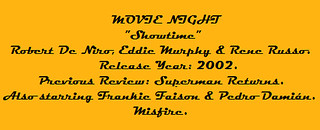
Review #1078: Showtime.

Cast: 
Robert De Niro (Detective Mitch Preston), Eddie Murphy (Officer Trey Sellars), Rene Russo (Chase Renzi), Frankie Faison (Captain Winship), Pedro Damián (Cesar Vargas), Drena De Niro (Annie), William Shatner (Himself), Mos Def (Lazy Boy), and Peter Jacobson (Brad Slocum) Directed by Tom Dey.

Review: 
Showtime manages to read out like a studio notes version of what it wanted to be. It tries to have its moments to make fun of the buddy cop structure along with its moments about reality TV, but it all crashes down to mediocrity in part because it never really takes off. The chemistry between De Niro and Murphy is better than something like Hollywood Homicide (#1075) (which also depicted a cop who wanted to be an actor, only done less funny), but it is fairly obvious that the film doesn't give them much to really do. Both of them deliver okay performances, with Murphy generating a few more laughs than De Niro, but I didn't find myself laughing too particularly hard with it. Russo does a decent job with what she's given, with the rest of the cast delivering okay performances that don't really come off as detrimental to the film, although Damian can't lift the material to make his villain role anything good. The film isn't painful or intolerable by any means, but it also isn't anything that rises to anything particularly good. It doesn't help when the movie at one point starts throwing out lines from other films (such as Taxi Driver - #990) that only serves to remind me of what I'm not watching. Its beats with the plot are a bit by the numbers, and nothing comes off as a big particular surprise with even its action sequences seeming by the numbers. The parts with Shatner playing himself end up feeling like the most amusing parts of the film in part because they seem offbeat and interesting (with a T. J. Hooker reference, of course) compared to the other parts that come off as routine and a bit sloppy. At 95 minutes, the film isn't too much of a chore, but it isn't anything that will come off as particularly rewarding for most. If you watch as something just for entertainment and nothing more, you might get a few moments here and there, but you won't find yourself particularly loving it.

Overall, I give it 5 out of 10 stars.

July 3, 2012

Movie Night: Maximum Overdrive.

Review #192: Maximum Overdrive.

Cast
Emilio Estevez (William "Bill" Robinson), Pat Hingle (Bubba Hendershot), Laura Harrington (Brett Graham), Yeardley Smith (Connie), John Short (Curtis), Ellen McElduff (Wanda June), Frankie Faison (Handy), Leon Rippy (Brad), and Christopher Murney (Camp Loman) Directed by Stephen King.

Review
The first thing to mention is that this is Stephen King's only directed film which he also wrote (adapted from a short story of his own named Trucks) It's like he wanted to say, "Hey you think you can adapt my novels to books good? Well I can do better!" But...It isn't. The acting is standard, with Estevez doing his best given the role (It's like he acted angry because he had to be in this film) The action is...well action, standard for an action film. The violence is even more standard, getting a bit old after a while. The one thing I find of note to be worthy is the soundtrack by none other then AC/DC. Pure awesome. The film in a way is enjoyable, even with its bizarre explaining in the beginning that's contradicted in the end. It's a weird film, that can be only enjoyed if you let yourself go (there are films you must do that other wise you'll hate it, like...Transformers 2 *snickers*). Countdown to 200: 10, 9, 8....

Overall, I give it 6 out of 10 stars.