Showing posts with label Paul Giamatti. Show all posts

May 6, 2024

The Amazing Spider-Man 2.

Review #2206: The Amazing Spider-Man 2.

Cast: 
Andrew Garfield (Peter Parker / Spider-Man), Emma Stone (Gwen Stacy), Jamie Foxx (Max Dillon / Electro), Dane DeHaan (Harry Osborn / Green Goblin), Campbell Scott (Richard Parker), Embeth Davidtz (Mary Parker), Colm Feore (Donald Menken), Paul Giamatti (Aleksei Sytsevich / Rhino), Sally Field (May Parker), and Felicity Jones (Felicia) Directed by Marc Webb (#1780 - The Amazing Spider-Man)

Review: 
Okay, so maybe The Amazing Spider-Man (2012) had a few admirers for its ideas on the character (as originally devised by writer-editor Stan Lee and artist Steve Ditko for comic books). It was self-serious in a way that surely seemed distinct from those other Spider-Man movies from the first decade of the 20th century, well, as much as one can be when having a villain be someone named The Lizard. A sequel was pretty much right on the get go, complete with Webb returning to direct. This time, the screenplay was done by Alex Kurtzman, Roberto Orci and Jeff Pinkner, who had been hired to do a re-write of the first draft that had been done by James Vanderbilt (as such, each were credited for the story). Plans to set up further films by Sony to basically set up their shared universe involving Spider-Man related things such as, say the "Sinister Six" or Venom were in mind prior to the release of this film in May of 2014. The film was made at a budget that is probably more than the reported $290 million that attracted slightly fewer people to the theater than the last film (read: money, but money...).; amusingly, X-Men: Days of Future Past came out three weeks after this film (good lord, I actually remember seeing it in theaters) as a film made in the shadow of previous franchise films that hinted at the idea of a follow-up film to a different type of result. Of course, any plans with further Spider-Man films with Garfield as the star all went away in a flash in the span of roughly a year to where the next appearance of Spider-Man came with Captain America: Civil War (2016) and blah blah blah, you probably already know about Spider-Man: No Way Home (2021) and the return of certain folks with different costuming.  

Admittedly, there are a few elements worth appreciating, because even the lesser films had something useful to watch in the main lead, and Garfield does manage to carve out something worth watching for a film that is now a decade old. The charm exhibited between him and Stone is star-crossed enough to make the resolution something worth exploring in its impact in a sequel (in theory). They have useful chemistry together, even if some could have the caveat of "nice romcom, but this is a Spider-Man movie" right then and there. A good chunk of the movie is "in theory" when you send a few compliments its way, but there is no truly terrible aspect on the level of say, Blade: Trinity (2004). The action generally works out for those expectations one could hope for in a mid 2010s film that was at least trying to provide some sizzle alongside a moderate steak. And then you get to the film itself and realize that some movies just don't know when to stop. The first film may have been a bit lacking in its attempts to differentiate itself from a previous acclaimed trilogy, but it at least didn't have the gall to throw everything at the wall with a smirk on its face. Here I just find watching a competition of whether one can call it a poor man's Batman Returns (1992) or Batman Forever (1995) that was made by people who really thought they could get away with making a bloated sequel that could also set up something called "The Sinister Six" rather than picking one villain and sticking with it. Did the world really need bits and pieces of a "how did the Parkers die conspiracy"? I think they needed it about as much as they needed a blue Electro. If Spider-Man 3 (2007) was the byproduct of a studio wanting just a bit too much for their superhero sequel, Amazing Spider-Man 2 is the one that says, "hold my beer" and then some (this is a movie that casts B.J. Novak for a bit role that I guess is actually a "thing" in certain comics that for a film is about as interesting as the end of this sentence). Either have an Electro or have the weirdness of a man infused with the mode of a goblin, you really should pick one regardless of if it is a sequel or not (to say nothing of the attempt at setting up a bigger future threat in Giamatti and an "accent" that is completely unnecessary). It is bloated and average in all the frustrating ways possible, somehow being even more self-serious than the first one. 

I barely read any kind of comics, but I vaguely remember looking over a cheap reprint of a Spider-Man comic with Electro in it that had him in a green and yellow outfit that looked about on par for the 1960s that thought it would be cool to do crime when he got struck by lightning on a power line. Obviously one can see that the blue present here had inspiration from less older renditions of Electro, but I imagine that having a blue look also helps when it comes to making spectacle filmmaking. They really thought they were cooking with this character, but all they managed to do was cook up a really amusing look to go with characterization that absolutely cannot hold water with Foxx there to try and play a "nobody turned into a somebody". Of course, it probably isn't nearly as clunky as trying to set a fast one in having Garfield and DeHaan look like old reunited buddies prior to tragedy, which really seems to come off as if one was watching part three of a five part plan that actually is being held up by duct tape. His stuff seems almost studio note'd away with the parts that actually seem like a descent into madness (with the transformation sequence anyway). Field described in an interview after the release as one with troubles when it came to depth as if trying to put "10 pounds of [expletive] in a five-pound bag". This is a pretty accurate way to describe her characterization in terms of having exactly one remotely interesting scene (involving her and Garfield sitting and talking about one's parent). Hell, by the second film of the Rosemary Harris version of Aunt May, it had her finishing prayers to annoying goblins and seeing bank robberies up close. All you get with Field and her characterization is, um, being a nursing student to help with bills that get the sidelines because hey, got to get all this other stuff in about a secret abandoned station or ghost Denis Leary showing up at the most, um, interesting times. It is entirely possible that if you combined the amount of screentime of Scott/Davidtz between the two films as the Parker parents, you might actually finish neck and neck with Field, and only one had the distinct pleasure of being in the start of a film for some reason (the answer for that probably has something to do with the reasoning for wanting to ask exactly who asked about who the Parkers were to an audience that still has "with great power comes great responsibility" stuck in their head). When it comes to comparing bloated movies like say, a Pirates sequel to this, that one has it beat because it at least looks like it is having fun doing things. In general, this is a muddled movie that is all "in theory" - the chemistry of Garfield and Stone work in bits and pieces for a movie that is bloated with too many villains and not nearly enough structure to hold it up beyond the bare minimum of average. There are good comic book movies and bad ones, and this one (ten years standing) achieves the goal of straight average disappointment. 

Overall, I give it 6 out of 10 stars.

September 11, 2020

American Splendor.


Review #1534: American Splendor.

Cast: 
Paul Giamatti (Harvey Pekar), Hope Davis (Joyce Brabner), Judah Friedlander (Toby Radloff), James Urbaniak (Robert Crumb), with Harvey Pekar, Joyce Brabner, Toby Radloff, Earl Billings (Mr. Boats), Maggie Moore (Alice Quinn), James McCaffrey (Fred), and Madylin Sweeten (Danielle) Written and Directed by Shari Springer Berman and Robert Pulcini.

Review:
"We're used to coming from the most obscure world and trying to make it accessible to people. So something that's already accessible made us nervous"
“Of course I don’t think I have it made by any means. I’m too insecure, obsessive and paranoid for that."

Anybody can have a story made about them, provided that there is something of interest to really drive its creators to make it more than what might have been done before. The film is the theatrical debut of Berman and Pulcini, a wife-and-husband duo who had both graduated from Columbia University with a master's degree in film. They first worked together with Off the Menu: The Last Days of Chasen's (1997), a documentary about the end of a famous restaurant. American Splendor started in 1976 by Harvey Pekar under the desire for him to make comics as more than just fantasy or adventures, inspired by what he read from Robert Crumb's underground work in the 1960s. In 1972, Pekar showed him some basic drawings that drew upon his life and Crumb was interested in drawing them alongside others, for which Pekar would publish himself on an irregular basis (he did this for the first sixteen issues, which went from 1976 to 1991 with a page count of at least 52 pages each) before having Dark Horse Comics and Vertigo help in publication for the remaining 23 issues that followed until the last one in 2008 before his untimely death in 2010. The comics were autobiographical in nature that led him to a description as "poet laureate of Cleveland" for his work in detailing a life as it was happening (while working as a file clerk at a Veteran's Administration hospital for over thirty years) that surely will seem familiar to anyone who details numerous aspects of their life on the Internet for others to look at, although I'm sure no one also did graphic novels about a year detailing their treatment of cancer or had their life's work even result in productions in the theater (the appearances on the Late Night show with Letterman are a different beast all together, mixing real footage and re-enactment).

This is a curious and offbeat film about a human life because of its approach to depicting the life of an offbeat man and the people around him, which as you might notice includes actors playing Pekar, Brabner, and Radloff while also featuring them within documentary segments to go with certain moments of animation of Pekar that end up making a hybrid production, filmed on a budget of around $2 million dollars (shot in Pekar's native Ohio in Cleveland and Lakewood) that was originally destined for airing on HBO before becoming a HBO Films release. It is likely one of the most offbeat and most relevant adaptations of a comic book ever made, but it also probably one of the more interesting takes on the everyman ever put to film, because there definitely is a little bit of Pekar in us when it comes to the idea that maybe all of us have a story begging to be told, whether one is a file clerk or something else. There is both the cinematic vision of Pekar we see that is both biting and diverting and also the real touch that lends further perspective to what is important while also emphasizing just how well the main performances are. Let's start with Giamatti, who perfectly captures the caustic nature of the man we see and hear that sticks to us like gum on the shoe for all the right reasons in conviction that makes great pathos come alive without overextending himself as an outsider everyman. Davis achieves just as much in seeping right into the part played with no brazen difficulty, matching Giamatti in reflective awkward honesty that contributes well to a bit of perspective of following along with the second end of an ordinary couple of people with their spike of chemistry. Friedlander and Urbaniak do fairly well in contributing moments to stand out in their own way, whether that means a particularly speaking style (reflecting the actual Rafloff that we see both in archive footage and later on) or as a sort of dandy that will surely be familiar to those knowing of artists like Urbaniak with Crumb. Whether one knows much about the comic doesn't really matter to its enjoyment (a statement that can apply to several adaptations), but having Pekar and Brabner there helps in figuring out the perspective for reality's sake, which works depending on how much one is on the level with these folks. As a film about being oneself and persisting on with the habits that make a life different from another, I fairly enjoyed the experience as one excelling in creativity and its main performances that make it a good ordinary accomplishment that will prove effective for those into what it is selling from off the streets in Cleveland.

Overall, I give it 9 out of 10 stars.

August 29, 2020

Saving Private Ryan.


Review #1520: Saving Private Ryan.

Cast: 
Tom Hanks (Captain John H. Miller), Edward Burns (Private Richard Reiben), Matt Damon (Private James Francis Ryan), Tom Sizemore (Sergeant Mike Horvath), Jeremy Davies (Corporal Timothy Upham), Vin Diesel (Private Adrian Caparzo), Adam Goldberg (Private Stanley Mellish), Barry Pepper (Private Daniel Jackson), Giovanni Ribisi (Medic Irwin Wade), Ted Danson (Captain Fred Hamill), Paul Giamatti (Sergeant William Hill), Dennis Farina (Lieutenant Colonel Walter Anderson), Joerg Stadler (Steamboat Willie), Max Martini (Corporal Henderson), and Nathan Fillion (Private James Frederick Ryan) Directed by Steven Spielberg (#126 - Close Encounters of the Third Kind, #168 - Raiders of the Lost Ark, #169 - Indiana Jones and the Temple of Doom, #170 - Indiana Jones and the Last Crusade, #302 - Indiana Jones and the Kingdom of the Crystal Skull, #351 - Schindler's List, #480 - Jaws, #563 - The Sugarland Express, #573 - E.T. the Extra-Terrestrial, #642 - Jurassic Park, #958 - Always, #1068 - Ready Player One, #1305 - Catch Me If You Can, and #1478 - The Color Purple)

Review: 
"What Steven wanted to do from the get-go was to use all of his magic, and all of the tools that existed in cinema as of 1997, and make a war movie that was going to break every one of the tropes, visually and cinematically, that all war movies had"

The 1990s were an interesting time for films, with Steven Spielberg being a significant contributor to that distinction through six films, which primarily resulted in audience attention, a studio that he helped to establish in DreamWorks Pictures, and three Academy Awards. Within those films are a mix of both adventure and historical drama, although this would be his first epic war film since Empire of the Sun (1987). The genesis for the script by Robert Rodat came from inspiration over the Niland brothers while reading Stephen Ambrose's book about D-Day (Ambrose's other book in Band of Brothers would later be turned into a miniseries by Spielberg and Hanks). There were four brothers in the family that served in World War II, with three of them fighting in the Normandy campaign. The surviving brother was believed to be the only Niland left, and he was shipped back to the United States to complete his service (however his oldest brother, a member of the Army Air Forces captured in a POW camp, was eventually liberated before the end of the war). The script appealed to Spielberg and his interest in the war, which he once described as "the most significant event of the last 100 years", one in which his father had served in as a member of the Army Air Corps, with the younger Spielberg being fascinated with the war due to his father's stories and recollections and what was depicted of it on American television; some of his early short films were combat ones inspired by his father. It shouldn't be surprising that the actors seem up to what is required in depicting combat with respect, since the main stars all endured a mini-session of boot camp led by Marine Dale Dye, who you might hear about as a trainer for other military-themed films.

The film opens and ends at the same place that seems interesting for an epic war film: the Normandy American Cemetery and Memorial, with Harrison Young as our first focus as a certain veteran here to pay his respects. I found these sequences to be fairly well-done in setting the film on pace for the thought that occurs after war when it comes to sacrifice in the horrors of war. And then of course there is the second sequence of the film, likely one of the best ever put to film that involves the landing on Omaha Beach in Normandy, France, with over a thousand extras used within a recreation of the beach shot in Ireland. There is nothing quite like it in such devastating power as it moves across the killing field with tactile precision that makes for a harrowing experience for its viewers (who can feel every little moment of spilled seasickness and various other things) to set in and feel immediately without pretense. Soldiers being taken down before they hit the sand is still a striking image to dwell on. It has been a point of debate over the idea of said battle being the "peak" moment of the film. To me, that's pretty ridiculous, because that seems to imply that the rest of the film isn't as maintained in heightened fear or well-executed in discipline. If the D-Day sequence was at the end, would we being saying the same thing? Of course I also don't find the film drowns in maudlin nature unlike others - it grips me and keeps that grip firm and steady. I found that the film worked just as well in building its conflict within its mission that makes the inevitable fates all the more successful. One doesn't bat an eye much at the 169 minute run-time because of how well-involved it is when relaying the sacrifices made in the name of war. The film does its best work in depicting the fears and instincts that made up the men to fight without becoming a caricature, the absolute best in uncompromising epics for what Spielberg wanted to do.

But enough about details, there has to be a cast to go with it. Hanks proves quite resilient in displaying the humane side of persisting onward with what he must do regardless of the reasons or consequences, one who maintains himself with range that stands on his own terms as a useful lead to follow without becoming swept up in platitudes. Damon, showing himself past the halfway point does well with role filled in reluctance and care apart from the main group that does what is needed. Burns (in his first role that he also did not direct/write/produce, as he debuted with The Brothers McMullen three years prior) and Sizemore both do well with simmering intensity that carry the film in moving with the tides of weariness that doesn't seem wavering. Davies works well with unassuming quiver that we observe in the contrast between combat in translation and non-combat in translation a different way that sells that harrowing last shot of him worth it. Another filmmaker featured in this film Diesel, who had previously made two low-budget films of his own (as writer, director, producer, and star), and it was his short in Strays (1997) that impressed Spielberg to wedge his way into this film, and Diesel makes the most of it with some of the hard-edged charisma that would later make him a star. The others that are peppered through the film work handily in keeping the candor efficient from its journey across the fields of war with care, whether that involves folks like Goldberg or smaller turns for Danson and Giamatti. As a film that set itself on garnering more realism from what had come from war films in the previous decades (which featured films such as The Longest Day), Saving Private Ryan packs enough a wallop in its initial setup of harrowing bloodshed to make its resulting story a stirring experience that leaves its audience something it cannot forget about as just entertainment when it ends.

Overall, I give it 10 out of 10 stars.

August 28, 2020

The Truman Show.


Review #1519: The Truman Show.

Cast: 
Jim Carrey (Truman Burbank), Laura Linney (Hannah Gill / Meryl Burbank), Ed Harris (Christof), Noah Emmerich (Louis Coltrane / Marlon), Natascha McElhone (Sylvia), Holland Taylor (Alanis Montclair / Angela Burbank), Brian Delate (Walter Moore / Kirk Burbank), Paul Giamatti (Simeon), Jen Taylor (Contralto Singer), Peter Krause (Laurence), and Harry Shearer (Mike Michaelson) Directed by Peter Weir (#960 - The Year of Living Dangerously and #1185 - Witness)

Review: 
"I'm still amazed how you can put your pen down and think not a line can be changed... You've finally got it right. You pick it up ten days later, and it's all so bad."

Intuition matters in a director, and Peter Weir has made an accomplished career built on that in his native Australia and beyond. He was inspired by people he met while studying law at the University of Sydney to take up film, and he soon became part of Ubu Films, a short-lived filmmaking collective in the region, with it being morphed into the Sydney Filmmakers Co-op that favored independent filmmakers both in the region and abroad with a focus on experimental work. When he was 24, he started in film by making his first shorts with The Life and Times of the Reverend Buckshotte (1968). Weir added television to his foray with Man on a Green Bike (1969), and his next contribution was the segment "Michael" in the TV/film anthology 3 to Go (1971). He then made his first true film with the 50-minute black comedy Homesdale later in that year. The Cars That Ate Paris (1974) later found a cult following, but it was Picnic at Hanging Rock (1975) that proved his first triumph in Australia and abroad. The script had been done by Andrew Niccol (known for writing/directing Gattaca in 1997) over the course of several years (with the first treatment being done in 1991) and numerous re-writes, which originally featured prominent elements of science fiction in a New York City setting, which Weir (recommended by Niccol after failed considerations of directors like Brian De Palma) felt should be lighter. Also contributing to a wait in filming was Carrey's busy schedule, but it ultimately proved worth it as a comedy-drama triumph for Carrey that differed from his usual comedic work.

We gravitate to comfort because sometimes we are afraid of the truth that stares us in the face. People can get absorbed into the lives of others because it gives us something that we can gravitate to as a community - imagine watching someone's life at a bar. Creepily enough, the film depicts an aftershow to the main subject - I mean, how many after-shows are there about discussing the show that you literally just watched on television (or streaming, if one is into that)? In that sense, this is a very prescient winner, one that fascinates itself in tender enjoyment held in place through a dynamic Carrey and a good sense of timing in terms of harrowing reality satire. Carrey is enjoyable and convincing for our curiosity to focus on because of the fact that he draws us in through simplicity of the heart: we warm to him with no hesitation or desiring some sort of cheap gag or rubbery movement - in other words, an average Joe that draws humor from what we the audience know at first. Linney does pretty well in generating humor through a retro-inspired act of dubious normalcy that generates an amusing one-two punch with Carrey when there. Harris (hired after Weir let Dennis Hopper go a few days into production) comes along for the second half with an aura of visionary exploitation that pulls in a craven nature of wanting to show entertainment with complicity and conviction without even needing to go past the viewing room like a scientist looking upon his specimen with fascination. Emmerich makes for an adequate assuming pal, while McElhone does okay in small parts involving being the one sane person in this land of television.

The look of the film is certainly very interesting. It was filmed primarily in the master-planned community of Seaside, Florida, which Weir found about due to his wife telling him about Seaside, which falls in line with the inspiration of old-style postcards and paintings and a surveillance-like touch to certain shots. Perhaps it is no surprise that there is actually a delusion suffered by people that relates to the film, one in which people that believe their lives were reality TV shows (such as climbing the Statue of Liberty in the belief that it would release him from the show). If you believed that people all over the world were watching you, would that be a comforting feeling or outright horrifying? Imagine the people you loved or were friends were actually liar-I mean actors. I bet there's probably at least one person who really would like to be on television for the masses to see, or if that fails, stream it to the Internet for unchecked audiences. Perhaps people might really just might watch anything if you give them something to look at, whether that involves surviving on an island, or living on the shores of Jersey, or other representations of supposed "reality television." It lingers for 103 minutes with a fair hand on the wheel in prescience of human satire without becoming consumed in just showing off its premise to pull cheap tricks or diverge itself from keeping its adventure on point right to the very last moment of choice. In the end, we see a lot with our eyes, but it is our choices with what we see and hear that means the most to being free.

Overall, I give it 10 out of 10 stars.

July 14, 2017

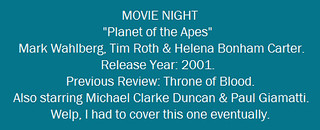
Planet of the Apes (2001).


Review #969: Planet of the Apes.

Cast: 
Mark Wahlberg (Captain Leo Davidson), Tim Roth (General Thade), Helena Bonham Carter (Ari), Michael Clarke Duncan (Attar), Paul Giamatti (Limbo), Estella Warren (Daena), Cary-Hiroyuki Tagawa (General Krull), David Warner (Senator Sandar), Kris Kristofferson (Karubi), and Erick Avari (Tival) Directed by Tim Burton (#040 - Batman, #107 - Beetlejuice, #132 - Alice in Wonderland, #196 - Charlie and the Chocolate Factory, #262 - Corpse Bride, and #316 - Batman Returns)

Review: 
On the cusp of a new film from the Planet of the Apes franchise (of which I've covered three of them: #347 - Planet of the Apes (1968), #615 - Rise of the Planet of the Apes#662 - Beneath the Planet of the Apes) , I figured that it made sense to cover the 2001 film of the same name that was a remake and an attempt to start the franchise up again; I remember my dad watching this on DVD one quite a bit when I was growing up, and the only part I remember vividly was the ending, so perhaps that colors my thoughts on the movie (although it is the probably the only part of the film anyone remembers). Not only does it try to be based of the 1968 film, it also is based off the novel La Planète des Singes (known in English as Planet of the Apes) by Pierre Boulle. So how does this "reimaging" do?

How is it a movie with a good deal of production value like this manage to feel so shallow? What is it about this movie that springs an energy of mild but not quite there sense of entertainment? How is this not as good as the original? Unlike the ending, these are questions that the movie can provide answers for. The easiest way to say why the movie isn't particularly exciting is the fact that the story and some of the acting seem hollowed out and not as appealing as in the original 1968 film. Wahlberg doesn't do a terrible performance, but he also never really springs much enthusiasm as a lead hero; even a scene where he laments the loss of a crew looking for him doesn't have much emotion to it. It's not that he is inherently unlikable, it's just that he also isn't inherently one to really root for. Not to compare it with the original too much, but Heston's character was someone the audience could go for and want to see succeed, and he actually viewed the environment he landed in with a better sense of shock, as opposed to Wahlberg's space jockey attitude. Technically he has two love interests in the film, though neither have particularly good chemistry with him and it predictably goes nowhere. Roth steals the show with his militaristic, scenery chewing performance that gives the film a bit of life, even if his fate is somewhat of a letdown. Bonham Carter is fairly decent, but she doesn't really give too much depth or life to the character that one probably would've wanted from the role. Clarke Duncan and Hiroyuki Tagawa are fairly decent standouts as well; Warren doesn't really have too much expression nor impact, and Giamatti does fine in a smarmy role that probably had more screen-time than it probably should've had. Charlton Heston has an uncredited cameo appearance, having a somewhat pivotal role that is interesting in the one scene he appears in. The prosthetic makeup by Rick Baker is commendable and quite an upgrade from the original, with this likely being the only shining achievement in the movie. The plot is a bit muddled, and with no real character to go for and care about, there isn't much to want to watch happen. It's watchable as an action flick, but not so much as a science fiction movie. Burton does direct the movie fine enough, with the movie looking pretty decent, but the way that the movie operates with its characters sinks its hopes.

And of course there's the ending. To some, the ending could be viewed as a reasonable way to end the movie and leave the possibility of doing a sequel (as Burton has stated), or it could be viewed as one that doesn't make much sense. It's interesting, considering the ending falls in line with the novel that it is based off of. For me, it was weird watching the movie in full and then getting to the ending and finding myself giggling at it. Who knows how Thade beat Leo to Earth? Who can care to speculate about what the ending is supposed to mean? After all, this is a movie that never really kicks into full gear, with the ending that is like the movie: mild, without much substance. It's not awful, but it also doesn't feel entirely necessary either.

Overall, I give it 6 out of 10 stars.

February 22, 2014

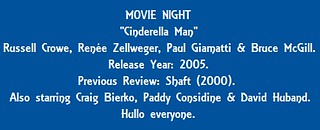
Movie Night: Cinderella Man.


Review #546: Cinderella Man.

Cast
Russell Crowe (James J. Braddock), Renée Zellweger (Mae Braddock), Paul Giamatti (Joe Gould), Bruce McGill (James Johnston), Craig Bierko (Max Baer), Paddy Considine (Mike Wilson), David Huband (Ford Bond), Connor Price (Jay Braddock), Ariel Waller (Rosemarie Braddock), Patrick Louis (Howard Braddock), Rosemarie DeWitt (Sara Wilson), and Linda Kash (Mrs. Gould) Directed by Ron Howard (#301 - How the Grinch Stole Christmas)

Review
Damon Runyon once described the life of James J. Braddock in one quote: "In all the history of the boxing game, you'll find no human interest story to compare with the life narrative of James J. Braddock." The movie attempts to make a winner of that story, and it succeeds. It's taken over 500 reviews, but I finally reviewed a move that has Russell Crowe, and he does a good job, he dominates the movie, but he does let the other two in the main trio of main actors shine, Zellweger does well, especially in the scenes with Crowe, and Giamatti is memorable, along with really talented. The boxing action is good, it certainly looks like a match, and the interior scenes look good along with it. The movie has an old fashioned feel that certainly looks good on film. The movie may have good boxing, but it also focuses on the downturns of the Great Depression and Braddock's family, and the scenes make the movie more whole, it doesn't bring the film down, it just gives it a new voice to keep on going. This is a good film that manages to be both entertaining and warming.

Overall, I give it 9 out of 10 stars.