Showing posts with label Eugene Pallette. Show all posts

September 6, 2022

The Love Parade.

Review #1881: The Love Parade.

Cast: 
Maurice Chevalier (Count Alfred Renard), Jeanette MacDonald (Queen Louise), Lupino Lane (Jacques), Lillian Roth (Lulu), Eugene Pallette (Minister of War), E. H. Calvert (Sylvanian Ambassador), Edgar Norton (Master of Ceremonies), and Lionel Belmore (Prime Minister) Produced and Directed by Ernst Lubitsch (#1026 - The Shop Around the Corner and #1358 - To Be or Not to Be)

Review: 
"I made sometimes pictures which were not up to my standard, but then it can only be said about a mediocrity that all his works live up to his standard."

So, here we are with an example of film directors honing their craft with the dawn of sound in features. Ernst Lubitsch had been a director after honing his craft in the early 1910s as an actor in his native Germany, doing so with a mix of comedies and historical dramas before notice abroad led him to leave for Hollywood in 1922. He directed for various studios over the next two decades, and one wouldn't be surprised that his first part-sound film in The Patriot (1928) earned him an Academy Award nomination. The Love Parade, which premiered in late 1929 but not released to the public until January of 1930, is his first true sound feature. Go figure that his first sound film featured two singers for actors. Chevalier became a performer in his native France since the turn of the 20th century, with only a stint as a prisoner of war in World War I serving to interrupt his career (apparently his two years as a POW is where he learned English). He did appear in a number of films before this one, which included Innocents of Paris (1929), but it is this film that made him a key name, although he had to be convinced by Lubitsch that his voice (a working-class one) would fit the style that Lubitsch wanted with a fantasy-land European sounding country. As for MacDonald, she was in the business of performances since she was a child, complete with touring in kid shows before becoming a teenager and soon doing stints on Broadway. Strangely enough, the way to her becoming involved with this film came from a screen test for a film she wasn't allowed to do (due to contract), since Lubitsch happened to look through old screen tests and found the one he wanted with her, with this being her debut feature. MacDonald and Chevalier would do a couple of films together (most notably with The Merry Widow (1934), which had Lubitsch as director).

The film is based on the play The Prince Consort, a French play written by Jules Chancel and Leon Xanrof (which in turn had been a Broadway play in 1905). Guy Bolton and Ernest Vadja wrote the screenplay for the film. Lubitsch made a musical different from the early approaches of doing a sound movie that folks saw with The Broadway Melody (1929) in having songs performed in front of a static camera. In other words: sometimes to tell a story, you tell it with a song, complete with a solid supporting cast to back them up in amusement. When it comes to good-natured escapism, you can't go wrong with something like this, one that makes for a solid achievement of entertainment. It does so with gusto of energy from its director that gives its main stars things to do beyond just being vehicles to sing, as their chemistry together proves quite refreshing. It is a romance of assessment, one where the wooing isn't as important as the process of finding out just what love really means to people living in a royal place where everyone seems to have their noses in business. Chevalier makes a quality rogue to follow with from the very first sequence we see and hear of him in the 107-minute feature, which involves him dealing with a scorned lady and even sees him address the audience for a moment (singing won't come for quite a while, and he isn't even the first one to sing) before fake weapons get used for playful fun. He has a sly charisma that seemed exotic for audiences in need of someone like him in a time for new sounds and charms. Of course, MacDonald isn't to be lost in the shuffle, because her self-assured charm and collected confidence make a worthy match, one who can sing as well as she can delegate with him in graceful charm. Being a royal is one thing, being a happy royal is another, one might say. Lane and the others (including the distinct voice of Pallette) make worthwhile contributions in chuckles along with a bit of singing that make it a splendid romp across romance and the lines between being just someone's spouse and being in love. In that sense, it works out quite well, complete with having Lubitsch find ways to get around early sound quirks, complete with directing two couples to sing the same song in alternative places by having two sets built (orchestra between them off camera) that he could then piece together with editing. As a whole, it may move within the expectations that encapsulate romantic musicals, but it still manages to move with resourceful timing and pace from cast and crew that worked beyond the dreams of what one thought sound movies could be that still seems engaging today. For that, Lubitsch seems just as interesting to look back now more than ever.

Overall, I give it 8 out of 10 stars.

August 9, 2022

The Mark of Zorro (1940).

Review #1869: The Mark of Zorro.

Cast: 
Tyrone Power (Don Diego Vega/Zorro), Linda Darnell (Lolita Quintero), Basil Rathbone (Captain Esteban Pasquale), Gale Sondergaard (Inez Quintero), Eugene Pallette (Friar Felipe), J. Edward Bromberg (Don Luis Quintero), Montagu Love (Don Alejandro Vega), Janet Beecher (Senora Isabella Vega), George Regas (Sergeant Gonzales), Chris-Pin Martin (Turnkey), and Robert Lowery (Rodrigo) Directed by Rouben Mamoulian (#773 - Applause)

Review: 
Zorro, if you remember correctly, originally appeared in serialized form in 1919 from author Johnston McCulley, which went under the title as "The Curse of Capistrano" (it has since been published as The Mark of Zorro). As such, the first film adaptation came with The Mark of Zorro (1920), with Douglas Fairbanks as the adventurous one-man force that served as a co-writer, producer, and star. 20th Century Fox had the rights to do a remake when they bought them from Fairbanks, although it did not stop other stories to be adapted involving the character as created by McCulley, such as Republic Pictures making The Bold Caballero (1936). Of course, Tyrone Power is an ideal matinee idol to take the helm as the title lead. The Cincinnati native was an actor as was the case with his Irish great-grandfather (the original Tyrone Power), his grandmother (Ethel Lavenu), and his father (Tyrone Sr.). He appeared in films starting in 1932, but it was his appearance in his fifth with Lloyd's of London (1936) that made him into a screen presence worth seeing on the screen over and over, and he was only 22. At the helm of director was a solid successor from Fred Niblo in Rouben Mamoulian. He had emigrated from the Russian Empire to England before to direct plays before moving to the States to teach and direct opera/theatre. He would direct a variety of productions even after entering film such as Oklahoma! and Carousel. His first film was Applause (1929), an early sound feature, but his best-known feature is probably Dr. Jekyll and Mr. Hyde (1931). He would direct films on a regular basis from 1929 to 1942 (with two more films afterwards) that did a variety of genres (noir, musicals, adventure) while also serving as a founding father for the Directors Guild of America; he died at the age of 90 in 1987. Six years before his death, Zorro, the Gay Blade (1981) was dedicated to him as a tribute to the classic adventure portrayed in this film. 

The screenplay was done by John Taintor Foote while the story was done by Garrett Fort and Bess Meredyth. One other key tribute came with the world of comic books, as it is one of the parts of the original origin-story of Batman (whose parents were killed after a screening of the movie); Zorro in general proved an inspiration to the concept of Batman as devised by Bob Kane and Bill Finger, since both characters are folks presenting themselves as rich playboys while secretly fighting crime in a dark costume. Coincidentally, this film has a member of the cast in Robert Lowery, who would become the second actor to play the character of Batman in a film serial later in the 1940s. This film and The Adventures of Robin Hood (1938) share two actors basically playing the same type of character with Rathbone and Pallette. It might not be as great as the original feature in terms of outright professionalism and newness (i.e. not being the first great Zorro adventure), but it does make for a solid adventure film with enough reason to exist with a capable lead and all-around charm to make it just as interesting for the curious moviegoer to view hand in hand with past and future Zorro movies. Mamoulian achieves a film with plenty of fluid engagement and rhythm that achieves plenty in 94 minutes. The balance of narrative and action is done to where one isn't aching to see too much of one over the other, moving along with smiles rather than gloom. Power plays the double act required in the title lead with worthy screen presence, dashing in the moments needed for his public face but also riveting when it comes to being the man in black with an accompanying tight drawl. He might be young, but he has the presence of an old soul that probably would've fit well in a variety of action eras (sure, Zorro should probably be played by someone of a different ethnicity when it comes to helping people living in California before it became a state, but one must pick their battles when it comes to older films). Darnell and Power have semi-decent chemistry together despite the age difference (ten years between the 26-year old Power and, well...) with at least some sort of general innocence to make things look semi-solid (Sondergaard does seem more intrigued to be in the same room with Power at times though). Pallette is the ideal pairing with Power in heroic accomplice for all of his drawing power in voice qualities and timing. Bromberg makes for a decent stooge pretender, although Rathbone is the key other highlight, one with dignified ruthlessness that simmers well against Power in the ways expected to help make its ultimate endpoint quite worth it (of course, he was quite good with fencing to where he did not need to have a double). Fred Cavens helped choregraph the fencing sequence while his son Albert served as a stunt double for Power in shots from behind, which means one isn't watching sequences of folks jumping around while trying to fence (not that there's anything wrong with that, since it is execution that matters more than anything). The funny thing is that it isn't the final part of the film, since there's still a bit of time left to wrap things up, which works out just fine, bookending itself in throwing a sword into the air with winking convenience. As a whole, it runs at a slick rate that will dazzle all whoever heard of the term "matinee" and lined up to see it with rapt attention, packed with energy that has not dulled over the prevailing eight decades since release that shows how one can re-adapt prior material and make it seem fresh and worthy of viewing for audiences that other films wish they could do so well.

Overall, I give it 8 out of 10 stars.

Next Time: Sanshiro Sugata.

January 12, 2022

My Man Godfrey.

Review #1787: My Man Godfrey.

Cast: 
William Powell (Godfrey), Carole Lombard (Irene Bullock), Alice Brady (Angelica Bullock), Gail Patrick (Cornelia Bullock), Jean Dixon (Molly), Eugene Pallette (Alexander Bullock), Alan Mowbray (Tommy Gray), Mischa Auer (Carlo), and Pat Flaherty (Mike Flaherty) Directed by Gregory La Cava.

Review: 
Admittedly, this film had been on the waitlist for quite a bit of time. The 1930s were an interesting time to see sound comedies make their way to the big screen with various stars and directors adapting (or not) to growing demands set by an audience that had plenty of interest in having a good time at the theater (of course, there was still room for a few little timely references of the day, but you get the idea). At any rate, it is also a decade that deserves far more coverage besides the usual classics; of course, this film is in of itself considered a worthy classic, considering that it features William Powell and Carole Lombard at their pinnacle in stature to go with a seasoned director with Gregory La Cava (he had agreed to do the film with Powell...and Constance Bennett). Born in 1892, the Pennsylvania native had started his adulthood in animation studios beginning in 1913; in 1922, he moved to Hollywood to do features (specifically comedies, shorts and features). By the time La Cava directed his final film in 1948, he had done over a hundred directorial efforts (with over thirty features), and he had seen five of his films receive notice with Academy Award nominations (with this being one of them); he died at the age of 59 in 1952.

The film is adapted from the 1935 novel 1101 Park Avenue by Eric Hatch. Hatch and Morrie Ryskind wrote the screenplay while Zoƫ Akins and Robert Presnell Sr served as contributors. As a screwball comedy, it proves quite efficient in its 94-minute run-time with a biting edge and energy from its main actors that makes for a fairly dignified time (perhaps it shouldn't be surprised that a remake would follow in 1957 alongside a Broadway production in 1985). There have been quite a few butler movies over the years, and this one does well with examining its quirky characters and situations without turning into outright farce. It is Powell that draws the most curiosity, in part because of how he manages to handle the screwball aspects with apparent clarity that has good timing and dignity. Of course, Lombard (cast at the request of Powell, who were actually married for a time) is right there to match against him with plenty of grace and charm that draws in her share of laughs, which is generally spent with Powell for interesting moments that all start with trying to one-up a scavenger hunter. Patrick makes a worthy snob to the antics, adept in bite that matches against the two leads well enough. Brady, a veteran actress of the silent and sound eras (who had taken a ten-year break from films to do stage in 1923), makes for a quirky figure among the others, doting but offbeat in all the right ways. Pallette was a noted character presence for hundreds of films in three decades, and he certainly engages well as the straight man to everybody with that distinct voice and timing. The sequence in the first half where Powell is subjected to questions as the "forgotten man" that are closed with him making fun of then is probably the most interesting moment of the film in bite, although there are quite a few more things one could highlight (such as the first scene with him with Pallette and the others together). It has a capable energy to its screwy elements that for the most part sticks the landing by the time it reaches the inevitable closing. The weird status in the public domain (where the film copyright accidentally was left to lapse but the book copyright did not) might make it a useful curiosity to seek out as well, and one will surely be rewarded by what they see here. La Cava and company made a fine film with enough amusement that serves well for itself 85 years later.

Overall, I give it 9 out of 10 stars.
Next Time: Henry V (1944).

February 25, 2020

Topper.

Review #1346: Topper.

Cast: 
Constance Bennett (Marion Kerby), Cary Grant (George Kerby), Roland Young (Cosmo Topper), Billie Burke (Mrs. Clara Topper), Alan Mowbray (Wilkins), Eugene Pallette (Casey), Arthur Lake (Elevator boy / Bell boy), Hedda Hopper (Mrs. Grace Stuyvesant), Virginia Sale (Miss Johnson), and Elaine Shepard (Secretary) Directed by Norman Z. McLeod (#688 - Horse Feathers)

Review: 
One needs a gimmick sometimes to make a comedy click with interest. One involving fun-loving ghosts haunting their stuffy friend sounds like a good one to go with. The main trio of actors involved with this film each have their own versatile qualities to help make this a quite enjoyable experience. Bennett was known for her work in melodramas alongside comedies that made her a prime star of the 1930s (having also made the shift from silent to sound films), while Grant was slowly gaining recognition for his suave charm (having moved from vaudeville to film in 1932), and Young was known his diverse work in comedies, mysteries, and dramas. Of course a film needs a good director to lead the actors together, with Norman Z. McLeod being a worthy one to help with comedy. The WWI fighter pilot-turned film-man started his career as an animator with comedy shorts, and it was his skills as a gagman that would serve him well for his eventual directing career. His big break was assistant director on the 1927 film Wings, and he had his directorial debut with Taking a Chance (1928). Before his death in 1964, McLeod directed films with notable comedy actors that ranged from W. C. Fields to the Marx Brothers to Bob Hope. The film was an adaptation of the 1926 novel (known as both Topper and The Jovial Ghosts) by Thorne Smith. The sequel novel Topper Takes a Trip (1932) would also be adapted into a film in 1938, with a further film named Topper Returns (1941) coming to theaters a few years later. Young and Burke appeared in all three films, while Bennett and Mowbray appeared only in the sequel. In any case, this is an entertaining comedy, full of charm with little moments and entertaining chemistry between Bennett, Grant, and Young that makes the 97 minutes go without too many hitches. It's a silly charmer (for a film that has its main couple die in the first 25 minutes, anyway) that runs its gags to good mileage, whether that involves sight gags where special effects help make things look like they move on their own (such as a ghost driving a car) or whimsical screwball dialogue (which helped sell Grant on doing the idea when hesitant on the supernatural material). Bennett and Grant thrive on inspiring fun and charm, while Young succeeds on his dryness alongside a daffy Burke. Playful and absurd, it should be no surprise that turned out the way it did as a neat little supernatural comedy gem, deserving of a watch to see charm display itself on screen with such effective power that is executed well enough to make for interesting entertainment.

Overall, I give it 8 out of 10 stars.

February 11, 2020

Shanghai Express.


Review #1337: Shanghai Express.

Cast: 
Clive Brook (Captain Donald "Doc" Harvey), Marlene Dietrich (Shanghai Lily / Madeline), Anna May Wong (Hui Fei), Warner Oland (Henry Chang), Lawrence Grant (Reverend Carmichael), Eugene Pallette (Sam Salt), Gustav von Seyffertitz (Eric Baum), Louise Closser Hale (Mrs. Haggerty), and Emile Chautard (Major Lenard) Directed by Josef von Sternberg (#1325 - Underworld)

Review: 
One needs a little adventure in their life. Of course they also might need a good partner to go along with it to make it really come alive. Naturally, one could think of Marlene Dietrich when asking for a description of someone glamorous and exotic enough for said adventure. Born in Berlin, she had studied the violin and briefly worked in a pit orchestra for a cinema and their silent films before becoming a chorus girl and eventually finding small parts for film and theater, with her first appearance on film being The Little Napoleon (1923). However, it was in 1930 that she received her breakthrough opportunity with the UFA production of The Blue Angel (1930), directed by Josef von Sternberg. He is a director who admitted that he regarded actors as "marionettes, as pieces of color in my canvas...I watch a motion picture as a surgeon watches an operation." That film proved to be a success, and the two would go on to work together at Paramount Pictures for six films in the following five years, with this being the fourth overall collaboration between the two. One can only appreciate the magic occurring on and off camera, with this being a journey with many stops worth checking out in terms of style and charisma, where even the dialogue seems like it is being spoken like a train. As one would expect, there is a vibrant group of characters to view with this adventure, where no one is exactly who they seem at first, much like how one can find themselves revealing things about themselves to strangers if on a trip long enough, and this film fits the bill of satisfaction at 80 minutes. Brook and Dietrich provide a one-two punch of workable chemistry, where one is absorbed in their passion, which works itself quite well with Dietrich when it comes to the camera and focusing on her absorbing qualities, captured neatly by cinematographer Lee Garmes alongside guidance from von Sternberg, who clearly knows what he wants in capturing a star in the midst of shining. Wong proves as resilient in her time on screen, as one could expect from a veteran star that had found success in both Hollywood and Europe despite the prevailing typecasting of the time. Oland, a Swedish born actor whose famous/infamous portrayal of the Chinese-American Charlie Chan remains a topic of discussion decades after his death, does a fine job in making for a compelling adversary, a scoundrel that we at first see with empathy before taking control. Grant provides some sort of moral edge alongside the motley crew of Palllette and the rest to make for an engaging sit-through, where one is entranced to see what goes on like a dream. Simply put, it is a charmer when it needs to be. Onscreen credits refer to this film being adapted from a Harry Hervey work referred to as both "Sky Over China" and "China Pass", although it apparently was never published. In any case, the script from Jules Furthman and Hervey served as the basis for two remakes in Night Plane from Chungking (1942) and Peking Express (1951). It shouldn't prove surprising that this was the hit of its year, even exceeding the star-studded Grand Hotel, which this film was compared to "on wheels". In any case, this is a fair charmer of entertainment, filled with romance and adventure with a wonderful Dietrich performance in a ride from von Sternberg that you never really want to see end.

Overall, I give it 8 out of 10 stars.

December 23, 2013

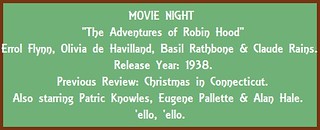
Movie Night: The Adventures of Robin Hood.


Review #505: The Adventures of Robin Hood.

Cast
Errol Flynn (Robin Hood), Olivia de Havilland (Maid Marian), Basil Rathbone (Sir Guy of Gisbourne), Claude Rains (Prince John), Patric Knowles (Will Scarlett), Eugene Pallette (Friar Tuck), Alan Hale Sr. (Little John), Herbert Mundin (Much), Melville Cooper (High Sheriff of Nottingham), Una O'Connor (Bess), and Ian Hunter (King Richard the Lionheart) Directed by Michael Curtiz (#125 - Casablanca and #416 - Yankee Doodle Dandy) and William Keighley (#501 - The Man Who Came to Dinner)

Review
This is the first film I've reviewed that starred Errol Flynn, along with the first of Olivia de Havilland, and they both are impressive, especially when they are paired together in scenes. Flynn is quite the adventurer and he does an extremely great job in the action scenes and the swashbuckling. Basil Rathbone (who I wanted to talk about in more detail when I eventually got to reviewing The Hound of the Baskervilles) is an effective adversary, getting a good fight with Robin at the end, but also being a good foil as well. Claude Rains lurks around as a fine villain that while not having a fight scene, is still a useful villain. The rest of the cast are effective at entertaining, especially Herbert Mundin, who while not given much to do, makes an impression, at least for me anyways. The action is excellent and the Technicolor give the film a colorful, yet memorable look. This is a well made, excellent adventure film that hasn't dated much, if at all.

Overall, I give it 10 out of 10 stars.