Showing posts with label Brian Donlevy. Show all posts

May 18, 2025

The Great McGinty.

Review #2381: The Great McGinty.

Cast: 
Brian Donlevy (Daniel McGinty), Muriel Angelus (Catherine McGinty), Akim Tamiroff (The Boss), Allyn Joslyn (George), William Demarest (Skeeters), Louis Jean Heydt (Thompson; "Tommy"), Harry Rosenthal (Louie), Arthur Hoyt (Mayor Wilfred T. Tillinghast), and Libby Taylor (Bessy) Written and Directed by Preston Sturges (#188 - Sullivan's Travels, #431 - The Palm Beach Story).

Review: 
"It's taken me eight years to reach what I wanted. But now, if I don't run out of ideas – and I won't – we'll have some fun. There are some wonderful pictures to be made, and God willing, I will make some of them."

Call it spring cleaning, call it overdue, it does seem right to return to the beginning of a worthwhile career with Preston Sturges as a director. Born in Chicago to parents that divorced when he was young, he actually served as a lieutenant in the United States Army Air Service in the late 1910s but did not see action in World War I. He had become a published writer when his essay about humor was printed when in camp, but he became an actual playwright later, after, well, a litany of stuff done that ranged from developing a kiss-proof lipstick to stage manager. The Guinea Pig, premiering in January 1929, came on a suggestion. Sturges apparently was spurred to come up with a play because a woman he was dating apparently was trying to write her own play. She wasn't actually writing a play, but Sturges and his efforts paid off with a small run on Broadway. He did a few plays but soon went to doing scripts-for-hire. Among the first scripts Sturges contributed as a writer-for-hire in Hollywood was the dialogue for The Big Pond in 1930. Probably his most noted script of the time came with The Power and the Glory (1933), a movie that happened to involve a recollection of the life of a now-dead tycoon by the people that knew him. So, how did Sturges become a director? Well, he had a script that seemed interesting to Paramount Pictures, and he sold it to them for apparently $10 with the stipulation that he direct it. The script originally was written in 1933 with Spencer Tracy in mind, but it had been unsuccessfully shopped around (even the Saturday Evening Post rejected it); apparently, Sturges was inspired by the tenure of William Sulzer as Governor in New York, where he was elected in 1912 as a Tammany Hall machine guy before he decided to pursue reform and was soon impeached and removed in nine months. The movie was shot in roughly a month, and the result was that Sturges won the first ever Academy Award for Best Writing (Original Screenplay) for his work here. Sturges would have a busy next couple of years, with this film being followed months later with Christmas in July. While his career would peak in 1944 because of quibbles with producers, Sturges ultimately directed twelve movies prior to his death in 1959 at the age of 60, such as The Lady Eve (1941), The Palm Beach Story (1942), and Hail the Conquering Hero (1944). Donlevy and Tamiroff would reprise their roles for The Miracle of Morgan's Creek (1942). 

Sure, of course this is the kind of movie that starts with a text screen: "This is the story of two men who met in a banana republic. One of them was honest all his life except one crazy minute. The other was dishonest all his life except one crazy minute. They both had to get out of the country." What you get is a recollection of grafting and the mockery that comes in seeing waste and corruption on display for the public that reminds you that the past wasn't merely just "the good ol' days" for everyone. Granted, we don't go around giving money to the bread-liner who votes, but who is going to say that people are more aware of their local politicians playing the grift game? But then again, how many honest people do you see in public anyway? In that regard, Donlevy makes for a quality lead performance, one that can be smooth in his ways of words that can bully/sweet talk plenty of people in the film because of how he makes it sound. In other words, when you get the chance at a hustle, you might as well jump at it in full force. Of course, it just so happens he does fall for Angelus because, well, there is a certain type of interest that she generates in her casual nature of normalcy even when playing a part in the initial scam of a happy family. Tamiroff* happens to make for quite the booming figure of the man behind the strings, a baron of his surroundings with plenty of timing to match in what you might call good ol' boy bluster. The 83 minutes passes through with ease and a worthy sense of biting wit for the ridiculousness that comes through in politics and people in general with what they believe is worthy for the people to see from the public and the real price of truth and power. The movie chuckles along with itself in the manner of someone who knows a cynical ditty and is all the more ready to make a yarn about it, and this is a worthwhile debut for Sturges and company, managing to be a funny film of grifts and grafts gone by the wayside of influence that is a neat gem for those to encounter all these years later.

Overall, I give it 9 out of 10 stars. 
*Orson Welles once called him "the greatest of all screen actors."

November 5, 2022

The Quatermass Xperiment.

Review #1917: The Quatermass Xperiment.

Cast: 
Brian Donlevy (Professor Bernard Quatermass), Richard Wordsworth (Victor Carroon), Jack Warner (Inspector Lomax), David King-Wood (Dr. Gordon Briscoe), Margia Dean (Mrs. Judith Carroon), Maurice Kaufmann (Marsh), Harold Lang (Christie), Lionel Jeffries (Mr. Blake), and John Wynn (Det. Sgt. Best) Directed by Val Guest (#224 - Casino Royale (1967))

Review: 
"It wasn’t quite like anything fans had seen before. The success of the picture helped put Hammer on the road to specializing in sci-fi and horror movies.”

You may know the film as The Creeping Unknown, since that was the issue title when released in America (with a run-time of 78 minutes as compared to the British 82 minutes). But we are talking about a film made by Hammer Film Productions as one of their first big hits, and the reason for the X is because that was the Certificate (rating) it got from the British Board of Film Censors. The film is adapted from the 1953 television serial The Quatermass Experiment, which was broadcast for six episodes from July 18 to August 22 on the BBC (who agreed to a deal with Hammer for the rights to do a film). The episodes were transmitted live, but only the first two episodes survive due to the other four not even being recorded on their live broadcast. Each episode was written by Nigel Kneale and directed by Rudolph Cartier. Hammer co-produced the movie with Robert L. Lippert, the distributor/producer behind a number of American and British movies that had seen him finance and supply American stars for certain Hammer films in exchange for distribution of his films in the UK. With this film, American star Brian Donlevy was brought in to serve as the main character, as originally played by Reginald Tate. At director was Val Guest, who actually started out as an actor before he became a writer, first for London's edition of the Hollywood Reporter before a challenge by an interviewee had him writing his first screenplay, which led to a comedy career for a time before becoming a director in 1943. A director for Hammer of fourteen films (starting with The Men of Sherwood Forest), Guest wanted to make the film look as if it was filmed by hand-held camera. Kneale would write three further television serials (1955, 1958-59, 1979), with each being turned into feature films in 1957, 1967, and 1979, respectively. Hammer also did X the Unknown (1956), which was meant to be a sequel to this film before they had to do a bit of re-branding when Kneale refused to allow the title character of this film to be included, but Hammer would later be behind the 1955 and 1967 Quatermass features, with Guest directing the former.

It should be noted that Kneale was not too big on this film, one he had no involvement in and one that he did not like the casting of Donlevy. The ending being modified for one with action to decide the climax rather than a "talking down" as per the original probably didn't help either. As a film though, it does work out pretty well, primarily because it makes for a fundamentally sound 82-minute feature in balancing procedure and the eventual horror with useful and chilly atmosphere. Yes, it is a movie involving British astronauts being spooked by a mass of space from out there, but it is a clinically useful movie, never wasting its time on anything too pointless, aside from a few quiet characters. Donlevy is firmly in the middle between the general scientist cliche: he isn't a mad doctor nor is he exactly the one envisioned by Kneale, which certainly tried to appeal to scientific and moral authority, although he has been quoted as wanting to write a strong character that counteracted the "horrible people" in American sci-fi films. Honestly, I understand where he is coming for in his sensibility (I mean, he has more written works than most ever dream of), but I found Donlevy to be the ideal fit for what the film needs: hard-set in ways, regardless of the terror provided. He may seem like he was pulled out of a noir, but it works to his beat because of how he maneuvers the situation without becoming beholden to gobbledygook. If it was this guy that had to "talk the creature to death", we would laugh at it, so he seems right for what the script really wants in. He looks like a guy who cares about what he does in terms of basic execution and nothing else, which makes for quality tension when compared to the others - so yes, moving forward matters most. Wordsworth is the one notable interesting supporting presence, if only because he is the key man besides Donlevy to make an impression because of what he is asked to do as a slowly mutating (and quivering) shape. I enjoy seeing him play out the fear required to make this horror a relevant one to bring terror to proper shape (which evidently used bovine entrails and tripe). The stunt of electricity at a set to double for Westminster Abbey is a quality climax to go with a movie that for all of its low budget surroundings is generally involving, and I especially like the final little shot of Donlevy walking back without saying much to get back to what matters most in the logical sense: Beginning again.

As a whole, it may not compare to the original serial it arose from, but it does manage to make a useful impression for its audience that wants to enjoy what Hammer set out to do in horror sci-fi entertainment. It set the stage for them to seep further into the world of horror to entertain audiences in ways that hadn't been seen before, and for that, I think it makes the film a useful curiosity to look into.

Overall, I give it 7 out of 10 stars.

Next Time: House of Usher.

October 28, 2022

Curse of the Fly.

Review #1910: Curse of the Fly.

Cast: 
Brian Donlevy (Henri Delambre), George Baker (Martin Delambre), Carole Gray (Patricia Stanley), Burt Kwouk (Tai), Yvette Rees (Wan), Michael Graham (Albert Delambre), Mary Manson (Judith Delambre), Charles Carson (Inspector Charas), Jeremy Wilkin (Inspector Ronet), and Rachel Kempson (Madame Fournier) Directed by Don Sharp.

Review: 
Return of the Fly (1959) was not exactly a good movie to follow The Fly (1958), but you can at least understand where one would have fun in making a quick buck when success had just struck before. Robert L. Lippert loved making movies on the B-level, making over 200 movies. Of course, by 1966, now he was making movies in England that had distribution by 20th Century Fox, because making movies in Hollywood was not as cheap (plus with the Eady Levy, there was a tax on box office receipts in England for nearly two decades). This was the phase in his career that saw films such as Witchcraft (1964) and The Earth Dies Screaming (1964), for example. His career ended with The Last Shot You Hear (1969) when he and Fox mutually parted ways. At any rate, Lippert figured he could churn out one more of these films with the rights he had, so he tasked Harry Spalding, the writer behind plenty of Lippert productions, to go along with the idea. Don Sharp was recruited to direct, and he stated that the opening pages at the asylum were pretty good although he said the overall script "wasn't good enough". It did not help that he and Spalding were not particularly happy that Donlevy was cast as the lead, because Spalding actually envisioned Claude Rains (by that point 75 years old, as opposed to Donlevy, who was 64) in the role. In fact, it seemed to help Sharp lose confidence in what he made, since the only reason he did the film was to get back in the directing chair after spending months doing second-unit work on Those Magnificent Men in Their Flying Machines (1965); Sharp had moved from acting to directing by the mid-1950s and would direct for three decades.

The film never received a proper video release on VHS or LaserDisc, being rarely seen for many years until the 21st century, and it didn't help that the movie was little seen on release in 1965. Calling it the movie where a fly isn't present is probably the easiest way to describe it, but there are a few decent points made when not mired in complete mediocrity. Both Fly sequels aren't good, but they make useful curiosity pieces as the depths one can go in trying to draw blood from a stone. This film is technically a sequel, in that it retains the family name seen in the last two films (Delambre) and even shows a still from the second film that tries to connect the dots, although the Delambre here is...the son of the guy who got turned back into a human in the second one, I think (well, maybe the elder Delambre is the one played by Donlevy, but the second film had him named Philippe, so...). Hell, put it like this: a guy got turned into a fly, went nutty, then got turned back into a human, but his offspring have after-effects...a curse, you might say. Yep, that is what the title refers to, as the family is cursed to keep trying to do teleportation (oh, and they had tested on others, with...less than savory results); they basically act like mad scientists, but with a bit less competency (one guy teleports across the continent but can't go anywhere because he has no passport and gets sick to go along with that - the climax of his fate is just as amusing). With an 86-minute run-time, the result is a movie that doesn't particularly get more interesting than the opening scene with a woman breaking out of an asylum and casually lying her way in hitch-hiking (yes, the escape is presented in slow-motion). The rest manages to be a stiffly executed feature that moves in exactly one way that seems inevitable in plodding nature that means one is trapped with a movie that never reaches greatness or awfulness. It is too modest to go anywhere beyond mildness, as if the idea of a family trying to reach for "the greater good" is just a bit too quiet. 

Well, casting the man behind a number of tough guy roles and The Quatermass Xperiment (1955) seemed like an interesting plan. Donlevy isn't terrible in the film, but I think you can see where the filmmakers seemed like they didn't have the guy they wanted, since he seems a bit too quiet to really make the role seem anything more than a pale one, and I imagine even an elderly Rains would lend some gravity to the situation. You should feel the ooze of a man who sees experiments go really wrong (including on himself) and decides to go full speed anyway. This goes for Baker as well, who has to deal with the fact that he has a middling chemistry with Gray that tries to play the angles of both having secrets on the other and her possibly going nuts (ooh, the asylum escapee thinks she is going nuts, wonder how that will work out). Seeing the reaction to the first wife being used to test the experiment (and the horrifying result probably sounds a tad more interesting, but I digress. It just seems all too plain, never really seeming to gain much steam besides a few cheap effects, such as a writhing mass concocted by teleporting two people in the same chamber, or the moments where the younger Delambre starts to show his age. The feeling of inevitability overwhelms the movie in a way that just makes things out to feel like obligation rather than general interest. There are ideas here that could make for a fun time, but it just can't go beyond first gear to really get anywhere. It is a watchable sequel, and in some ways, it may prove a bit better than Return of the Fly but neither movie hold a candle to The Fly (original or remake). If you want to see just where the road leads in sequels for horror movies and like to see obscure movies not be held out, I suppose here is your chance.

Overall, I give it 6 out of 10 stars.

May 12, 2017

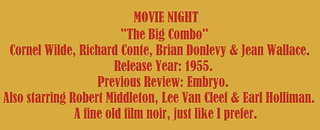
The Big Combo.


Review #934: The Big Combo.

Cast:
Cornel Wilde (Police Lt. Leonard Diamond), Richard Conte (Mr. Brown), Brian Donlevy (Joe McClure), Jean Wallace (Susan Lowell), Robert Middleton (Police Capt. Peterson), Lee Van Cleef (Fante), Earl Holliman (Mingo), Helen Walker (Alicia Brown), and Jay Adler (Sam Hill) Directed by Joseph H. Lewis.

Review:
When it comes down to film noirs, there is always something interesting about their appeal, whether it be due to the cast (or supporting cast), the way that it is shot, the way that it is structured, or even just the way that it is on an entertainment level. The Big Combo (produced by Theodora Productions and Security Pictures while distributed by Allied Artists Pictures) stands out in how nifty it operates with the cast and pacing. It isn't a great movie, but it certainly is a good enough movie that works on enough entertaining levels. It has a raw edge to it (particularly with one scene involving tonic) that underlies a fairly well-moving gangster movie. Wilde and Wallace (who were married at the time) have their fair share of moments together that work due to how they balance each other and their roles simply and coherently. Conte is a capable villain, giving this character the professional touch required for the movie. Donlevy does a fine job as the right-hand man to Conte, and they do a fine job balancing out their nefarious operation. The rest of the cast are serviceable in their supporting roles, not doing anything to ruin the balance or tone. The latter half of the movie is well executed, with Conte's fate being particularly memorable to watch; the climax in a foggy hangar is done quite well. At 87 minutes, it certainly has a good pace to it that is readily accessible. It's the final scene, with Wilde and Wallace standing in the airport with fog and shadows around them that stands out among the rest, with the credit going to John Alton and his cinematography that resulted in such a nice shot in a movie that works best as a neat little film noir gem.

On a different note, I graduate from my local college (South Texas College) today, with an Associate's Degree in Secondary Education in hand. What a ride it has been for four semesters, especially with how Movie Night has operated around it. With any luck, the reviews will keep coming, no matter what the next step is for me as long as I continue to enjoy doing them, which I still do. Thank you.

Overall, I give it 8 out of 10 stars.