Showing posts with label George Siegmann. Show all posts

November 2, 2022

The Cat and the Canary (1927)

Review #1914: The Cat and the Canary.

Cast: 
Laura La Plante (Annabelle West), Creighton Hale (Paul Jones), Forrest Stanley (Charles Wilder), Tully Marshall (Roger Crosby), Gertrude Astor (Cecily), Flora Finch (Susan), Arthur Edmund Carewe (Harry), Martha Mattox (Mammy Pleasant, housekeeper), George Siegmann (the Guard), and Lucien Littlefield (Dr. Ira Lazar) Directed by Paul Leni (#863 - Waxworks and #999 - The Man Who Laughs)

Review: 
When it comes to the haunted house movie, you can't go wrong with The Cat and the Canary, even if it wasn't the first to really come out. There were quite a few films with a killer going around a house, such as Cecil B. Demille & Oscar Apfel's The Ghost Breaker (1914), its 1922 remake by Alfred E. Green, D. W. Griffith's One Exciting Night (1922), along with Roland West's The Monster (1925) and The Bat (1926), for example. It would continue in further years, with West remaking his film in 1930 as The Bat Whispers, and James Whale directed The Old Dark House (1932). But some films last longer in the public consciousness than others, as is the case with a film like this. The movie was adapted from the 1922 play of the same name that had been written by John Willard to noted success on Broadway. The screenplay was written by Alfred A. Cohn and Walter Anthony, while the story was done by Alfred A. Cohn and Robert F. Hill. This was the first of five adaptations: Universal did both an English and Spanish version in 1930 (The Cat Creeps and La Voluntad del muerto, respectively), which are both lost. A 1939 film was done with more comedy involving Bob Hope and Paulette Goddard, while the next (and last) adaptation was done in 1979 for British audiences. It was the first of four American films directed by German director Paul Leni, the German Expressionist director that went from avant-garde painting to set designer to work in film by the 1910s. He moved to America at the invitation of Carl Laemmle at Universal Studios, as part of a wave of people from Europe coming to America for films (like Fritz Lang, for example). The Last Warning (1928), his final film, was presented as a companion film to The Cat and the Canary, as it also stars La Plante (it was released in both part-sound and silent, but the latter survives), albeit more as a mystery than comedy-horror. Leni would not live long to direct many films in America, dying of a sepsis from a tooth infection in 1929 at the age of 44.

So yes, we have a story about a creepy house filled with folks hearing about a will from a man 20 years dead. The only thing standing in the way of riches for one is to just not be declared insane but sliding panels and a fiend called "The Cat" threaten the whole affair. So yes, the suspense is balanced with comic relief, because this was the time for that kind of movie where horror can't be given to you full throttle, and the final twist is about what you might expect. However, it is the presentation that matters most, and that is where Leni shines. He utilized all of the tricks one would hope for in terms of establishing quality atmosphere, whether that involves shadows, superimpositions, gliding camera shots, or its lively title cards. The scene with a person walking in the hallway with a candle in hard while curtains blow is certainly a highlight when it comes to striking effect, alongside the opening sequence when it comes to saying "a man is trapped like a canary". So yes, the movie is a causal ride of spooky terror that fits far better than a movie without as much subtlety, because, well, things in 1927 can still play well in 2022. La Plante was a key presence for a number of Universal Pictures in the pre-sound era, and she does pretty well for not having too much to really do besides having things happen to them rather than with them. So yes, it's not too hard to be on her side when it comes the towering threat of spooked either by weirdo eccentrics or visitors. The other castmates are mostly there for relief without pandering to bad jokes, which works in favor for Hale in goofy charm that compliments La Plante pretty well or with the familiar face in Marshall. The others bumble in all the right ways without leaving an obvious clue to what could happen next. Yes, you have a good idea where things could go in its 82-minute runtime by about the halfway point, but it still is weird and engaging enough regardless of that fact. As a whole, it is a solidly dignified bit of horror worth a look for its era, being unsettling while having a solid atmosphere that makes everything work out just right.

Overall, I give it 8 out of 10 stars.

Well, we have had a quality month of horror. But you know the turn to November means it ain't over yet. As with the case with 2019, 2020, and 2021...it is time for Halloween: The Week After 4.0. That is correct, a number of horror reviews from November 1 to November 7, basically comprised of movies that deserved to be covered in October but are now present in November for all to enjoy. This time, I will be generous and tell you what is coming next because I like you very much.

Next film up is Exorcist II: The Heretic. Shit.

October 2, 2022

The Avenging Conscience.

Review #1895: The Avenging Conscience.

Cast:
Henry B. Walthall (The Nephew), Blanche Sweet (His Sweetheart), Spottiswoode Aitken (The Uncle), George Siegmann (The Italian), Ralph Lewis (The Detective), and Mae Marsh (The Maid) Written, Produced, and Directed by D. W. Griffith (#415 - America#695 - Broken Blossoms, and #1317 - Way Down East)

Review: 
You have to remember that film is an old medium, one that had to evolve beyond shorts and productions made in humble little studios. This is how it works out for horror, which has been there in some shape and form from the beginning, although we are here to talk about features because of their depth, regardless of the notability that came with early ones such as The House of the Devil (1896) or Frankenstein (1910). One of the people at the forefront of doing films that became more than what they were was D. W. Griffith, who went from failed attempts at script-writing to acting in 1908 only to become a director of shorts in that same year for Biograph Company, and it was he who became one of the first directors of films produced in the States alongside one of the first feature-length movies in Judith of Bethulia (1914). His disputes with the company over wanting to make features along with budgets and cast listing made him leave the company in 1914, taking his troupe of actors with him. Six months after the release of this film (the ninth he did in this year, keep that in mind) came The Birth of a Nation (1915) ...and you get the idea about Griffith being a name not long forgotten among cinema. The movie is based on two works by Edgar Allan Poe: the 1843 short story "The Tell-Tale Heart" and the 1849 poem "Annabel Lee". If one is curious about the film, it is widely available in the public domain for all to check out, and an alternate title is presented in the opening as The Avenging Conscience: or 'Thou Shalt Not Kill'.

You may remember that the Heart story was about a man killing someone and then being tormented by the thumping he hears from somewhere that sees his sanity unravel over where the body is. As for the poem, it was a lament for a departed woman that left someone, and certain lines from the poem are shown as intertitles in the film. So yes, this is how Griffith tries to make a bit of material rise out of loose story elements for 78 minutes of staging, complete with a lead character that is depicted as having a liking for Poe (right down to showing a picture of him). It results in a film that seems a bit corny now but surely must have been quite the interesting one for diverting time in 1914. Walthall makes a quality focus, conveying the spooked desires and regrets required in the role to make tension without overextending himself. He fidgets and makes you think about fidgeting without giggling. Sweet plays the role of affections and all that jazz, while Aitken makes a quality target foil for someone meant to exist as both a grump, alive or dead. The effect to show the ghost of the dead soul isn't anything spectacular, but it gets the basic job done in trying to set some sort of unease in a film that also shows a spider catching a fly and visions of Death and demons (and, perhaps not surprisingly, religious overtones). As hammy it is in actually setting up the story you are here to see, there is something curious in getting to the road of desire and tortured regret that Griffith makes work in enough ways to offset the actual ending. If you think "it was all a dream" seems a bit cliche now, imagine how it must have sounded 108 years ago, one that is both cheap for narrative purposes and the Poe story as a whole (but hey, if you are doing a story "inspired by Poe" where a Poe devotee happens to get in a situation similar to a story, who is the real winner here). As a whole, it might not exactly rank highly as a great horror feature, but as a curiosity for where the steps to get to seeing further chills for the audience in the pre-1930 era, it makes a good start.

Overall, I give it 7 out of 10 stars.

October 18, 2017

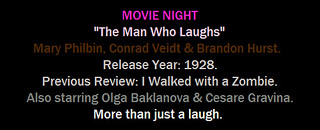
The Man Who Laughs (1928).


Review #999: The Man Who Laughs.

Cast: 
Mary Philbin (Dea), Conrad Veidt (Gwynplaine / Lord Clancharlie), Brandon Hurst (Barkilphedro), Olga Baclanova (Duchess Josiana), Cesare Gravina (Ursus), Stuart Holmes (Lord Dirry-Moir), Samuel de Grasse (King James II Stuart), George Siegmann (Dr. Hardquanonne), and Josephine Crowell (Queen Anne Stuart) Directed by Paul Leni (#863 - Waxworks)

Review: 
I figured that it would be fitting to do a silent film for the 999th review, with this being the 62nd of its type covered on Movie Night. You may notice that the square right next to the title card is in a few colors like pink, grey and black. These colors were utilized for the 99th review (Mutiny on the Bounty), albeit with a bit more stylizing this time around. Enjoy this review.

This was adapted from Victor Hugo's 1869 novel of the same name. The novel had one previous adaptation in 1921 named The Grinning Face, made in Austria. Universal had previously adapted Hugo's The Hunchback of Notre Dame (#850) back in 1923, and the intent was to have Chaney star in the title role after the success of that film, although issues to the rights of the novel meant that Chaney would be released from doing this film in favor of The Phantom of the Opera (#774). After that film's release, producer Carl Laemmle decided to try and make this as his next attempt at Gothic success, with Veidt picked to play the title role. Leni, who had recently moved to Hollywood after having been invited by Laemmele, was selected as director. Both choices prove to be fairly crucial in why this film works as well as it does; Leni uses his lighting and sets to fine effect, as one might expect from a German Expressionist such as him. Veidt wears a makeup device that made his mouth swollen while being supplied disturbing teeth, which contributes to the look of his character. While it is a great effect, it takes a good actor to help convey numerous emotions with only his eyes, and Veidt stands up to the challenge quite well. The appearance of Veidt proved to be the visual inspiration for the comic book villain the Joker, appearing in comics over a decade later. Philbin, playing a role not too different from her role from Phantom of the Opera (in which she played opposite Chaney), does a decent job, given that she is playing a blind person.

This film is sometimes counted as one of the films of the Universal Monsters series, and while it isn't much of a horror film, there is a fair amount of gloom within its tone to make a case for it, although it also has elements of romance and swashbuckling action. Yes, it has a climax with excitement, but the scenes that precede it also can be sad, such as when Veidt's character is shown in a freak show, or when he is being propositioned by Baklanova's character. The scene at the House of Lords proves to a moving and effective scene in part because of Vedit and his mannerisms towards the others. Though this is a silent movie, it was (on re-release) shown with sound effects, a synchronized score, and even a theme song (named "When Love Comes Stealing"). The sounds we get to hear are of laughter during the freak show, which is certainly a startling (and satisfying) effect, and the theme is fairly passable as well. As a whole, this is an efficient movie that satisfies on numerous levels while being fairly paced well at 110 minutes. It might not be the horror film that you might expect from seeing Veidt's appearance on screen, but it is a satisfying romance drama (with a bit of horror) with enough competence and style to make a top-notch effort.

Well. Here we are at end of review nine hundred ninty-nine. 
You are likely wondering what is next for the one thousandth review, so I'll tell you...

...tomorrow night, when the review is actually up. I'm not trying to hype the review, but I figure it makes sense to let you all wonder a bit and enjoy. 

Overall, I give it 9 out of 10 stars.

March 15, 2017

The Red Mill.


Review #915: The Red Mill.

Cast:
Marion Davies (Tina), Owen Moore (Dennis), Louise Fazenda (Gretchen), George Siegmann (Willem), Karl Dane (Capt. Jacop Van Goop), Russ Powell (Burgomaster), Snitz Edwards (Caesar Rinkle), William Orlamond (Governor), Fred Gamble (Innkeeper), and Ignatz (Himself) Directed by Roscoe Arbuckle.

Review:
Fear not, folks. Spring Break does not mean that Movie Night is on break. Reviews will pick up in the next few days, do not fear. 

The Red Mill was the first feature-length film directed by Roscoe "Fatty" Arbuckle, who was working under the alias of William Goodrich due to the Virginia Rappe scandal, in which despite being found not guilty (after two hung juries), his reputation (and his name) had been tarnished. In any case, here's a movie set in Holland. It's not too terribly interesting, but it does have some decent moments, when it lets the players have fun and not go too slapsticky. Davies does a decent enough jobs with reaction shots, even when having to deal with a haunted mill. That, and an ice race. Seeing someone try to ice-skate (albeit with a little bit of help) is a nice little highlight. Moore is tolerable, though Fazenda and Siegmann stand out a bit more, seeming to have a little more chemistry with each other than the main two. The supporting cast is tolerable, with people that you'll recognize if you watch enough silent films, like Snitz Edwards, who hams it up as usual. The plot (adapted from a 1906 musical) gets itself tangled up a bit with romance between numerous characters, but it mostly handles itself without going overlong. Like a good deal of silent films covered on this show, the run-time (70 minutes) helps the film as this could've been a chore if it had been 90 minutes or longer. Honestly, there are better silent films, but at least this one has its moments and scenery along with moderately entertaining inter-titles that make it worth a glance.

Overall, I give it 7 out of 10 stars.