Showing posts with label Erich von Stroheim. Show all posts

June 7, 2023

La Grande Illusion.

Review #2017: La Grande Illusion.

Cast: 
Jean Gabin (Lieutenant Maréchal), Marcel Dalio (Lieutenant Rosenthal), Pierre Fresnay (Captain de Boëldieu), Erich von Stroheim (Captain (later Major) von Rauffenstein), Dita Parlo (Elsa), Julien Carette (Cartier), Gaston Modot (Engineer), and Georges Péclet (Officer) Directed by Jean Renoir (#1234 - The River)

Review: 
"[La Grande Illusion] is a story about human relationships and I am confident that such a question is so important today that if we don't solve it, we will just have to say 'goodbye' to our beautiful world.”

You know, the label of "auteur" apparently went out first to directors such as Jean Renoir. That is the theory that a director had such a control of their filmmaking in personal style that one could identify a film as made by them alone when it comes to talking about cinema. So yes, folks like Renoir or Hitchcock (depending on what critic is talking about, of course, since it was François Truffaut who called Renoir one of the "la politique des auteurs"). Renoir served in the French cavalry prior to the start of World War I. He took a gunshot to the leg and grew interested in cinema when recovering before eventually serving as a reconnaissance pilot. His father (Pierre-Auguste, a famed Impressionist painter who raised an actor son in Pierre, and a ceramic artist in Claude) suggested he should go into ceramics, but Renoir took inspiration from Erich von Stroheim and became a filmmaker in 1924. The film takes its title from the 1909 book The Great Illusion, as written by Norman Angell that said theorized that a European war wouldn't occur because of the economic cost of war being so great. The film was written by Jean Renoir and Charles Spaak; it is a French film that due to its interesting circumstances of character setup sees a mix of French, German, and English spoken all throughout the film.

As a film of brotherhood, it was quite popular in its day (despite trouble in finding a producer for years), owing to Renoir's goal of apparently doing a true picture of the men doing the fighting that had been done (in his eyes) by only All Quiet on the Western Front (1930). Franklin D. Roosevelt called it a film for "everyone who believes in Democracy". Renoir finished the decade with La Marseillaise (1938), La Bête Humaine (1938), and The Rules of the Game (1939); the latter was eventually referred to as one of his best films. Fierce bonds between prisoners clearly must have irked Nazi Germany, since the country not only banned the film (with a label of it being "Cinematographic Enemy Number One") but also found time to destroy most (not all) of the prints of the film. Given that the film was made right in the middle of two World Wars, it probably says more about the nature of people than anything, as if it isn't enough to have "class ailments" to go with wars that treat all folks the same in terms of who goes first or not. There may be time for POWs to go in drag and sing "La Marseillaise", but there isn't time for sentiment in war or time to wonder just what the place will be for a "Boëldieu" in a post-war society or if one is snuffed out before that can happen. In that sense, for an anti-war film that shows the plight of one trying to eke out with some sort of humanity remaining that basically says "damn the classes, let's get the hell out of this war".

Gabin has been called one of France's key stars in cinema, and he appeared in a wide range of films of varying directors beyond a handful of collaborations with Renoir. He has an understated charm that seems effortless when it comes to making a pursuit of escape at all costs, and the repertoire with Dalio (playing a rich but generous prisoner, with his Jewish heritage being noted) makes them a worthy pair to follow in solid timing (most tragically, Dalio would later see members of his family perish in concentration camps at the hands of the Germans, who used his face as a "typical Jew" on posters). The film is neither dour nor mired in sentimentality, finding a balance with its seamless sense of cinematography and humane spirit to make a mostly effective pacifist feature. Even the moments spent with Parlo (near the climax, which apparently came to Renoir late in production) make for a fruitful time in saying what needs to be said in the true measure of war from the only key person not playing a soldier. Evidently, von Stroheim and Renoir had an eventful time when it came to making the film together, but the former later said, "I have never found a more sympathetic, understanding and artistic director and friend than Jean Renoir." With certain suggestions made by von Stroheim (such as certain parts of dialogue) mixed in with Renoir's collaborative directing, it makes for a quality performance that doesn't seem constricted with the ratio of screentime to presence. Him and Fresnay represent the last of a potential dying breed when it comes to "needed names in society", and they play it straight to the bone in high-measured honesty, which makes their last scene together all the more poignant. The final sequence (the one after a would-be romance is essentially put on pause) is one best left to looking for oneself to imagine where it could go from there, pragmatic or not. As a whole, you can't go wrong picking this film when looking upon messages about people or war as is the case here, and it is easy to see why this endures as one of Renoir's most distinct films.

Overall, I give it 9 out of 10 stars.

May 9, 2022

Foolish Wives.

Review #1838: Foolish Wives.

Cast: 
Rudolph Christians (Andrew J. Hughes; Robert Edeson from the back), Miss DuPont (Helen Hughes), Maude George (Her Highness Olga Petchnikoff), Mae Busch (Princess Vera Petchnikoff), Erich von Stroheim (Count Wladislaw Sergius Karamzin), Dale Fuller (Maruschka, a maid), Al Edmundson (Pavel Pavlich, a butler), Cesare Gravina (Cesare Ventucci, a counterfeiter), and Malvina Polo (Marietta) Directed by Erich von Stroheim (#1782 - Blind Husbands)

Review: 
Sometimes you need a romantic epic drama. Yes, one with a person that serves as director, co-producer, writer, and star. And yes, one with Erich von Stroheim behind the wheel for his third time around the director's chair (all with Universal Pictures), with this following Blind Husbands (1919) and The Devil's Pass Key (1920, a lost film), which generated success with audiences and publicity alongside a raise. This would be a project that would feature an elaborate production of spectacle and melodrama with large re-creations built by the studio to try and mimic the French Riviera and the Mediterranean coast. This would turn into a production that would require the extensive attention of the studio with its technicians that drove Universal to promote Irving Thalberg to head of production to try and bring von Stroheim into control. Believe it or not, von Stroheim actually wanted the film to be released "as is", which would have run long enough to have to be shown on two consecutive nights. With a cost of over one million dollars that had a shooting time of nearly a year to go with half a year in editing with countless extras, interiors, and sets, it one perhaps isn't surprised to find von Stroheim as a possible successor to the legacy of D. W. Griffith, particularly since Griffith was a mentor to him for a time. However, this would be the last time that the director would have complete control over a film, as his next film in Merry-Go-Round (1923) would see him clash with Thalberg to the point where he was fired after six weeks (this time he did not have the luxury of using his power as star and director to create a stalemate, since he wasn't acting in that film); he was fired from Universal. Greed (1924) would have been his great epic...but von Stroheim would find himself clashing with the newly established man in charge of production in Thalberg; von Stroheim would direct five further times in the next eight years, but none were as successfully realized.

One wonders just how much von Stroheim enjoyed being at the center of all the attention when it comes to spectacle like this, because simply stating the plot may not be enough to get the whole point across about how oddly effective the film is, one century removed from its release. You can point at the fact that the director ordered actual caviar and champagne for banquet scenes, or the fact that he effectively is playing the devil with all of the romances he goes off on that go from married women to a half-wit to a maid, but my favorite little moment is the time a book is seen in a shot called "Foolish Wives by Erich von Stroheim" that ends up closing the film. It all seems to fit together for a movie built on facades, either in the time taken to make facades that look like the real locations or the facades of the people in the film to hide who they really are. The restored version of the film runs at 142 minutes, so you'd better believe you are getting plenty of time to spend with the oozing qualities of von Stroheim, because he easily is the best part of the film, controlling the camera whether in front of it or behind in terms of stage presence in conviction that you believe through and through (i.e. one sees a swindler that could swindle someone straight out of a melodrama). DuPont does okay as the romantic interest, filled with calm grace mixed with a bit of nativity that makes for fairly curious moments spent being pursued by the other main lead. Christians died midway through production, which means that the second half of the film features the character he was playing shown with his back to the camera (since Edeson is playing the character from the back). The performance is therefore murky to quantify, because the role is already one destined to be dwarfed as a "normal" foil to the director at any rate. George and Busch make fair facades of alleged dignity that pays off with the last scene in particular. Fuller and the rest are fine, even if it is the climax that is more memorable than actual sequences of chemistry attempted with the star, which features fires and sewer stuffing. As a whole, it may be more of a spectacle movie than a movie filled with deep plotting, but it is entertaining spectacle that generally rewards the patience of its viewer by pulling out the stops necessary to get where it wants to go in the folly of facades without hammering one in the head with piety. Instead, it presents a tale of decadence and stays where it wants to go right until it needs to stick the landing in appropriate measures that doesn't fall into mockery. Whether one likes this film or Blind Husbands, it is clear to see where von Stroheim gets his interests in terms of making useful spectacle with facades in human nature that make for distinct films that are very much his own (warts and all) that served its time well that could still reach a viewer today.

Overall, I give it 8 out of 10 stars. 

January 5, 2022

Blind Husbands.

Review #1782: Blind Husbands.

Cast: 
Sam De Grasse (Dr. Robert Armstrong, The Husband), Francelia Billington (Margaret Armstrong, The Wife), Erich von Stroheim (Lt. Erich von Steuben), Gibson Gowland (Silent Sepp), Fay Holderness (The 'Vamp' Waitress), Ruby Kendrick (A Village Blossom), Valerie Germonprez (Honeymooner), Jack Perrin (Honeymooner), Richard Cummings (The Village Physician), Louis Fitzroy (The Village Priest), William De Vaull (Man from 'Home'), Jack Mathis (Man from 'Home'), and Percy Challenger (Man from 'Home') Directed by Erich von Stroheim.

Review:
Well, we've heard of a few films that had a director that also served as writer. But there are fewer that had a director-writer-producer, you must say. Nay, one that might be even harder to find is a director-writer-producer-star adapting his own book into a film. And yet here we are with Blind Husbands (1919), likely one of the most curious debuts of a Hollywood director for the next several years: Erich von Stroheim. He was a character like no other when it came to showmanship, particularly when it came to his journey to moviemaking. He was born in Austria to middle-class parents (operators of a millinery) as Erich Stroeheim. Not interested in the life of business or merchants, he first did volunteer work in military transport with horses and wagons, but he did not last long due to physicality (incidentally, his reported height was 5'6). In 1909, he sailed to the States and identified himself as Count Erich Oswald Hans Carl Maria von Stroheim und Nordenwall. Dubious nobility aside, he first worked as a gift wrapper before eventually moving to the West Coast, utilizing his knowledge with horses in a riding academy in California. He soon found himself in the company of D.W. Griffith, starting with bit parts in the mid 1910s before moving onto Prussian roles late in the era (earning the nickname "The Man You Love to Hate", incidentally). His knowledge of military detail helped get him work in assistant directing, and he soon found an in when it came to a desire to direct for himself, doing so with Universal (headed by Carl Laemmle) in an agreement to star, direct and write alongside designing the sets and editing (at $200 a week in total). Von Stroheim would be noted for his lavish attempts at filmmaking that hindered his overall output: he made a total of nine films, with a considerable amount modified by the studio (most notably with Greed), for which two are lost and two others are missing their original versions; his last directorial film was in 1933, but he persisted in acting until his death in 1957.

This was an adaptation of his novel The Pinnacle. The movie was a considerable success for the fledging studio, even if von Stroheim was probably more irritated at the fact that the movie title was changed (strange, considering the fact that pinnacle in geology refers to an isolated indivdual column of rock in the shape of a shaft/spire). It is a curious debut, an offbeat fantasy film for its main name that looms over everyone with an interesting perspective about lust through the eyes of the folks at the center of it. Consider the fact that there have been plenty of love triangle films over the years, and consider the perspective of the adulterer in the middle of the action. Sure, adultery is a terrible thing, but emotional loss of a spouse beforehand is also a terrible thing to witness. Vulnerability is a terrible thing to have, whether spent in the mountains with oneself or spent with a mix of diminsihing hope and a manipulator willing to take advantage of it. Who is surprised to see von Storheim as the big presence? He glistens in self-importance in a way that makes him both detestable and the prime curiosity that could almost make him draw pity. Of course, the shot of him with a a big grin (and distinct scar) along with a pipe and hands pointing at the camera certainly lend attention. He isn't exactly playing a Don Juan type figure of seduction, you see, instead playing it with flattery to go with impeccable dress sense that works to his advantage in terms of appeal for the time. Besides, sometimes it does help to be a villain to stick out in silent roles, since one might recognize De Grasse for his handful of adversarial roles more so than this film (of course, he was also an early Canadian presence in film for two decades). He does fine here, benign to what is needed in terms of charm when paired with Billington until he is needed to match with von Stroheim in the climax. This ended up being the most famous role for Billington, who acted in a variety of films that are fairly obscure despite her acting for a variety of studios. At any rate, she does well here, playing the vulnerability to the lingering camera with the right emphasis. By the time the film is closing its 91-minute run-time, it has managed to make a useful drama on the perils of desire and neglect that would surely compare with the middle-tier of a growing silent era that would only continue to drive interest in the next decade of the 1920s, with von Stroheim playing a distinct part in that regard.

Overall, I give it 8 out of 10 stars.

Welcome to 2022! Year 12 of Movie Night starts here with a tremendous theme for the first month of the year - Movie Night: New Directors. Yes, you heard that right, Movie Night will feature a variety of directors not previously featured before from various eras and countries. 

Next Time: Sky High (1922).

June 11, 2016

Sunset Boulevard.


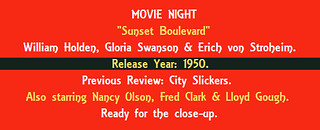
Review #809: Sunset Boulevard.

Cast
William Holden (Joe Gillis), Gloria Swanson (Norma Desmond), Erich von Stroheim (Max von Mayerling), Nancy Olson (Betty Schaefer), Fred Clark (Sheldrake), Lloyd Gough (Morino), Jack Webb (Artie Green), and Cecil B. DeMille. Directed by Billy Wilder (#106 - Some Like It Hot, #194 - Ace in the Hole, #422 - The Fortune Cookie, and #641 - The Apartment)

Review
The inventive (if not quirky) device of narration by our freshly dead main character certainly sets the tone for what is at all counts a fairly well-made movie that was later added to the National Film Registry as a film noir. Nostalgia is something that we all encounter at least once in our lives, whether it be for a different past time or for our own past. Sunset Boulevard certainly expresses nostalgia in the form of Swanson's character, from her private movie theater that shows her silent movies to playing bridge with a few "waxworks" (played by three silent film stars of the era: Buster Keaton, Anna Q. Nilsson, and H. B. Warner). The transition from the silent era to sound led to new horizons but also the decline of a good deal of the silent stars that had graced the screen and the hearts of moviegoers as well. The cinematography by John F. Seitz is excellent, making the movie look very well shot, particularly the final scene, with Swanson seemingly fading into the glitz of the camera. There's a certain sort of allure that Swanson brings to her character that makes her irresistible to watch on screen - her banter with Holden is especially entertaining. Von Stroheim is also wonderful to watch in his attempts at appeasing this husk of a star, with all of the desperation and pity in full display. Holden does a good job at telling this yarn, with enough quips along the way. One of my favorite lines is about how people don't really know the writing it takes to make a movie, assuming that the actors make it up as they go along. There's a certain mythic quality to these actors of yesteryear that is hard to explain at times but is always present, with a presence as large as Norma Desmond. Sure, one could figure out who killed who soon enough, but it's the spectacle that gives the movie breath. It's a movie with much to remember, from the main trio to the dialogue ("I'm ready for my close-up" being one of them) that makes for a fine thing to watch.

Overall, I give it 10 out of 10 stars.