Showing posts with label Brooks Benedict. Show all posts

January 7, 2022

Tramp, Tramp, Tramp.

Review #1784: Tramp, Tramp, Tramp.

Cast: 
Harry Langdon (Harry), Joan Crawford (Betty Burton), Edwards Davis (John Burton), Tom Murray (Nick Kargas), Alec B. Francis (Amos Logan), Brooks Benedict (Taxi Driver), and Carlton Griffin (Roger Caldwell) Directed by Harry Edwards.

Review: 
You may be wondering just what is so important about a movie like this, considering its inauspicious title. Well, it really is more about the star more so than the director, although the star and director generally should each have their own share of credit for when a comedy does as well as it should. So here we are with Harry Langdon, a presence in vaudeville and film for nearly four decades. Sure, folks will probably remember Chaplin, Keaton & Lloyd first as the silent comedy icons, but Langdon had his own measure of importance as a silent icon, albeit with less feature films to consider. The Iowa native started work in shows and stock companies as a teenager in the turn of the 20th century. A run in vaudeville was later followed his most famous association: Mack Sennett and his studio, where his pantomime act being quite popular in various short films. It was his work with Harry Edwards and writers Frank Capra and Arthur Ripley that is best known today. He also did a series of features in the latter part of the 1920s, for which three are generally known: this one, The Strong Man (1926), and Long Pants (1927) - the middle film incidentally was the debut of Capra as director. Langdon soon decided after two films with Capra to direct his own films; his three silent efforts (one short) did not fare well (although none are available to see for oneself), and the impending transition to sound in Hollywood likely did not help either; Capra once stated Langdon did not know why his persona was funny, while a producer once described him as "not so funny articulate". While he never became a major star after the end of the silent era, he did keep busy with roles (supporting ones in features and shorts) alongside writing until his death in 1944 at the age of 60. As for Edwards, this was one of only two feature films that he directed, since he was more of a shorts director (doing 150 of them in a three-decade career), although his reputation was not the highest, as his work with the Three Stooges would suggest - they made two shorts together before the group requested that he never work with them again.

Langdon has a persona was certainly interesting for folks to try and pin down about his appeal, one that certainly had a clownish and unique sensibility (one whose attempts at drawing amusement from his little gestures certainly seems different from Keaton). In a sense, it was a persona that was a bit child-like and perhaps just offbeat enough to generate laughs for the time. Of course, one may be wondering just what this film is about. Well, it is about a guy trying to help his dad save his shoe store and woo a woman by winning a cross country foot race across the country with a $25,000 cash prize. Yep, that's about it. The movie, running at an hour in length, is basically composed of a bunch of vignettes involving a child-like pantomime in Langdon going around getting into weird situations, whether involving sheep, prison work, or a cyclone. While one can see pretty easily why his persona may not have been long for the cinema world past the silent era (in terms of the time and as star), one can still find a good deal to appreciate about the efforts of Langdon and Edwards in crafting an energetic and quirky feature with plenty of interesting amusing sequences that he does well with, moving around with confidence and a face ripe for gesture to make useful gags. Strangely enough, it also features Joan Crawford in an early role, one in the midst of her attempts to promote herself as a film star that would merit success soon enough; she doesn't have much to really do, but she at least matches fine with Langdon in those attempts at warm chemistry. The segment with the prison (where he switches tools a few times) is quite amusing, although the cyclone sequence at the end does seem to be the most effective chuckler among the group of vignettes designed to show our quirky hero. The film ends with him playing a baby (because the two leads fell in love, as was pretty much every silent comedy of that time), which is probably just as weird to consider as it is to write that sentence, although it is amusing. At any rate, no matter where one considers Langdon's place in terms of the noted silent comics of Hollywood, one can't deny that Tramp, Tramp, Tramp (1926) is a solid effort worth checking out.

Overall, I give it 8 out of 10 stars.

Next Time: I Was Born, But... (1932)

April 11, 2018

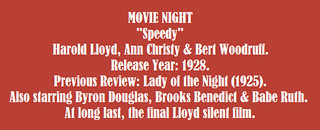
Speedy.


Review #1070: Speedy.

Cast: 
Harold Lloyd (Harold 'Speedy' Swift), Ann Christy (Jane Dillon), Bert Woodruff (Pop Dillon - Her Grand-daddy), Byron Douglas (W.S. Wilton), Brooks Benedict (Steve Carter), and Babe Ruth (Himself) Directed by Ted Wilde (#1044 - The Kid Brother)

Review: 
Speedy was the eleventh feature film starring Harold Lloyd, along with being his last silent film, released during the early transition from silent to sound features, with his next film Welcome Danger (1929) being filmed in both silent and sound but released in the latter. In any case, this is a fairly interesting film that manages to have its own share of charms. The plot involves Lloyd's character trying to save his love's grandfather from losing his business of operating a horse-drawn streetcar in New York City. Lloyd plays this carefree role convincingly enough, being quite charming and as useful as ever in his work with selling the gags. Christy and Woodruff are fairly decent, showing a bit of charm in each of their scenes with Lloyd. The other members of the cast are decent enough, although there isn't any particularly memorable adversaries or companions this time around, though the gags manage to make up for it enough.

There are numerous scenes showing the landscape of New York City, such as the scenes at Luna Park at Coney Island, or parts with Yankee Stadium, with the credit going to the filmmakers for not resorting to sets to try to simply have the film all filmed in sets, although a street of the Lower East Side was constructed on property that Lloyd owned on Westwood, California to complete the film. In any case, it's certainly interesting to look at this film as a time capsule of the city 80 years ago. The sequences on Coney Island are pretty entertaining, particularly the dollar-bill gag. Over halfway through the film, Babe Ruth (along with Lou Gehrig, appearing for a few seconds) shows up in an extended cameo role, being one of Lloyd's passengers on the taxi, which is pretty amusing. It may interest you to know that Wilde was nominated for the Academy Award for Best Director of a Comedy for this film, awarded at the 1st Academy Awards, although he lost to Lewis Milestone for his work on Two Arabian Knights (1927). This was the only Oscar ceremony in which there were separate categories (in this case, "Dramatic" and "Comedy") for Best Director. Naturally, the film ends with a big spectacle chase, filled with laughs and amusement that will surely prove charming to watch. On the whole, this is a fine piece of film-work that will certainly charm fans of silent films or fans of Lloyd - with me falling into both categories. It isn't as great as something like Safety Last! (#758), but it will fall under the line of an acceptable gem to focus 86 minutes on - take it for what it's worth.

Overall, I give it 8 out of 10 stars.

November 25, 2014

Movie Night: The Freshman.

Review #667: The Freshman.

Cast
Harold Lloyd (Harold Lamb), Jobyna Ralston (Peggy), Brooks Benedict (The College Cad), James A. Anderson (The College Hero), Hazel Keener (The College Belle), Joseph Harrington (The College Tailor), and Pat Harmon (The Football Coach) Directed by Fred C. Newmeyer and Sam Taylor.

Review
When people think of Harold Lloyd, they think of him dangling from the clock tower in Safety Last, or his work in Grandma's Boy (which I'll review in the future), or his role in The Freshman, which is what I'm covering. Lloyd's career could've been stopped before he gained his fame; in 1919 he lost a finger and a thumb in an accident, with a prosthetic glove concealing the damage. But he did not let that stop him. The Freshman was Lloyd's highest grossing silent feature, and it's easy to see why. His character (Harold, also known in the movie as Speedy) is so likable. Lloyd's character isn't a random passerby who happens to pop in, he's a character whose purpose is given depth. You emphasize with him and his plight, which makes it easier to laugh at his naiveness. The gags are slight but easy to recognize, the movie has a lot of fun with the situation Harold sets himself in. My favorite gags involves Harold speaking to the crowd...while a kitten comes out of his sweater. The characters are easily describable given their character names, but at least they act their parts convincingly, especially Benedict, who is easy to dislike, and for good reason. The romance between the main leads is sweet and brief enough to work. The football action at the end is particularly noteworthy because we get to see how football was over 80 years ago. The action was filmed at the Rose Bowl (with crowd shots at Cal Memorial Stadium), and the football action is about as wild and silly (with Lloyd) as it can get. It certainly is a good way to end the film. The movie is like a gift basket, sweet and entertaining for a short period of time (about 70 minutes), and that's probably why this movie is still a great hit with others. I highly recommend this film (along with other silent movies with Keaton and Chaplin) for a good way to spend a day, especially on Thanksgiving.

Overall, I give it 10 out of 10 stars.