
Showing posts with label Rock Hudson. Show all posts

July 28, 2021

Undertow (1949).

Review #1703: Undertow.

Cast: 
Scott Brady (Tony Reagan), John Russell (Danny Morgan), Dorothy Hart (Sally Lee), Peggy Dow (Ann McKnight), Bruce Bennett (Reckling), Gregg Martell (Frost), Robert Anderson (Stoner), Dan Ferniel (Gene), and Rock Hudson (Detective) Directed by William Castle (#369 - House on Haunted Hill (1959), #1071 - 13 Ghosts, and #1418 - The Night Walker

Review: 
Honestly, if you didn't know that the director was William Castle, would you bat an eye for this film? From 1943 to 1974, he made 56 films as a director, but it is strange to think that the films that you would recognize from him came in the last third of his career, one that saw him move past low budget crime affairs to low budget B-movies with sensational showmanship. But hey, the important part is that Castle was not just a director with one trick. He honed his desire of wanting to scare the pants out of audiences as a teenager to work in Broadway in a variety of jobs to a shot at Columbia Pictures before he was even 25 years old, and his first feature was The Chance of a Lifetime (released in 1943 as part of the Boston Blackie series of crime dramas). He moved to Universal Pictures with Johnny Stool Pigeon (1949). There isn't exactly a great deal of facts to talk about this feature, one where I can't explain why it is called Undertow, since that apparently sounded like a better one to market over the working titles of Frame-Up and The Big Frame (I guess framing is like a current of water?). The film was written by Arthur T. Horman (a busy writer for two decades) and Lee Loeb.

Honestly, for the brief sentences one can struggle to think about a movie that falls along the line of Castle's extensive early work, it proves to be a decent filler kind of movie. For a film noir, it works alright in generating tension in the moments that try to give off a sense of claustrophobia, one that has a selection of clichés you would see from a noir (such as the femme fatale or a race against time) that for the most part manages to not flub itself in getting to the finish line at 71 minutes while packing in a few nice shots of Chicago. Brisk is not a bad word to describe a movie, if you think about it. Granted, there are things to quibble about a movie involving a guy on the run having to prove his innocence for the murder of a kingpin where you don't even see the kingpin. It really is the kind of movie that focuses on the dry side of plotting that is exactly what you would expect from a programmer kind of movie. If you don't have that many cast members to begin with, the mystery can only go in a few directions that are more passable than clever; besides, having a small run-time means you can't have too much time spent on motivation, which affects Dow's character more so than anyone. It manages to have no terrible or great moments present, which means that the highlights really come from little sequences, such as a chase sequence with some steps or perhaps its quick climax that relies on a little confusion. Brady fares pretty well in one of his early roles in film, partaking in a slew of tough-guy roles while eventually adding on television to his line of work, which also can apply to Russell (each had a star role in a Western show in the following decade), who plays it pretty lean and fair. This was the first feature film for Dow, who had dabbled in modeling and radio before having a brief feature career; she does okay with a quiet part, one that can't be too contrived in innocence without seeming completely out of touch with the attempts at thrills and chemistry with Brady that pales when thinking of the allure generated in parts by Hart. Having Bennett's character be the way he is in the script is a bit of a stretch (an old buddy detective), but he at least makes it seem passable to what is needed in dry company. As a whole, one will either find comfort in its accomplishments of making a decent thriller with no frills or find it just a bit off their tastes. But one cant deny that Castle was the kind of director capable enough to try and make something out of nothing, and I suppose that makes it more than enough for the curious. 

Overall, I give it 7 out of 10 stars.

April 28, 2020

Pillow Talk.

Review #1401: Pillow Talk.
Cast: 
Rock Hudson (Brad Allen), Doris Day (Jan Morrow), Tony Randall (Jonathan Forbes), Thelma Ritter (Alma), Nick Adams (Tony Walters), Karen Norris (Miss Dickenson), Julia Meade (Marie), Allen Jenkins (Harry), Marcel Dalio (Mr. Pierot), Lee Patrick (Mrs. Walters), Mary McCarty (Nurse Resnick), and Alex Gerry (Dr. Maxwell) Directed by Michael Gordon.

Review: 
"Comedy is the most serious tragedy in the world. Play it that way and you can't go wrong. If you ever think of yourself as funny, you haven't got a chance."

Sometimes the best way to talk about a film is to just say it is nice and leave it that. This is a decent comedy for its time, a fair highlight for its stars and director to take pride in. Michael Gordon went from being a student of the Yale Drama School and member of the Group Theatre to working in films and stage, where he would go from crafting low-budget b-movies in the early 1940s to noirs and dramas by the end of the decade, with Cyrano de Bergerac (1950) serving as a highlight. His career was interrupted the following year due to blacklisting; he would do stage productions for the next eight years until successes in that field led to Universal-International wanting to bring him back into directing with this film, which would be the first in a string of eight comedies he would do for the rest of his career, which ended with How Do I Love Thee? (1970). As for Day and Hudson, both were established stars in their own right, with the former having success in musicals, comedies, and thrillers that went with a prolific singing career and the latter was a leading man for adventures and melodramas since the early 1950s. The two would collaborate on two further films together over the next five years, and they became lifelong friends.

For the time, this surely proved a fun daring time for enjoyment. The film was written by Stanley Shapiro and Maurice Richlin that was based on a story by Russell Rouse and Clarence Greene, who had done the script in the 1940s that was bought and sold numerous times without being produced (each would receive an Academy Award for their work in the category of Best Original Screenplay, beating out noted films such as The 400 Blows and North by Northwest). This was a time where even the title of the film had to go through wrangling with the Production Code before giving in (imagine if it had gone with the alternate choice of Any Way the Wind Blows). Party lines are (mostly) a thing of the past now, but they were quite prevalent for most of the 20th century as a way to provide service for cities both rural and urban through a shared local loop circuit. At any rate, there certainly is enough room for some clever moments with Day and Hudson with this scenario, particularly with the use of split-screens in certain sequences that make for some humor and passion. They click together in ways that seem instant, natural at inspiring curiosity and charm in their respective manners with class in romance, with Day being quite passionate and Hudson being subtle in charming humor. Randall (who would appear with Day and Hudson twice more) does well as a fussy foil while Ritter rounds out the cast with deadpan stupor. While one will know what they are in for pretty early in its 104 minute run-time, the film maintains itself with careful vigor that doesn't lead to impatience or a lack of meaningful interest in where the film wants to go to drive some laughs and passion, doing a relatively fine job in making appealing entertainment that has kept most of its luster through six decades of time.

Overall, I give it 8 out of 10 stars.

May 10, 2017

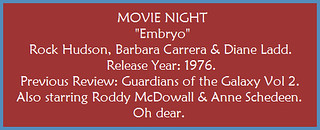
Embryo (1976).


Review #933: Embryo.

Cast:
Rock Hudson (Dr. Paul Holliston), Barbara Carrera (Victoria Spencer), Diane Ladd (Martha Douglas), Roddy McDowall (Frank Riley), Anne Schedeen (Helen Holliston), John Elerick (Gordon Holliston), Vincent Baggetta (Collier), Jack Colvin (Dr. Jim Winston), and Joyce Brothers (Herself) Directed by Ralph Nelson.

Review:
I had wanted to do this film a while back during the fall season, but I had forgotten about the movie (which is amusing, given all the reviews that occurred anyway) until now. Strangely, the movie begins with a statement from a Dr. Charles Brinkman III, stating: "The film you are about to see is not all science fiction. It is based upon medical technology which currently exists for fetal growth outside the womb. It could be a possibility tomorrow...Or today." I guess with words like that, one could have hope for this strange film, released by Cine Artists Pictures (who went bankrupt before being able to renew the copyright on the movie). And how is it? Well, it certainly is something you wouldn't expect (nor expect to find). The movie revolves around trying to make life (or more specifically, keeping life alive). Naturally, he starts with a dog before deciding upon doing so for a fetus with some sort of experimental thing called "placental lactogen". This goes about as well you'd expect (complete with voice-over by Hudson during the latter experiment), with all of it meant to be taken seriously. Yes, even with the fact that the decision to proceed with a human is only a few days after having "success" with a doberman. When the movie turns from a half-baked Frankenstein into an equally half-baked version of My Fair Lady (or Pygmalion) is likely when the movie lends itself rope to seal its fate. It is evident that the makers of the movie wanted to do something with horror and drama (with not-science fiction, if one goes by the opening) that would have an effect of audiences, but that never seems to succeed. At least it isn't too long (104 minutes), but that can't help in making it seem somewhat dull.

McDowell makes a "cameo" as a chess player who competes against Carrera's character, complete with an outburst after the match ends, which is somewhat amusing. Hudson is the best actor in the movie by merely having a presence that comes closest to being convincing, even with somewhat dry monologues (recorded on tape) throughout the film. Carrera doesn't really spring much personality into the role; she is watchable when trying to interact with colleagues or when trying to search for a cure to her biological problem, but that doesn't excuse a somewhat listless performance. Even when she makes a villainous turn (gasp if you aren't surprised), it doesn't help in making the movie entertaining. Ladd doesn't fare too well either, nor does Schedeen, in part because they don't have any sort of screen time to make anything significantly worth investing in. When the movie gets to its climax, there is no investment in any of these characters, and when you can't care about the stakes the film tries to set, one question is posed: Who cares? Naturally, it ends with a car chase (no joke), complete with aging makeup and a reveal that would be shocking if not merely serving to end a ridiculous movie. On the whole, this is a ridiculous movie that doesn't have as much entertainment value as it should while also not having as much credibility as it wants to strive for, failing on numerous levels for everyone.

Overall, I give it 5 out of 10 stars.