Showing posts with label Fritz Lang. Show all posts

August 1, 2023

Liliom (1934).

Review #2066: Liliom (1934).

Cast: 
Madeleine Ozeray (Julie/Her Daughter with Liliom), Charles Boyer (Liliom), Robert Arnoux (Strong Arm), Roland Toutain (Sailor), Pierre Alcover (Alfred), Alexandre Rignault (Hollinger), Raoul Marco (Detective), Antonin Artaud (Knife Grinder), Maximilienne (Madame Menoux), and Florelle (Madame Moscat) Directed by Fritz Lang (#333 - M, #500 - Metropolis, #1365 - Scarlet Street, #1619 - Destiny, #2009 - You and Me)

Review: 
Remember Liliom (1930)? who can't articulate their emotional feelings for each other beyond a spiritual connection that, well, made for an okay mess from Fox Film Corporation. But what about the other Liliom film, done for Fox within their "Europa" company in French? The only possible curiosity to watching a film that came out just four years after someone already made their production for Fox Film Corporation is the fact that Fritz Lang also apparently liked the film most among the ones he made. He was quoted a couple of years before his death as saying that he always liked it very much and even called it one he almost liked "best of all". You may or may not find what he is talking about here, but you have to remember that this was the film he made between The Testament of Dr. Mabuse (1933) and Fury (1936). Not exactly the easiest competition, although one wonders what the French Catholic clergy thought of those, since they did not like Lang's ideas involving Heaven. If you remember, the Austrian-born director (with Jewish heritage) found that he should leave Germany when the release of the Mabuse film saw bans by the Nazi regime, which actually had offered him an enticing position involving leading a studio. Obviously, he saw better than to do that, for which he left the country for good by the summer of 1933. He first settled in Paris before he eventually moved (and settled) in America after this film became a flop; his next film not directed for English-speaking audiences would not be until 1959. Lang, landing in a studio run by Erich Pommer, was offered the story for this film apparently over the choice of doing another one that involved detectives (that film, called A Man Has Been Stolen [On a volé un homme], was done by Max Ophüls but is now lost). It was written by Robert Liebmann (in adaptation) and Bernard Zimmer (dialogue).

Boyer had cultivated years of stage experience and supporting roles to eventual stardom in the 1930s, although he bounced around productions in Hollywood and his native France for the first number of years, which involved films such as this. He basically dominates the show in the manner you would expect from him, which works so well because of just how much he throws into a role that could have just been sunken by someone playing the role as just a miserable lout. It isn't a role that he is sent to make seem light (far from it, remember the source), and he does the job required in making a pathetic force of knowing unknowingness work within the bounds of a film that isn't exactly too tethered to reality. Ozeray is left with the other challenge that comes with having such a distinct lead presence in playing her role to a delicacy that won't be construed as just a doormat. The Belgian makes a fine case for going with Boyer in the face of what seems to be a foolishly doomed romance, one that only they can understand but can't quite say in clear words as to why they are there with each other. The film does take a deliberate pace within 116 minutes, but once it does settle among the place of gates in heaven and hell, it all comes together for curious viewing, (Rudolph Maté and Louis Nee did the cinematography for the film and do quite well with making the film look about right for whatever sort of "frivolous" level you can accuse Heaven as being depicted). For the film, one really can't just escape what decisions one makes "just like that", and I appreciate the irony set in depicting bureaucracy and even reviewing a clip from earlier in the movie. When it finally dawns upon one to reach back into the Earth after so long only to find themselves talking themselves into a corner, it does ultimately prove rewarding in the weirdest sense to see just how just one little motion can stoke old memories back in the favor of justice. As a whole, it is an odd little affair, but it is told with obvious interest from Lang to deal with life and death in a way that doesn't insult one's time or intelligence in the dealings of fantasy and illusion. It is a solid effort and one that could fit right into the dedicated structure that Lang favored when making films for as long as and effectively as he could for which we have the pleasure of searching for.

Overall, I give it 8 out of 10 stars.

Well, you may already have an idea of what August will be all about judging by the title card. Last August dealt with action films and the one before that dealt with anniversaries...so for this August, why not go "Around the World"? That is correct, an entire month dedicated to as many world cinema films as possible, which could go anywhere from Russia to Japan (already a popular country here but you get the idea) to...somewhere new. I can't guarantee a set number, but I'm sure there will be at least ten interesting films to cover for interesting reviews in the month that seems right for such an odd little month. Enjoy.

May 12, 2023

You and Me.

Review #2009: You and Me.

Cast:
Sylvia Sidney (Helen), George Raft (Joe Dennis), Barton MacLane (Mickey), Harry Carey (Mr. Morris), Roscoe Karns (Cuffy), George E. Stone (Patsy), Warren Hymer (Gimpy), Robert Cummings (Jim), Adrian Morris (Knucks), and Roger Gray (Bath House) Directed by Fritz Lang (#333 - M, #500 - Metropolis, #1365 - Scarlet Street, #1619 - Destiny)

Review: 
As the story goes, Norman Krasna wrote up a story at the request of Paramount Pictures that would have George Raft as a star. Krasna, for those who don't know, had gone from an ambition to do journalism to work his way into becoming a drama critic before moving onto playwrighting to then becoming a studio writer, first with Columbia before moving onto others such as Paramount. In fact, one of his ideas for a script would become the basis for what became Fury (1936) at MGM, with Krasna receiving a co-credit and a subsequent Oscar nomination. Important to the story of the film that eventually became a film is that Krasna wanted to direct it. However, Carole Lombard read the script and found it interesting (after plans had been done to have Raft star with Helen Burgess), which then made Paramount want someone to direct who, well, had experience directing, because Raft and Lombard wanted someone with experience. At any rate, Krasna was let go from directing, which was meant to go for Richard Wallace before it eventually landed to Fritz Lang, as asked by Sylvia Sidney (who had starred in Fury and You Only Live Once (1937), as directed by Lang), who was brought on to star with Raft. Lang later called the film his first flop ("deservedly") while saying that he had wanted to make a "didactic" film while having influence from Bertolt Brecht, a good friend of his that had made a theatre style called Lehrstück that basically was a play that would teach you something. Virginia Van Upp (a child actress-turned-script writer/reader/casting director/agent) is credited with the screenplay, although Jack Moffitt did uncredited work as well. As for Krasna, he would eventually get his chance to direct, albeit in the 1940s with Princess O'Rourke (1943), which he also wrote.

The movie is an odd curiosity, that much is certain. It is probably not too hard to see why the movie did not make much of an impact with audiences, because it was an odd film to have a guy like Raft star in a film with Lang that is more of a quirky crime film rather than straight drama. Of course, it is a decent movie, one that is fairly watchable if one has the patience for a film that is just a bit off center when it comes to teaching about just where crime really can go when it comes to a businessman who wants ex-cons to work for him to give them a second chance at things that might as well serve as more of a means to one's end in streetwise foundation. Oh, and there is a bit of a romance alongside things as well. Raft once described his ambitions when it came to acting as simply wanting "to be me", which basically meant he wasn't trying to just stick to roles similar to his presence-making turn in Scarface (1932), which led to a handful of suspensions from the studios he worked with, since he did not want really want to play heels (hell, he was a dancer before becoming an actor). As such, his charm is basically room temperature, which means he reacts to the situations around him with the mildest of reactions, as if the only thing that can faze him is being behind the ball when the final score is up (of which I mean the score of life). Besides, with a passionate Sidney (who appeared a handful of gangster films in the time period, with some exceptions) around, one finds that the movie moves along well enough already. Her well-meaning procession of foolhardy attempts to keep the one she loves and the secret she holds just as dear firmly away from each other, and she does the best to make the dilemma matter (making a case of "you dummie" into "oh, poor dummie"). Of course, the real highlight is a sequence near the end in trying to point out just how much one really could make when robbing a store when detailing all of the costs that come with the setup, which she handles with splendid timing that makes a simple "go home and think about coming to work on time tomorrow!" all the more fun. The supporting folks are mostly there to fill the chorus of would-be returnees to crime, which work in small bits of charm that mostly come from Hymer and his demeanor. Maybe there is a sense of irony to see Carey, an actor known for his rugged frame actor (generally seen in Westerns) playing an owner who likes to hire parolees. At any rate, it is an strange curiosity, one that isn't merely a crime drama or a straight romance because of the fact that it likes to dwell on the absurdity that comes with trying to find where the real game is at when it comes to something as simple as "you and me". As a whole, it may stretch itself a bit thin for 94 minutes, but it is firmly watchable and certainly something that should be considered for viewing among the curiosities that made the career of Fritz Lang all the more involving for what he did end up bringing to the screen in vision.

Overall, I give it 7 out of 10 stars.

January 3, 2021

Destiny (1921).

Review #1619: Destiny.

Cast:
Lil Dagover (Young Woman / Zobeide / Monna Fiametta / Tiao Tsien), Walter Janssen (Young Man / Franke / Giovan Francesco / Liang), Bernhard Goetzke (Death / Der Tod / El Mot / Bogner / Archer), Hans Sternberg (The Mayor), Carl Rückert (The Reverend), Max Adelbert (The Notary / The Chancellor), Wilhelm Diegelman (The Doctor), Erich Pabst (The Teacher), Karl Platen (The Apothecary), and Hermann Pischa (The Tailor) Directed by Fritz Lang (#333 - M, #500 - Metropolis, and #1365 - Scarlet Street)

Review:
"To begin with, I should say that I am a visual person. I experience with my eyes and never, or only rarely, with my ears—to my constant regret.”

It is easy to say that a film merits coverage because it came from a notable name. But how about one that turns a century old this year? Sure, Fritz Lang had his classics come around with films like Metropolis (1927), but one can't forget his earlier work. Lang did brief study in his native Vienna for civil engineering and art before moving to travelling abroad and later service in World War I for the Austrian army. He did a spell of acting in theater before moving into writing for UFA and other German studios and soon directing. Destiny, known in Germany as Der müde Tod: ein deutsches volkslied in 6 versen [Weary Death: A German Folk Story in Six Verses] (or Behind the Wall for US release), is the eighth feature film directed by Lang, who had begun his career with Halbblut in 1919 (which alongside his second film Der Herr der Liebe is lost). He continued with an assignment for a serial that resulted in two films with The Spiders (1919-20), which would be the first of numerous serials that he would be part of, with two-parters following in Dr. Mabuse, the Gambler (1922) and Die Nibelungen (1924). This was written by Lang and his wife Thea von Harbou, who wrote several films over the course of twelve years. Incidentally, the same year that they married was also the same year that Lang's mother passed away, although his version of Death came from his childhood memories upon having a fever, although it has been argued that he also may have been inspired by the Indian folklore tale Savitri and Satyavan. In any case, the love of Death, composed of horror and affection, was noted by Lang as a key player in his career, alongside fate and fear.

One should expect something interesting from a film opening in "Some Time and Some Place", and they sure do get a curious film. Technically speaking, what we have here is a parable in four parts, since it involves an interlinked narrative that starts and ends with Dagover and Goetzke, while three stories (referred to as "Lights", respectively) are told involving love and death that have certain actors sharing time together each time. Love and death seem to go hand in hand, whether that it is in "The City of the Faithful," or the Carnival in Venice, or during the reign of the Chinese Empire. The result is a film with eerie appeal, filled with numerous interesting shots and images that show what filmmaking could be in the 1920s in its strengths for storytelling and power while also being a useful mediation of death. Dagover was a considerable presence in German cinema, considering his varied career over six decades that led to work with directors like Lang and Robert Wiene to Maximilian Schell. She certainly does well for what is needed, careful in capturing the desperation needed alongside the needed nature for the other roles to play without just being drawn with a plain brush for costume drama. Janssen was in his second ever role of a varied career, and he does well here in the other role across time in star-crossed expression. One could argue this as the most notable film of Goetzke's career, but that would underscore his prolific nature, since he was in over a hundred films in forty years, and he seems to fit the description of what is needed from Lang involving mystery and dread with a pale and weary figure of the beyond. By the time the film moves towards its end at 99 minutes, one seems to be touched by its effectiveness, as it proves to be a key figure in what makes for a moody triumph of German Expressionism, probing the nature of separation and sacrifice that keeps its audience on its toes. It might not be the most memorable film to strike first in Lang's catalogue of work, but it certainly had an influence upon several filmmakers. Luis Bunuel was inspired by the film (specifically with the cemetery sequence) to make films (citing Lang and his films as the biggest influence upon him), while Douglas Fairbanks liked the trick photography effects used for the climax enough to get the rights to the film so they could grab the effects for use in The Thief of Baghdad (1924). At any rate, what we have is a grand curiosity of German Expressionism, dreary yet crisp in its filmmaking that serves as a useful silent feature and gem in Lang's career in terms of its look upon death and separation - and the figures that play their part on the board.

While I doubt I will reach the lengths of 2020 with reviews, there are still plans to do a few theme weeks throughout the year to further the perspective of cinema from various positions. One of these weeks, I'm pleased to announce, will focus on films done by directors never previously covered on Movie Night before. Looking at the catalogue of records of Movie Night show that there have been 958 different directors covered throughout the ten year history of Movie Night, so one can only wonder who is next on the list. A week of World Cinema is tentatively scheduled, along with a special surprise or two. Enjoy!

Overall, I give it 9 out of 10 stars.

March 19, 2020

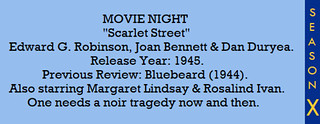
Scarlet Street.

Review #1365: Scarlet Street.

Cast:
Edward G. Robinson (Christopher Cross), Joan Bennett (Katherine March), Dan Duryea (Johnny Prince), Margaret Lindsay (Millie Ray), Rosalind Ivan (Adele Cross), Jess Barker (David Janeway), Charles Kemper (Patch-eye Higgins), Anita Sharp-Bolster (Mrs. Michaels), Samuel S. Hinds (Charles Pringle), and Vladimir Sokoloff (Pop LeJon) Directed by Fritz Lang (#333 - M and #500 - Metropolis)

Review: 
"Each picture has some sort of rhythm which only the director can give it. He has to be like the captain of a ship."

One can't forget about Fritz Lang when it comes to his diverse career of films, both in Germany and abroad. Born and raised in Vienna, Lang had a lengthy career, starting as a writer for film in 1916 before debuting as a director with Halbblut (1919). He met writer Thea von Harbou the following year, and they later married in 1922. They worked together in film for over a decade, which include films such as Dr. Mabuse the Gambler (1922), Metropolis (1927), M (1931, his first talking picture), and The Testament of Dr. Mabuse (1933). However, the two divorced due to an affair by Lang that same year. He would soon leave Germany owing to the rise of the Nazis, going to France (where he made one film in Liliom) before going to America. He made his American debut with Fury (1936), with his last in the country being Beyond a Reasonable Doubt (1956) before he returned to Germany (after thinking about retiring due to tough conditions to make further Hollywood films and growing age), where he made three films between 1959 and 1960, with his last being The Thousand Eyes of Dr. Mabuse before his death in 1976 at the age of 85. He was noted for his Expressionism (more so for his German films) alongside his talent in doing numerous genres, particularly with film noir.

The film was adapted (written by Dudley Nichols) from the French novel La Chienne by Georges de La Fouchardiere, which had already been played on the stage and in film in 1931 under its title by Jean Renoir (who notably disliked this film). This was the second time that Lang utilized this trio of actors, as they had appeared together in The Woman in the Window a year earlier. Both films had Robinson play a lonely middle-aged man and Bennett and Duryea play a criminal duo, and they even had the same choreographer in Milton R. Krasner. Robinson for his part did not like his experiences with either film, finding this one to be monotonous to do, although Lang found it to be one of his favorites to do. To each his own, one suppose - both of course do tremendous jobs in making a capable noir tick well. It goes to show how one can make something that plays numerous hands of deception to the benefit of its audience through 109 minutes, a clever experience with some psychological depth to it. It shouldn't prove too surprising that local authorities in three cities for censor boards objected to the content of the film, calling it many things besides "obscene". After all, it isn't exactly a noir with a happy ending, nor is it one that requires so. Just the idea of a character getting away with a murder was in some minds enough to object to, beyond portraying some sort of sordid life or illicitness with love. In other words, one needs a bit of risk sometimes to make things work better than a conventional film would do, with the best noirs utilizing imagination to give the viewer something to look into without needing things spelled out for them. Robinson does well with making an ordinary presence come into focus that we can follow along with to a point as a meek man that doesn't seem cartoonish or underplayed. Bennett and Duryea make for a conniving duo, ones with some luring power alongside a rough nature with chemistry. One can follow the film along without too much trouble, wrapped with a few twists that keep the viewer wanting more without displeasing them with where it needs to get to with its daring ending, where one can certainly find a prison for themselves without needing a conviction to do so. Lang certainly made plenty of memorable films, and this is one that is good to highlight, particularly since it is readily available through the public domain for anyone to view for themselves, a worthwhile little gem for the decade.

Overall, I give it 8 out of 10 stars.

December 19, 2013

Movie Night: Metropolis.


Review #500: Metropolis.

Cast
Brigitte Helm (Maria and Robot), Alfred Abel (Joh Fredersen), Rudolf Klein-Rogge (Rotwang), Heinrich George (Grot), Fritz Rasp (The Thin Man), Theodor Loos (Josaphat), and Erwin Biswanger (Georgy) Directed by Fritz Lang (#333 - M)

Review
What can I say but...wow. Metropolis is an science fiction epic, probably one of the first of its kind. It's a film from Germany with a storied history, as it originally ran for 153 minutes when first shown, but it was cut down in later showings due to censorship. The film had lost scenes for over 80 years, with a negative of the original cut later found in Argentina just a few years ago, and that was the version of the film I watched, which lasted almost (but not exactly) 2 and a half hours long. And it is tremendous. Tremendous in scope, tremendous in the effects and tremendous in itself. You could argue its one of the best films ever made because of its story, the tremendous effects and its lasting memorability that is the Maschinenmensch. It's a silent film that transcends just being a silent film, if that even makes sense. The actors may be odd in their movements, but they do at least work well with the film. What I found amusing is the contemporary reviews of this, with statements like "The pity of it is that this unimaginative, incoherent, sentimentalizing, and make-believe film, wastes some very fine possibilities." You know who said that? H. G. Wells himself, who was responsible for many novels...and Things to Come, which itself felt like Metropolis. Another criticism came from Lang himself, who said "Anyway, I didn't like the picture – thought it was silly and stupid – then, when I saw the astronauts: what else are they but part of a machine? It's very hard to talk about pictures—should I say now that I like Metropolis because something I have seen in my imagination comes true, when I detested it after it was finished?" It was a misunderstood film that rose up decades after its release, with enough care to restore this, and I applaud them. This is an outstanding achievement for the science fiction genre and film itself. Thank you to all who read these reviews, the old timers and the new comers, thanks.

Overall, I give it 10 out of 10 stars.

January 6, 2013

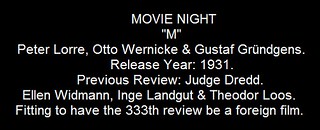
Movie Night: M.

Review #333: M.

Cast
Peter Lorre (Hans Beckert), Otto Wernicke (Inspector Karl Lohmann), Gustaf Gründgens (The Safecracker), Ellen Widmann (Frau Beckmann), Inge Landgut (Elsie Beckmann), Theodor Loos (Inspector Groeber), Friedrich Gnas (Franz) Directed by Fritz Lang.

Review
This is the eighth world cinema film reviewed here (#015 - The Good, the Bad, and the Ugly, #017 - A Fistful of Dollars, #019 - For a Few Dollars More, #167 - Gojira, #256 - Nosferatu, #261 - The Cabinet of Dr. Caligari, #309 - Santa Claus), with this one coming from Germany. This happens to be the first review of Fritz Lang here, and the third of Peter Lorre, with this being his breakout role that would later garner him more roles. Like Gojira, I watched a version with subtitles (Thus I can't really discuss the level of acting in voices per say.), but even with subtitles the film is easy to follow, not really requiring dubbing (Fun fact: There would later be a dubbed version a few years after this with Lorre speaking English) to work. Lang's direction is good, having style yet a gritty feel to it. If there is one memorable person that is in this, it undeniably is Peter Lorre. He brings a recognizable, sinister tone, and the way his eyes shift along with his demeanor works effectively. The story works well, always managing to have some sort of raw energy that is efficient. Out of the the eight world cinema films reviewed here, this is one of the best, rivaling with Gojira, Dr. Caligari, and the Dollars Trilogy. Great stuff.

Overall, I give it 10 out of 10 stars.