Showing posts with label Danny Huston. Show all posts

August 15, 2025

The Naked Gun (2025).

Review #2409: The Naked Gun.

Cast: 
Liam Neeson (Lt. Frank Drebin Jr.), Pamela Anderson (Beth Davenport), Paul Walter Hauser (Capt. Ed Hocken Jr.), Danny Huston (Richard Cane), CCH Pounder (Chief Davis), Kevin Durand (Sig Gustafson), Liza Koshy (Detective Barnes), Eddie Yu (Detective Park), Moses Jones ("Not Nordberg Jr."), and Cody Rhodes (Bartender) Directed by Akiva Schaffer.

Review: 
Okay, I wanted to wait a bit on this one. Hey, remember The Naked Gun? The trio of David Zucker, Jim Abrahams, and Jerry Zucker had been behind The Kentucky Fried Movie (1977) and Airplane! (1980) and they wanted to do another spoof movie, with the TV show M Squad as the basis, since they liked the show (which you might remember starred Lee Marvin back in the 1950s). But Michael Eisner of Paramount Pictures liked the concept enough to try and secure a six-episode TV show (against the better judgement of the trio) that ended up being aired on ABC in 1982...and the network didn't get it (a show with no laugh track that looked like a 60s program? Too hard for audiences). Six episodes (two directed by Joe Dante) were shown, but two were dumped in the summer. Eventually, through the efforts of them and Pat Proft, The Naked Gun: From the Files of Police Squad! (which took a few bits from the show) came out in 1988. Zucker described the kind of spoof that they did as one not of comic timing but dramatic timing that had actors act as if they didn't know they were in a comedy, with Leslie Nielsen being a natural. Sure, the two sequels (Zucker directed 2½: The Smell of Fear [1991] and co-wrote 33⅓: The Final Insult [1994] with Proft) were mostly fine in quality, but I think you understand the fun involved. Oddly enough, there really were plans for a fourth movie many, many years down the line in 2009, complete with it being intended for TV with Nielsen (ironically, the script was to be written by Alan Spencer, who had developed his own cop parody years prior with the TV show Sledge Hammer!). Nielsen passed away in 2010 before anything could happen, but plans bubbled again with Ed Helms in mind to be the lead, and Zucker and Proft were even tapped to write (with a secret agent son of Frank Drebin) that went nowhere. Finally, in 2021, plans bubbled again with Seth MacFarlane being hired to develop the project (which wouldn't have Zucker or Proft involved, although at least the former isn't bitter about it) and pitch it to Liam Neeson (who had worked with MacFarlane with A Million Ways to Die in the West [2014]) to star. The result is a movie written by Dan Gregor, Doug Mand, and Akiva Schaffer (with various contributions by Mark Hentemann, MacFarlane and Alec Sulkin); you might know Schaffer from such movies as Hot Rod [2007] and Popstar: Never Stop Never Stopping [2016].

There are probably a few people who love or hate reboots, remakes, the whatever word you want to call it. I'm pretty on the fence on the idea because maybe I am not old enough to really stress about the world soon having two Running Man movies. There are quite a few nice things I can say about this movie, which is a nice relief. Neeson seems to be the right choice to go from a litany of dramas and action movies to try and play comedy, doesn't he? Admittedly, doing a "new version" of something might make one hesitate (especially when nearly doing the "horror movie followed up with the same title" thing), but I think what The Naked Gun does best is to simply roll along with the lines with daffy enthusiasm, right down to ending on a take on freeze frames. It probably helps that the runtime (85 minutes) just seems right on point for having the viewer satisfied with quick satisfaction that doesn't seem rushed or seem like an overgrown made-for-TV sheen. It just aims to deliver as many gags as possible with an interest in having fun with the idea of real-world foibles like oddball rich people (some obsess over naming apps after letters, others obsess about their pants), oddball technology, cloying over the old days (people actually hate Clippy? Shame!)*, and so on. Even for someone in their seventies, Neeson clearly has the touch for comedy to really carry this movie as long as it needs to go, operating the proceedings with such gruff sincerity that isn't simply just trying to be Leslie Nielsen all over again (the instance of gun fu at one point is particularly amusing). It happens that he has some worthwhile chemistry with Anderson*, who is just as adept in mowing down lines with sharp rhythm that might be worth seeing again in the future. Huston (as following the tradition of Ricardo Montalbán, Robert Goulet, and Fred Ward in Naked Gun adversaries) actually ends up being pretty neat, smarmy but totally just having fun with being the kind of guy who would be in a comedy about trying to make people fight each other (the last scene in particularly is pretty funny). You then have a worthy supporting ensemble that runs down from Hauser (a neat successor to Sr's George Kennedy) to the always on-time Pounder. There are a litany of gags and cameos that accompany the movie like any good ol' comedy would do without seeming like painful obligation and it leaves the possibility of wanting more without reeking of desperation. As a whole, it probably is the best of the three follow-ups to the original Naked Gun,
which is a hell of a thing to say when wanting to talk about a commitment-filled comedy in 2025.

Overall, I give it 8 out of 10 stars.
*What the hell is a TiVo, anyway?
*Apparently, Anderson was to be in the third Naked Gun movie but had to turn it down. The circle is complete.

March 31, 2022

Marie Antoinette (2006).

Review #1823: Marie Antoinette.

Cast: 
Kirsten Dunst (Marie Antoinette), Jason Schwartzman (Louis XVI of France), Judy Davis (Anne de Noailles, "Countess of Noailles"), Steve Coogan (Florimond Claude, Count of Mercy-Argenteau), Rip Torn (Louis XV of France), Rose Byrne (Yolande de Polastron, Duchess of Polignac), Asia Argento (Madame du Barry), Molly Shannon (Madame Victoire), Shirley Henderson (Madame Sophie), Danny Huston (Joseph II of Austria), Marianne Faithfull (Empress Maria Theresa), Mary Nighy (Princesse de Lamballe), Jamie Dornan (Axel von Fersen), Al Weaver (Charles, Count of Artois), Sarah Adler (Maria Theresa, Countess of Artois), Sebastian Armesto (Louis Stanislas, Count of Provence), and Clémentine Poidatz (Marie Joséphine, Countess of Provence) Directed by Sofia Coppola (#700 - Lost in Translation)

Review: 
“I’m so happy it has an audience now because at the time it was not successful. People didn’t go see it; they didn’t really know what to make of it...It means a lot to me that it continues to live on.”

Oh sure, the Coppola name may be a connected one in cinema, but it doesn't hurt to see the promise of another Coppola making their mark on film. Born in New York City, Sofia Coppola actually became involved in film from a young age, dabbling with a number of appearances in the background of several films done by her father Francis (her first film credit as writer would be as co-writer with her father on "Life Without Zoë", a segment for the anthology New York Stories in 1989), although she also had plenty of her own interests (such as design, photography, and music) while growing up in California; her most notable film role was in The Godfather Part III (directed by F. Coppola) in 1990. She had a handful of interests, but filmmaking would prove to unite all of her interests in a way she wanted, and her first film was Lick the Star, a short done in 1998. Her first chance to direct and write in features came with The Virgin Suicides in 1999 (with F. Coppola's encouragement as co-producer); the film received notice on release in the festival circuit, and her next film would go further. Lost in Translation (2003) won Coppola an Academy Award for Best Original Screenplay (to go alongside a nomination for Best Director and Best Picture). The film utilizes the 2001 novel Marie Antoinette: The Journey by Antonia Fraser as the historical material used for the story of Antoinette, and Coppola wanted to make a portrait of the historical figure that did not aim for a traditional biopic and instead aim for a more intimate look of the world of that time; in other words, both the novel and film would end up telling the story of Antoinette without anticipating her ending or reference the sentence she is unfairly associated with ("let them eat cake", a phrase she never said at any point in time). In addition to writing the screenplay, Coppola also served as a co-producer. This was the third film that Coppola has directed over her two-decade career. The film made $61 million on a budget of $40 million while cultivating a divided response from audiences. Fraser noted the differences between her book and the film while saying that she adored the film, for what it's worth.

If you did not know, Marie Antoinette was the Queen of France from 1774 to 1792, having been sent from her native Austria to France at the age of fourteen to secure an alliance between the two countries, which resulted in marriage to Louis XVI (they would not consummate the marriage for eight years); she died at the age of 37 under the French Revolution by guillotine (as was the case with her husband Louis XVI). The storming of the Bastille on July 14, 1789, the state prison by the kings of France, is commemorated as the country's national day (France would have a long history of changeover in the next century, which included three Republics and two Empires as Louis XVI was not the last French monarch). Look, do you want a cast's cast for this film or not? Any movie that dares to have Rip Torn play a king and dabble on for moments to chew on as a "randy" King in the first half is clearly on the right track. Dunst makes for a splendid lead performance, one that captures the contradiction that comes with being a young royal with expectations thrusted upon them, one who is whisked away from all she knows to serve strange people in a country that seems so far away when kept in a palace where people are expecting you to have children before you are even 18 while gossiping about you and your "foreign" status; there is a certain angst present within all of the glamour seen, if only because one can only do so much to distract themselves (whether that means wanting candy or not), and Dunst shows the patience required from balancing impulse and dignity, whether that involves life in the Palace of Versailles trying to play nice or time spent in the Petit Trianon for ease away from burdens (such as with supposed affairs). Schwartzman plays well in the curiosity that comes with tenuous chemistry shared with Dunst that reminds one of a janitor trying to find the right broomstick (or in this case, key) for the task required, which results in a few laughs for useful effect, since he seems more adept for locks and hunts rather than the prowl of the bedroom. There is a handful of faces to see through the film that provide a few useful or amusing moments, and this mostly falls on the shoulders of Coogan or Torn, which works out without distraction. Davis and the others do fine in carrying the background among all the pomp and circumstance that make for a worthy paradox (or satire), because Shannon and Henderson essentially remind one of high school gossipers. The film is quite wonderful to gaze upon as expected, most notably with the costume design by Milena Canonero and cinematography by Lance Acord, as each help to make the film an arresting experience to view in a way that movies are meant to do.

As a whole, I think this is actually a pretty underrated movie, one that seems quite relevant and interesting despite the passage of over fifteen years and other costume dramas. Yes, it is a glossy historical movie, but it is a glossy historical movie that manages to be an engaging look into the world of 18th century France and the royalty that feels more apart of the country rather than actually part of it (of course it isn't like the film is a defense of the kingdom over rioters); it is a film that utilizes a stylized interpretation of the doomed queen and privilege to worthwhile effect. It captures both aristocratic fun and the loneliness that comes on the other side to useful effect. It never wastes its 123 minute run-time on sanctimony, serving instead to show its lavish atmosphere (rising and falling) in all the right places with a charming lead that makes for a curious film involving womanhood that makes for a modern hidden gem and a worthy third effort from Sofia Coppola.

Overall, I give it 9 out of 10 stars.

Well, we have reached another end of March. It was quite interesting to do another themed March involving women directors, one that saw a handful of captivating perspectives that one would only hope we will see some of again next year. Suggestions are always welcome when it comes to theme months, so we shall see where the wind blows next time. 

June 5, 2017

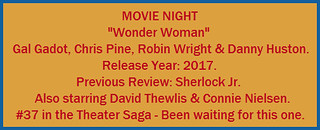
Wonder Woman (2017).


Review #942: Wonder Woman.

Cast:
Gal Gadot (Diana Prince / Wonder Woman), Chris Pine (Steve Trevor), Robin Wright (General Antiope), Danny Huston (Erich Ludendorff), David Thewlis (Sir Patrick Morgan), Connie Nielsen (Queen Hippolyta), Elena Anaya (Isabel Maru / Doctor Poison), Lucy Davis (Etta Candy), Saïd Taghmaoui (Sameer), Ewen Bremner (Charlie), and Eugene Brave Rock (Chief) Directed by Patty Jenkins.

Review:
Last year, Wonder Woman made her first live on-screen theatrical appearance in Batman v Superman: Dawn of Justice (#788), a movie that tried to set the stage for DC's own movie universe, though I would argue that it set the bar pretty low for future films to be better (as evidenced by Suicide Squad - #828). With this one, however, there is no question that this is a good film that manages to be quite consistent along with being well-crafted. The reason for this starts with Gadot and Pine, who have great chemistry and timing together; it's not so much that one doesn't do great without the other, but they certainly help the movie when they are interacting with each other (or the supporting characters). It shouldn't be understated that Gadot is wonderful as Wonder Woman, giving off an earnest performance that is easily likable and watchable; she is easily convincing in the action sequences, which helps the movie earn its wings in being good entertainment. The villains in the film aren't anything too special, but they are at leas serviceable entertainment, though the climax muddles them up a bit (no doubt due to the effects and the lighting clashing a bit). Regardless, they work for the film just fine, much like the trio that accompanies our main leads (Taghmaoui-Bremner-Brave Rock), who are easily watchable, while providing some light charm. Wright and Nielsen are also pretty good for the time they have on screen in the first half of the film.

The action scenes are pretty spectacular, with the sequences being executed well without becoming overstuffed (the climax is a bit big, but that makes sense for the end). The time period of the film (1918, near the end of World War I - called the "war to end all wars") was a neat choice in part because it gives the film different ground to tread (instead of being based off WWII like Captain America: The First Avenger (#060) did) while leaving shades of gray ambiguity. At 141 minutes, the movie runs at a useful pace, balancing its characters and scenes fairly well. The climax of the movie isn't particularly great (owing to a bit of muddy but workable tone that is somewhat cliche), though it doesn't hurt the movie too much. This is a movie that shines in sincerity, making its own mark in a world filled with comic book films. Is it a perfect movie? No, but it certainly is an fine achievement that I'm sure many were waiting for.

Overall, I give it 9 out of 10 stars.