Showing posts with label Halliwell Hobbes. Show all posts

October 23, 2025

The Invisible Man's Revenge.

Review #2450: The Invisible Man's Revenge.

Cast: 
Jon Hall (Robert Griffin / The Invisible Man), Leon Errol (Herbert Higgins), John Carradine (Dr. Peter Drury), Alan Curtis (Mark Foster), Evelyn Ankers (Julie Herrick), Gale Sondergaard (Lady Irene Herrick), Lester Matthews (Sir Jasper Herrick), Halliwell Hobbes (Cleghorn), Leyland Hodgson (Sir Frederick Travers), and Doris Lloyd (Maud) Produced and Directed by Ford Beebe. 

Review:
You may or may not remember that The Invisible Man wasn't exactly the Universal favorite. It took seven years from the release of The Invisible Man (1933) to merit a follow-up and, well, they never appeared in one of the Universal crossover movies, so you got The Invisible Man Returns (1940). Instead, you got stuff like The Invisible Woman (1940), a comedy feature (starring Virginia Bruce) and Invisible Agent (1942), a spy movie that happened to have Jon Hall play the title character. With this movie, Hall became the only actor to play an Invisible Man in multiple movies. The movie was directed and produced by Ford Beebe, a grab-bag man of directing various genres for cheap, whether as the Western with Overland Bound (1929), the serial such as Flash Gordon's Trip to Mars (1938) or the adventure with Bomba, the Jungle Boy (1949-1955). The movie was written by Bertram Millhauser, who had written for several mysteries such as four Sherlock Holmes movies. Previously, Beebe had directed a horror movie for Universal with Night Monster (1942).  Universal did one other Invisible Man, albeit as a spoof, with Abbott and Costello Meet the Invisible Man (1951). There were movies abroad that cribbed from the H. G. Wells novel such as The Invisible Man Appears (1949) and The Invisible Avenger (1954), which each had effects work by Eiji Tsuburaya and there was also the Japanese feature The Invisible Man vs. The Human Fly (1957). And then of course there was some overrated Universal movie in 2020.

Now we are in the realm of pushing mad scientists to the sidelines for tired plots about revenge. To put it out of the way, this is the weakest of the three Invisible Man movies. You would think a movie that relies on draining blood from people to maybe become visible again would have an effect on you, but nope, the whole thing is just played for mild-mannered scare. The story (77 minutes long) isn't even that involving either, since the lead character is presented as just a weird guy trying to get revenge, so even if his motives were interesting beyond "maybe" being screwed over in safari, he does his stuff in the most complicated of ways, because it isn't enough to target two people, no, he wants to get their daughter married to him as well. He gets rescued by someone and decides, yes, I'm going to give them a bit of a boost and try to help them win a game of darts too. The ending is sheer audacity in ridiculous: the loyal dog of the guy the Invisible Man kills ends up being responsible for his demise, because he just happened to wander all the way through. Hall in general is too bland to really make this path of "revenge" that interesting. Carradine at least looks enthused to not be in a Universal movie with makeup (he played Count Dracula a few times) but he isn't even allowed to really go off for curiosity. Sure, his plan to help a guy gain visibility (dog gets drained of blood) sounds mad but he is quickly disposed of anyway. To say nothing of the bland triangle between Hall, Curtis, and Hendrick is the easiest thing, because really, getting money sounds more compelling than having to get visible just so you can "get" a girl. Everything is stacked in just doing things in the corniest of ways that don't even make for a great showcase of invisible effects this time, save for a scene or two. As a whole, for a studio that pumped out stuff such as House of Frankenstein the same year as this, you get basically the same amount of rushed ham-handedness for a pretty tired movie. 

Overall, I give it 6 out of 10 stars.

October 9, 2023

Dr. Jekyll and Mr. Hyde (1931).

Review #2103: Dr. Jekyll and Mr. Hyde (1931).

Cast: 
Fredric March (Dr. Henry Jekyll / Mr. Edward Hyde), Miriam Hopkins (Ivy Pierson), Rose Hobart (Muriel Carew), Holmes Herbert (Dr. John Lanyon), Halliwell Hobbes (Brigadier-General Danvers Carew), Edgar Norton (Poole), and Tempe Pigott (Mrs. Hawkins) Directed by Rouben Mamoulian (#773 - Applause and #1869 - The Mark of Zorro [1940])

Review: 
Well, I'm sure you are familiar with at least one adaptation of the 1886 novella The Strange Case of Dr Jekyll and Mr Hyde, as written by Robert Louis Stevenson. The novella was popular enough to inspire a stage play in 1887 by Thomas Russell Sullivan, who was asked to write it by actor Richard Mansfield because he was intrigued at the idea of playing two roles. In the 20th century, a handful of the Jekyll and Hyde films took their inspiration from the play, and the screenplay by Samuel Hoffenstein and Percy Heath here is not too different. Undeniably, this had been on my to-do list for quite a while, because how could I resist the urge to do a 1930s horror film made by a major studio that wasn't from Universal? The only other Jekyll film I watched was the 1920 edition with John Barrymore, but that was five years ago (incidentally, 1920 also saw the release of Der Januskopf, a F.W. Murnau production that had Conrad Veidt as the star that is unfortunately lost). Besides, the pre-Code era is never a bad one to look through when it comes to the days of getting in tune with "talkie" films and literary adaptations that engage in a degree of entertaining acting along with the fact that one could even see the film at all. Cuts had been made later in the decade for a re-issue due to the Code, but thankfully those scenes are still around. When MGM made their own version of the Hyde story in 1941, they had Victor Fleming as director and Spencer Tracy as the star while making sure to purchase the rights to the previous 1931 film and they basically hid it to avoid competition, which meant one couldn't really study it or rescreen it on a regular basis for the next two decades (ironic too, because the 1941 film is generally considered fairly inferior to the 1931 movie). Apparently, it was Mamoulian who suggested the use of March for the lead role rather than Paramount's idea of using Irving Pichel (or Barrymore, but he was busy at MGM) because he would be fine but "not handsome enough" for the role of Jekyll. The makeup was done by Wally Westmore, but the key element to the effects for transformation came with cinematographer Karl Struss, who noted the use of panchromatic film with differing color in makeup for certain filters to go with certain camera shots. He actually felt that the effect for Hyde looked too much like a monkey while wishing it was more of a psychological change with subtle effect for the change in the mental state. 

Eventually, one sees the deterioration that comes with the arrival of Hyde to the scene, which does make for a useful 98-minute venture of costume drama in atmospheric scares. It is the kind of thing one would retain in their memory to go along with other present 1931 novel "adaptations" with Frankenstein and Dracula (either version). Evidently, one sees March as Jekyll just a notch above when they see him as Hyde in terms of scenes/time, which manages to come off as two distinct people in the boisterous way that March plays his hand. The film isn't a stagy stodgy adaptation in part because the camera action is focused on establishing the tension that comes from a man waiting to burst out of his traditional chains, whether that involves POV shots (which actually start the film) or the eventual crash of man and pre-evolved man. It probably isn't surprising that he won an Academy Award for this film (sharing it with Wallace Beery), because he is tremendous here, showing the tragedy that comes with curiosity that goes too far, which involves desperation and lunacy that impulsively strikes fear for those around him. Those transformation sequences (by potion or later by impulse) are astounding, and that first sequence of Hyde in the open as one of uninhibited design and desire works to what the film wants in distinct characterization with useful effect. What we have is a victim of his own desires. Hopkins and Hobart make up both sides of the impulse here, whether that involves charm or stuffy patience for the scenario presented in upbringing (one lives in a boarding room and the other is not allowed to marry until it reaches a certain day), which makes for a quality payoff when seeing the result of overblown desire (or passionate frustration). The rest of the cast play their parts in the roundabout way to be expected, contrasting the impulsive March handily. In total, this is a splendid horror film in its camera construction and its headliner performance from March that makes for a neat encompassing film still fit for the times required.

Overall, I give it 8 out of 10 stars.
Next up: Night of the Creeps.

May 12, 2022

Double Door.

Review #1839: Double Door.

Cast: 
Evelyn Venable (Anne Darrow), Mary Morris (Victoria Van Brett), Anne Revere (Caroline Van Brett), Kent Taylor (Rip Van Brett), Guy Standing (Mortimer Neff), Colin Tapley (Dr. John Lucas), Virginia Howell (Avery), and Halliwell Hobbes (Mr. Chase) Directed by Charles Vidor.

Review: 
Sure, what is there to really expect from a movie that is billed in its opening credits as "The play that made Broadway gasp"? The play was written by Elizabeth A. McFadden and had been performed in 1933. The film script was done by Jack Cunningham and Gladys Lehman, who each wrote dozens of films in Hollywood. Who knows where the inspiration came from, but one can always wonder where the minds of eccentric millionaires go to wander, whether that involves the current age or famous ones like the Wendel family, a New York family with a famously frugal head brother that ruled over the affairs of his sisters with iron grip (the last of the Wendels died in 1931). Morris and Revere are reprising their roles from the original production, as done in New York for over a hundred performances. This was the third feature film for Charles Vidor (second credited). Born in Hungary, he developed an interest in film after serving in World War I, and he moved to the United States in 1922. He worked as an assistant to Alexander Korda alongside other jobs in productions before his first film in The Bridge (1929 short) got him his first chances to work with studios. He worked with a variety of studios such as MGM, Monogram Pictures, and Paramount Pictures before his death in 1959 at the age of 58.

Well, it is a chamber thriller full of petty domestic strife that seems ripe for a stage-bound film like this, one with name actors in a production that doesn't need many sets or much to really drive itself beside careful pacing. Think about it: you really would not change too much going from stage to film even now, if only because adding shades of gray to the lead character wouldn't really add to much to the overall story that can be boiled down to "crazy relatives with too much money and time to spend on people". The 75 minute run-time means a fairly efficient film that doesn't go off to any unnecessary tangents or become overdrawn in hysterics. Morris (not to be confused with the Fijian-British actress of the same name) studied at Radcliffe College and made her professional debut on stage in 1916 (where she would act for the next forty years); she made exactly one film appearance: this film, doing so at the age of 39. Yes, you read that right, because here she is playing a character likely twice her actual age and doing so with no real trouble at all. This results in quite a steely performance, one with the timing of a rattlesnake waiting to stalk prey that fits the bill of one loves to hate. Venable is technically the other main star (i.e. the outsider in a family drama), and she does fine in making a suitable presence to follow without just being a goody-goody broomstick actor. The climax between the two involving a soundproof vault door proves suitable in terms of wicked interest (seeming a bit like The Cask of Amontillado). Taylor is the man in the middle, and he does alright in maintaining balance for useful chemistry with Venable without being a pale square, capturing the machinations that come with trying to break free from what one was to become what one believes they should be. This was the first feature film for Revere, who would star in roughly three dozen features as a character actor alongside work in television and theater that resulted in an Academy Award and a Tony Award. She does well here in a performance built to be wrapped around Morris with desperation that proves quite convincing. Standing and the others are okay in being the neutral set-pieces to the action (that word is used for confrontations of words, remember), since no one really overacts or under-acts the scenarios presented. The final shot is a doozy, since it actually ends with someone giving out a scream before the "The End" title card appears. As a whole, the movie proves suitable for a watch for what it draws in its effective one-of-a-kind performance from Morris and the rest of the crew with useful pacing from Vidor that makes for a solid recommendation on a curious day.

Overall, I give it 8 out of 10 stars.

May 20, 2017

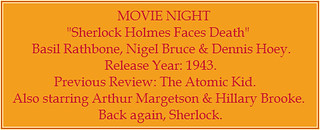
Sherlock Holmes Faces Death.


Review #936: Sherlock Holmes Faces Death.

Cast:
Basil Rathbone (Sherlock Holmes), Nigel Bruce (Dr. John Watson), Dennis Hoey (Inspector Lestrade), Arthur Margetson (Dr. Bob Sexton), Hillary Brooke (Sally Musgrave), Halliwell Hobbes (Alfred Brunton), Minna Phillips (Mrs. Howells), Milburn Stone (Captain Vickary), Gavin Muir (Phillip Musgrave), and Gerald Hamer (Major Langford) Directed by Roy William Neill (#846 - Frankenstein Meets the Wolf Man, #873 - Sherlock Holmes and the Secret Weapon, and #925 - Sherlock Holmes in Washington)

Review:
I hope that I am not boring you folks with the reviews of these certain films; I do indeed have some interest in these detective films, which clearly have some sort of appeal for me. This is the sixth of the Rathbone series (#583 - The Hound of the Baskervilles, #721 - The Adventures of Sherlock Holmes, #798 - Sherlock Holmes and the Voice of Terror, #873 - Sherlock Holmes and the Secret Weapon, and #925), but this one is a mystery revolving around murder in a house (instead of something involving the war, though there are military characters present). After three films of wartime infused spy plots, this certainly comes off as refreshing (honestly, the title is a bit strange - doesn't he always face people dying?). One of my favorite scenes is when Holmes realizes one of the clues in a "ritual" involves a checkerboard floor on one of the rooms, and naturally Holmes decides to use the people in the house in order to act the ritual out. The film runs smoothly enough at 68 minutes, mixing capable characters alongside Rathbone and Bruce (with his character having a bit more competence than before) as expected. One of the more quirky scenes with Rathbone is him talking to a squawking raven. It isn't the best Holmes film with Rathbone (for me, nothing tops the first film), but it certainly is an improvement over the previous three movies, in part because of the way it operates itself. The villain (Margetson), while not strong or particular clever, is somewhat satisfying in that he is not merely one dimensional. Brooke is a somewhat fair supporting actress (the most quirky scene involving her is one where she is reciting a ritual and a bolt of lightning strikes through a window and hits a suit of armor near her). It ends with a dialogue between the two main actors about a "new spirit abroad the land" that isn't about greed (inspired by an act of selflessness by Brooke's character), which is interesting if not somewhat broad. The mystery is entertaining enough, and this is a fairly good way to spend an afternoon with a serviceable type of movie like this.

Overall, I give it 7 out of 10 stars.

November 30, 2012

Movie Night: Dracula's Daughter.


Review #297: Dracula's Daughter.

Cast
Otto Kruger (Dr. Jeffrey Garth), Gloria Holden (Marya Zaleska), Marguerite Churchill (Janet), Edward Van Sloan (Van Helsing), Gilbert Emery (Basil Humphrey), Irving Pichel (Sandor), Halliwell Hobbes (Hawkins), Billy Bevan (Albert), and Nan Grey (Lili) Directed by Lambert Hillyer.

Review
This is one of those "Wait, there was a sequel to this?" kind of film, having been a sequel of Dracula (#71), released 5 years it, with no Lugosi (Except one wax model of him), but Van Sloan is back as Van Helsing (misspelled as Von Helsing, but whatever), which is a plus. The acting is ranges from good to okay, depending on the actor/actress. Kruger and Holden do a good job, along with Van Sloan, as he was back in Dracula. Churchill is okay, but not much else other then a small annoyance. The rest of the actors are all alright, doing a standard yet useful job. There are a few scares, but not as chilling as the first one or as mysterious. It is slightly original, not really based off any novels (Okay it was actually based off a short story, but it apparently didn't take any of the story's plot), but it is short enough to run a suddenly short length of 71 minutes. In the end, while the film does have some good moments that might work, it is slightly bogged down by sluggish pace at times and a weird pace of story. Not bad, but not great either. Countdown to 300 Reviews: 10, 9, 8, 7, 6, 5, 4, 3...

Overall, I give it 7 out of 10 stars.