Showing posts with label 1950. Show all posts

September 23, 2025

Gun Crazy.

Review #2424: Gun Crazy.

Cast: 
Peggy Cummins (Annie Laurie Starr), John Dall (Barton "Bart" Tare; Mickey Little as age 7 Bart, Russ Tamblyn as age 14 Bart), Berry Kroeger (Packett), Morris Carnovsky (Judge Willoughby), Anabel Shaw (Ruby Tare Flagler), Harry Lewis (Deputy Clyde Boston; Paul Frison as age 14 Clyde), Nedrick Young (Dave Allister; David Bair as age 7 Dave), Trevor Bardette (Sheriff Boston), and Stanley Prager (Bluey-Bluey) Directed by Joseph H. Lewis (#934 - The Big Combo)

Review: 
"I told John, "Your cock's never been so hard", and I told Peggy, "You're a female dog in heat, and you want him. But don't let him have it in a hurry. Keep him waiting." That's exactly how I talked to them and I turned them loose. I didn't have to give them more directions."

I suppose a weapon like a gun has always been an object of unimaginable desire in our minds for as long as people can remember. Whether to use it for hunting or other methods, there are just some people that have such a reaction to the sight and feel of a gun that likely made it interesting to show what happens when you get a couple of misfits together with a mutual obsession. The basis for the film is a short story ("Gun Crazy", which you can see some of it here if you focus your eyes) originally published in The Saturday Evening Post in 1940 that was written by MacKinlay Kantor. Kantor wrote the screenplay for the film with Dalton Trumbo (formerly, Millard Kaufman was used as a front for Trumbo due to the blacklist), who crafted it into a doomed romance. For whatever reason, the movie was originally known as "Deadly Is the Female" (yes, United Artists thought that would be a quality title for a quality movie) before it eventually was re-issued with the title you know today. In 1992, a movie inspired by the film came out with Guncrazy, as directed by Tamra Davis. This was the first film directed in the 1950s by Joseph H. Lewis, who had been directing features for over a decade by this point in a variety of genres (Minstrel Man, The Falcon in San Francisco, you get the idea). The New York City native (and son of an optometrist) followed his brother to Hollywood and went up from camera assistant to assistant editor to, well, director of cheap but efficient movies. Apparently, before his death in 2000 at the age of 93, one of his last public appearances was to introduce a screening of none other than Gun Crazy, which he called his favorite film.

It is amazing what you can do with a relatively fast production (shot over roughly 30 days for $400,000), isn't it? There is an electricity here for such a sordid little tale of obsession and desire that is shot and executed with commitment to the material that makes one appreciate the qualities that come with such strange people fit for a confident noir. You've got one person who can stroke the gun but can't quite shoot to go along with someone who can't really control their inner self when shooting a weapon. Dall appeared in a total of eight movies in his career (with a handful of stage and TV work before his death at age 50 in 1971); Gun Crazy was his fifth film, which followed his turn as one of the killers in Rope (1948). Lewis apparently picked him because he knew that Dall would show the "inner weakness" of the character*. Lewis clearly had the right idea in mind because Dall does a tremendous job in showing the vulnerability that comes not really knowing who one is beyond choices thrust upon them (reform school, robbing people, for example). He makes for a quality tragic character to see in all of flaws that come with a lack of general direction beyond being good with a gun. This was actually the last of the movies Cummins made in Hollywood, where she had travelled to from England in 1945, having started acting in films at the age of 15 in 1940. She settled back in England for good in 1950 and did a bit of television to go with stuff that probably is best highlighted with Night of the Demon (1957). She was cast over original rumblings of getting Veronica Lake, and it would seem that Cummins was a solid choice, mainly because her troubling desires and shaky hold on reality is also fascinating to see paired with Dall. Their chemistry is interesting because it really is a clash of energy bursting to come out, one with people that are begging to just be one entity that, well, probably fits exactly with what the director told both of them to do for direction. For such a strong duo, the movie also happens to move with damn-good efficiency in showing the descent into crime (which goes from kid troublemakers to back home again) with such charming execution. The robbery sequence in particular, where it decides to just never enter the bank by just shooting from in the car (which naturally is cheaper to do than building a bank set) is probably one of the most interesting sequences you could shoot for a robbery in terms of fascination with how one could pull it off so smoothly (evidently it took a bit of lighting, fiddling with the back of the car and guys on the actual roof of the car for boom mics). I particularly like the ending in showing the culmination of one's choices not so much in what to shoot but in what to shoot for (obviously crime doesn't pay with the time the film was made in but consider how the movie gets to where it is). As a whole, this is an efficient movie that just exudes energy and curiosity over what could've just easily been a Bonnie and Clyde pastiche and makes it into a fascinating and intriguing feature worth anyone's time in the noir stands.

Overall, I give it 9 out of 10 stars.

*Dall was apparently gay, as referenced several times over such as this: https://www.tcm.com/tcmdb/title/77083/gun-crazy#articles-reviews?articleId=581435

July 16, 2025

The Baron of Arizona.

Review #2400: The Baron of Arizona.

Cast: 
Vincent Price (James Reavis), Ellen Drew (Sofia; Karen Kester as child Sofia), Vladimir Sokoloff (Pepito), Beulah Bondi (Loma), Reed Hadley (Griff), Robert Barrat (Judge), Robin Short (Lansing), Tina Pine (Rita), Margia Dean (the Marquesa), Jonathan Hale (the Governor), Edward Keane (Miller), and Barbara Woodell (Mrs. Lansing) Directed by Samuel Fuller (#1790 - Park Row, #2234 - The Steel Helmet)

Review: 
"The cameraman is master of his own kingdom. I feel the same about the rest of my crew: sound technicians, makeup people, hairdressers, costume designers. We'd discuss the kind of picture I wanted to make. Then I'd give them ample freedom to get the job done. They always did, no matter the budget or time constraints. I was always lucky with my production crews...The Baron from Arizona wasn't a big success. At least it was fun to make." - Samuel Fuller

Once ago, the West was a weird place. There once was a man named James Reavis that claimed to be a Baron of Arizona. The Missouri native apparently first learned he was good at forging signatures when enlisted in the traitorous Confederate Army as a teenager. He soon decided to surrender to the Union and served briefly there before doing a variety of jobs, one of which was real estate. It was only in 1880 that Reavis visited the then-Arizona Territory. He soon honed his plan that would see him file papers involving grants, deeds, and a claim that would've effectively nullified all existing land titles within the grant. Complications arose in the grant that saw him go to a second plan: an heiress to the grant that he could marry. Finally, in the year of 1889, the ball was rolling for nailing down the lack of validity of the claim, most notably with surveyor general Royal Johnson that noted the irregularities such as using a steel-nibbed pen rather than a quill for 18th century documents. Reavis did sue the United States government that went down the toilet in 1895. He was tried for forgery and found guilty in 1896, where he served prison time until 1898. He died in a pauper's grave in 1914. Incidentally, the tale of Reavis loosely inspired the 1939 film The Night Riders. According to Samuel Fuller's autobiography, he came across the Arizona story in the 1930s when drinking in New Mexico, as one does when on the writing beat. At any rate, years later Robert Lippert, satisfied with I Shot Jesse James (1949), was ready to produce another of Fuller's films and liked the pitch Fuller (who aspired to not leave Lippert after having one good time with him) gave to him. To beef up the curiosity, the movie states a source with a 1949 article in The American Weekly by Homer Croy, which had apparently also had material from Sam White that had been published earlier in True magazine. By Fuller's own admission, he wrote a script that he believed was more interesting than the actual Reavis story, particularly in the planning and with the love story.  Fuller even had the benefit of James Wong Howe as cinematographer because Howe, a friend of his, didn't care about the money for shooting a film and just wanted to do it. 

Admittedly, even though the movie is fine at best with the overall experience, you can clearly see the development present in a growing talent. The movie does take a bit of time to really get going with its setup (with narration present in setting certain things up, as they say), but the 97-minute runtime is generally watchable to make things worth it. Obviously first choices don't come to most movies, as Fuller had Fredric March in mind first for the lead role, but Lippert couldn't afford him. Instead, Fuller went with a gentleman that he saw on Broadway with a worthwhile voice and movements: Vincent Price. Fuller wrote a lead character that is arrogant and a conniving swindler to nearly everyone he meets and he has the absolute right guy for the film to work when you consider that Price was more than just a guy in horror movies (which happened later in the decade, as we all know), he could even do comedy in films such as Champagne for Caesar (1950). Simply put, Price makes me smile anytime I see him in a film because the mannerisms and voice just fit right from the word go even when playing a swindler. You love to see him in how the cogs turn in his head about where to jump to next in zest that in some way we all wish we had. The rest of the cast by comparison is okay, as if somehow looking at the film behind them (because Howe's cinematography is nice to experience, for one) is more interesting, but nobody detracts from the experience. You can at least believe Drew's character really does have affection for Price even with all that comes with someone who constricts an entire narrative about being descended from great things. The ending is the old fashioned "leave 'em happy going home", but it is definitely the result of a director that wanted to show that even con men can make schemes they didn't see coming work in their favor (besides, the part beforehand involving revealing ink is charming). As a whole, Fuller's second effort as a filmmaker is relatively fine, telling a worthy enough yarn of a conman and the spirit that it takes to carry things as long as it takes to get what they desire most in the game of life. For those who want a curious type of Western that plays fast and loose with history in the most curious of ways with an icon (for me, at least) in his young years, The Baron of Arizona is practically right up your alley.

Overall, I give it 7 out of 10 stars.

June 28, 2024

The Gunfighter.

Review #2223: The Gunfighter.

Cast: 
Gregory Peck (Jimmy Ringo), Helen Westcott (Peggy Walsh), Millard Mitchell (Marshal Mark Strett), Jean Parker (Molly), Karl Malden (Mac), Skip Homeier (Hunt Bromley), Anthony Ross (Deputy Charlie Norris), Verna Felton (Mrs. August Pennyfeather), Ellen Corby (Mrs. Devlin), and Richard Jaeckel (Eddie) Directed by Henry King (#1687 - O Henry's Full House)

Review: 
On July 14, 1882, a body was found in the Arizona Territory with a gunshot in the head. It was revealed to be an outlaw associated with various cowboys in Cochise County along with Tombstone and people such as Wyatt Earp. It was none other than Johnny Ringo. The real Ringo was a pretty cut-rate killer, but the Ringo for this film is vastly different, and for good reason. The film was written by playwright/sometimes screenwriter William Bowers and William Sellers, as based on a story by Bowers and Andre de Toth (a steady director in his own right, such as Westerns), albeit with uncredited contributions by producer Nunnally Johnson (a playwright in addition to producing and writing films, most notably The Grapes of Wrath [1940]) and apparently Roger Corman. Corman, who worked as a messenger at Fox, was so annoyed at his suggestions being used without getting credit, soon left Fox for study at the University of Oxford. Anyway, this was the first film done in the 1950s for its director King, who had been working consistently since 1915 in a variety of genres that spanned from the original Stella Dallas (1925) to Twelve O'Clock High (1949). Fans of the Western will recognize parts of The Shootist (1976) that sure seem to have been inspired by this film (an old, famed outlaw coming into a town and seeing familiar faces). John Wayne, who starred in that film, apparently had a motivation to want the lead part for that film because of the fact that he had rejected starring in this film because of its initial starting point being at Columbia Pictures (as headlined by an executive he hated). Incidentally, Bowers stated that he had wrote the film with Wayne in mind but when approached by Wayne, he rejected selling it to him in favor of shipping it elsewhere (which resulted in more money but also the enmity of Wayne). 

There are plenty of Westerns about people with the hands to match with anyone when it comes to gunfighting, but you don't get as many in terms of interesting looks at the people who wish the attention would just end. It starts, interestingly enough, with a gunfighter shooting someone in defense in which we don't see their hands when it comes to that fateful gunshot. It is an efficient 85-minute movie that feels like it is occurring in real time when it comes to the tension that lies within trying to stay in town when others only a tool of confrontation. The choices matter most of all in this Western rather than grand landscapes or big towns when one man arriving into town is an event on itself. Sure, one could wonder what the film would be with Wayne, but Peck (drabbed in a period-looking moustache and all) erases those doubts with an efficient performance that is imposing to go along with a semblance of pity that reminds one of seeing an old alley cat; it may not surprise you to know that this was one of six films Peck did with King. He does so well with the film that he sells that fateful final scene (establishing just who really shot who to death) with all of the punch it is worth in expressing the "known gunfighter". Mitchell provides the ideal side of the coin in terms of reformed men with just as much dignity when matched with Peck for a solidly reliable performance. The rest of the cast is pretty good, with Malden being the most enjoyable in terms of character presence (he was in the original Broadway production of A Streetcar Named Desire), although Homeier's smarmy dandy presence is a suitable antithesis to Peck when it comes to opportunism that can be slapped away just as easily. The tension comes not in wondering if you are going to get some sort of, well, gunfight but instead comes from the tension of wondering just what will happen to our lead in his quest for some sort of fulfillment that doesn't involve a gun. It sure is packed with elements that make one seemed as trapped in a manner that might make you think you were in a noir. In the end, there is plenty to enjoy in terms of a solid cast and atmosphere that executes on a level worth every moment in the art of choices made through a gun in a frontier starved for attention. 

Overall, I give it 9 out of 10 stars.

May 17, 2023

Winchester '73.

Review #2010: Winchester '73.

Cast: 
James Stewart (Lin McAdam), Shelley Winters (Lola Manners), Dan Duryea (Johnnie "Waco Johnnie" Dean), Stephen McNally (Henry "Dutch Henry" Brown), Millard Mitchell (Frankie "High-Spade Frankie" Wilson), Charles Drake (Steve Miller), John McIntire (Joe Lamont), Will Geer (Wyatt Earp), Jay C. Flippen (Sergeant Wilkes), Rock Hudson (Young Bull), John Alexander (Jack Riker), and Steve Brodie (Wesley) Directed by Anthony Mann (#1048 - He Walked by Night and #1408 - El Cid)

Review: 
"The very idea of changing my whole thing from the sort of shy, fumbling fellow to the western was just my work. It's all hard work and dedication, to be able to make a go of it. And those were the things offered to me."

James Stewart believed that the real change added in being more of a presence in Westerns when it came to a new phase in his career was the increase of vulnerability, one that differed him from presences in the same genre such as John Wayne. It probably helps that Stewart was now in his forties and was getting back into the thick of more roles in film since his return from serving in the Army Air Forces during World War II, whether that involved It's a Wonderful Life (1946) or Call Northside 777 (1948). As such, 1950 (just as it was in 1948) saw him in numerous starring roles: this film, Broken Arrow, Harvey and The Jackpot; Stewart got to do the film with Universal in tandem with them making Harvey, by the way. Stewart worked with a wide variety of directors over his career, but he would work with Mann on eight films from 1950 to 1958, five of which were Westerns. The film was written by Borden Chase (brought in by Mann to do a re-write and best known as the co-writer of Red River) and Robert L. Richards with a story by Stuart N. Lake, and it was a script that had been bounced around a bit before it became a film, which evidently had Fritz Lang tapped to direct at one point before that went down the wayside, and it was Stewart who had picked Mann (after seeing scenes from Devil's Doorway) to direct in the first place; Mann had done a share of noirs before breaking in better with Westerns, which he did a handful in the 1950s. For the rest of the decade, Stewart would be involved in a variety of box office hits while having a fair share of time spent in the Western, which would serve him just as well in the next decade. 

It's a pretty good movie, rounding all of the bases that you could see in a routine Western while having a main character with absorbing intensity. The odyssey on just how much one gun can affect the lives of others in the West is a curious one, one told with visual acuity. It is not just some frazzled innocent looking for his gun, this is a trip of bloodshed because of the human quality of wanting something so bad they could kill for it. In a row of gunslingers of familiarity and blood, the one who knows how to adapt to the situation is the one who come out alive with the weapon in their hand, which makes for a film that likes to summarize atmosphere for effect that seems fresh that has been used as an argument for starting its own wave of Westerns. The hero is not just a symbol of something decent in the West or something, now he is just a man looking to stay safe on the frontier, by any means necessary.  You see many types of people here, trying to go with the flow of the wind that get touched by the power of the gun, whether that involves Indian traders or would-be robbers, and it makes a riveting odyssey. 

Stewart clearly prepared for the role to the best of his abilities, right down to practicing handling a weapon (obviously he did not do the trick shots in the film, but you get the idea). He proves brilliant in a role that could've simply been one of blandness with an actor less determined to show vulnerability or interest in playing it straight down the line. His odyssey matters to how we care about the layers that get revealed about why it is more than just an odyssey for a gun, which makes the final confrontation (with a lack of music) that much better. McNally makes a quality presence to counteract him as the adversary, efficient in establishing the threat without missing a beat. Winters was quoted as not particularly understanding the role she played, once being quoted as asking, "What does that tell you about the values of that picture? If I hadn't been in it, would anybody have noticed?" Granted, it is hard being the one prominent woman in a cast, but she does fine with it anyways, a weary presence of battered patience.  Mitchell and Duryea make solid supporting presences to the action on either side of the coin in the odyssey (mostly for the latter, as one always likes the adversary taking a licking). The film is generally involving for its 92 minute runtime in showing what really mattered in the West without falling right away to easy tricks or bland dialogue, instead treating one to a patient story about just what it took to survive with more than just a weapon in stock. It takes a certain impulse and certain timing to differentiate one gunslinger from another, which is captured to lean effectiveness by Mann and company here.

Overall, I give it 9 out of 10 stars.

March 24, 2023

Outrage (1950).

Review #1991: Outrage.

Cast: 
Mala Powers (Ann Walton), Tod Andrews (Rev. Bruce Ferguson), Robert Clarke (Jim Owens), Raymond Bond (Eric Walton), Lilian Hamilton (Mrs. Walton), Hal March (Det. Sgt. Hendrix), Kenneth Patterson (Tom Harrison), Jerry Paris (Frank Marini), and Angela Clarke (Madge Harrison) Directed by Ida Lupino (#799 - The Hitch-Hiker, #1651 - Never Fear, #1811 - Not Wanted)

Review: 
In 1950, the Production Code was still prevalent for most motion pictures in the United States. But cracks were starting to flow, and one of those films that helped was Johnny Belinda (1948), since it covered a topic that was prohibited from being depicted: the mention of rape (that movie, incidentally, was a period drama). But there was still lines to not cross when it came to this film, since the Code objected to a variety of phrases such as "sex maniac" and "sex fiend" being used countless times. The script was done by Ida Lupino, Malvin Wald, and Collier Young for Young & Lupino's The Filmakers company. The Production Code Administration (as led by Joseph I. Breen) approved a re-done version of the script that resulted in a film that never says the word "rapist" once. Outrage was the third of six films directed by Lupino from 1949 to 1953.

As a 75-minute B-movie that technically falls under the lines of film noir (with encroaching shadows and situations without being a straight crime drama), it is a fairly decent movie for what it manages to convey as a movie of the times talking about such a sensitive subject. In the act of not actually talking about "rape", it actually has staying power in the present time because of the fact that the film is about the psychological pain that comes with what happens after an assault (which is conveyed carefully). The blame inadvertently seems to be more on the assaulted than the assaulter, whether that involves her ordeal in being asked to participate in an identification lineup or in the ordeal of trying to just walk a corner. It is all about the experience of the woman who suffered this assault upon her that sees her break away in torment on all sides over perceptions that come from being firmly on edge every second. Powers (in her first starring film role) pulls in a well-rounded performance filled with raw conviction, one who evokes all of the qualities required in making her emotional turmoil our turmoil to experience in terms of not veering into exploitation. The plight experienced by the character she plays could happen to anyone of us, and the frustrations and fears showed here remind us that there are no simple absolutes. Andrews does fine with the material in calm stature, which mainly involves being oneself in the eyes of a small town with subtle religious tones. They have the kind of warm chemistry that is meant to rebuild one's sense of self rather than outright romance - admittedly, there is more than one way to recover (if possible) from an assault than what happens here, but the important thing that Lupino shows is a story without artifice. By the time the film gets to a tragic decision with a wrench, you see just how it gets to that point and wince. The ending of the film might seem quite sudden, but the important thing to remember is that it is not quite a movie that reverts everything to the status quo when it comes to the matter of a woman who will have to continue to forge her own path forward where forgetting about the past is simply not something that you can do. It isn't just finding their way back in the arms of a man that gives her identity back, it is finding one's faith in themselves that means the most. Seven decades later, this is still a lesson we are trying to search for inside.

Overall, I give it 7 out of 10 stars.
Next: The Wild Party (1929).


February 10, 2022

No Way Out (1950).

Review #1798: No Way Out (1950).

Cast: 
Richard Widmark (Ray Biddle), Linda Darnell (Edie Johnson), Stephen McNally (Dr. Dan Wharton), Sidney Poitier (Dr. Luther Brooks), Mildred Joanne Smith (Cora Brooks), Harry Bellaver (George Biddle), Stanley Ridges (Dr. Sam Moreland), and Dots Johnson (Lefty Jones) Directed by Joseph L. Mankiewicz (#750 - All About Eve and #1378 - People Will Talk)

Review:
“If the fabric of the society were different, I would scream to high heaven to play villains and to deal with different images of Negro life that would be more dimensional. But I’ll be damned if I do that at this stage of the game. Not when there is only one Negro actor working in films with any degree of consistency.”

There were film noirs that also existed within the realm of social consciousness. Boomerang! (1947) dealt with following the rule of law, Crossfire (1947) was a mystery that gradually revealed a message against antisemitism, Panic in the Streets (1950) dealt with trying to stop the plague. What we have here is a film of blind rage...specifically, racist rage, complete with a hallmark film debut for Sidney Poitier. Born in 1927, Poitier grew up in the Bahamas before moving to the United States as a teenager, where he would serve in the United States Army during World War II. Right after the war ended, he applied twice to the American Negro Theatre, where he would study acting - he broke into Broadway in 1946. He was under contract for a play when he decided to take a screentest for this film, not expecting to actually receive the part. However, director Joseph Mankiewicz saw something he liked in Poitier (who actually fibbed his age to say he was five years older than his actual age). Poitier became a star in the next two decades in his way to becoming the first major African American film star, one who became the second black actor to win an Academy Award before he shifted focus to directing in later years; Poitier passed away this year at the age of 94, and he is generally remembered as an icon who made a difference with his integrity as a filmmaker. 

The script was done by Lesser Samuels and Mankiewicz, as the former had a son-in-law doctor (Philip Yordan provided uncredited contract script work). Mankiewicz modified the story to be more of a noir with the viewpoint of Poitier rather than an observation of black medical hopefuls. Darryl F. Zanuck, the head of 20th Century Fox (the studio that released the antisemitism expose Gentlemen's Agreement three years prior), personally supervised production of the film. Of course, the original script apparently ended with a gruesome murder, but the studio did not want to leave audiences with a hopeless feeling (which honestly seems like a good decision). Seven decades later, this 106-minute film certainly pulls enough punches within an outspoken flair for useful storytelling and a message that still stings curiosity without turning into predictable mush on any count. It is the story of a man trying to dig his way out of an awful situation: trying to prove themself when a racist is breathing down their neck (complete with inciting a riot). The unshakable object meets the immovable force when the facts are not enough to stop rage, and this still seems like something that could be seen today.

You have to remember that Widmark had captivated the screen with Kiss of Death (1947), so to see him in a scuzzy role filled with venom is not too surprising. He proves startling effective as the simmering bully, one who balances the line between caricature and terror, since he serves as a reflection of people who would rather blame race rather than confronting themselves for why their lives are the way they are (in that sense, he makes the audience uncomfortable and thus does it right). Of course, Poitier can't be forgotten, even if he is billed fourth despite having the brunt of screentime. Filled with self-doubt and pride, he makes an astonishing debut here (incidentally, Widmark and Poitier became friends during production, and he would even go so far as to apologize to him after certain takes), with the enmity between the two leads being quite palpable when it comes to a match of pride. McNally is fine here, although one can see the seams of a character that could've seeped into self-righteousness. Darnell fares better in the conflict of which strife matters most to her (i.e. the scuz-ball saying things in her ear or her crappy life) that makes the climax (and its fateful last words) fairly worth it.

The supporting cast is nicely assembled, revolving from the warm presence of Smith to the tense Johnson. Additionally, this is the onscreen debut of Ossie Davis (in a brief uncredited role), and he appears with wife Ruby Dee briefly for the first time of numerous occasions where they were paired together on screen. The film was not a major success, likely owing to objections from select censor boards due to its content (what with the whole race riot and all, although I wonder if they were totally fine with all the racial epithets), with Chicago fearing it would incite riots (which as we all know is bullshit) before cuts were made regarding the riot. Of course, Mankiewicz already had another film ready to release later that year with All About Eve (1950), while this film is less well-known (incidentally, each film would have their script nominated for Academy Awards). At any rate, this is a film anybody would be proud to have been a part of, and it is definitely one worth seeing for what it manages to do for the time as a socially conscious movie with a worthwhile debut from an actor that was just getting started.

Overall, I give it 8 out of 10 stars.

Next Time: Carib Gold.

September 16, 2021

Los Olvidados.

Review #1723: Los Olvidados.

Cast: 
Stella Inda (Pedro's mother), Miguel Inclán (Don Carmelo), Alfonso Mejía (Pedro), Roberto Cobo ("El Jaibo"), Alma Delia Fuentes (Meche), Francisco Jambrina (The principal of the rural school), Jesús Navarro (Julián's father), Efraín Arauz ("Cacarizo"), Jorge Pérez ("Pelón"), Javier Amézcua (Julián), Mário Ramírez ("Ojitos"), and Ernesto Alonso (Narrator) Directed by Luis Buñuel (#1383 - Él)

Review: 
“[The cinema] is an instrument of poetry, with all that that word can imply of the sense of liberation, of subversion of reality, of the threshold of the marvelous world of the subconscious, of nonconformity with the limited society that surrounds us.”

If you think about it, no one really wants to see the truth displayed on the film screen. Sure, we can proclaim much as we want about our desire to see real life come out in film with no lingering artifice. Of course, it is also possible that this could apply to Luis Buñuel when it refers to which of his films have endured most in international perspectives. Most know of his shocking debut with the surrealist short Un Chien Andalou (1929), but just as important to mention is L'Age d'Or (1930), his feature debut that generated umbrage and curiosity over its place within surrealist cinema (a classic. After this, he made a pseudo-documentary with Land Without Bread [Las Hurdes: Tierra Sin Pan] (1933), which generated a few years of furor upon release in Spain for its "defamation" (of course, asking certain folks from Las Hurdes wouldn't generate universal praise). After this, he worked a few years at Filmófono as an executive director in Spain's attempts at commercial filmmaking, which resulted in four features before the Spanish Civil War began in 1936. He moved to the United States before the war ended in 1939, but he could not make a mark in the Hollywood system despite his intense attraction to "American naturalness and sociability"; he worked instead in dubbing while also working with the Museum of Modern Art. The seeds to his return came because an old friend wanted to adapt a play into a film in Paris, with a stopover in Mexico City; the play adaptation went by the wayside, but they attracted interest to make a feature in the country, which was in the throes of what is referred to (the Golden Age in its cinema. At any rate, Buñuel made his return with Gran Casino (1947). Of course, we are not here to talk about that feature, because it isn't particularly remembered (his most notable feature done in Mexico. Los Olvidados (which translates to The Forgotten Ones, but it was known in the States as The Young and the Damned) is undoubtedly the most famous of the films he made in the country along with being the first film he did in his busiest decade as a director (he would make fourteen films in Mexico before he found opportunities to make films abroad in 1954 and 1956, although he did make a few more films in the country until 1965). Although he found his previous feature (El Gran Calavera, released the previous year) banal, its success meant that Buñuel was sought out exclusively by producer Oscar Dancigers. Buñuel first thought of a film about a lottery ticket seller kid, but Dancigers aimed to seek a more realistic depiction of struggling children living in the slums of Mexico City. Luis Alcoriza and Bunuel were credited with the screenplay, while dialogue collaborators left un-credited included Max Aub, Juan Larrea, and Pedro de Urdimalas; sure, one could think about neorealism when it comes to this film, because Bunuel was noted for his admiration of Vittorio De Sica's Shoeshine [Sciuscià] (1946).

Did I mention that this film did not receive immediate acceptance at the time? It didn't even take a week for the producer to pull the film, which received negativity because...yeah, I suppose one really can't just watch a movie about poverty without a little bit of fantasy. Imagine stoking the anger of not only the public but also the government as well, because having a narrator say that behind every beautiful city are poor children is probably too honest, as if country morale is going to decrease because of a movie. I guess having a character throw an egg at the camera is just too shocking to go alongside a slo-mo nightmare and a gut-punching finale (of course, there was an alternative ending shot, but it was lost for a few decades). Of course, when the film was shown at the Cannes Film Festival, it received better notices, to where Buñuel won the festival prize for directing; awards really do seem to improve reputations (as opposed to the inverse effect), and the film is quite respected in its native country now. There are no moments to mount a sermon for easy solutions to preach here, which I suppose some could interpret as uncompromising. But that is the point, and it is the fact that we can still recognize the depravity that humanity can go when hope has flickered away like a dying wind that makes the film so striking and so memorable today. We may not like to see it, but we can still find someone like the folks depicted in this film, one that has endured for seven decades because of how it exposes the depravity that comes from the bottom without a plug to contain it, as if growing progress will always somehow leave someone behind. Rot is the center of what we see in the characters, played by a mix of actors and others that proves harrowing. Mejia and Cobo each lead the film with their own degree of rot that seems quite shocking when you see it from a child, which obviously means that it is quite effective, since you can see the distinct differences and similarities between them in how they face the dark world at large (i.e whether to try and run with the wave or to try and not become swept up by it). Inda represents rotted love of the most heartbreaking kind: a mother and her son; it reflects on society and its easy response to a cycle of depravity in which rejection is easier than confronting the afflicted. No one is spared in the cycle of poverty and rot, extending all the way down to Inclan and his portrayal of a blind man (of course, the actor was noted for his villainous roles within the country, so perhaps this wasn't as much a surprise), or a withering Fuentes, encased in the rot of youths. For a 76 minute film, it moves quite well for itself in maintaining its perspective on what it shows about poverty without becoming just a movie that says things about poverty, one that confronts the viewer without turning any blatant tricks, keeping the nightmare firmly on check - realism never looked so haunting with actors like these. Buñuel would have likely smirked at the idea of this being termed a comeback movie, but he certainly dared to keep making movies in his own distinct image because of the success that came from this one, which had their own varying levels of surreal or satirical edges that made him a true curiosity for the world stage.

Overall, I give it 9 out of 10 stars.

March 13, 2021

Never Fear.

Review #1651: Never Fear.

Cast:
Sally Forrest (Carol Williams), Keefe Brasselle (Guy Richards), Hugh O'Brian (Len Randall), Eve Miller (Phyllis Townsend), Lawrence Dobkin (Dr. Middleton), Rita Lupino (Josie), Herb Butterfield (Walter Williams), Kevin O'Morrison (Red Dawson), Stanley Waxman (Dr. Taylor), Jerry Hausner (Mr. Brownlee), and John Franco (Carlos) Directed by Ida Lupino (#799 - The Hitch-Hiker)

Review:
When it comes to social message movies and the folks who directed them, one name that should come up with reverence is Ida Lupino. It is interesting to note her as a director considering her road to getting there from her first turn as an actress. She was the daughter of a comedian and an actress in an English family known for their theatrical roots. She was encouraged to act from a young age, and she would study at the Royal Academy of Dramatic Art. She would make her first venture into film in 1931 at the age of 13 and enter the stage three years after that; she would eventually be cast into lead roles while calling herself "the poor man's Bette Davis." Her arguments with Warner Bros over the quality of roles they favored for her lead to numerous suspensions that she used to observe the process of filming and editing films. Although she would do dozens of roles over the years, what she really wanted to do was take her creativity and use it to direct her own films, having found acting to be a "torturous profession", and she felt that directing was the more interesting work. Inspired, she would form with her husband Collier Young an independent company to produce and direct low-budget works called The Filmmakers. In 1949, she had her first chance to direct with Not Wanted, as Elmer Clifton had a heart attack during filming, with Lupino (who co-wrote and co-produced the feature) deciding to not take credit for the controversial film (involving the topic of unwanted pregnancy). Counting Not Wanted, Lupino directed eight films in the span of seventeen years (with her last film in The Trouble with Angels (1966) being the only one done after The Filmmakers closed up shop in 1955). Lupino, who once joked that her quality as a director was as a "poor man's Don Siegel" (although one of her influences was Roberto Rossellini), would persist in directing and acting in three decades (most notably The Twilight Zone, being the only person to direct an episode alongside star in an episode each) until retirement in 1978. Her films generally dealt with difficult subject matter that were not generally covered within mainstream material of the time, such as bigamy or rape, but she also directed film noir (being un-credited for On Dangerous Ground (1952) while also doing The Hitch-Hiker the following year). This film is also known as The Young Lovers, although it did not help when it came to audience appeal, since this was not a major success. Lupino co-wrote the film with Young, and they also each served as producer for the film, which was distributed by Eagle-Lion Films.

This certainly was a personal film for her, as Lupino had been diagnosed with polio in 1934. Although she would eventually recover without losing the ability to walk, it reinforced her desire to focus on her abilities on an intellectual level without such focus on physicality. In this case, Lupino is making a feature that feels like a documentary at times with its shots of recovery for folks with polio at the Kabat-Kaiser Institute in Santa Monica, whether that means shots of treatment or shots of swimming or even square-dancing (in wheelchairs); ultimately, it is the tale of someone finding their place again in life and not dealing with it alone and become wrapped with self-pity. At the time, polio was a fairly prevalent health crisis across the world; two years after the release of the film, over 3,000 people alone would die of the disease in the United States, with the first safe vaccine for the disease coming out in 1955 by Jonas Salk (efforts to eradicate it worldwide have persisted since the 1980s). This was the second of three films that Forrest had done with Lupino (she made her formal debut in acting with Not Wanted). She does well with a tough role, because one has to convey an isolated tone without seeming too closed off in their arc for 82 minutes. She shows that degree of fear one would have if in that scenario without overplaying her hand. Brasselle matches her on the other side of life with polio - the person closest to her in adjustment, whether that involves trying to sell houses while waiting for someone to get better, or persisting in trying to get his girl on her feet. He does okay with that, seeming more suited for the cheesy number in the beginning or one scene spent with Miller involving regrets and an embrace. This was the first feature role for O'Brian, a former Marine who got into show business after being asked to take part in rehearsals for a play (directed by Lupino) after the lead failed to show that led to an agent wanting to sign him. He probably gives off the best performance, one with confidence and peace of mind for what needs to occur in perspective that never seems like someone doing it on one take. Miller has that fine little sequence with Brasselle as stated, while Dobkin rounds out the general focus decently enough. If it seems a bit off-kilter in its face of adversity in terms of physical and psychological trouble without being wrapped in too much inevitability. It is a closed-in type of movie, where one experiences the pain of the main character that ranges from closed-off despair to lingering doubt that makes its "you are there" segments work handily for what it needs. For me, it seems similiar to another film that would come out later in the year of 1950 with The Men, which dealt with a paralyzed veteran having to adjust with the loss of his legs while at a hospital that goes through a bout of isolation and self-pity. It isn't about what you assume is going to happen as it a film about what you feel about what is going to happen, where that doubt about one's health could apply beyond polio, particularly in recent years where isolation seems more rampant than ever when dealing with (or hearing about) illness. In that sense, Lupino has managed to make a fairly well-made feature that seems quite prescient, and when it comes to key female directors, Ida Lupino makes for a good start in terms of pressing the issue of perspective.

Next Time: Going across the pond with Muriel Box and Street Corner (1953).

Overall, I give it 8 out of 10 stars.

December 6, 2020

Harvey.

Review #1607: Harvey.

Cast: 
James Stewart (Elwood P. Dowd), Josephine Hull (Veta Louise Dowd Simmons), Peggy Dow (Miss Kelly), Charles Drake (Dr. Lyman Sanderson), Victoria Horne (Myrtle Mae Simmons), Jesse White (Marvin Wilson), Cecil Kellaway (Dr. William Chumley), William H. Lynn (Judge Omar Gaffney), Dick Wessel (Bartender Mr. Cracker), Nana Bryant (Mrs. Hazel Chumley), Grayce Mills (Aunt Ethel Chauvenet), and Clem Bevans (Herman Shimmelplatzer) Directed by Henry Koster.

Review: 
"I must say it was a complete, one hundred percent pleasure, the whole picture. I had the most wonderful performers. The spirit of Harvey, that splendid and helpful ghost, was always with us while we did it."

What does one expect from a movie involving an eccentric lead that has a six-foot (and 3 1/2 inches) invisible rabbit for a best friend? Plenty, if you can believe it from a film celebrating its 70th anniversary. I'm sure at least one of my readers has had an imaginary friend that lurked in their lives, and I remember having one to talk my thoughts with out loud (it didn't have a name, however). Harvey first began as a play of the same name, written in 1944 by Mary Chase. She was awarded a Pulitzer Prize for Drama the following year for the play. Its original production ran for five years on Broadway, which originally featured Frank Fay as the lead with Josephine Hull in the secondary role. There were various actors that would take over the role during that run, which included actors such as Joe E. Brown and James Stewart. He managed to snag the role in a deal with Universal-International that meant he would be cast if he agreed to be the star of Winchester '73 (1950), which arguably played a great role in his second phase of stardom. Stewart would play the role again on the stage numerous times, including a revival on Broadway and a run on the West End as well as a TV adaptation in 1972 (done between two other TV adaptations, which had Art Carney and Harry Anderson as leads, respectively). He would note this as one of his favorite roles, reflected as such by him in a special introduction he did for the release of the film onto video in 1990. If you can believe it, Chase wanted the film to show the rabbit at the end, as if to show that the lead was not in fact just a drunk - the studio decided to not do so, instead going with for the final shot of the movie a credit for the title character that shows a door quietly being opened as "as himself" title appears (besides, he technically makes an appearance - in a painting with him and Stewart). This was a film in the middle of the lengthy career of Henry Koster, who grew up interested in cinema from a young age growing up in Berlin, Germany. He grew up to become a screenwriter for German films before moving into directing with Thea Roland (1932) before leaving for Austria and later the United States before World War II started. Koster would direct numerous films in three decades of work (for a variety of studios, most notably with Universal Pictures), directing a variety of genres such as musicals and comedies (including discovering Abbott and Costello that led to them being hired for films) - simply put, it is long overdue to look upon his career.

Chase and Oscar Brodney wrote the screenplay, while Myles Connolly did uncredited contribution as well. So how goes the film with plenty of calm whimsy? Oh, it's a fine one, one that honors its stage roots to make a well-mannered adaptation into film. With Stewart at the helm, he makes the experience all the more useful in quiet endearing charm, which one can expect from a number of his performances in a lengthy career, but this one fits right at home with what is needed here, because he doesn't make it out to seem like one is waiting for a joke to arise, as he is instead a bit stooped over with kindness (since the shots make it look like there really is someone near him to begin with). It may not be a great film, but it is nice to see that no one has tried to remake it into a theatrical effort since this one. While this was only the fourth of five film roles for Hull, don't let that fool you into seeing the talent within, because she was a stage actress for fifty years, going from stock to chorus girl to eventual star. She makes a worthy mild tempered foil to go with Stewart, one that has the interesting act of having to believe and not believe in the title character at the same time. In other words, this is a fine film where either Stewart or Hull can be thought of as easy to go along with. Others do fine in keeping up, such as a fair duo with Dow and Drake in clinical straight folks, alongside quirks such as White and Kellaway in interaction spent with Stewart and/or Harvey.  It balances its main quirk with reasonable pace at 104 minutes and a few interesting performances to go alongside Stewart that delivers some chuckles that keeps its main focus from devolving into farce with simple wisdom in one key thing: normal humans may be stinkers, but that doesn't mean one that happens to believe in a friendly spirit like Harvey is dangerous to you or me. Basically, you could shorten it to "be yourself", but without the eye-roll that comes at times to folks because of the struggle that comes to wrestle with reality in offbeat ways. In any case, one's enjoyment of the film is all up to your imagination, which goes with the amusement of errors that happen throughout its runtime. What we have is a light-hearted winner in bending the usual expectations seen in comedy-dramas, one with no need for an adversary or a romance to carry itself along, instead relying itself on the folksy charm of Stewart and a pooka to carry your imagination anywhere it wants to go. Sometimes, that is more than enough for a fine time, whether for 1950 or 2020.

Overall, I give it 8 out of 10 stars.

April 4, 2020

The Men.

Review #1377: The Men.

Cast: 
Marlon Brando (Ken Wilocek), Teresa Wright (Ellen), Everett Sloane (Dr. Brock), Jack Webb (Norm), Richard Erdman (Leo), Arthur Jurado (Angel), Virginia Farmer (Nurse Robbins), Dorothy Tree (Ellen's Mother), and Howard St. John (Ellen's Father) Directed by Fred Zinnemann.

Review: 
"If you want something from an audience, you give blood to their fantasies. It's the ultimate hustle."

We all have our own challenges to face in life. If one rises to the occasion with courage or dedication, they may find themselves with success or at the very least something to be proud of. In the case of Marlon Brando, it was opportunity that fell onto him, as he had a knack for mimicking since he was a youth. He eventually set out to study acting, the one thing he enjoyed and felt accepted with. He credited the teachings of Stella Adler and Elia Kazan in acting, more specifically the Stanislavski system, where one is encouraged to look into what makes the character they are playing inside and out with realism. He found himself on Broadway in 1944, but his big break came with Kazan's direction of the Tennessee Williams play A Streetcar Named Desire (1947) as Stanley Kowalski. He would later reprise the role for the film adaptation four years later, but his debut film came in this feature, where he accustomed himself to the role by remaining in a wheelchair on and off the set for filming. One should not be surprised to find Fred Zinnemann behind the director's chair for a film with stark realism that certainly seemed to take risks outside of the usual fare for dramas. He had grown up with ambitions of music before graduating with a law degree in his time in his native Austria, but he found himself interested in film and how they were produced, which is where he became a cameraman. One of his first films he worked on was People on Sunday (1930), but he soon moved to America, working a variety of film jobs such an extra or with Robert Flaherty, and his debut film came with Redes (The Wave) in 1936, a documentary-turned-drama about the plights of a small fishing community in Mexico. He eventually found films with darker reach such as The Seventh Cross (1944), which featured German refugees in some of the roles, and The Search (1948), which depicted the attempts at reuniting families separated by World War II. In a career that spanned over five decades, Zinnemann would make over 20 films, with two of them winning Best Picture (From Here to Eternity, A Man for All Seasons), while Zinnemann won a total of four Academy Awards (two for short subjects, two for directing).

One can always applaud the efforts to make a compelling social drama that strives for honesty, whether it involves adjustment back to society or adjusting romances, which both applies to this film, with paraplegic veterans trying to adjust back to society. The film was written by Carl Foreman, who had previously collaborated with producer Stanley Kramer with films such as Champion (1949). The film utilizes actual patients from the Birmingham General Hospital (located in the town of Van Nuys, California that closed down in 1950), which Brando lived for a month to study people there. He proves himself with a worthy debut, one that is tragic and absorbing, whenever dealing with his condition or with the world at large while having to act in either a bed or in a chair, which works to an actor like Brando. Wright makes for a fine show of professionalism and patience, reflected in the careful chemistry demonstrated with Brando that makes for a few quiet highlights. Sloane shines in a resounding patient role, while Webb (noted for creating and starring on Dragnet, which started on radio the previous year) shines with a mix of cynicism and humor, such as when he recites lines from Shakespeare. In any case, the film runs at a fair pace with 87 minutes, reaching most of the points it wants to make without seeming like an overreach when it comes to its message or seeming outdated. It is a film that approaches its subject with a sense of honesty and sensitivity, highlighted by a dynamic debut from a transcendent actor like Brando and capable directing from a maverick like Zinnemann to make a little gem of a film count now.

Overall, I give it 8 out of 10 stars.

April 2, 2020

Broken Arrow (1950).

Review #1376: Broken Arrow.

Cast: 
James Stewart (Tom Jeffords), Jeff Chandler (Cochise), Debra Paget (Sonseeahray), Basil Ruysdael (Gen. Oliver Otis Howard), Will Geer (Ben Slade, Rancher), Joyce MacKenzie (Terry, Scatfly Proprietress), Arthur Hunnicutt (Milt Duffield, Mail Superintendent), and Jay Silverheels (Geronimo) Directed by Delmer Daves.

Review: 
There have been plenty of Western directors, and one who had his own place with stars was Delmer Daves. He started his film career as a prop boy on a Western with The Covered Wagon (1923), having aspired to be a lawyer in California. Despite finishing his studies, he decided to become a screenwriter for MGM in 1929. Through various studios such as MGM and Warner Bros, he wrote numerous films such as The Petrified Forest (1936) and Love Affair (1939). Although he did not receive the kind of nominations and awards like other directors of his time, he still found time to make a 22-year career worthwhile while directing numerous stars in his films, revolving from Gary Cooper to George C. Scott in his 22-year directing career, with highlights including 3:10 to Yuma (1957), The Hanging Tree (1959), and Spencer's Mountain (1963). This film was not different when it came to stars, in terms of Stewart, who started the decade with a renewed output in films that evolved his everyman persona with a bit more ruggedness (with this being the first of his Westerns for the era), while Chandler was a relative unknown with physicality and radio (and a bit of film) experience that lifted him to stardom.

The film was adapted from Elliott Arnold's novel of the same name by Albert Maltz (who used a front name due to blacklisting), which told the story of a peace agreement between Cochise and the U.S. Army that occurred for a few years, with dramatizations of historical figures such as Jeffords and Cochise, particularly with the former in terms of a romance. However, it is the attempt to show Native Americans in a balanced manner that made it stood out from the hostile manner of other Westerns in previous years. It is dignity that encompasses the film in its portrayal of attempted peace in the face of prejudice that has its own merits now as it did then, where understanding is the real key to a just land as opposed to a whirlwind of strikes and revenge. Stewart is the fiber of the film, one with growing principles towards a future besides the status quo of war. Chandler (who would play the role again alongside Silverheels in The Battle at Apache Pass two years later) proves to be just as interesting with fiber, giving credence to a fairly balanced historical role with a sense of presence that makes him compelling to watch. Paget seems a bit too young for this particular role, since there is a considerable age difference of 25 years between her and Stewart, which ends up with a bare sense of chemistry that tangles up the climax a bit. Ruysdael and the others lend a fair hand at giving credence and differing tension to a film that yearns to tell a story beyond just fighting for a Western - which works itself out most of the time. On the whole, the film works itself for 93 minutes without too much trouble, a careful film that stands competently after eight decades with structure worth looking forward to now among the usual Westerns of its time.

Overall, I give it 7 out of 10 stars.

Panic in the Streets.

Review #1375: Panic in the Streets.

Cast: 
Richard Widmark (Lieutenant Commander "Clint" Reed, M.D.), Paul Douglas (Captain Tom Warren), Barbara Bel Geddes (Nancy Reed), Jack Palance (Blackie), Zero Mostel (Raymond Fitch), Alexis Minotis (John Mefaris), Dan Riss (Neff), Guy Thonajan (Poldi), and Tommy Cook (Vince Poldi) Directed by Elia Kazan (#104 - East of Eden, #109 - A Streetcar Named Desire, and #110 - On the Waterfront)

Review: 
"I don't move unless I have some empathy with the basic theme."

Elia Kazan is thought to be one of the greatest influential directors of our time. He started his post college life as a stage actor, but his most important influence was the Group Theatre, a collective dedicated to a naturalistic and forceful style of acting, influenced by the teachings of Konstantin Stanislavski, with this particular style being associated later in the 20th century as the Method style of acting. Kazan did do some acting in his time with the Theatre, but it was his directing that soon came to be noticed on the New York stage, where he won three Tony Award for direction (most notably with Death of a Salesman). He came to Hollywood to direct his debut picture in A Tree Grows in Brooklyn (1945). 1947 was a critical year in his life, as he directed three films and had one of them (Gentlemen's Agreement) win an Academy Award for Best Picture and Best Director. He also helped to form the Actors Studio (along with Cheryl Crawford and Robert Lewis), which later had Group Theatre founder Lee Strasberg as director, who would later be described as the father of method acting in America. Ultimately, Kazan would direct nineteen films in 29 years of directing, with a majority of his films receiving award nominations and nine actors receiving Academy Awards for work in his films. Kazan liked to pick people for his films that weren't necessarily big stars, acting as a mentor to them to try and figure them out so they aren't a complete unknown when it comes to filming. One particular unknown who got a break from Kazan in this film was Walter (Jack) Palance. He had made his debut in theater in 1947 at the age of 28 after spending his life doing a variety of professions, ranging from a coal miner to a boxer to working various cooking jobs at Stanford University (where he nearly gradated from). He was later described by main star Widmark as "the toughest guy I ever met. He was the only actor I've ever been physically afraid of."

In any case, this is certainly an interesting film to pick out from Kazan, one to start out a prime decade for capable films from him alongside ones involving noir thrillers. For one thing, it's a film about a hunt for a killer that doesn't know he has the plague, filmed on location in New Orleans (with the underbelly parts being emphasized for effect) with a mix of professional actors and hired locale. Perhaps predictably, the Hays Code had their slight issues with the film (which had working titles Port of Entry and Outbreak) before it could get itself going, mostly with the ideas of not having a suggestion of a cop being killed, or a falling mattress scene being not too realistic in gruesomeness. The film had two separate writing credits, with Richard Murphy and Daniel Fuchs doing the screenplay while Edna and Edward Anhalt wrote the story. The Anhalts would win an Academy Award for Best Writing, Motion Picture Story for this film. In any case, this is a film that basks itself in its setting with openness and a sense of realism that makes for compelling staying power for this exact time seven decades after its release. It finds a path to not being just a plain procedural with relative tension and a collection of capable presences to follow along with. Widmark (known early for villainous roles) gives off a durable performance, one that is urgent and easy to follow along with no trouble in terms of belief. Douglas (having started his film career just one year earlier) accompanies him with rough assurance. Bel Geddes makes her time count with decent chemistry when needed with Widmark. Undeniably, Palance makes for a enterprising debut, a clear chilling presence whenever he is on screen, while Mostel (who was blacklisted in the late 1940s) accompanies him with panicky brilliance. On the whole, the film balances itself through 96 minutes with a grimy mix of terror and drama that doesn't sell itself short in overwrought decision-making, having a proactive vision of realism that applies especially now more than ever.

Overall, I give it 8 out of 10 stars.

April 1, 2020

Quicksand (1950).

Review #1374: Quicksand.

Cast: 
Mickey Rooney (Dan), Jeanne Cagney (Vera), Barbara Bates (Helen), Peter Lorre (Nick), Taylor Holmes (Harvey), Art Smith (Mackey), Wally Cassell (Chuck), Richard Lane (Lt. Nelson), Patsy O'Connora (Millie), John Gallaudet (Moriarity), and Minerva Urecal (Landlady) Directed by Irving Pichel (#617 - Destination Moon and #709 - The Most Dangerous Game)

Review: 
Every decade has its dawn and characteristics that distinguish it from the one before it, particularly for film. The 1920s served as a prosperous time for silent film while the 1930s cultivated sound into a permanent trend alongside finding ways to entertain Great Depression audiences and the 1940s
found war along with film noir and the beginning of the end of the studio system. With the beginning of the Atomic Age, one could only wonder how different things could get for film and the world at large. With scares of the television and red kind, stars and directors found themselves at a crossroad over where to go with a choice beyond studio loyalty in free-lance work. In this case, this film served as a crossroad for its stars and director. Rooney, to put it lightly, had one of the most distinguished careers in acting. He had his debut in film at the age of six, having started in vaudeville with his parents before they separated and his mother moved with him to Hollywood. The following year, he starred in the short film series Mickey McGuire, doing 78 films in seven years. He would find himself into stardom in the latter half of the 1930s with films such as A Midsummer Night's Dream (1935), A Family Affair (1937), and Boys Town (1938). He had reached the peak of his career by the time of his 30s (including an Academy Juvenile Award at the age of 18), but he kept on in a variety of media for 88 years until his death in 2014, whether it was a big or small film role, television, or even Broadway. Lorre had come from the stage to film through Fritz Lang's M (1931) before settling in Hollywood four years later. He had a career of B-movies and character roles that allowed for some highlights, such as Mad Love (1935), The Maltese Falcon (1941), and The Beast with Five Fingers (1946). His career had slowed down in the late 1940s, but he continued on until his death in 1964. Pichel had his start in the theater after graduating from Harvard, soon finding himself into directing alongside character roles in film in the 1920s and 1930s. He had his debut in film direction with The Most Dangerous Game (1932). His career slowed down in the 1950s as a victim of blacklisting (a consequence of fear over certain activity of American writers and directors), with a subsequent heart condition leading to his death in 1954.

This is a decent little film noir, one with a quiet presence of careful pace and a standout performance from Rooney that makes this ever-growing web of seediness and naivety work out fine. Rooney makes things work as well as they do because we can see ourselves in this everyman though his various moments with others in an attempt to play against type, playing tension with grace. Cagney does well with in a role oozing alongside a descent, while Bates serves as a decent contrast, although both have just slight chemistry with Rooney. Lorre is nice to see with his careful seedy presence, but he disappears from the film after the first half (speaking of sudden appearances, Bates really only becomes a presence in the last 25 minutes), since the real villain of the film is ill-advised decision making. Noirs can find themselves in binding twists and turns, and this one (written by Robert Smith) moves along for 79 minutes with an aim for descent that one can at least think is possible (where one mistake can lead to several others) without shaking their heads too much, particularly with its ending, where crime may not pay, but that doesn't mean one mistake is too much to overcome with time. Ultimately, this is a fairly competent little noir from Pichel as a useful curiosity through Rooney and Lorre that serves itself well in the public domain to view at some point in time.

Overall, I give it 7 out of 10 stars.

June 11, 2016

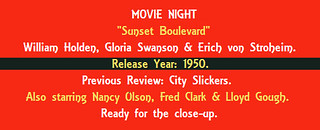
Sunset Boulevard.


Review #809: Sunset Boulevard.

Cast
William Holden (Joe Gillis), Gloria Swanson (Norma Desmond), Erich von Stroheim (Max von Mayerling), Nancy Olson (Betty Schaefer), Fred Clark (Sheldrake), Lloyd Gough (Morino), Jack Webb (Artie Green), and Cecil B. DeMille. Directed by Billy Wilder (#106 - Some Like It Hot, #194 - Ace in the Hole, #422 - The Fortune Cookie, and #641 - The Apartment)

Review
The inventive (if not quirky) device of narration by our freshly dead main character certainly sets the tone for what is at all counts a fairly well-made movie that was later added to the National Film Registry as a film noir. Nostalgia is something that we all encounter at least once in our lives, whether it be for a different past time or for our own past. Sunset Boulevard certainly expresses nostalgia in the form of Swanson's character, from her private movie theater that shows her silent movies to playing bridge with a few "waxworks" (played by three silent film stars of the era: Buster Keaton, Anna Q. Nilsson, and H. B. Warner). The transition from the silent era to sound led to new horizons but also the decline of a good deal of the silent stars that had graced the screen and the hearts of moviegoers as well. The cinematography by John F. Seitz is excellent, making the movie look very well shot, particularly the final scene, with Swanson seemingly fading into the glitz of the camera. There's a certain sort of allure that Swanson brings to her character that makes her irresistible to watch on screen - her banter with Holden is especially entertaining. Von Stroheim is also wonderful to watch in his attempts at appeasing this husk of a star, with all of the desperation and pity in full display. Holden does a good job at telling this yarn, with enough quips along the way. One of my favorite lines is about how people don't really know the writing it takes to make a movie, assuming that the actors make it up as they go along. There's a certain mythic quality to these actors of yesteryear that is hard to explain at times but is always present, with a presence as large as Norma Desmond. Sure, one could figure out who killed who soon enough, but it's the spectacle that gives the movie breath. It's a movie with much to remember, from the main trio to the dialogue ("I'm ready for my close-up" being one of them) that makes for a fine thing to watch.

Overall, I give it 10 out of 10 stars.

October 23, 2015

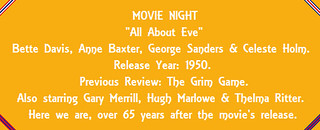
All About Eve.


Review #750: All About Eve.

Cast
Bette Davis (Margo Channing), Anne Baxter (Eve Harrington), George Sanders (Addison DeWitt), Celeste Holm (Karen Richards), Gary Merrill (Bill Sampson), Hugh Marlowe (Lloyd Richards), Thelma Ritter (Birdie), Gregory Ratoff (Max Fabian), Marilyn Monroe (Miss Casswell), and Barbara Bates (Phoebe) Directed by Joseph L. Mankiewicz.

Review
Based off "The Wisdom of Eve" by Mary Orr, All About Eve is a movie that held the record for most Oscar nominations (14) until Titanic tied it over four decades later, with five actors receiving nominations, and one (Sanders) winning. In fact, Joseph L. Mankiewicz won two Oscars for the movie (Best Director and Adapted Screenplay). 65 years later, the movie is heralded as a classic. And why not? It is great. It's interesting that the big highlight in a movie all about Eve is not Eve herself, but Bette Davis and her tremendous screen presence. She is always interesting to watch and always entertaining, especially when interacting with the cast. Baxter is effective in making her character come off as innocent and helpful...for a while, anyway. Her scene with Holm in which she would will be willing to use Karen's deep friendship with Margo as leverage just to get a part shows the extent of Eve's manipulation. But while her ambition got her out of one problem along with getting her this far, it may have gotten her into another situation...but the movie ends on a different character, named Phoebe. The final scene, with her taking the award and imagining herself winning one is certainly fitting. Sanders manages to ingrain his character into the narrative. He may be snide. but his way with words is much more devastating. His scene with Baxter at the end, is especially well-done, as the movie comes full-circle. The movie begins with Eve winning an award for her performance in a play...but maybe in a way she hasn't won. She won the award, but perhaps at the cost of her heart, in a sense. One actress who also is in the movie, though brief, is Marilyn Monroe, whose character also plays a role in regards to Eve's rise. Monroe doesn't get much to do, but she is interesting to watch, especially when being guided by Sanders in his attempts to give her a career. The movie certainly looks well in both fashion and just in general, with the Costume Designers (Edith Head and Charles LeMaire) winning an Oscar for it. Bottom line, the movie is interesting to watch, especially if you love big performances and love big classical drama.

Thank you for reading this 750th Review. I hope you enjoyed it.

Overall, I give it 10 out of 10 stars.

For all of the appreciation over the past 750 reviews, I made a collage detailing from the first big landmark (and the number before it is, as customary)...all the way up to now. Thank you. Enjoy.


July 20, 2014

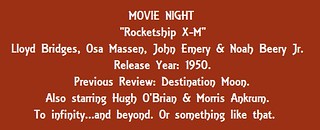
Movie Night: Rocketship X-M.


Review #618: Rocketship X-M.

Cast
Lloyd Bridges (Col. Floyd Graham), Osa Massen (Dr. Lisa Van Horn), John Emery (Dr. Karl Eckstrom), Noah Beery, Jr. (Maj. William Corrigan), Hugh O'Brian (Harry Chamberlain), and Morris Ankrum (Dr. Ralph Fleming) Directed by Kurt Neumann.

Review
Rocketship X-M was rushed into production after Destination Moon had production delays. This was made on a $95,000 budget, shot in 18 days, and released only 25 days before Destination Moon, with Lloyd Bridges heading the cast. So how is the movie? It's okay. It's evident that it's slightly rushed, and while the effects are just alright, at least the film manages to be passable. The cast is alright, Bridges is the best aspect of the movie, he just has a certain charm to him that's practically magnetic. The story is fine, even if it's rushed, the movie just feels like a breeze, it's surprising when you get through 30 minutes because it doesn't feel like 30 minutes has passed. It is what is, a sci-fi flick that goes fast and has a few quirks (who brings weapons on a trip to Mars?), but it is okay and easy to watch, though I'd stick to Destination Moon for its better quality. Take this for what it's worth, a sci-fi breeze.

Overall, I give it 7 out of 10 stars.

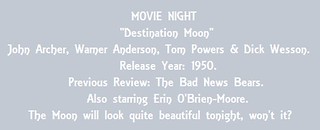
Movie Night: Destination Moon.


Review #617: Destination Moon.

Cast
John Archer (Jim Barnes), Warner Anderson (Dr. Charles Cargraves), Tom Powers (General Thayer), Dick Wesson (Joe Sweeney), and Erin O'Brien-Moore (Emily Cargraves) Directed by Irving Pichel.

Review
In honor of the 45th anniversary of the Apollo 11 landing today, I've decided to do a double feature of films dealing with expeditions to the moon, both movies being released in 1950, this one being released second. This was made way before Sputnik helped begin the Space Age, and 19 years before Apollo 11. This was produced by George Pal, who would later produce the 1953 version of The War of the Worlds and later direct 7 Faces of Dr. Lao (#430). So how is this film? This is a really interesting movie that manages to seal itself and its premise in a 90 minute window, with really dazzling special effects to boot. While there is a small cast, it more then makes up for it by being exceptionally entertaining, the cast itself is fine, Wesson steals the show and makes for a good wisecracking relief character. The effects by Lee Zavitz are really astounding to watch, even the matte paintings by Chesley Bonestell are nice to look at. My favorite scene for some reason is the scene in which a cartoon is shown to would-be funders of the spaceship Luna to help explain how a rocket can get from the Earth to the Moon and how it lands, starring none other than Woody Woodpecker. It's a amusing scene, but it also is a informative scene that just shows how cool space travel can be. The story (written by the trio James O'Hanlon, Rip Van Ronkel, and Robert A. Heinlein) is pretty good, it's balanced well and certainly adds to the level of entertainment, The movie is fun to watch, especially in the last half hour, which is actually pretty riveting. In the end, this is a good film to watch not only on this day, but any day, for anyone looking for a good sci-fi flick. That, and one with the Moon in it.

Overall, I give it 9 out of 10 stars.

March 15, 2014

Movie Night: Experiment Alcatraz.


Review #560: Experiment Alcatraz.

Cast
John Howard (Dr. Ross Williams), Joan Dixon (Lt. Joan McKenna), Walter Kingsford (Dr. J.P. Finley), Lynne Carter (Ethel Ganz), Robert Shayne (Barry Morgan), Kim Spalding (Duke Shaw), Sam Scar (Eddie Ganz), and Kenneth MacDonald (Col. Harris) Directed by Edward L. Cahn (#331 - It! The Terror From Beyond Space)

Review
Experiment Alcatraz was one of the many B-movies made by Edward L. Cahn, also notable for directing Our Gang shorts in the late 1930s. So how is this B-movie? For all of its limitations, this is a pretty okay film. My expectations weren't high, it's a b-movie about injecting radiation into prisoners that turns into a mystery. The actors are alright, they keep the movie going without much flaws. The action is okay, not too bad, typical, but you get what you want. The plot is not that bad, it has a few twists along the way, and the movie runs okay, it runs about an hour, so it's a real easy breeze, a mostly typical b-movie good enough to pass the time.

Overall, I give it 5 out of 10 stars.