Showing posts with label Joseph Schildkraut. Show all posts

February 29, 2020

The Rains Came.


Review #1351: The Rains Came.

Cast: 
Myrna Loy (Lady Edwina Esketh), Tyrone Power (Major Rama Safti), George Brent (Tom Ransome), Brenda Joyce (Fern Simon), Nigel Bruce (Lord Albert Esketh), Maria Ouspenskaya (Maharani), Joseph Schildkraut (Mr. Bannerjee), Mary Nash (Miss MacDaid), Jane Darwell (Aunt Phoebe - Mrs. Smiley), Marjorie Rambeau (Mrs. Simon), and Henry Travers (Rev. Homer Smiley) Directed by Clarence Brown (#423 - A Woman of Affairs, #433 - Angels in the Outfield, and #484 - Plymouth Adventure)

Review: 
If you want a disaster film to go along with your romance, I guess this could fit the bill. This was a film that 20th Century Fox spent nearly half of its 100-day schedule in making rain to go along with a flood sequence (using a 50,000 gallon tank of water on a studio soundstage), with 33 million gallons of water used, with a fifth of the $2.5 million budget being spent on flood and earthquake scenes. It surely paid off for its effects crew, since E. H. Hansen and Fred Sersen ended up as the first awardees for Best Visual Effects through this film. Who better to helm the film than veteran director Clarence Brown (a versatile director of romance, dramas and period pieces) and established actors like Loy (a versatile actress known for vamp roles prior to The Thin Man in 1934), Power (a matinee idol in the latter 1930s along with the 1940s), and Brent (a leading man for romances primarily in the 1930s and 1940s) to go with it. The film was adapted to the screen by Philip Dunne and Julien Josephson from the 1937 novel of the same name by Louis Bromfield. A remake would be produced by the studio with The Rains of Ranchipur (1955), which changed the ending (so no one dies). This is a glossy but finely crafted film,  where one will be pleased at what they get on a visual level alongside the romantic quartet when it comes to generating intrigue. Loy certainly seems to be having fun with such a mischievous (at least at first mischievous) headline role, brash but immensely watchable every time she is on screen, whether that involves playful banter or helping the sick. Power comes off a bit reserved, but it works out in making calm passion. This plays itself out with Loy's death scene, where Brown had told her to try acting it out with her eyes open through holding her breath. It is a striking scene, one must say. Brent plays a decent rogue, one that fits in contrast to whoever leading lady he is playing towards, whether that means a clash with Loy or a fresh (in that this was her debut role) Joyce. Bruce (a character actor since 1922 whose most famous portrayal was of Dr. Watson starting in 1939) certainly does fine with a boorish turn, and Ouspenskaya certainly proves a charmer from time to time. The romances play out fine for its 105 minute run-time, where one can see how they'll draw themselves out but not find themselves predicting everything (for a film with a title like this, at least).  In a year with plenty of romance and spectacle on numerous fronts, The Rains Came is a decent little gem among others. It makes for a decent show with its fair passion and well-done effects to make a diverting time to go with, utilizing a workable cast and an accomplished director to get things done without too many troubles.

Overall, I give it 7 out of 10 stars.

Ah yes, the end of the month (and the tribute to the 1930s) has come. If you are wondering, I have not forgotten about doing films from the current year as well. Those will be sprinkled into March at their own time, apart from the primary goal of March, the third phase of Tribute to the Decades with the 1940s.

February 25, 2020

The Life of Emile Zola.

Review #1347: The Life of Emile Zola.

Cast: 
Paul Muni (Émile Zola), Gloria Holden (Alexandrine Zola), Gale Sondergaard (Lucie Dreyfus), Joseph Schildkraut (Captain Alfred Dreyfus), Donald Crisp (Maitre Labori), Erin O'Brien-Moore (Nana), John Litel (Charpentier), Henry O'Neill (Colonel Picquart), Morris Carnovsky (Anatole France), Louis Calhern (Major Dort), Ralph Morgan (Commander of Paris), Robert Barrat (Major Walsin-Esterhazy), and Vladimir Sokoloff (Paul Cézanne) Directed by William Dieterle.

Review: 
"I've never tried to learn the art of acting. I have been in the business for years but I still can't tell what acting is or how it's done"

As redundant as it may sound, one needs a bit of history now and then. Who better to headline a biographical film than Paul Muni? The son of actors, he had started a career in Yiddish theatre in Chicago after emigrating there from Lemberg (a city that was in the Austro-Hungarian Empire but is now referred to as Lviv, Ukraine). He was noted for his makeup skills, appearing as an 80-year-old man to debut on stage while being just 12. He spent three years on Broadway before being signed by Fox Film in 1929, making two films (The Valiant and Seven Faces), but he went back to Broadway before being enticed to return in 1932, with Scarface and I Am a Fugitive from a Chain Gang leading to him being signed by Warner Bros. Muni was noted for his preparation for roles, particularly for biographies, which served him for films such as The Story of Louis Pasteur (1936), which won him an Academy Award for Best Actor. Muni made 13 of his 23 films in the 1930s, having script approval over what he wanted to do, a rare thing at the time. He ended his career the same way he started it: with an Academy Award nomination (he had five in total).

Naturally, one is to expect a few wrinkles of inaccuracy, which the film anticipates with a title card stating that the while the production has basis in history, the historical basis was "fictionalized for the purposes of this picture". Relating to that, a cursory search of Zola leads me to a fact I didn't discover in the film: he wrote a cycle of twenty novels named Les Rougon-Macquart, for which Nana (mentioned in the film) was part of. The obvious sticking point with history is how the film deals with the Dreyfus affair when relating to anti-Semitism of the time that was key to the case since he was Jewish (the word isn't even mentioned in dialogue, only shown on screen once), which has been argued to be due to the timidity of studios when it came to dealing with Nazi Germany. There are numerous quibbles that can be freely noted, ranging from how he is brought into the Dreyfus case (not over the tears of the wife) to the fact that his death (carbon monoxide poisoning through a badly ventilated chimney) was not in fact the day before exoneration of said general. But as Zola once said, "The truth is on the march, and nothing shall stop it." The film relies on the sentiment of truth and justice eventually prevailing in the end, with German actor-turned-director Dieterle being the one to help do it, having directed Muni to three biographical films (the aforementioned Pasteur film and Juarez) in a directing run that spanned forty years. The film has a stagy quality to it, where one senses a speech with some sort of platitudes to pop up sooner than later, which can work out well when a moment of dignity is required. In that sense, Muni makes the best of it, where one sees the dedication in bringing an icon of writing to the screen come out without seeming too much like overacting (which Muni has been criticized for, with Dieterle even accusing him of doing occasionally). One can see his conviction on display without hesitation in the monologue scene for the court, a six-minute scene of dedication to making the measure of a man. The rest of the actors (including an Academy Award-winning performance from Schildkraut) do just fine, keeping up with Muni in displaying some dignity in keeping the momentum going without too many bumps in the road, whether as people who stand with Zola for truth or stand among keeping it buried to not have to deal with an army admitting fallibility. Granted, the resulting film that comes from said statements seems a bit long at 116 minutes, but at least one can say that this worked better with being a biography than the previous biographical Best Picture winner in The Great Ziegfeld (1936), even if it is at best a fairly okay experience to spend time with. One can be inspired to inquire further about the famed author than the mild snapshots that this provides. It may not be the most prime material for its decade, but it still finds a way to create curiosity through its attempts at entertainment along the lines of other films of its ilk in most of the right places.

Overall, I give it 7 out of 10 stars.

December 16, 2017

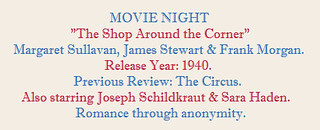
The Shop Around the Corner.


Review #1026: The Shop Around the Corner.

Cast: 
Margaret Sullavan (Klara Novak), James Stewart (Alfred Kralik), Frank Morgan (Hugo Matuschek), Joseph Schildkraut (Ferencz Vadas), Sara Haden (Flora Kaczek), Felix Bressart (Pirovitch), William Tracy (Pepi Katona), Inez Courtney (Ilona Novotny), and Charles Halton (Detective) Directed by Ernst Lubitsch.

Review: 
Honestly, I did not expect to watch this film before I saw it, although I will admit that it has lingered on my mind for quite a while. I especially did not expect to do it after doing a film that took elements (along with the play I will mention later on in this review), which was You've Got Mail (#1020), reviewed by me just eleven days ago. That movie was okay, not being anything too special but also not too cynical. Viewers of both films will notice the scenes that share some (but not too much) similarity with each other, although the structure and characters both differ. As mentioned before, The Shop Around the Corner is based off the play Parfumerie by Miklós László, a Hungarian play that premiered at the Pest Theatre in Budapest in 1937. I had forgotten to mention that the film was later turned into a musical named In the Good Old Summertime (released in 1949), which featured Judy Garland and Van Johnson. In fact the play was adapted into a musical itself in 1963 with She Loves Me, so clearly there has been quite a bit of ground covered with this material.

In any case, this is a fine fun time, and it is the work of Sullavan and Stewart that make all of that possible, as they just have an interesting amount of scenes with each other that gives the movie charm. Stewart always seems to leave a fine impression of sincerity and no-nonsense that certainly resonates well even today, and that reflects especially well in a movie in which he bickers with Sullavan's character. She also does a fine job at making her character credible along with one that we can also root for without any doubt. The heart of the film is in the characters that are showcased to us, and the fact that they become people we care about in some way, such as Schildkraut and his kindly nature that zings well with Stewart and Morgan at times. Speaking of which, Morgan also does a tremendous job in the film as well, balancing the line between insecure and bossy in the best way possible, never becoming one that we can't find interesting to watch. The rest of the cast also do fine, with Schildkraut and Tracy standing out due to how they play their roles neatly. The film goes along the lines you might expect, but it's the way that it uses charm along with some enjoyable atmosphere that makes it a clear winner. It doesn't smother you with sentimentality, but it also doesn't skimp on being romantic along with amusing, being smart with what it wants in its 99 minute run-time. It's a movie that is inclusive in its fun, not sealing itself for only a select few. It's an easy pick to recommend, particularly if one is in the spirit for things such as this.

Overall, I give it 9 out of 10 stars.