Showing posts with label Paul Benedict. Show all posts

June 24, 2020

The Goodbye Girl.

Review #1455: The Goodbye Girl.

Cast: 
Richard Dreyfuss (Elliot Garfield), Marsha Mason (Paula McFadden), Quinn Cummings (Lucy McFadden), Paul Benedict (Mark), Barbara Rhoades (Donna), Theresa Merritt (Mrs. Crosby), Michael Shawn (Ronnie), Patricia Pearcy (Rhonda), and Nicol Williamson (Oliver Fry) Directed by Herbert Ross (#244 - The Sunshine Boys)

Review: 
"I think Herb Ross is the best director I've worked with in films. The others just don't understand my material as well."

"I always knew I was going to be an actor and that was that - no doubts, no uncertainties, no changing my mind. And that was when I was like, nine, ten. And it never changed."

It's good to make a comedy-drama when you've got the hands to make something meaningful. The film was written by Neil Simon and directed by Herbert Ross, who had collaborated with Simon in a group of films and plays that went from The Sunshine Boys (1975) to Max Dugan Returns (1983). Ross was a dancer-turned-choreographer-turned director, while Simon was a playwright and screenwriter that had started his line of work with radio before moving to TV with Your Show of Shows (1950-54), plays with Come Blow Your Horn (1961), and film with After the Fox (1966). Both lead actors had already had their moment in the sun rise in the decade in the year of 1973, starting with Dreyfuss in a quick rise from TV to American Graffiti while Mason made her feature debut in Blume in Love that led to work in theater with Simon (along with marriage after meeting during auditions for The Good Doctor). Simon had originally written a script named "Bogart Slept Here", which would have had Mike Nichols direct and Robert De Niro star in a film about the changes in an struggling actor's life after becoming a star. Production on that lasted just a week before De Niro was found to not being suited for the comedic aspects (with Nichols following later on), and Simon reportedly re-wrote the script in a span of six weeks.

For 110 minutes, one is presented with a fairly neat package of comedy and drama, rolling along with a few neat lines and some quirk-laced characters that interact with some zip to make a romance that paints its corners with fair conviction and enough moments to make it worth it. While it does prove awkward at times, Dreyfuss and Mason do eventually make things worth it in the build to establish interesting chemistry that makes the second half resonate with interest over the establishing half. Dreyfuss grows on you very quickly, having a spark of sensitivity and energy that inspires plenty of curiosity with good timing that drives as a bright charmer, whether that means trying to act in a play to his best or drunkenly reading scathing reviews of said play. Mason does well with what she is given, straight-laced but not too unapproachable for banter with Dreyfus or with Cummings, who makes for a fine family pairing to watch. The supporting cast is fine, with Benedict making for a worthy eccentric to see play out in his moments on screen, since the Richard III production scenes (based on an actual production that Mason had a part in) are generally the most amusing sequences in the film anyway, delivering a bit of perspective to what can go in a vision for something (regardless of how strange or funny it might seem). On the whole, when the film hits its mark in making you care for these characters, it hits with charm without needing to go overboard in one genre over the other to make a worthy watch for the era.

Overall, I give it 8 out of 10 stars.

June 11, 2020

Jeremiah Johnson.

Review #1441: Jeremiah Johnson.

Cast: 
Robert Redford (Jeremiah Johnson), Will Geer (Bear Claw Chris Lapp), Stefan Gierasch (Del Gue), Delle Bolton (Swan), Josh Albee (Caleb), Joaquín Martínez (Paints His Shirt Red), Allyn Ann McLerie (The Crazy Woman), Paul Benedict (Reverend Lindquist), Jack Colvin (Lieutenant Mulvey), Matt Clark (Qualen), Richard Angarola (Chief Two-Tongues Lebreaux), and Charles Tyner (Robidoux) Directed by Sydney Pollack (#084 - Tootsie)

Review: 
"Timing is a big thing with actors. You don't ever want to over-rehearse, but you don't want them under-prepared either. Part of the trick is knowing when to roll the cameras. So many times I'll see a performance peak during the rehearsal process and they never quite get it back. That's why I'd rather be rolling early."

"Storytellers broaden our minds: engage, provoke, inspire, and ultimately, connect us."

It never fails to turn to a new face for a film experience, whether for the 1970s or for versatility when it comes to directors or actors. It should only prove fitting to showcase a film involving lifelong friends in director Sydney Pollack and Robert Redford, who each experienced success in their own fields both with and without each other. This was the second of seven collaborations between Pollack and Redford (the first one being in Pollack's second feature This Property Is Condemned six years prior). Redford had his debut in the stage in 1959 while starting work on television as a guest the following year, while Pollack started studying theatre acting in 1952 with appearances in television starting in 1956. The two would meet up together in 1960 on the production of War Hunt (1962), which was the major acting film debut for both actors, and they would become life-long friends. The key to wanting to become a director came in 1961 when Pollack worked on The Young Savages as a dialogue coach, as he was encouraged by its star Burt Lancaster to try his hand at directing. He soon found television work to direct while cutting back on his acting appearances, and he received his first film to direct with The Slender Thread (1965). Redford (who would become a noted director in his own right) described him as a director with an ability to "connect the more commercial strain with the more abstract", one who could work with stars and make a film with wit that could differ from the usual commercial fare. Pollack would direct over twenty projects over the next four decades while also having a hand in producing (and occasionally acting) in them before his death in 2008, with notable films including They Shoot Horses, Don't They? (1969), Tootsie (1982, director/co-producer/actor), Out of Africa (1985, director/co-producer that garnered him two Academy Awards), and The Firm (1993, director/co-producer). 

The film is based on two works: Crow Killer: The Saga of Liver-Eating Johnson (written by Raymond Thorp and Robert Bunker) that detailed the life of John Jeremiah Johnson and Vardis Fisher's novel Mountain Man, which was a fictional work inspired by the exploits of Johnson. He was a man who went through many professions, such as sailor, trapper, and even deputy (although obviously the film is based on just the trapper experiences). The film was adapted to the screen by Edward Anhalt (co-writer of Panic in the Streets along with other films with and without his wife Edna) and John Milius (whose most notable writing credit was The Life and Times of Judge Roy Bean earlier in the year). It should only figure that Redford would be involved in a film like this (which he considers his favorite), one with a mountain man that seeks out the nature of the land (shot mostly in Utah, which Redford had bought his own ski area), a western of the wilderness with a careful pace and tremendous visual style to tell a worthwhile experience that will hopefully leave the viewer with some sort of appreciation for the loner in all of us or at least for the environment for which one can (and should) take time to view and breathe in all of its strange qualities. Redford lives up to the challenge of a role that requires a patient actor to suffer through the coldness of the land and reality with conviction and understanding. It is a role for the actor that wants to make something of themselves to make a mythic role their own with no pretentions. Geer and Gierasch make for colorful standouts among a carefully collected supporting cast that build a myth of nature and revenge with pathos and good timing. At 116 minutes (including overture and intermission), it makes for a fair sit to go through at least once, filled with wide open moments to see Redford and a landscape worth viewing for some quality entertainment as a wilderness western fitting for its era and the people who featured prominently in it.

Overall, I give it 8 out of 10 stars.

February 3, 2014

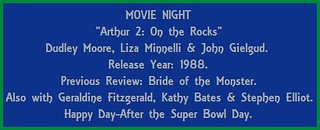
Movie Night: Arthur 2: On the Rocks.


Review #538: Arthur 2: On the Rocks.

Cast
Dudley Moore (Arthur Bach), Liza Minnelli (Linda Marolla Bach), John Gielgud (Hobson), Geraldine Fitzgerald (Martha Bach), Kathy Bates (Mrs. Canby), Paul Benedict (Fairchild), Stephen Elliott (Bert Johnson), Cynthia Sikes (Susan Johnson), Ted Ross (Bitterman), and Barney Martin (Ralph Marolla) Directed by Bud Yorkin.

Review
I have reviewed this particular character before, with the remake (#203) which while I may have given a bit too much credit, wasn't awful. I then reviewed the original Arthur (#206), and...yeah, I have a confession to make. After watching the original Arthur once more just recently before doing the sequel, I realized that the first one is actually better then what I first thought. Moore does a very entertaining performance. He of course can be hilarious to himself and others, but the scenes he shares with Gielgud are brilliant and showcases Moore at his best. And Arthur's Theme (Best That You Can Do) is a really good song, especially for a film like that. Steve Gordon did such a good job in sadly the only film he directed. So yeah, I will change my ranking for Arthur, all because of my regret.  And then there's this sequel. Make no mistake, I won't ever revoke my thoughts on a film like Arthur 2: On the Rocks. A seven year wait, and all you get...is a lemon of a sequel. Does it have its moments? Sure, even really awful movies have their brief moments (Except for of course, #442 - The Garbage Pail Kids Movie, which has no merit because that would require me to let out my repressed memories of that film), and the beginning of this film at least tries to make an effort. Then...Arthur goes broke.

After that, the movie segues into even more mediocre quality, until of course it reaches the last possible trick it has, John Gielgud...who appears an hour into the movie (as a drunken hallucination, mind you), and leaves after eight or so minutes. Is he funny? Sort of, but by then, the movie has sunk to a depressive quality that makes you wonder why was this even made. And yes of course Arthur gets his money back, if he didn't, the movie would end with him (and the audience to a lesser extent) doomed. Arthur doomed because the light at the end of the tunnel turned out to be an oncoming train, and the audience, who just realized their time was just wasted. It's all too predictable, half the time you're just waiting for him to get his money back because seeing him try to make the best of his...drunken state, while a novel attempt at trying to twist things up, is not very entertaining. Minnelli is okay, I suppose. At least Stephen Elliott (who is okay, delusional, but okay) returns, though his daughter played by Jill Eikenberry in the original didn't. Sikes is okay, though she can't save the movie. Moore seems more aged, seemingly tired of this role, he even disowned the film after it was released. The movie seems to have a few subplots: An adoption subplot, Bach's attempts to get his money subplot, and Bach's alcoholism struggle, none of the subplots are great, the movie tries so hard, and yet it falls so flat. This is a sad movie when it all comes down to it, it's not awful, it's just a disappointment. If you want to see more of Arthur, I'd recommend it. If you want to see more sequels to movies that were probably forgotten after they were watched, I'd suggest Staying Alive, Grease 2, or Airplane II: The Sequel.

Overall, I give it 4 out of 10 stars.