
Showing posts with label Joe Dante. Show all posts

October 10, 2024

Piranha (1978).

Review #2270: Piranha (1978).

Cast: 
Bradford Dillman (Paul Grogan), Heather Menzies (Maggie McKeown), Kevin McCarthy (Dr. Robert Hoak), Keenan Wynn (Jack), Dick Miller (Buck Gardner), Barbara Steele (Dr. Mengers), Belinda Balaski (Betsy), Melody Thomas Scott (Laura Dickinson), Bruce Gordon (Colonel Waxman), Barry Brown (Trooper), Paul Bartel (Dumont), and Shannon Collins (Suzie Grogan) Directed by Joe Dante (#007 - Looney Tunes: Back in Action, #096 - Gremlins, #097 - Small Soldiers, #1494 - Gremlins 2: The New Batch, #1744 - The Howling, #2026 - Twilight Zone: The Movie)

Review: 
"We got a lot of bad comments about Piranha because we killed off all those summer campers and it wasn’t even the end of the movie, which was black humor then and kind of shocking. Today, I don’t think that would shock anybody. I think you are now dealing with an audience that is so much more sophisticated and aware of the cliches and tricks and tropes of the genre and you have to be on your toes in order to keep their interest."

Sure, any big film can inspire a few homages, and who better to get that through the line with Roger Corman? New World Pictures? Among other things, this was filmed around the same time as. Avalanche. Apparently, the budget for Piranha was reduced by $200,000 (essentially making it a production made for roughly under $700,000) prior to production in order to help give more resources to the disaster film Avalanche (which ended up being forgotten by audiences). The film had two credited writers: Richard Robinson and John Sayles. Sayles was brought in to re-write the film for its perceived failings as a script (according to one Dante interview, the original script showed a problem in getting people to actually get in the water). It was the first feature credit for Sayles, who had graduated from Williams College in the 1970s and quickly went to work writing articles and his own novel in Pride of the Bimbos before finding work with New World Pictures (one year after the release of this film, funds used from Corman paying Sayles to write scripts saw him direct/write Return of the Secaucus 7 on his way to a further career as writer/director, which included Dante's The Howling (1981). This was the second feature effort for director Joe Dante, who had gone from editing trailers for New World to co-directing Hollywood Boulevard (1976) with Allan Arkush. He went for the film when offered it as opposed to Rock 'n' Roll High School (1979), since Arkush expressed passion for wanting to do that. Dante would also co-edit Piranhawhich he described as being extensive in his dedication to editing. The movie was released in August of 1978, nearly two months after Jaws 2. Apparently, Universal Pictures tried to file an injunction against the release of the film, but they dropped it when Steven Spielberg stated his approval of the film, one that he called "the best of the Jaws rip-offs". While the film was a relative success, Corman did not express interest in doing a sequel, but he sold the rights to people who were interested in doing so, which resulted in the 1982 US-Italian production of Piranha II: The Spawning, which had a young James Cameron for a film with only a hint of a cult audience. The original film has been remade twice, once for television in 1995 and the other with Piranha 3D, released in 2010 (which in turned had a sequel two years later).

There had been plenty of horror films involving killer creatures of the sea before, whether they tried to call themselves parodies such as Creature from the Haunted Sea (1961) or ecological threats such as Frogs (1972) or "Jaws ripoffs" such as Orca (coincidentally, Wynn was in that film, released in 1977). But Piranha makes its own mark in delight. It straddles the line between horror and amusement without straining itself in overwrought expression that can be credited to Dante and the company he had with him that wanted to make it more than just a "nature gone wild" movie. You don't really see that much of the piranhas in the film, but it has enthusiasm from a director who clearly grew up on Corman and monster movies and wanted to make one with as much fun as those (complete with name actor enjoyment from McCarthy, Wynn, and the always-on-point Miller). Dillman and Menzies prove to make an interesting pair together. I particularly like the haggard expressions that come from Dillman (amusingly, Dillman was picked because Peter Fonda rejected it because he wouldn't do the film unless it had good effects and it was taking too long). He just has the confidence to just roll with the lines given out involving little killer fish and being thrust into a conspiracy where maybe the real monsters are on the surface. Gordon and Steele provide quality presence in terms of scuzzy behavior on and off the surface, although Miller amuses the most in scuzzy nature for such a brief amount of screentime. The creature effects were done with a mix of mostly rubber piranhas (and some with a few metal teeth, as done by Phil Tippett, while Chris Walas and Rob Short did prosthetic limbs for biting. The movie could've just been a silly one with little commitment from its actors in creature features, but instead they managed to have one with energy, where even a little scene involving a stop motion creature (not a piranha) shows curiosity. The terror involving piranhas (who in real life have a varied diet beyond rare attacks on humans) is handled patiently for 95 minutes (I especially like the sound of the piranhas in their attacks) in carefully executed carnage and danger. The film serves as a representation of just what Dante has to offer in directing and moving around scenes with real belief present. It is a warm fun movie for the movie-lover in all of us that appreciate horror wherever they can find it.

Overall, I give it 8 out of 10 stars.
Coming up in the next few days: Terrifier, 50s stuff, 70s stuff, 10s stuff...

June 28, 2023

Twilight Zone: The Movie.

Review #2026: Twilight Zone: The Movie.

Cast: 
Opening sequence: Albert Brooks (the Driver), Dan Aykroyd (the Passenger), and Burgess Meredith (Narrator)

"Time Out": Vic Morrow (Bill Connor), Doug McGrath (Larry), and Charles Hallahan (Ray)
"Kick the Can": Scatman Crothers (Mr. Bloom), Bill Quinn (Leo Conroy), Martin Garner (Mr. Weinstein), Selma Diamond (Mrs. Weinstein), Helen Shaw (Mrs. Dempsey), and Murray Matheson (Mr. Agee)
"It's a Good Life": Kathleen Quinlan (Helen Foley), Jeremy Licht (Anthony), Kevin McCarthy (Uncle Walt), Patricia Barry (Mother), and William Schallert (Father)
"Nightmare at 20,000 Feet": John Lithgow (John Valentine), Abbe Lane (Sr. Flight attendant), Donna Dixon (Jr. Flight attendant), John Dennis Johnston (Co-Pilot), and Larry Cedar (Gremlin)

Directed by John Landis (#328 - Trading Places#410 Coming to America#513 - Spies Like Us, #1114 Animal House, #1462 - The Blues Brothers#1465 - An American Werewolf in London#1699 - Blues Brothers 2000, and #1718 - The Stupids), 
Steven Spielberg (#126 - Close Encounters of the Third Kind, #168-#170, #302, #351, #480#563#573,  #642#958#1068#1305, #1478, #1520, #1528, #1560, #1843, and #2000 - Duel), 
Joe Dante (#007 - Looney Tunes: Back in Action, #096 - Gremlins, #097 - Small Soldiers, #1494 - Gremlins 2: The New Batch, #1744 - The Howling
and George Miller (#380 - Mad Max, #392 - Happy Feet, #493 - The Witches of Eastwick, #707 - Mad Max 2, #781 - Mad Max: Fury Road)

Review:
The Twilight Zone, originally broadcast on CBS in 1959, is generally considered one of the best television shows of its time, if not one of the best ever. There were 156 episodes of the anthology series, with a good majority of them (92!) written by series creator (and presenter) Rod Serling. He had come up with the idea for an anthology series that would use its "science-fiction setting" to have more freedom to write what he felt. Technically, the show was not meant to be scary, but it just happened to have plenty of twists within a mostly consistent show. Providing a list of what episodes are the best seems futile, but here is a list of episodes that would be neat for one to check out if they want to see just what the show could do in its format (most are a half-hour long, minus the hour-long fourth season): "One for the Angels", "Walking Distance", "A Quality of Mercy", "Printer's Devil", and "One More Pallbearer" (one could also go for Serling's reported favorites in "The Invaders" and "Time Enough at Last"). Rod Serling had an interest in doing a Twilight Zone film for quite some time prior to his death in 1975. Various cast members that had appeared in an original episode appear in the film: Burgess Meredith, Patricia Barry, Peter Brocco, Murray Matheson, Kevin McCarthy, Bill Mumy, and William Schallert. The movie was marked by tragedy in the making of the first segment of the film due to an accident involving a helicopter crash during filming on July 23, 1982. Two children, Myca Dinh Le, Renee Shin-Yi Chen were hired to do a scene at night (under the table) that involved pyrotechnics and a helicopter. This resulted in an accident that saw the death of Morrow and the two children. Various people, which included Landis, were tried and ultimately acquitted on manslaughter charges in a trial that spanned 1986 and 1987. Of course, the tragedy as a whole sparked a movement for fire safety regulations and entertainment industry requirements, complete with a safety committee made by the Directors Guild of America about safety bulletins and a phone hotline. The film was released 40 years ago in June of 1983, and it was a mild success with audiences. It would inspire CBS (who had the rights to the show because Serling had sold it to them) to go forward with a second rendition of the show in 1985. After its end in 1989, two further shows came and went in the following decades (2002-2003 and 2019-2020). 

The opening segment (roughly eight minutes) features Albert Brooks and Dan Aykroyd in a car conversation that eventually talks about the show within the movie and the question of if one wants to see something "really scary"? It is, uh, a strange way to start a movie, mostly because when I think of Twilight Zone, I don't think, man suddenly finds a surprise in a car. But it is with two folks that I like, so there's that. Burgess Meredith, who appeared in classic episodes of the show such as "Time Enough at Last", introduces each story in narration, which is a nice tribute to Serling's previous method, although they do use Serling's voice for the ending as a whole. John Landis directed this sequence alongside the first segment in "Time Out". The segment, lasting roughly 18 minutes, involves a racist and resentful man that goes to a bar after being passed over for promotion that finds himself wrapped up in the past, more specifically places such as Nazi-occupied France, a racist Klan rally, or in Vietnam. Evidently, the segment is a mishmash of the classic stories "Back There" (namely the time travel) and "A Quality of Mercy", with the writer being none other than Landis.  The original scripted idea obviously couldn't be completed due to the tragedy that occurred, which apparently was meant to have a resolution that would've tried to find redemption for the racist that saw him try to help two children out of a helicopter attack in a Vietnamese swamp. Instead, it ends on him going through a frenzy of terrifying events before being sent off by a train despite yelling out to his friends that he can see out of the slats. As such, the story is mild because it requires a bit more bite than what is required to either reach a payoff of redemption...or the opposite, and a segment that doesn't even last the time of an actual TV episode isn't going to cut it. As such, Morrow is essentially trapped in a segment with an unavoidable pall over the entire thing, but you can see the glimmer in one part of the diner scene. There he is, blithering around with a dirty mouth, and for a moment you can see him for what he is beyond the epithets: a loser who really thought the world owed him one because of what he looks and sounds like "as an American". Intended redemption or not, there obviously was something that could've been done here beyond what you know.

"Kick the Can" (lasting roughly 21 minutes) is based on the third season episode of the same name originally written by George Clayton Johnson. The segment screenplay was written by Johnson, Richard Matheson, and Melissa Mathison. It was directed by Steven Spielberg. Apparently, he had plans for an ambitious segment before the helicopter tragedy led to him curtailing plans...for a remake of an episode that I honestly can't remember watching to begin with beyond the phrase "old people get young". It has been rumored that Spielberg, under contract but having lost the heart for the project due to the tragedy, made only a half-hearted effort here. All of this is meant to subside the actual thoughts of the story about "the day we stop playing is the day we start getting old", which I vaguely remember seeing in my neighborhood park when I was a kid. If the Landis segment could be thought of as perhaps a bit too short, the Spielberg segment can be best described as half-brained and half-effective. I can't tell what is more annoying, its cloying sense of "cheer" for such an average effort, or the very rumor of Spielberg half-assing a story just to get out of a dilemma. Crothers actually does provide a decent performance here, pulling some of the mysterious requirements necessary to make a story telegraphed to us in every step of the way not nearly as painful as it could be, and Quinn is at least a quality foil the basic arguments made involving the inevitability of age. By the time the segment gets to the ultimate decision made, the lesson put there is at least one that isn't sapped of hokum...and then of course Crothers does a fourth wall bit before leaving. As a whole, it's just an okay segment, one that makes you wonder if being the "light segment" of the film is really a compliment.

"It's a Good Life" (roughly 27 minutes long) is loosely based off the third season episode of the same name (as written by Serling that was based on a short story by Jerome Bixby). Matheson wrote the screenplay for this segment (which Serling had discussed prior to his death as writing a draft to make into a film), with Joe Dante serving as director. The story involves a lady schoolteacher finding the company of a young boy at a rural diner when she helps him after he is accosted only to then accidently back her car into his bike. She gives him a ride home and meets the rest of his family, who all seem nice. Heck, I like Kevin McCarthy, what could go wrong with his character presence? Despite having quite a hill to climb in trying to remake one of the most famous Zone episodes, Dante has provided something special here: an off-beat and weird segment that seems to take you on a trip of not just sight and sound but of mind. It is a delightful and deranged segment, headlined by a useful cast. I of course dig the presences around the supporting folks like McCarthy, ever the panicky one in trying to keep appearances as essentially the elder statesmen of character presences here, made clear when he tries to figure just how a magic trick with an imaginative boy is going to go. Quinlan and Lichy make quite an effective pairing in the realm of dealing with such a funhouse of creativity that invites a tragic quality not present in the earlier adaptation (of course, since this adaptation uses an eight-year-old rather than a six-year-old, why not?), which seems like a suitable twist. It's a neat story as a whole.

"Nightmare at 20,000 Feet" (22 minutes) is a remake of the story of the same name (based on the short story by Richard Matheson, who also wrote the screenplay for this segment) that had premiered in the fifth season of the show, which I'm sure you remember had William Shatner as star. George Miller serves as director here. The key change is to the circumstances of the man in the predicament of seeing a gremlin on the plane he is flying in: the TV episode had him travel with his wife after just spending time in a sanitarium while the film features a man with a fear of flying traveling alone. The segment is all about the tension that comes with what you know of the person observing a nightmare right in front of their eyes that obviously could be just our nightmare too: what if you saw something that no one could see that could lead to your death? The gremlin costume is the biggest evident difference in adaptation, mainly because it actually looks quite spooky in the moments it is seen in the dark rainy night, which only add to the fear portrayed excellently by Lithgow. This segment is probably the one that hews closest to the original spirit of the TV episode, which either makes it the best segment of the film or a pretty close second and one can't go wrong there. The movie begins and ends with the same man asking if one wants to see something really scary. Friends of anthologies with varying quality such as O. Henry's Full House (1952) or Dr. Terror's House of Horrors (1965) will be just fine with this movie, one that will have enough peaks and lows to make the 101-minute runtime seem useful to perhaps step further into the realm of the Twilight Zone and see just how fun anthology can be in the right hands.

Overall, I give it 7 out of 10 stars.

October 21, 2021

The Howling.

Review #1744: The Howling.

Cast: 
Dee Wallace (Karen White), Patrick Macnee (Dr. George Waggner), Dennis Dugan (Chris Halloran), Christopher Stone (R. William "Bill" Neill), Belinda Balaski (Terri Fisher), Kevin McCarthy (Fred Francis), John Carradine (Erle Kenton), Slim Pickens (Sam Newfield), Elisabeth Brooks (Marsha Quist), Robert Picardo (Eddie Quist), Margie Impert (Donna), Noble Willingham (Charlie Barton), James Murtaugh (Jerry Warren), Jim McKrell (Lew Landers), Kenneth Tobey (Older Cop), and Dick Miller (Walter Paisley) Directed by Joe Dante (#007 - Looney Tunes: Back in Action, #096 - Gremlins, #097 - Small Soldiers, #1494 - Gremlins 2: The New Batch)

Review: 
"We have a fondness for this kind of thing. They're our fairy tales. The trick, then as now, is to try to find a way to connect this material to people who are younger and don't have a background in the classics."

As the saying goes, everyone is entitled to one good scare. And as it turns out, there was plenty of room to expand on the legend of the werewolf, mostly because there had been quite a lull in meaningful story-telling since the most prominent wolf film came with The Wolf Man (1941). Of course, there had been a handful of werewolf films in the subsequent four decades, such as 1957's I Was a Teenage Werewolf (released by American International Pictures, an inspiration for filmmakers like Dante), but the 1980s seemed like the best time to let loose with a beastly tale for the times. 1981 ended having three major horror features with werewolves as the subjects for general release: The Howling (released in March), Wolfen (released in July), and An American Werewolf in London (released in August); while An American Werewolf in London was the most successful of the group, this film has managed to endure just as much in its own perspective on the werewolf that has worthy effects and cast to work well four decades after its release. To start with, this film is an adaptation of the novel of the same name by Gary Brandner, released in 1977 (the first of three in the series). However, production of the film resulted in various scripts and directors going through to the point where it became a loose adaptation, complete with Jack Conrad being replaced by Joe Dante while Terence H. Winkless was replaced as script-writer for John Sayles (who had worked with Dante on Piranha in 1978); a cursory glance of the source material notes similarities within stark differences: the circumstances of the opening attack (and occupation) are altered, alongside the fact that the setting was a town as opposed to a patient resort (complete with a certain connection); lastly, while both end with two characters getting out of the town, each have different ways of inducing an open ending (in other words, the last line is both a gag and bait). Strangely enough, Brandner would co-write the screenplay to Howling II: Your Sister Is a Werewolf (1985), the first of seven sequels to this film, which had loose continuities with each other that resulted in two theatrical releases and the rest direct-to-video (perhaps it was irony that this happened at all, since Dante apparently stated in a Q&A that he disliked the book...with Brandner in the audience). 

A movie with character presences like McCarthy, Carradine, AND Pickens? Shoot, sign me up for 91 minutes. Sure, the in-joke references added by Dante to stuff like previous horror films (or naming characters after horror directors) or with certain wolf names is fine, but the curiosity will vary depending on one's taste, much in the same way one wonders just what a werewolf desires from humans: cattle or prey. Of course, it really is about what it means to deal with one's animalistic desires in the guise of a werewolf movie that actually plays like a slasher for a significant amount of time (as devised by Dante, who wanted to bring in the supernatural elements slowly); having a protagonist that isn't a werewolf probably helps in freshening up the expectations, too. Wallace does fine in balancing the long and winding road that comes with seeing weirdos at every turn, whether that means "self-help" folks or lingering nightmares of reality, which she sells better in its second half. Macnee pops in from time to time with his take on dignified quackery that seems pretty relevant now when it comes to the line of what is the best way to spend time with desires of animals. Dugan does okay with a cursory role (one that in an older movie perhaps would have had him as the lead focus), at least until the climax anyway; Balaski is also fine, but anyone that can handle terror with wolves like a champ is worthy in my book. Honestly, it is the supporting folks that seem to generate more curiosity (although Stone and his stoic timing, wolf or not, is close), which comes out best with the ever-casual Pickens or the spry nut in Carradine, while Brooks captivates well in presence (without saying much) and Picardo makes a worthy adversary in looming creepiness. 

Rob Bottin was responsible for the werewolf transformation scenes (which involved humanoid creatures rather than the desire of the studio to use "large wolves", as quoted by Dante). If you remember, there was also another werewolf film in 1981 with An American Werewolf in London, and the effects man for that was Rick Baker, who had decided to help with the effects for this film as a consultant and designer (since London had been stuck in pre-development for nearly a decade); when the other film actually did start to ramp into being made, Baker left to do that film (while giving advice to Bottin). The effect involved air bladders (as suggested by Dick Smith), animatronics, and spirit gum that had the actor in the chair (Picardo) being there for ten hours (of course, there were also parts that had to be done with animation and stop motion, although it isn't as lengthy is usage); Bottin also helped to supervise the way his effects would be shot and lit, for what its worth. While Baker would end up being the winner of the first Academy Award for Best Makeup (while Bottin didn't even get a nomination, which instead went to Stan Winston for Heartbeeps), one can certainly appreciate each effects man for what they managed to do with making their mark count in conviction when it comes to matching the mood of what is required from each transformation: one that looks painful and one that looks prideful. As a whole, I admire the way the film handles the werewolf legend with atmosphere that lends attention for terror and satirical fun that makes for a worthy curiosity as one of the most curious horror features to come out in the 1980s. No matter which werewolf film of 1981 was better than the other, the important part to remember is that each one served as a worthy crawl in horror that weaved their own perspective on the creature with distinct effects that only seem to look better and better after four decades with conviction all the way around for the season.

Overall, I give it 8 out of 10 stars.

August 1, 2020

Gremlins 2: The New Batch.

Review #1494: Gremlins 2: The New Batch.
Cast:
Zach Galligan (Billy Peltzer), Phoebe Cates (Kate Beringer), John Glover (Daniel Clamp), Robert Prosky (Grandpa Fred), Robert Picardo (Forster, chief of security), Christopher Lee (Doctor Cushing Catheter), Haviland Morris (Marla Bloodstone), Dick Miller (Murray Futterman), Jackie Joseph (Sheila Futterman), Gedde Watanabe (Mr. Katsuji), and Keye Luke (Mr. Wing), with Howie Mandel (Gizmo), Tony Randall (Brain Gremlin), and Frank Welker (Mohawk, Other Gremlins) Directed by Joe Dante (#007 - Looney Tunes: Back in Action, #096 - Gremlins, and #097 - Small Soldiers)

Review:
"It's the one time someone came to me and said: 'We want this movie and we don't care what it is. Do whatever you want, just give it to us by this date."

When it comes to underappreciated directors, Joe Dante certainly deserves consideration. He grew up with an interest in cartoons alongside watching matinee films as a youth. While a graduate of the Philadelphia College of Art, it was Roger Corman who Dante honed his craft into becoming a filmmaker, initially starting out in the trailer-cutting department at New World Pictures. He made his debut with Hollywood Boulevard (1976), co-directing with Allan Arkush along with editing the film. His first minor triumph was Piranha (1978), and The Howling (1981) helped get his foot in the door with Warner Bros. to make Gremlins (1984). The original film is a triumph of comedy and horror, dark and entertaining that had attracted attention for their effects (and of course, complaints from folks who managed to be fooled by the Christmas setting and critics of violence that don't know any better and are rightfully made fun of here) along with being a key force in the creation of the PG-13 rating. It is entirely possible that this is a sequel that was just a little too late to the party. It took six years for a sequel to Gremlins to arrive into theaters and its director Joe Dante had to be convinced to even do another film in the first place, and he was granted creative control and a bigger budget. Charlie Haas would take over in writing duty (the original had been done by Chris Columbus), who moved the action to New York City with satirical elements all throughout the film, such as the advent of cable television (most notably with Ted Turner) and sequels in general that was more cartoonish than dark, with Dante describing it as one of his most personal films.

It's a shame that this wasn't too successful on release, because I enjoyed it just as much as the original Gremlins. The quality is just about even here, replacing its dark sentiment for cartoonish anarchy that manage to resonate just as much in amusement. It touches upon elements of the original without being smothered by expectations or becoming too much of an effects show, and it does so without becoming dated. It does what one could want for someone with a clear interest in having a good time at the movies in a similar vein to someone like William Castle or even in cartoons with Chuck Jones (who provided the animation for the opening/closing titles). Galligan returns alongside Cates, and each prove just fine in providing continuity and some small moments of levity among themselves and some sort of Mogwai mayhem. Of course the real focus is on Glover, wrapped in spry curiosity that is very much in his element with a bit of camp enjoyment. Prosky, imitating Al Lewis' portryal of another famous horror Grandpa that hosted a horror TV segment, does just fine with mixing camp and care that does lend itself to some quick smiles. Picardo does fine with smarmy chuckles, but the true curiosity ineviably turns to Lee, with that solumn voice going just right with the cliches required for some momentary smiles. Miller and Joseph also return for a quick turn around with the creatures, while Morris and the Mogwai voices round out the cast just fine. Like before, there are quite a handful of cameos lurking around, most notably with Leonard Maltin being dragged away by unsatisfied viewer gremlins. The effects are always lurking in one's mind, and Rick Baker does a tremendous job with delivering some distinct creatures (with a mix of puppetry like before and also mechanical work and stop motion) that get to do a bit more madcap action, such as a bat gremlin for example. The plot threads verge a bit familar at times with its structure, but it makes up for it with some interesting tricks of offbeat humor (such as having the film be stopped and then re-started) that goes in the right direction to make a fun time worthy of further inspection as a quality sequel and an interesting film to highlight for the start of the 1990s.

Overall, I give it 8 out of 10 stars.

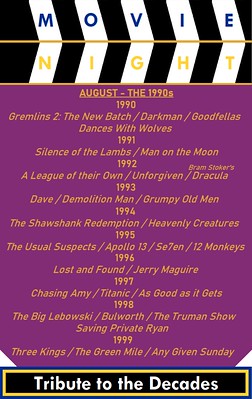
And now, the schedule for this month, a mix of familiar and new faces on and behind the camera as one approaches the end of the millennium. 

February 6, 2012

Movie Night: Small Soldiers.

Review #097: Small Soldiers.

Cast
Gregory Smith (Alan Abernathy), Frank Langella (Archer), Kirsten Dunst (Christy Fimple), Tommy Lee Jones (Chip Hazard), Phil Hartman (Phil Fimple), George Kennedy (Brick Bazooka), Jim Brown (Butch Meathook), Ernest Borgnine (Kip Killigan), Clint Walker (Nick Nitro), Bruce Dern (Link Static), Kevin Dunn (Stuart Abernathy), Ann Magnuson (Irene Abernathy), Jay Mohr (Larry Benson), David Cross (Irwin Wayfair), and Denis Leary (Gil Mars) Directed by Joe Dante.

Review
This is a bit similar to Gremlins (#096), with our lead hero releasing the villans to the world, destroying things, and ultimately losing to another toy/gremlin. But the film does try to distance itself a little, with action and slight laughs all over the film. It may be a little dark, but compare it to Gremlins, which had microwaved heads and more. This is just a cherry to that cake, really. It has excellent effects with good voice acting and standard acting that entertains you for two hours (Make that 1:50). It's not a great film, but it at least is enjoyable. Countdown: 10, 9, 8, 7, 6, 5, 4, 3...

Overall, I give it 6 out of 10 stars.

February 4, 2012

Movie Night: Gremlins.

Review #096: Gremlins.

Cast
Zach Galligan (Billy Peltzer), Phoebe Cates (Kate Beringer), Hoyt Axton (Rand Peltzer), Frances Lee McCain (Lynn Peltzer), Corey Feldman (Pete Fountaine), Frank Welker (Stripe and Mogwai), Howie Mandel (Gizmo), Keye Luke (Grandfather), John Louie (Grandson), Dick Miller (Murray Futterman), Jackie Joseph (Sheila Futterman) Directed by Joe Dante (#007 - Looney Tunes: Back in Action)

Review
The film is thrilling after it begins innocently enough with little mogwai and such. The acting is standard, but we know we really are here for. The gremlins. The gremlins are excellent in effects and personality. It's a dark film, especially when the lead actress delivers why she doesn't celebrate Christmas. It's interesting when you see the Gremlins and the characters duke it out rather then see the beginning, but never the less it's still an interesting film to watch. We are close to 100 Reviews. Countdown: 10, 9, 8, 7, 6, 5, 4...

Overall, I give it 8 out of 10 stars.

December 20, 2010

Movie Night: Looney Tunes: Back in Action.


Review #007: Looney Tunes: Back in Action.

Cast
Brendan Fraser (D.J. Drake), Jenna Elfman (Kate Houghton), Steve Martin (Mr. Chairman), Joe Alaskey (Bugs Bunny, Daffy Duck, Sylvester, Beaky Buzzard, Mama Bear), Jeff Bennett (Foghorn Leghorn, Yosemite Sam, Nasty Canasta), Heather Locklear (Dusty Tails), Joan Cusack (Mother), Timothy Dalton (Damian Drake), Bob Bergen (Porky Pig), June Foray (Granny), Brendan Fraser (Tasmanian Devil), Eric Goldberg (Marvin the Martian, Michigan J. Frog, Speedy Gonzales, Tweety), Bruce Lanoil (Pepé Le Pew), and Billy West (Elmer Fudd, Peter Lorre) Directed by Joe Dante.

Review
This is the first film covered of the 2000s, a decade that has just passed us by recently. The film is a wacky, but fine comedy with animation and live action mixed in very well. The cartoon characters are voiced well, with decent acting from Fraser and crazier acting by Martin. It's a zany, but cool film worth all the comedy, action, drama, spyness, and more all into a 90 minute film that entertains even if it may have been overshadowed by Elf, Matrix Revolutions, and *sighs* Cat in the Hat (#210). I'd say it's an underrated gem, but you'll have to check it out to see for yourself. For me, it's successful.

Overall, I give it 8 out of 10 stars.