Showing posts with label Gene Hackman. Show all posts

August 17, 2026

Cisco Pike.


Review #2570: Cisco Pike.

Cast: 
Kris Kristofferson (Cisco Pike), Gene Hackman (Detective Leo Holland), Karen Black (Sue), Harry Dean Stanton (Jesse Dupre), Viva (Merna), Doug Sahm (Rex), Roscoe Lee Browne (Pawnshop Owner), Joy Bang (Lynn), Severn Darden (Lawyer), Antonio Fargas (Brother Buffalo), with Don Sturdy (Recording Engineer), and Allan Arbus (Sim Valensi) Directed by Bill L. Norton.

Review:  
My favoritism does ring strong for select folks, admittedly. How many people can beat Barbra Striesand at their own game in trying to be the big fish in terms of actual presence in a movie (I fondly still remember watching A Star is Born (1976) and being amazed its sheer mediocrity). The Brownsville-born nomad was prolific enough at Pomona College that there were ideas of him being a writer, complete with study at the University of Oxford. Instead, he ended up as a jack of all trades in odd jobs (okay there was stuff in the middle of that such as being in the Army), one of them being a janitor at Columbia Records as a wannabee songwriter. He did appear in his first film with the adventure from hell in The Last Movie (1971). Apparently, in the aftermath of drunkenly stumbling through being rejected for a part in Two-Lane Blacktop, he got offered the script for this film and decided against the advice of taking acting lessons for a character that he thought he related to. Inadvertently, this also is a chance to spotlight a forgotten filmmaker that had a brief flash in the sun. Bill L. Norton was the son of William W. Norton, who actually was a writer in Hollywood that ranged from television with The Big Valley to movies with White Lightning [1973]*. As for the younger Norton, he graduated from UCLA and went from writing stuff such as How to Succeed with Girls (1964) and (uncredited) camera operating on movies like The Fortune Cookie (1966). But when film producers looked for any type of "freethinkers" or "hippie" perspective in the wake of Easy Rider's success in 1969, Norton got his chance to be a director with a script (with one working title being "Dealer") that attracted producer Gerald Ayres and Columbia Pictures. Robert Towne was asked to look over the script, with his most noted contribution being the addition of Hackman's character, although he was left uncredited. Lumped in some circles to other counterculture movies such as Getting Straight [1970] and Making It [1971], the movie had its opening premiere in late 1971 before going into limited release in 1972 that resulted middling reviews and a lack of an audience. The next Norton movie was More American Graffiti (1979). While there were a few showings to theaters that still had a print, the movie wasn't available on home media such as VHS or DVD until a release in the latter format in 2006. 

I suppose it makes sense that Norton called it his rendition of La Dolce Vita but set in L.A." In the domain of the Venice neighborhood with things of yesteryear such as the Pacific Ocean Park (closed since 1967). You could consider how Kristofferson considered acting to be as one that could be "just understanding a character, and then being just as honest as you can possibly be" (as said in 1974), or, for what he thought about the movie over 50 years later, one where he mused about what exactly "gave me the audacity to think I could act." The movie coasts along with a lead character that basically is an anachronism going through a travelogue in a type of California (West L.A.) that either runs on the fumes of banality or, well, is curious enough to actually see all the way through its 95-minute runtime. Kristofferson is the drifter, the has-been, the elusive one, the guy in all of us that can't just be one thing without some smart aleck or oddball trying to get one over us (such as trying to not be a dealer). Hackman made the movie right before doing The French Connection (Cisco premiered shortly after Connection). His panicky oddness popping in every now and then (for what could generously be estimated as being less than 20 minutes) is a curious one to see when compared to the familiar comforts of the kooky Black (by this point a recent Academy Award nominee with Five Easy Pieces [1970]) or the splattering of support that comes with Viva or the withered Stanton. Any observation about the movie, positive or negative, basically can be responded to with "it depends, man". The songs from Kristofferson are delightful for those who roll with doing something for the sake of it that basically is the movie in a nutshell: you drift in and drift out and maybe figure something out by the time it all has come to pass (or not). I can't call it a great movie, but a drifting movie with likeable enough folks and music is more than enough to at least call it a possible gem for the curious.

Overall, I give it 7 out of 10 stars.

Next up: Fuck it, it's 20 years old: 8.18.06: SNAKES ON A PLANE

*Honestly, I have no bias against Streisand, I just...never got into watching her movies. Or her songs. I accidentally took nearly 15 years of Movie Night to actually get to a Jane Fonda movie, it isn't exactly a surprise that I've seen two Streisand movies in the span of 16 years.

*Mr. William W. Norton was a strange guy. He crapped on his contributions to movies (once stating that one would only know his films if their "I.Q" [was] low enough"), later moved to Ireland and got mad about Roman Catholic residents getting attacked to the point where he went back to the States to run guns to the Irish National Liberation Army. He got caught and served 19 months in prison. He moved to Central America only to get robbed and killed one of the robbers. He moved around before finally being smuggled back to America. He died in 2010 at the age of 85 while his son Bill still lives.

*Forgot to send a link: LIFE - Google Books

December 23, 2025

French Connection II.

Review #2490: French Connection II.

Cast: 
Gene Hackman (NYPD Detective Jimmy "Popeye" Doyle), Fernando Rey (Alain "Frog One" Charnier), Bernard Fresson (Inspector Henri Barthélémy), Philippe Léotard (Jacques), Ed Lauter (General William Brian), Charles Millot (Miletto), Jean-Pierre Castaldi (Raoul Diron), Cathleen Nesbitt (Old Lady), and André Penvern (André) Directed by John Frankenheimer (#559 - Grand Prix, #985 - The Manchurian Candidate)

Review:
"I like the script, I like the characters, I like the Hackman character in France and not speaking a word of French. It's a very difficult film because we want in no way to rip off the first one, which is one of the best films I've ever seen. I want to make a movie that stands on its own as a movie"

Sure, why not do a sequel to The French Connection (1971)? To reiterate, the film took influence in atmosphere and style from films such as Le Samouraï (1967) and Z (1969). You probably remember that the film had a handful of characters based on real-life people in terms of distribution of heroin, which was turned into books such, as, well, The French Connection in 1969 (as written by Robin Moore) that detailed Eddie Egan and Sonny Grosso trying to figure out the drug ring (oddly enough, there was another film based on the exploits of Egan in Badge 373 [1973], with Robert Duvall as the star). One of those people was based on Jean Jehan, who really never did get extradited from France and apparently did die peacefully in old age. But hey, screw reality, right? Sometimes you really want to make some money and sometimes audiences will want to watch a sequel that gives you more of what you think you want, so screw it, French Connection II, complete with only Hackman and Rey returning from the first film. Friedkin had no interest in doing the second film and apparently never watched it. The story was written by Robert and Laurie Dillon, who worked on the screenplay with Alexander Jacobs (in his penultimate film credit as a writer), although apparently Pete Hamill provided an uncredited remake for nearly all of the dialogue shortly before production started (apparently Hackman had "nothing to act" with the lack of Roy Scheider in the cast*). John Frankenheimer signed on to direct the movie because he wanted to do a movie that audiences would see. Made on a budget of over $4 million, the movie made nearly three times its budget back (for comparison, the first film made over $70 million).

Admittedly, a movie that features the lead character getting addicted to heroin - he gets kidnapped about 40 minutes into the film, gets injected with heroin not long after, gets dumped back to the cops and eventually gets through the cold turkey treatment by about the 80-minute mark so he can torch a place (and call the cops and no I'm not joking about any of that). It surely is a curious one. Doyle isn't nearly as abrasive as he was in the first film because this time around, he spends more time trying to understand (miserably) the French people around him in one of those "fish out of water" scenarios. Hackman was appreciative for the role of Doyle but he also went on record for stating he never actually re-watched the first film after 1971. He is still pretty offbeat and still pretty entertaining in that certain type of gritty rage that could only come from someone like Hackman. He just has the knack in making a guy like Doyle seem more than just a blowhard or one that could vanish into thin air in the action. Fresson makes for a quality counterpart in capturing the restrained nature of authority that probably fares best in the sequences when having to confront Hackman trying to go cold turkey. Rey is the same type of elusive presence as before, mainly because he doesn't really have to do much besides slide in and slide out of the background that is mostly convincing in nebulous drug dealing*. Regardless of its fictional nature in following up such a hard-nosed first film, there is a worthy sense of danger and entertainment that comes through for engagement that at least makes you care about most of the 119-minute runtime, even with the amusement that arises in straight up fading to black right after the pivotal moment of the whole thing. You get a nice foot chase and even a burning building sequence to see havoc, some sequels don't even try to give you that even when they aspire to top the original. As a whole, French Connection II doesn't do anything particularly great when compared to the long shadow cast by the first film, but it is a solid enough film in its general execution of thrills to go along with enough from Hackman and company to make the trip at least seem like one worth going through once. 

Overall, I give it 7 out of 10 stars.

*Hackman and Rey had interesting paths to being cast in the first film, by the way. Rey was cast because Friedkin had wanted the small performance of a Spanish actor that had been in Belle de Jour (1967)...which was Francisco Rabal. Hackman on the other hand came about because they couldn't get the people Hackman or the studio envisioned for Doyle: Paul Newman, Jackie Gleason, Peter Boyle, Steve McQueen, Charles Bronson, Lee Marvin, James Caan, Robert Mitchum, Rod Taylor, and...Jimmy Breslin!

*Hey, fuck drugs. Sure, you can try weed, but in general, well, fuck heroin. Hell, cigarettes give you cancer, fuck them too. Don't even get me started on alcohol or vaping.

August 13, 2020

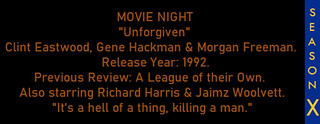
Unforgiven.

Review #1501: Unforgiven.

Cast: 
Clint Eastwood (William "Will" Munny), Gene Hackman ("Little" Bill Daggett), Morgan Freeman (Ned Logan), Richard Harris (English Bob), Jaimz Woolvett (The Schofield Kid), Saul Rubinek (W. W. Beauchamp), Frances Fisher (Strawberry Alice), Anna Thomson (Delilah Fitzgerald), David Mucci (Quick Mike), Rob Campbell (Davey Bunting), and Anthony James (Skinny Dubois) Produced and Directed by Clint Eastwood (#1252 - Space Cowboys, #1310 - Million Dollar Baby, and #1476 - Pale Rider)

Review: 
"Gene Hackman was interesting because I gave the Unforgiven script to his agent and he said no, he didn't want to do anything violent. But I went back to him and said, "I know where you're coming from. You get to a certain age and I'm there too, where you don't want to tell a lot of violent stories, but this is a chance to make a great statement"

It's easy to make a lasting great Western when it is going to be the last one you make after a long career defined by them. Eastwood had at least one defining Western that he was featured in, whether that involved television with Rawhide or with films such as A Fistful of Dollars, Two Mules for Sister Sara, or Pale Rider. This was his 17th directorial effort (and fourth involving the Western), and it surely proved a fitting last hurrah for Eastwood to declare as his last Western so as to not repeat himself or others (which has proven correct in for over two decades). The script for this film was written by David Peoples (who prior to writing had been a editor for TV and news programs) in 1976, with one development title being "The William Munny Killings", and one inspiration for him when it came to the depiction of violence was Taxi Driver. The script languished for years while Peoples wrote for other films such as The Day After Trinity (1980) and Blade Runner (1982), with Eastwood having waited around for years to do other projects first. Eastwood thought of making changes to the script, but he changed his mind because of how he saw the script was better without it (minus one thing, which involved having the opening having a text crawl rather than a voiceover). The result was two Academy Awards for Eastwood (for direction and Best Picture) and one for Hackman alongside one for editing.

At last, a Western great enough for the 1990s to deserve. It proves to be a riveting and somber ilm with its subversion of the Western and the myths that could make outlaws famous with whatever exploit could be covered fast enough. Sure, there have been quite a few films that have played with the clichés and traditions of what we saw in the Western in the classic era (with one slight resemblance being The Shootist, for example), but this one handles itself with a great elegiac quality in its direction, characters, and pace that make it one for the ages. It lives and moves with a great patience for making its surroundings resonate with its audience, with a false note never happening as more characters come and leave the picture as reflections of the time and place, whether that means a once-removed killer/farmer, or a savage outlaw, an outlaw with publicity, or even a sight-challenged kid with reputation. The easiest strength of the film lies within its main trio of actors, starting with Eastwood. No one ever fit the mythic mold of the Western hero ever so much in the last few decades of the 20th century film era like Eastwood did, who resonates in pained grit that reflects past and present with no contrived frills as a man with shades of gray. Hackman proves just as worthy in matching up to Hackman on the other side of the hill, tenacious and dedicated in intimidation and order (one of the people Hackman drew from was a police chief, for example) that lend excellence to small moments, such as a conversation with Harris and Rubinek involving the nature of fact and fiction with outlaws turning into a quiet showdown of chicken. Freeman (in the midst of a deserved rise in prominence with supporting and lead roles in the late 1980s) fills in the main details with resonating nerve and conviction that we come to depend on in a careful balancing act between him and Eastwood that make for useful time spent. Harris, despite being in the film considerably less than the others (and only having time with just Hackman and Rubinek) does a resoundingly good job in playing the part of the myth of a refined killer come out splendidly when faced with Hackman and his own interpretation of killers and those who write about them. Woolvett is the key supporting piece to encapsulate the film, brash but quite convincing as the lasting piece of the dealings of myth and reality when it comes to bits of amusement and action between him and Eastwood, never grating on one's patience. Rubinek and the others prove well in filling the town with interest and the dealings that come with conflicting view of justice and morality. What we have here is a film to stamp out the myths that came from films about a time as myth-inducing as the Old West with a wise one at the hand behind and in front of the camera in Eastwood to do wonders with for 131 minutes. This is a well-done piece of subversion and execution on a variety of levels that range from its cast to its look (done entirely in Alberta, Canada) that make the grand myth of outlaw one to look closer into and care about with flourish and satisfaction. It isn't the first Western one might view for themselves, but it sure is the one deserving of being up there to see time and time again among the classics.

Overall, I give it 10 out of 10 stars.

July 21, 2020

Hoosiers.

Review #1481: Hoosiers.

Cast: 
Gene Hackman (Norman Dale), Barbara Hershey (Myra Fleener), Dennis Hopper (Shooter Flatch), Sheb Wooley (Cletus Summers), Maris Valainis (Jimmy Chitwood), David Neidorf (Everett Flatch), Brad Long (Buddy Walker), Steve Hollar (Rade Butcher), Brad Boyle (Whit Butcher), Wade Schenck (Ollie McLellan), Kent Poole (Merle Webb), Scott Summers (Strap Purl), Fern Persons (Opal Fleener), and Chelcie Ross (George Walker) Directed by David Anspaugh.

Review: 
"I took the film at a time that I was desperate for money. I took it for all the wrong reasons, and it turned out to be one of those films that stick around. I was from that area of the country and knew of that event, strangely enough. We filmed fifty miles from where I was brought up. So it was a bizarre feeling. I never expected the film to have the kind of legs it's had."

"For so long studios were afraid of making sports movies because they thought they would only appeal to men. But Hoosiers isn't about basketball...They're about bigger things--family, community, and second chances."

To put it mildly, Indiana loves basketball. If one looks hard enough, you can find plenty of interesting things about Hoosier hysteria for the game, which extends to a film often thought of as one of the best sports movies ever. Writer-producer Angelo Pizzo and director David Anspaugh had first met when attending Indiana University, and each eventually found their way into doing what they liked: to be involved in films, and this was the feature debut for both of them. I think you know the story of Hoosiers, even if you haven't actually seen it. How many of us have grown up in a small town that focused their attention all on one certain part of the high school sports team? I myself can say I've been to countless basketball and football games, and you can certainly see plenty of faces old and new cheering on with pride. Granted, the game and season will end in the same manner, but it is the journey that counts most, right? The film may be very predictable for some, but who can resist a film where the little guy has a shot of winning? There is precedent for this within Indiana sports, with one small inspiration for this film being the 1954 Milan High School Indians, who with an enrollment of 161 students managed to go all the way in the state tournament (which had over 700 schools competing in one tournament), winning it all in the same place that would be used for this film's final: Hinkle Fieldhouse.

One thing that can't be lost in all of this is Gene Hackman. Whether in a supporting role or as star, he certainly knew how to bring a vital energy to the roles he played on screen, which could prove pretty versatile and fairly effective in the right hands. He was cast in this film because of scheduling problems with Jack Nicholson, one of two castings by chance that are interesting to note (the other being Dennis Hopper being cast when Harry Dean Stanton declined).  Although it might seem obvious to note the film's success, Hackman really did believe it wasn't going to be a hit on release, and Anspaugh had some tough times on filming with Hackman. One wouldn't really see any problems here, since Hackman is tremendous here, a show of professionalism and intuition that plays really well to a film that invites one in to no-nonsense warmth. Hershey follows along for the ride with fairness that matches up with Hackman without too many bumps, although the romance between the two seems a bit dubious - an alternative version of the film (which apparently ran at 168 minutes) had more scenes with the two together, although I can't imagine a longer version doing better than the 115 minute version we have here. Hopper, in the midst of a career resurgence with this and Blue Velvet (1986), nearly steals the show. A former addict playing an alcoholic, he proves adept at giving this role the gravitas and care it needs to come alive with warmth that permeates interest whenever on screen. The others prove just fine in giving the small-town spirit the film requires, following along certain traits you could see in your town or in other sports films, whether involving the small athletic wonder, the devout athlete, or the opinionated townsfolk (headed by a distinct Ross). The basketball sequences prove fine in emulating classic 1950s basketball in the midst of fairly effective small town sequences destined to warm the heart of those living in the heartland desiring exactly this kind of film. It overcomes any lingering sense of hokey hooey with enough authenticity to make an interesting piece in the sports film library with a presentable charm and a well-rounded core to go with it all.

Overall, I give it 8 out of 10 stars.

June 11, 2020

The Poseidon Adventure.

Review #1442: The Poseidon Adventure.

Cast: 
Gene Hackman (Reverend Frank Scott), Ernest Borgnine (Detective Lieutenant Mike Rogo), Red Buttons (James Martin), Carol Lynley (Nonnie Parry), Roddy McDowall (Acres), Stella Stevens (Linda Rogo), Shelley Winters (Belle Rosen), Jack Albertson (Manny Rosen), Pamela Sue Martin (Susan Shelby), Arthur O'Connell (Chaplain John), Eric Shea (Robin Shelby), Leslie Nielsen (Captain Harrison), and Fred Sadoff (Linarcos) Directed by Ronald Neame (#673 - Scrooge and #1204 - Meteor)

Review: 
"I suffer along with them. We have many story conferences. As a writer/director/producer, I have triple agonies. I'm bucking to be known as the most sympathetic producer in town."

Oh sure, there were plenty of films to pick from that had an independent streak with directors and stars in the 1970s, but let us not forget about the films that followed the lines of all-star casts that came from previous decades. In this case, the all-star cast format came in the disaster movie genre, one that is just as prevalent in generating spectacle as other genres. Airport (1970) was the start of a whole new era of disaster films, as it made over $100 million upon release that was followed by three sequels before the decade ended. Who better to further the genre than Irwin Allen, the "Master of Disaster"? After all, he had already mastered the hand of producing/directing in television and film with projects such as The Sea Around Us (1953, an Academy Award winning documentary), Voyage to the Bottom of the Sea (1961, which became a hit 1964-68 series), and Lost in Space (1965-68). He would produce four further disaster films (with all but one in the 1970s) with The Towering Inferno (1974, about a fire in a tower), The Swarm (1978, involving killer bees), and Beyond the Poseidon Adventure (1979, which involved a return to the ship to recover treasures). The director who fell right into directing this film turned out to be a good one with Ronald Neame (after Gordon Douglas stepped off). He had been a cinematographer in British films starting in the 1930s before taking a hand at producing (Cineguild, with David Lean and Anthony Havelock-Allan) in the late 1940s that moved to directing with Take My Life (1947). Although he did not find the final result to be one to be proud of, he did describe it as his favorite film in that it gave him plenty of "F.U. money".

I suppose one reason for my curiosity with this film (based on the 1969 novel of the same name by Paul Gallico) was seeing how all of these stars would match up with each other, considering there are five Oscar-winning actors here (Hackman, Borgnine, Winters, Albertson, Buttons) alongside a mish-mash of supporting actors with melodramatic turns and plenty of spectacle. The result is one of the most ridiculously enjoyable films to ever sit through, one that is soapier than Grand Hotel (1932), with actors that did a majority of their own stunts that makes one think they are watching a P.E. competition. It is like going to a restaurant and asking everyone about who they were and what they liked to do and then going back to eat something you know is overstuffed but eating it anyway because you just need that experience (or getting a kick, I suppose), regrets be darned. Hackman leads this disaster squad with plenty of unorthodox spirit and candor to go with it that makes for an fair rapport with the equally blustery Borgnine who is charmingly rough around the edges. The others fall around the lines you could see coming from their opening moments, such as the quiet haberdasher Buttons that proves resourceful when paired with a nervous Lynley, or a gloomy but game Winters (who apparently gained 30 pounds for a role that requires her to do a swimming sequence). Others like Albertson, Stevens and Shea have smaller parts to play, but they do their best in making a good time with convenience (whether that means a quick remark or not), and this also includes short trips with McDowall (switching accents as a waiter, I kid you not) and a sternly useful Nielsen (an actor with standing even before hitting it bigger with comedy). One is here to see some fiery action, and they do generally pay off well, starting with the crash that starts all the fun (complete with a massive fall onto a light in an upside down dining room, a tremendous stunt to see). It is executed well with a fine look of despair and water to keep things sinking through for 117 minutes with plenty of moments that can make your head agape for better or worse (the question one generally associates with that would be "Wait, what?" in my view). It's funny, I had heard of the song "The Morning After" a number of times before seeing this film, but I didn't actually realize that it was performed in this film first (written by Al Kasha and Joel Hirschhorn), which was apparently written in one night. Oh sure, it's a terrible song (cheesy but annoyingly catchy), but it found a following and ended up winning an Academy Award for its songwriters. The additional Academy Award won by the film (which snagged eight nominations, mostly technical) was for its visual effects from L. B. Abbott and A. D. Flowers. A sequel followed a few years later, and there were two remakes (one for television, one theatrical), but none have really matched the sheer lasting power of this, one with plenty of silliness alongside enjoyment to go for an era like this.

Overall, I give it 8 out of 10 stars.

June 8, 2020

The French Connection.

Review #1438: The French Connection.
Cast: 
Gene Hackman (Det. Jimmy "Popeye" Doyle), Fernando Rey (Alain "Frog One" Charnier), Roy Scheider (Det. Buddy "Cloudy" Russo), Tony Lo Bianco (Salvatore "Sal" Boca), Marcel Bozzuffi (Pierre Nicoli), Frédéric de Pasquale (Henri Devereaux), and Bill Hickman (Bill Mulderig) Directed by William Friedkin (#037 - The Exorcist)

Review: 
"If you're going to make a film or an album of music or a painting, you cannot afford to stop and think what other people will think of it. You've got to take into consideration what your editor thinks, if, say, you're a writer. But I don't have anyone to answer to. I make a film because I want to. Sometimes they're successful, sometimes they're not, but the way I think about my films is always very personal." - William Friedkin

"Acting was something I wanted to do since I was 10 and saw my first movie, I was so captured by the action guys. Jimmy Cagney was my favorite. Without realizing it, I could see he had tremendous timing and vitality." - Gene Hackman

All decades could be studied for their grittiness, but perhaps no decade had it more interesting than the 1970s. After a decade of shifting in Hollywood and within the culture, it only figures that some of the best films from this era would be ones with tinges of moral ambiguity and raw disenchantment of the angry young man, where law and order was a catchphrase rather than a show. Accordingly, it should only make sense that the first R-rated film to win an Academy Award for Best Picture would be The French Connection, based on the non-fiction book by Robin Moore released two years prior. Produced by 20th Century Fox, it featured the pursuit by two detectives (inspired by actual detectives Eddie Egan and Sonny Grosso, who both served as technical advisors in the film) of the New York Police Department of a substance smuggler in New York City. It should prove fitting that such a frank and urgent film came from a director with humble backgrounds in William Friedkin. The Chicago native was the son of a salesman and nurse that grew into becoming interested in films in his teenage years, viewing films such as Les Diaboliques, Psycho, and Citizen Kane (the last being the one to cement his love for the cinema). He went from working in the WGN-TV mail room to directing live TV shows and documentaries when he was 18, starting with The People vs. Paul Crump (1962). Incidentally, one documentary that Friedkin directed was The Thin Blue Line (1966), which focused on the police force and problems of combating increased crime. He started his feature film career with Good Times (1967), which featured Sonny and Cher in a comedy musical western. Of his first four films, only The Night They Raided Minsky's (1968) proved any success with audiences or critics. And yet here he is, directing a film under the production of Philip D'Antoni, who had previously produced Bullitt (1968) for Fox only after several rejections and a small budget of $1.8 million dollars. There were a few follow-ups to this film of sorts. The Seven-Ups (1973) was directed by D'Antoni  while having Scheider as the main star as a tough-guy cop with Grosso as technical advisor and Bill Hickman back as stunt coordinator. French Connection II (1975) was a fictional sequel directed by John Frankenheimer that had Hackman and Rey return to their roles that was a mild success.

Of all the unlikely things, Hackman not being the first, second or even third choice must rank high up the list. Famed newspaper columnist Jimmy Breslin was actually in the running at one point in time (he would lose out in light of his inability to drive), while Jackie Gleason was thought to be bad for box office with the failure of Gigot (1962), and Peter Boyle disapproved of the violent themes. Hackman, who was known for supporting roles such as Bonnie and Clyde (1967) and I Never Sang for My Father (1970) after going from the Pasadena Playhouse to doorman-between-acting, was found at the last moment. Similarly, Scheider had just a few small roles to his credit before this film (along with Klute) helped rise him to stardom. To have the actors get a feel for the cops they would portray, they patrolled with Egan and Grosso for a month. One can see that this proved effective in making for tremendous performances from Hackman and Scheider in how grizzled and hard-edged they prove for a film that serves as a key point for police procedural films for its era. Hackman proves especially great in showing the maniacal drive and act that one seems to need to have to be on the beat to take a criminal down on and off the clock with intensity, while Scheider follows along with measured conviction; probably the best sequence with the two is their first, with them chasing a criminal down the street that turns into questioning with offbeat fervor from Hackman ("Did you ever pick your feet in Poughkeepsie?") in a Santa suit. Rey (who came into international status with collaborations with Orson Welles and Luis Bunuel films in the 1960s and 1970s) is elegantly devious to fit this cat-and-mouse game of cops and drug kingpins without trouble. Boca and the others (including Egan and Grosso in brief roles) fill in the gritted atmosphere of thrills and action fitting to be talked about as a neo noir. Perhaps having Shaft writer Ernest Tidyman behind this screenplay helps in making this 104-minute film really tick with tension and competence. It might seem quaint to the eyes of those who have encountered plenty of procedurals in the near half century since release, but one has to start somewhere with grimy gripping films like this. The chase sequence (which had a mix of Hackman and stunt driver Hickman driving) is excellent to see play out in real traffic between a car and a train with careful angles and a poster-worthy showdown moment to boot. By the time it gets to its bittersweet finale, one knows they have watched an interesting film with plenty of looks and sounds of New York City from an era long ago with documentary-style filming from Friedkin that serves the film well in driving one up the wall and never letting things go too easily. As a whole, This is a film with a controlled obsession of sordid realism that makes for a classic of the age that had people like Hackman and Friedkin deservingly reap the rewards of for the rest of the era.

Overall, I give it 10 out of 10 stars.

August 11, 2017

Bonnie and Clyde (1967).


Review #981: Bonnie and Clyde.

Cast:
Warren Beatty (Clyde Barrow), Faye Dunaway (Bonnie Parker), Michael J. Pollard (C.W. Moss), Gene Hackman (Buck Barrow), Estelle Parsons (Blanche Barrow), Denver Pyle (Frank Hamer), Dub Taylor (Ivan Moss), Gene Wilder (Eugene Grizzard), and Evans Evans (Velma Davis) Directed by Arthur Penn.

Review:
August holds significance for this film, as it was released 50 years ago on this month, with three different premieres: August 4 (for the Montréal Film Festival), August 13 (New York), and August 23 (Los Angeles) before going into general release the following month. In any case, I decided it made sense to finally cover this movie today to see how it has aged after (roughly) 50 years. There is something about how the movie works on nearly every level, from its cinematography by Burnett Guffey to its dynamic cast to how it becomes more than just a movie with violence (and lots of it) that opened the floodgates to a new level of bloodshed in cinema that is still readily apparent today. There have been countless other films revolving around criminals and/or a good deal of violence (such as say, The Wild Bunch (#591), though that was a Western), but this does not manage to fall into the background because of how it operates itself, with the ending scene being shocking in its execution. Of note is the use of squibs (a miniature explosive device) in order to imitate bullet hits, which surely stands out from prior movies that didn't have as much (or any) blood for the violence. The editing by Dede Allen is also quite good, having a rapid pace that rolls with the action neatly, with influence coming from the styles used for films directed during the French New Wave. Beatty and Dunaway both do great jobs, along with having a great chemistry together that seems instantaneous. The rest of the cast is also quite excellent in roles that led to further fame (along with an Academy Award for Best Supporting Actress for Parsons), with Hackman and Parsons being enjoyable to watch in their interactions within the Barrow Gang. In a film as rough as this is, there is still a level of humor and excitement one can get from all that happens in the movie, from the first scene with Beatty and Dunaway to the Gang escaping from the cops with Parsons holding onto a spatula. It's a forthright kind of film that never seems inauthentic with its goals and pace. The film does take liberties with what happened in real life with the Barrow gang, but it does not alter the fact that this is still a fine piece of entertainment that never ceases to be anything other than captivating.

This was a controversial film upon release, with criticism being about the level of violence apparent in the movie, but it was still a major success (no doubt due its appeal for the generation the movie was released to). No matter what you might think about how the film portrays violence, the legacy that Bonnie and Clyde has in changing the way violence is depicted on screen is undeniably still felt today, for better or for worse. It may not be everybody's cup of tea, but it definitely pulls no punches in how it operates itself and achieves all of its goals.

Overall, I give it 9 out of 10 stars.

March 26, 2016

Superman IV: The Quest for Peace.


Review #787: Superman IV: The Quest for Peace.

Cast
Christopher Reeve (Superman / Clark Kent), Gene Hackman (Lex Luthor / voice of Nuclear Man)
Jackie Cooper (Perry White), Margot Kidder (Lois Lane), Jon Cryer (Lenny Luthor), Mark Pillow (Nuclear Man), Sam Wanamaker (David Warfield), Marc McClure (Jimmy Olsen), Mariel Hemingway (Lacy Warfield), and Damian McLawhorn (Jeremy) Directed by Sidney J. Furie.

Review
Simply put, this movie is terrible. Any which way you look at it, the movie fails at every level, from failing as a superhero movie to failing to make a plot or direction that works to failing be a movie of spectacle or excitement. To make a long review of this movie would be redundant, but a basic criticism will suffice for such a basic movie. The first (and easiest) flaw to notice is the opening credits, which are representative of both the cheapness of the production studio (Cannon Films) and the harbinger of a movie that goes downhill from there. As usual, Reeve (who contributed to the story for the film) does a fine job, and Hackman returns to make for an entertaining Luthor once again, but neither can save a movie bogged down by terrible, terrible film-making not just from directing, but from a (chopped-down) budget that can't support what the movie wanted to be. The effects are the ultimate final blow, with easily visible strings, a shot of Reeve "flying" towards the camera being repeated numerous times, and numerous other examples of futile attempts at penny pinching. At least Cooper, Kidder and McClure are back, though they don't really very interested in the movie, much like the rest of us. The less said about Cryer, the better. Nuclear Man is certainly a strange villain, looking like he was time-warped from the early 80's, especially with the silver nails, and the fact that he is voiced by Hackman is somewhat off-putting. The fights between him and Superman are downright laughable, and the solution to defeating him via moving the moon in front of the sun is the only perfect way to end such a silly climax.

What is interesting in all of this is the amount of footage that was cut from the movie. Originally, the movie was over 2 hours long, but due to a bad test screening, Furie cut over 30 minutes out of the movie, with a good portion of those scenes (but apparently not all of them) later resurfacing on DVD many years later. Almost all of them have a bit of degradation to them, and scenes meant to show special effects (such as one scene where Superman rescues a child from a tornado) are unfinished, and even the final intended scene, with Superman and Jeremy (a child who wrote him a letter wanting him to intervene in possible war) flying over the Earth isn't finished, with a red glow effect on them.

In the end, the movie has no hope, no substance, no luck, and most of all no budget, proving to be the death knell of the movie franchise for 19 years. I'd recommend the movie as a guide on what not to do with regards to budgeting, editing, and most importantly, presentation.

Overall, I give it 4 out of 10 stars.

March 20, 2016

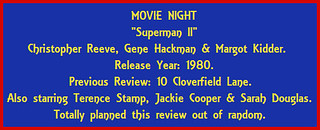
Superman II.


Review #785: Superman II.

Cast
Christopher Reeve (Clark Kent / Superman), Gene Hackman (Lex Luthor), Margot Kidder (Lois Lane), Terence Stamp (General Zod), Jackie Cooper (Perry White), Sarah Douglas (Ursa), Jack O'Halloran (Non), Ned Beatty (Otis), Valerie Perrine (Eve Teschmacher), Marc McClure (Jimmy Olsen), Susannah York (Lara), Clifton James (Sheriff), and E.G. Marshall (The President) Directed by Richard Lester (#541 - A Hard Day's Night and #594 - A Funny Thing Happened on the Way to the Forum)

Review
If you're interested in the review, skip this paragraph, as it does not pertain to the review, merely serving as a little bit of background...

If you remember my review from two years ago of the original Superman movie (#547), I had said that it was a fine epic that succeeded in nearly every way possible, with the most important being that it was entertaining. Naturally, the movie was a success, and Superman II (which had been filmed simultaneously with the first film) would soon follow...but not with Richard Donner, who was "replaced" from the film by the Salkinds producers a few months after the first film's release. Richard Lester was tasked to finish the film. The dispute over what footage of the movie is Donner's and so on continued for years, with a "Richard Donner Cut" made in 2006 that tried to restore (as much as possible) footage that Donner had shot, though he was not involved with that cut.

With all that in mind, Superman II still manages to be a decent sequel. While it isn't up to the same craft as the first film, Superman II is as least entertaining enough to work. The movie has elements of humor that veer into slapstick (no doubt added by Lester), which admittedly gets in the way of enjoying my favorite part of the movie: The climatic fight with Superman and Zod, Ursa & Non. While it is a good fight that takes up the last 30 (or so) minutes of the movie, it is marred by random aspects. One example is Superman throwing his emblem shield at Non, which mystifies me on the level of practicality. Reeve and Kidder do have good chemistry together once again, and the romance is at least watchable, even despite the fact that Superman can just erase memories with a kiss (if he chooses to, I suppose), which makes for a peculiar (if not extremely inevitable) reset. The movie takes time to get going in the sense that it is more fun with Zod and the others around. The effects, while a bit peculiar at times, fit the movie well enough. Stamp certainly makes for a standout villain in the sense that there finally is a villain who can match to the physical strength of Superman, alongside the fact that Stamp is entertaining to watch, especially when asking someone to kneel. I wish that the idea of Superman taking his powers away in favor of being with Lois could have been more than just a five minute blip that just passes through and is nearly forgotten, right up to the end, anyway. I do find it interesting that at the end of the movie, Superman beats up a trucker (the one who had beaten him up while he was temporarily human), because...I guess Superman really felt that he needed to get some sort of retribution. Superman II is a sequel that has its bogging flaws, but it shines just enough with charm and a little bit of magic to work.

As for the sequel...next time.

Overall, I give it 8 out of 10 stars.

October 26, 2014

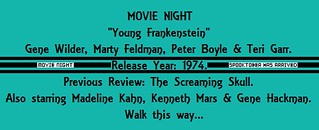
Movie Night: Young Frankenstein.


Review #655: Young Frankenstein.

Cast
Gene Wilder (Frederick Frankenstein), Marty Feldman (Igor), Peter Boyle (The Monster), Teri Garr (Inga), Cloris Leachman (Frau Blücher), Madeline Kahn (Elizabeth), Kenneth Mars (Inspector Kemp), and Gene Hackman (Harold, the Blind Man) Directed by Mel Brooks (#061 - Blazing Saddles, #198 - Spaceballs, #248 - Robin Hood: Men in Tights, #361 - The Producers, #364 - High Anxiety, and #623 - Silent Movie)

Review
Yeah, I guess at this point I had to cover this movie, and I have three reasons why: The 40th Anniversary of the movie's release is coming up very soon, It's October, for Pete's (or in this case, Rob's) sake, and...It's been long overdue. Seriously, I should've reviewed this last year, but I just forgot (Of course last October I reviewed 20 films in 31 days, but who's counting?), so I am now rectifying a mistake (Though I know I will undoubtedly make another mistake in the future). The movie is a wonderful parody of the classic Universal Horror films, especially Frankenstein (#072), right down to the black and white shooting. In fact, Kenneth Strickfaden, who made the electrical equipment for the lab scenes for the Universal films (and still had it with him), let them use the equipment for this film, which is highlighted by his name on the credits. But let's get to the part of the review where I just say the movie's really funny because that is the next part, isn't it? Every major actor in this movie has or is involved in a funny scene, especially Marty Feldman (What hump?), who is just so fun to watch move around and gaze upon. I especially like Peter Boyle in this film because his movements and way of speaking as the Monster (especially while singing "Puttin' on the Ritz") is just so charming. The movie flows really well and never misses a beat when it comes to being funny, it has so much atmosphere and so much charm, and that is just perfect for October, or for any month in particular. I urge anyone, if not everyone to go see it, you just have to look.

Overall, I give it 10 out of 10 stars.

September 6, 2014

Movie Night: The Birdcage.


Review #637: The Birdcage.

Cast
Robin Williams (Armand Goldman), Nathan Lane (Albert), Gene Hackman (Kevin Keeley), Dianne Wiest (Louise Keeley), Dan Futterman (Val Goldman), Calista Flockhart (Barbara Keeley), Hank Azaria (Agador), and Christine Baranski (Katherine Archer) Directed by Mike Nichols (#175 - Who's Afraid of Virginia Woolf? and #550 - The Graduate)

Review
What we have is a wild, weird movie full of fun scenes that make a unique experience. The biggest reason this movie works is the cast, they all seem to just mesh together awkwardly, which makes sense given the premise. It really is Hackman's facial expressions that just sum up what kind of world he's in, and any time you can end a movie with him in disguise at a nightclub with he doing the most uncomfortable expressions ever is pure gold. Williams and Lane are just watchable in every scene they share together, I especially like the scene where Williams tries to demonstrate how to dance for a musical scene by channeling dances, such as Madonna. The way that Williams moves and his energy make a strange scene into a great one. Does the movie have its cliches? Yes, but it embraces them, this is a movie on its own terms, with some great music and some good jokes. What we have here is a movie that is flashy, silly fun with a touch of decor for flavor.

Overall, I give it 8 out of 10 stars.

February 23, 2014

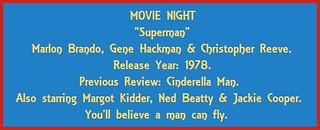
Movie Night: Superman (1978).


Review #547: Superman.

Cast
Marlon Brando (Jor-El), Gene Hackman (Lex Luthor), Christopher Reeve (Clark Kent/Superman), Margot Kidder (Lois Lane), Ned Beatty (Otis), Jackie Cooper (Perry White), Glenn Ford (Jonathan Kent), Valerie Perrine (Eve Teschmacher), Phyllis Thaxter (Martha Kent), Trevor Howard (First Elder), Maria Schell (Vond-Ah), and Terence Stamp (General Zod) Directed by Richard Donner (#075 - Scrooged, #355 - Lethal Weapon, and #356 - Lethal Weapon 2)

Review
Of all the comic book movies I've done on this...show, I suppose, the one glaring omission has been the Superman franchise. Superman was the first major superhero feature movie made (Side note here: There had been three serials made before this movie, such as Superman (1948), Atom Man vs. Superman (1950), and Superman and the Mole Men (1951), along with animated shorts made by Fleischer Studios, a radio and television series), and the movie's success would lead to more superhero films. But anyway, how is the film itself? Let's start with the actors. Brando does well for the small amount of time he has, and his speech to his newborn son is effective, but also powerful. Hackman is a decent villain, he does pair well with Beatty, who isn't half bad in a supporting role. Christopher Reeve is just perfect in both roles, managing to act well enough to make these two personalities stand out effectively. Kidder is good, she pairs off well with Reeve, and the scene where Superman takes Lane on a flight is a really good scene that only shows the emotion the movie has. The movie has excellent effects and manages to tell a good story with only a few bumps along the way. The ending either makes Superman's character fully defined...or a cop out that is actually more confusing in how it works then infuriating. I think it's more of both, it defines that Clark/Superman is here for a reason, a point mentioned by Kent's adoptive father, in contrast to Jor-El's warning about changing history. Superman finds his destiny, and it does make sense, though the time traveling part boggles my mind. Endings aside, the movie is a fine epic that succeeds in nearly everyway possible.

Overall, I give it 9 out of 10 stars.

April 29, 2013

Movie Night: The Replacements.


Review #370: The Replacements.

Cast
Keanu Reeves (Shane Falco), Gene Hackman (Jimmy McGinty), Brooke Langton (Annabelle Farrell), Jon Favreau (Daniel Bateman), Rhys Ifans (Nigel Gruff), Orlando Jones (Clifford Franklin), Brett Cullen (Eddie Martel), Faizon Love (Jamal Jackson), Michael Taliferro (Andre Jackson), Jack Warden (Edward O'Neil), and Ace Yonamine (Jumbo) Directed by Howard Deutch.

Review
This is at heart...an epitome of generic sports movie. This is a movie filled with sports cliche on top of more sports cliches. In fact, you could count the amount of cliches and play Cliche Bingo. What is Cliche Bingo? Think of the cliches that make up sports movies, such as:

The washed up player who is trying to redeem himself.
The grumpy coach.
The romance subplot between a player and cheerleader/person.
The crazy owner.

The big man.
The crazy guy who has a lot of power.
A speech about needing heart/determination/the guts to win.
Playing a strong team and being the underdogs yet somehow winning.

The antagonist who could also be one of their own.
The comic relief character.
Being down at halftime/near the end of the game.
Dramatically diving/slding/slapshooting/moving by a player.

I realize that's only 12 and you would need 12 more to make an actual bingo card, but let me tell you a secret: You can find the rest if you look hard enough. The acting is decent enough, though I do wonder what exactly motivated Hackman to do this movie. I know what you're thinking is the reason, which might be the reason for Welcome to Mooseport, but that's neither here or there. The football action is at least watchable, the movie's not horrible, it's just a typical sports movie that is sickeningly sweet to the point where by the end of it you just want to watch actual football, at least that isn't acted out. Most of the time.

Overall, I give it 6 out of 10 stars.

December 20, 2010

Movie Night: Get Shorty.


Review #005: Get Shorty.

Cast
John Travolta (Chili Palmer), Gene Hackman (Harry Zimm), Rene Russo (Karen Flores), Danny DeVito (Martin Weir), Dennis Farina (Ray "Bones" Barbone), Bette Midler (Doris Saffrin), Delroy Lindo (Bo Catlett), and James Gandolfini (Bear) Directed by Barry Sonnenfeld.

Review
This film is smart, engaging, interesting, useful, and more. The characters are interesting, with Travolta and DeVito being the best standouts, as the film also has a comedic touch to it, making it feel excellent in many ways. It feels like one of those classics from the old classic times that make you feel right at home, with each scene do a great job in style. Believe or not, there was a sequel to this, but I have not watched it. It took 512 reviews and over three years, but I finally got to the sequel.

Overall, I give it 8 out of 10 stars.