Showing posts with label 2014. Show all posts

December 20, 2024

Interstellar.

Review #2322: Interstellar.

Cast: 
Matthew McConaughey (Joseph "Coop" Cooper), Anne Hathaway (Dr. Amelia Brand), Jessica Chastain (Murphy "Murph" Cooper; Mackenzie Foy as 10-year-old Murph; Ellen Burstyn as elderly Murph), John Lithgow (Donald), Michael Caine (Professor John Brand), Casey Affleck (Tom Cooper; Timothée Chalamet as 15-year-old Tom), Wes Bentley (Doyle), Bill Irwin (TARS - voice and puppetry and CASE puppetry), Topher Grace (Getty), David Gyasi (Professor Romilly), and Matt Damon (Dr. Mann) Directed by Christopher Nolan (#054 - The Dark Knight, #055 - Inception, #062 - Batman Begins, #980 - Dunkirk , #1562 - The Dark Knight Rises#1618 - Tenet, #2050 - Oppenheimer)

Review: 
“It’s been a really interesting challenge. When you say you’re making a family film, it has all these pejorative connotations that it’ll be somehow soft. But when I was a kid, these were family films in the best sense, and they were as edgy and incisive and challenging as anything else on the blockbuster spectrum. I wanted to bring that back in some way.”

Honestly, the best way to talk about a movie like this is to just go with it. In 2006, Kip Thorne (a theoretical physicist, writer, and future Nobel Prize winner) and Lynda Obst had come up with trying to work with each other again, having previously collaborated on Contact (1997), in which Thorne's study of wormhole space travel had been incorporated into the screenplay (as written by Carl Sagan, a close friend of Obst). Thorne had theories involving “warped space-time" that eventually found Jonathan Nolan assigned to write that outline into a narrative. When the original director in mind (Steven Spielberg) had other ideas in mind to work on, Christopher Nolan expressed interest to direct and to incorporate his own ideas for the screenplay (evidently, the first hour of the film, set in the not-too distant future with inspiration taken from the Dust Bowl era of the 1930s, is pretty true to the original screenplay while one particular shape for the climax came from C.Nolan). Thorne had set out two guidelines for the Nolans in having a film that wouldn't "violate established physical laws" while having wild speculations spring in some sort of science. He later wrote a book on his experiences as a consultant on the film (The Science of Interstellar). The effects by Double Negative had the use of digital projectors to go along with miniature effects from other collaborators for spacecraft (incidentally, that one famous image of an actual black hole came out in 2019). Released in November of 2014, Interstellar was a pretty fair success in its time, with probably the visual effects receiving the most praise (for its 10th anniversary, select theaters showed the film again in 70mm IMAX).

I do wonder if I would like this film better on a re-watch a few years down the line. In fact, the reputation of the film suggests that, well, for all the engineer and craftmanship, the mysteries really can have love as one of the ways forward. It is worthy spectacle and also a mash of human interest for 169 minutes. Time is the important factor in the great vacant reaches of spaces that ultimately lend one to the immeasurable pull of hope in the strange margins. The best way to go with the movie is to watch with as little to really know about it as possible, one in which you don't look for tricks but just try to absorb the film piece by piece. It does not leave one impatient to get to space because of the general commitment shown by Nolan and company to let things breathe in a place filled with blighted surroundings (consider this is a film where textbooks talk about the Apollo missions as one of waste and elaborate conspiracy). In a film with plenty of worthwhile effects, it also happens to be a movie with a worthwhile cast to support it all, since it basically is a fable of people who have to learn to look up again, ones who cannot just be caretakers or "stay" where they are. McConaughey has the calm sense to make it all work in maneuvering charm that is worth playing out for a journey beyond the stars. That first third (rough estimate) in the fields of a blighted world with him and the on-screen youth in Foy and Chalamet to go along with Lithgow make for an earthy quartet to balance out the inevitable when one is brought into the mix of Caine (reciting one particular poem) and the reasoned grace from Hathaway. Of course, the other key is in the latecomer in Damon to round out a look on human nature in all of its facets when confronted with danger, loneliness, love, or the space between (of course, Irwin is there too to convey the robot voice and puppetry to really round out the highlights, I didn't forget that). The enjoyment of the film is in layers, really, managing to walk the frontier tightrope (as one might say) in drawing a sci-fi epic in the eyes of a family and where that leads for meaningful stakes in what really matters most when it comes to the immeasurable qualities of survival. There are plenty of moments that one will find astounding, such as say, the tidal wave sequence or the manual docking sequence to go along with the eventual "clicking together" moment that rewards the curious with threading the needle in not just being a cop out for the sake of sweeping it all up. In totality, it is a pretty neat movie when viewed all the way through in execution in ways that can only be understood for those with the patience to six through such a worthwhile journey. I can't call it my favorite Nolan movie, but it is worthwhile enough to recommend on the best screen possible to absorb for all that it brings beyond the stars. 

Overall, I give it 9 out of 10 stars.

Welcome again to December 20, the anniversary day for Movie Night, which is now 14 years old. I apologize for the lengthy delay between reviews, I simply wanted to take some time off to refresh myself so that I close out 2024 by not "phoning it in". Surprise: today is a doubleheader day.

October 14, 2024

It Follows.

Review #2277: It Follows.

Cast: 
Maika Monroe (Jaime "Jay" Height), Keir Gilchrist (Paul Bolduan), Olivia Luccardi (Yara Davis), Lili Sepe (Kelly Height), Daniel Zovatto (Greg Hannigan), Jake Weary (Hugh / Jeff Redmond), Bailey Spry (Annie Marshall), Debbie Williams (Mrs. Height), and Ruby Harris (Mrs. Redmond) Written and Directed by David Robert Mitchell.

Review: 
"The idea for It Follows came from a dream when I was a kid, but I sort of built on it later. And at a certain point when I was working out the story, in the back of my mind, I thought that it would be nice to have [the monster] be something that can move between people. It just sort of made sense to me that if it was something that was passed through sex, it would be a way to link the characters — to connect them both physically and emotionally. And it tied into some of the other larger themes that I was working towards."

It is not much of an understatement to say that some horror movies like to have sex mean something in their tales of suspense and/or terror. Here we are with a Detroit-shot film filmed by a Michigan native (specifically Clawson). After graduating from Florida State University, he became a feature director with The Myth of the American Sleepover (2010). Mitchell began writing this film in 2011 when working on a separate film he intended as a follow-up, but this would end up getting more development as a film with personal ties (this anxiety dream basically came about around the time his parents were getting divorced) to go along with a premise that seemed weird to describe out loud to others. The look of the film to go along with the monster were inspired by the photography of Gregory Crewdson, known for his large-scale prints of staged scenes in suburban settings. The film was given a premiere at the Cannes Film Festival in 2014 before eventually getting a theatrical release in 2015. Mitchell followed up this film with Under the Silver Lake (2018) to go with a future release of Flowervale Street (2025). Just last year, it was announced that a sequel to It Follows would come up with They Follow with Mitchell returning to direct, presumably to shoot in 2025.

Mitchell's interest in this film is one where love and sex are ways to at least push the inevitability of death away for a time. One sees plenty within the wide-angle shots used in a film that deliberately looks as one wrapped in its own time, starting with a seashell e-reader. This is a film all about the nature of trying to make one's own choice when it comes to being together with flesh (so not quite body horror, but horror of life sure is something). One tries to stay sane with the company of others when confronting a monster that is as single-minded as people can sometimes be when it comes to one-track mind carnal interest. The creature threat is quite interesting because it is two-fold: it is one that you have to take considerable time to really find anything to touch it and also something that comes up for those who have had this thrust upon them out of the blue. Could you imagine having both the dilemma of a terrible monster lurking anywhere you may be and wondering what one did to deserve such a quandary (or why anyone would do it at all, starting right with knocking someone out just to explain it). This is the kind of movie with a group that talks aloud about some sort of "divide" between the suburbs and the city as a whole. Monroe does manage to lead the way with righteous timing as the one target of this sexual fable that you might notice doesn't have many older adults. It is their story, and Monroe deals with that fear in engaging human fashion. The others do just as well in trying to adjust to the hang-ups one would expect to see. It is a carefully paced movie at 100 minutes that keeps one's attention in the eyes of perpetual terror that keeps one imagining what could come next even among the hang-ups in a film that comes and goes without needing to play into too much for explanations, gore, or even needing to go all-in on its ending. This sexually transmitted demon reflects the inevitability of it all and trying to merely pass it off as much as possible much in the same way one tries to pass off a romance as one to try and enjoy the ride as much as possible. I'm not sure where it lands among its era for horror, but it does have a clear appeal in riveting execution. It makes for a solid feature based on hang-ups and suspense in the human element for a pretty good time.

Overall, I give it 8 out of 10 stars.

May 6, 2024

The Amazing Spider-Man 2.

Review #2206: The Amazing Spider-Man 2.

Cast: 
Andrew Garfield (Peter Parker / Spider-Man), Emma Stone (Gwen Stacy), Jamie Foxx (Max Dillon / Electro), Dane DeHaan (Harry Osborn / Green Goblin), Campbell Scott (Richard Parker), Embeth Davidtz (Mary Parker), Colm Feore (Donald Menken), Paul Giamatti (Aleksei Sytsevich / Rhino), Sally Field (May Parker), and Felicity Jones (Felicia) Directed by Marc Webb (#1780 - The Amazing Spider-Man)

Review: 
Okay, so maybe The Amazing Spider-Man (2012) had a few admirers for its ideas on the character (as originally devised by writer-editor Stan Lee and artist Steve Ditko for comic books). It was self-serious in a way that surely seemed distinct from those other Spider-Man movies from the first decade of the 20th century, well, as much as one can be when having a villain be someone named The Lizard. A sequel was pretty much right on the get go, complete with Webb returning to direct. This time, the screenplay was done by Alex Kurtzman, Roberto Orci and Jeff Pinkner, who had been hired to do a re-write of the first draft that had been done by James Vanderbilt (as such, each were credited for the story). Plans to set up further films by Sony to basically set up their shared universe involving Spider-Man related things such as, say the "Sinister Six" or Venom were in mind prior to the release of this film in May of 2014. The film was made at a budget that is probably more than the reported $290 million that attracted slightly fewer people to the theater than the last film (read: money, but money...).; amusingly, X-Men: Days of Future Past came out three weeks after this film (good lord, I actually remember seeing it in theaters) as a film made in the shadow of previous franchise films that hinted at the idea of a follow-up film to a different type of result. Of course, any plans with further Spider-Man films with Garfield as the star all went away in a flash in the span of roughly a year to where the next appearance of Spider-Man came with Captain America: Civil War (2016) and blah blah blah, you probably already know about Spider-Man: No Way Home (2021) and the return of certain folks with different costuming.  

Admittedly, there are a few elements worth appreciating, because even the lesser films had something useful to watch in the main lead, and Garfield does manage to carve out something worth watching for a film that is now a decade old. The charm exhibited between him and Stone is star-crossed enough to make the resolution something worth exploring in its impact in a sequel (in theory). They have useful chemistry together, even if some could have the caveat of "nice romcom, but this is a Spider-Man movie" right then and there. A good chunk of the movie is "in theory" when you send a few compliments its way, but there is no truly terrible aspect on the level of say, Blade: Trinity (2004). The action generally works out for those expectations one could hope for in a mid 2010s film that was at least trying to provide some sizzle alongside a moderate steak. And then you get to the film itself and realize that some movies just don't know when to stop. The first film may have been a bit lacking in its attempts to differentiate itself from a previous acclaimed trilogy, but it at least didn't have the gall to throw everything at the wall with a smirk on its face. Here I just find watching a competition of whether one can call it a poor man's Batman Returns (1992) or Batman Forever (1995) that was made by people who really thought they could get away with making a bloated sequel that could also set up something called "The Sinister Six" rather than picking one villain and sticking with it. Did the world really need bits and pieces of a "how did the Parkers die conspiracy"? I think they needed it about as much as they needed a blue Electro. If Spider-Man 3 (2007) was the byproduct of a studio wanting just a bit too much for their superhero sequel, Amazing Spider-Man 2 is the one that says, "hold my beer" and then some (this is a movie that casts B.J. Novak for a bit role that I guess is actually a "thing" in certain comics that for a film is about as interesting as the end of this sentence). Either have an Electro or have the weirdness of a man infused with the mode of a goblin, you really should pick one regardless of if it is a sequel or not (to say nothing of the attempt at setting up a bigger future threat in Giamatti and an "accent" that is completely unnecessary). It is bloated and average in all the frustrating ways possible, somehow being even more self-serious than the first one. 

I barely read any kind of comics, but I vaguely remember looking over a cheap reprint of a Spider-Man comic with Electro in it that had him in a green and yellow outfit that looked about on par for the 1960s that thought it would be cool to do crime when he got struck by lightning on a power line. Obviously one can see that the blue present here had inspiration from less older renditions of Electro, but I imagine that having a blue look also helps when it comes to making spectacle filmmaking. They really thought they were cooking with this character, but all they managed to do was cook up a really amusing look to go with characterization that absolutely cannot hold water with Foxx there to try and play a "nobody turned into a somebody". Of course, it probably isn't nearly as clunky as trying to set a fast one in having Garfield and DeHaan look like old reunited buddies prior to tragedy, which really seems to come off as if one was watching part three of a five part plan that actually is being held up by duct tape. His stuff seems almost studio note'd away with the parts that actually seem like a descent into madness (with the transformation sequence anyway). Field described in an interview after the release as one with troubles when it came to depth as if trying to put "10 pounds of [expletive] in a five-pound bag". This is a pretty accurate way to describe her characterization in terms of having exactly one remotely interesting scene (involving her and Garfield sitting and talking about one's parent). Hell, by the second film of the Rosemary Harris version of Aunt May, it had her finishing prayers to annoying goblins and seeing bank robberies up close. All you get with Field and her characterization is, um, being a nursing student to help with bills that get the sidelines because hey, got to get all this other stuff in about a secret abandoned station or ghost Denis Leary showing up at the most, um, interesting times. It is entirely possible that if you combined the amount of screentime of Scott/Davidtz between the two films as the Parker parents, you might actually finish neck and neck with Field, and only one had the distinct pleasure of being in the start of a film for some reason (the answer for that probably has something to do with the reasoning for wanting to ask exactly who asked about who the Parkers were to an audience that still has "with great power comes great responsibility" stuck in their head). When it comes to comparing bloated movies like say, a Pirates sequel to this, that one has it beat because it at least looks like it is having fun doing things. In general, this is a muddled movie that is all "in theory" - the chemistry of Garfield and Stone work in bits and pieces for a movie that is bloated with too many villains and not nearly enough structure to hold it up beyond the bare minimum of average. There are good comic book movies and bad ones, and this one (ten years standing) achieves the goal of straight average disappointment. 

Overall, I give it 6 out of 10 stars.

November 25, 2023

Left Behind (2014).

Review #2151: Left Behind.

Cast: 
Nicolas Cage (Rayford Steele), Chad Michael Murray (Cameron "Buck" Williams), Cassi Thomson (Chloe Steele), Nicky Whelan (Hattie Durham), Jordin Sparks (Shasta Carvell), Lea Thompson (Irene Steele), Lance E. Nichols (Pastor Bruce Barnes), William Ragsdale (Chris Smith), Martin Klebba (Melvin Weir), Quinton Aaron (Simon), and Judd Lormand (Jim) Directed by Vic Armstrong.

Review: 
Hey, remember Saving Christmas (2014), that religious film about the holidays with Kirk Cameron that made for quite the doozy for last year's Turkey Week? Well, how about another religious movie to help close this Turkey Week out, this time without the machinations of Cameron that got released in 2014 just as well? Religion is not a particularly strong subject for me, but I think we can draw the line to possibly look at those that try to push the idea of faith-based "entertainment" and, say, Passion of the Christ. Perhaps next year will be something even more drenched in dying for the sins of the hustle. So, what do we have here? In late 1995, Baptist evangelical Christian minister Tim LaHaye and writer Jerry B. Jenkins wrote a novel together called Left Behind. LaHaye came up with the idea of apocalyptic fiction involving the Rapture that made for plenty of notes for Jenkins to write books based on the notes. And yes, the inspiration came because LaHaye saw a married pilot flirting with a flight attendant. In total, there were sixteen books written from 1995 to 2007 to go along with a barrage of novellas done for children fittingly called "Left Behind: The Kids". The book series generated interest for a film that led to rights being optioned by the beginning of the new millennium, which eventually found its way to Cloud Ten Pictures (as founded by the Lalonde brothers of Peter and Paul). The result was a 2000 adaptation that had Kirk Cameron as the lead with an initial direct-to-video release before a limited theatrical release. There were two further direct-to-video sequels, but the funny thing is that LaHaye disliked the films enough to sue the production company, and eventually he gained a chance to do his own film attempt. I particularly like the ambition of wanting to "enter the movie theater with a first-class, high-quality movie that is grippingly interesting, but also is true to the biblical storyline". Anyway, two years after that lawsuit, Cloud Ten got the rights back and decided to begin again with Left Behind, with Paul LaLonde and John Patus doing the screenplay. Vic Armstrong, a stunt coordinator with one directorial credit in Joshua Tree (1993), was hired to direct. In the year of films such as God's Not Dead (2014), Left Behind was a $16 million film that did make a profit of sorts. There have since been two other Left Behind films, one based on the kid novellas and the other being Left Behind: Rise of the Antichrist that came out this year, complete with crowdfunding (everyone has a hustle, here's one where someone needs the money to get back up doing all of those books as a multi-film series) and a whole different cast. 

Consider the quotes of LaHaye: "It is the best movie I have ever seen on the rapture" and Jenkins: "I believe it does justice to the novel and will renew interest in the entire series. It's better than good." Now consider the film itself. Do I really need to lay out just how bad the film is? Okay, I'm sure you remember the four selections of Airport films over the years. Each of those were boring in their own ways when it comes to that art of trying to not just be about terror in the skies with growing terrible quality of actual star power and execution. Okay, Left Behind is Airport if it was made by the world's biggest narcoleptic. I can't believe that Nicolas Cage was involved in such a bland film, but my eyes and ears did not lie to me, this was probably the dullest experience you could have that involved a plane. There is no sense of scope with this film, because even the Rapture is handled with such strange lowkey timing. Apparently, all the children are raptured, and I remember that when I was a kid, I once tricked a fellow kid into Googling a certain type of waffle (okay maybe some kids aren't little ba-you get the idea). The cities may look like they are being ravaged by the lack of certain people, but then you see shots that look cleanly free of damaged buildings until the sequel baiting final shot. Religion or not, there is no sense of interest in actually inspiring anything in the viewer when it comes to raptures or in the people that are left over that can only be described in bland platitudes or "the singer that doesn't sing" or "the pirate from Pirates of the Carribean". Who was this movie made for? People who needed 110 minutes to take a nap, or people who need to see what bad editing looks like? It presents boring people with faith and boring people with a lack of it, gee, what a good idea to show the Christian folks. Did the money go to paying the cast or to the accountants? As you might remember, Cage was reported as taking roles left-and-right to help stave off a tax debt around this time. You can see it on display here. He can't give this crap any sort of dramatic heft, particularly since it is mired in autopilot with plane drama that can't even make two planes passing by seem anything other than just a minor inconvenience. Good god, imagine trying to have scenes of would-be adultery-turned-liar revelry with Whelan seem like it was dinner theater night. Murray can at least say a random episode of One Tree Hill had more for him to actually do. Thomson is stuck on the set of the grounds of mildly inconvenient rioting that, you know, this is a film that can't even show the Antichrist, so I'm just going to phone it in here. Klebba being punted out of the plane onto a safe spot is probably the most amusing thing of the whole film. This would make a good doubleheader with Saving Christmas - both films are dubious in their intentions of trying to reach a religious audience, but the latter is repugnant in its construction of "facts" and in its star while this is just straight boring. Unless you want to see what "The Skydivers of religious movies" is, I'd stick to doing anything else than watching this, like hearing a drunk man talk about Israel. But hey, what do I know...

Overall, I give it 1 out of 10 stars.

Congratulations, you have seen the end of Turkey Week 4. What a fun crop of crap, eh? There were plenty of candidates to make the nine-film shortlist that either couldn't be found to satisfy the curiosity or just didn't seem ripe right now, such as: An Alan Smithee Film: Burn Hollywood Burn, Moment by Moment, The Legend of the Lone Ranger, The Adventures of Ford Fairlane, The Conqueror, An American Hippie In Israel, Ballistic: Ecks vs. Sever, Parting Shots, Showgirls, and Striptease.

Turkey Week The Fifth will be November 24-30, 2024 - suggestions are always welcome.

November 24, 2022

Saving Christmas.

Review #1927: Saving Christmas.

Cast: 
Kirk Cameron (Kirk Cameron), Darren Doane (Christian White), Bridgette Ridenour (Kirk's sister), David Shannon (Diondre), Raphi Henly (Conspiracy Theorist), and Ben Kientz (St. Nick) Directed by Darren Doane.

Review: 
“Why are Christians so joyless sometimes? It’s actually sad, it’s interesting how Christians will sort of pride themselves on saying hey don’t you know Christmas is a pagan holiday…We call this 2014 for the very reason that Christ was born and changed the world, he separated AD from BC, and we should celebrate that with 100 percent joy. There is no reason why you and I should not have 14-foot-tall Christmas tree and presents and caroling session with delicious food, because it is time to celebrate God becoming flesh.” - Kirk Cameron

You may or may not know who Kirk Cameron is. Well, he was best known for being one of the stars of Growing Pains, which ran from 1985 to 1992 that turned a kid actor into a teen star. He did a couple of films and television projects between this show, but for the most part, this is the thing he is best known, unless one counts his work in Christian-themed projects such as the Left Behind trilogy (2001-2005) and Fireproof (2008), since Cameron converted to Evangelical Christianity in the mid-1990s. Darren Doane must have enjoyed being a co-star in a film that he co-wrote (with Cheston Hervey) and directed, if only because this is the film he is generally known for, unless one counts a variety of concert films, music videos, and documentaries (such as Unstoppable (2013), which featured Cameron in a co-production with Liberty University, which is also the case with this film). Interestingly enough, he has made exactly one film as a director since this film, which was a documentary.

I will state for the record that I have nothing against religious movies or films that try to present a point-of-view that may or may not differ with what I believe. In fact, I steer clear of religious movies (for the most part) because of my lack of enthusiasm for trying to pry my eyes into what are probably good-intentioned films of faith (in other words, I don't find much to care about with films such as War Room (2015), at least not now). But I made an exception for this sniveling piece of dogcrap. Sure, Cameron may be a worthy target to make fun of when it comes to the Internet age, particularly since this film was released with his name on the film title, but what the hell do you really expect from a movie that says that every time you see a Christmas tree, "you're actually looking at an empty cross"? But I am getting ahead of myself. There are a handful of weird things to point out in an experience that proves that even Jehovah's Witnesses don't waste an hour of your time. The 79-minute run-time is a complete lie, since the movie is really only 62 minutes of real plot, five minutes of hip-hop dancing (no, seriously), and roughly 12 minutes of credits (ten of them being at the end, because the movie has the balls to have opening credits seven minutes after it has "started"). Keep in mind that the first four minutes is Kirk Cameron talking about how much he loves Christmas while drinking an empty cup of hot chocolate. But hey, if Kirk Cameron wants to counteract people supposedly saying to "tone down" the holiday spirit, what could go wrong?

Cameron may have actually had a good idea on his hands, but in reverse: he has the eyes that look like they would be good on a Devil figure, one who influences their friends to do weird things with "facts". If that doesn't suit you, I'll do you one better: the set-up to Doane's character makes it look like he could actually devolve into a serial killer for the Lord. Anyway, that opening scene only proves that when it comes to making movies that are "kind, compassionate, helpful, generous", Cameron has merely provided a kick to the nuts to anyone who isn't already highly religious. I understand his idea in trying to provide new stories to old symbols, but the result is a film with barely anything in it besides Kirk Cameron talking in gobbledygook about pagans (whether in a car or in monologue). Instead of a film that tries to remind one of what the spirit of Christmas is beyond just a tree, Cameron has instead made a movie that loosely ties Christmas traditions to the Bible along with commercialization. Hell, a movie that talked more about Saint Nicholas, the guy whose story that Santa Claus is inspired by, would be better than the throwaway segment shown here. It is a divine experience in the art of boredom, inspiring no sense of joy unless one thinks of mockery as truly the highest form of flattery. The only thing that this movie would possibly be more enjoyable in weirdness would be an atheist filming themselves "debunking" Christianity.  

Notice how I don't even have to refer to previous comments of Kirk Cameron and his evangelical ministry The Way of the Master (as co-hosted with Ray Comfort) when it comes to making fun of him. This is obviously one of those movies made on the cheap while packing as many folks Cameron and Doane knew in some way, whether that meant the Ridenour families or even Cameron and Doane's children (to say nothing of Cameron's sister playing...Cameron's sister, which is amusing). Well, and Shannon, who gets to say such "interesting" lines such as talking about conspiracies like no crazy shirt Fridays or "straight power" or talking to a conspiracy guy behind coffee cups (????). By the time the movie finishes with Doane taking a bellyflop slide into the Christmas tree, the only thing one gets from this sniveling mess is that one can't tell how much of this dreck is the fault of Doane (co-writer, director, co-star) and how much is the fault of Cameron (star, executive producer). All of this would be pretty blah if it wasn't for the subsequent actions of Cameron. When he saw the reviews on sites such as Rotten Tomatoes (a zero rating from critics and a low rating from people on the site), he went online and called for people that loved the movie to give it a high rating that would "send the message to all the critics that WE decide what movies we want our families to see." He proceeded to believe that the movie is the target of a conspiracy between "haters" and "atheists". Sorry Kirk Cameron, but it doesn't take a person of religion or non-religion to say that your movie sucks. A decade will pass from the release of this film in a couple of years, and the movie will still be thought of as a piece of crap. A couple of years will pass to make it a quarter-century since it was release, and people will still be considered a piece of crap. Hell, the year of 2114 will come and go to commemorate a century since release (assuming that the Earth is alive), and you know what? The movie will still be considered a piece of unholy crap. Enjoy the holidays.

Overall, I give it 0 out of 10 stars.

Later today: The Wild World of Batwoman.

November 20, 2022

United Passions.

Review #1923: United Passions.

Cast: 
Tim Roth (Sepp Blatter), Gérard Depardieu (Jules Rimet), Sam Neill (João Havelange), Fisher Stevens (Carl Hirschmann), Jemima West (Annette Rimet), Thomas Kretschmann (Horst Dassler), Julian Miller (Ludwig Sylow), Jason Barry (Edgar Willcox), Martin Jarvis (Sir Stanley Rous), Bruce Mackinnon (Louis Muhlinghaus), Anthony Higgins (Lord Kinnaird), Nicholas Gleaves (Henri Delaunay), Richard Dillane (Larsen), and Antonio de la Torre (Enrique Buero) Directed by Frédéric Auburtin.

Review: 
"What’s very hard for me is that I’m not a stupid director that took the job for a big check. I tried to do my best, and little by little because of the way the production went and because of FIFA’s involvement and because there was no marketing, now when you Google it, the film is the worst ever and biggest box office disaster."

To get myself into the mood to watch a movie about FIFA, I decided to watch the first thing that popped into my head about reacting to United Passions...a contemporary John Oliver clip. Sure, my brain may think of Oliver as a lizard that happens to be able to talk, but I did want some sort of reference for what folks thought of United Passions before it came out. Apparently, the clip showed that a screening in New York had just one person buy a ticket for the film when it premiered in America in 2015, after it had been shown around other countries in the summer of 2014 as a French production that is mostly told in English (aside from a few parts with English subtitles). Apparently, it sold about $300 worth of tickets when it premiered in a few theaters in the USA. No, not $900 in each theater, $900 combined. I could have saved even slightly more time by watching Tim Roth talk about the movie for a minute, but nobody wants to watch an actor apologize for a movie, especially when seeing them be in crap is far funnier. Thankfully, I did not have to buy this movie to see it. Generally, I try to avoid wasting my money when it comes to spending time (109 minutes this time) with movies, so one can thank YouTube for bringing curiosity to the masses. Aside from seeing a blurb designating this film being shown at the Cannes Film Festival (?), one can only expect what to see from a work of "dramatic fiction". The only reason I picked this film is because of the tremendous coincidence of FIFA deciding to hold a World Cup in Qatar (totally a place with no human rights violations, huh?) in the middle of November. Just a reminder: this film was released in America in the wake of the 2015 FIFA scandal, which saw accusations of bribery of FIFA officials and the eventual resignation of its federation president. Of course, the funny thing is the fact that the movie was released in the summer of 2014 to coincide with the 2014 World Cup, held in South Africa (with the movie ending on a re-enactment of the announcement of the country being the host of the Cup). The film was written by Frédéric Auburtin and Jean-Paul Delfino. The French director had worked as an assistant director on a handful of films from 1985 to 1998 (most notably The Man in the Iron Mask, for example). He directed three films (with one film segment, with none generally known) alongside a few television projects, but this is his most known effort. In fact, it is the last film he has directed. FIFA funded most of the $30 million project, if you did not already know (going from funding 40% of the film as intended to...much more).

Who the hell wanted to make a movie not about the game of soccer, but the founding of an organization? More specifically, who the hell wanted a movie about International Association Football Federation (FIFA)? For the rest of this review, I will refer to the game as soccer, if only because I refuse to not stop saying soccer. Anyway, this movie about a soccer federation has the dubious task of trying to tell a history that spanned many decades, whether that involves the growth of the organization in the turn of the 20th century to the first World Cup in 1930 to the delay of not holding a World Cup from after 1938 until 1950, the "Death Match" in 1942, to the Blatter era (the only word that I can think of for him is "hack"). Incidentally, FIFA saw England join it three times: 1905, 1924, and 1946, which is pretty contrary to the opening sequence of seeing England (referred to lovingly and mockingly numerous times in the films as "inventor of the game") reject FIFA. A documentary, preferably not funded by FIFA, might have proved more interesting. Hell, watching soccer itself may have been less of a timewaster than this. For one, it would have actual compelling aspects to it, if only to see the different angles of how an organization came together: the real truth, corruption and all. I feel like I am watching a really glossy PR ad, one that looks more like 1954 than 2014 in general excitement for the material it wants to show, which is "mild". There is something amusing about presenting the 1950 World Cup match between Brazil and Uruguay in a somber matter (where the host nation Brazil lost in the final group stage needing only to tie to win the Cup) when it comes and goes like all the other things that happen in the movie. The most amusing sequence is a stock montage that sees clips from various World Cups to pass time, which even has a shot of Roth standing by a closed casket of a dead person (yes, seriously). I especially like this one line that talks about how the Olympics is political, but that the World Cup is about people...before a line a couple of minutes later about South Africans and that it is impossible to "keep politics out of sport" contrary to the belief of South Africans. 

So, you have Tim Roth play a person born in Switzerland, "Academy Award-winning producer Fisher Stevens" play a Dutch man and Sam Neill play a Brazilian. Roth shows up by the hour mark, after Depardieu has dominated a good part of it and Neill has just managed to come in the picture at the 49th minute. Perhaps there is a certain irony in an actor taking a role solely for the money when the person he is playing has been dogged about claims of corruption and financial mismanagement. This is even more amusing since the film is actually mostly about the tenure where Neill's character is in charge rather than with Roth (Blatter was not FIFA president until 1998). Roth may talk all he wants about his apologies for not questioning the script ("Where's all the corruption in the script? Where is all the back-stabbing, the deals? So it was a tough one. I tried to slide in a sense of it, as much as I could", an actual quote from Roth), but he is laughably stiff here. There is a black hole where a performance should be: a vanity project that doesn't have the slightest bit of charisma from any of the performances that make the main actors look like anything other than accountants. Neill looks like he wants to be anywhere else, while Depardieu is having a ball in terms of zoned out acting. The director may say he tried to insert ironic parts past FIFA's "observation". Who came up with the idea to show kids playing soccer in a dump throughout the movie? Actually, that was the writers, who apparently came up with it to avoid having the film be connected with their first idea of an investigator looking at the history of FIFA in corruption. Is it irony or unintentional amusement in the face of FIFA wasting money on this? As a whole, the only thing to say about the movie is that it sucks. Watching eleven corporate videos in a row would be more tolerable than this movie, which is glossy in the same way a gold bucket of crap is still crap. Watching a soccer game end in a tie may actually be more entertaining than this movie, which is probably the funniest way to waste making money on a glossy propaganda mess.

Overall, I give it 1 out of 10 stars.

Turkey Week is upon us again! This time, for the 3rd edition of this favorite project of mine of films known in some way for being "turkeys", I am going to take out the traditional method of starting with older movies and instead going in a free-form pattern to make for a few surprises. In fact, the traditional eight-course of bad movies will increase slightly...to a surprise amount. Next up in Turkey Week III: Alone in the Dark.

September 23, 2022

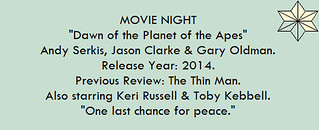
Dawn of the Planet of the Apes.

Review #1888: Dawn of the Planet of the Apes.

Cast: 
Andy Serkis (Caesar), Jason Clarke (Malcolm), Gary Oldman (Dreyfus), Keri Russell (Ellie), Toby Kebbell (Koba), Kodi Smit-McPhee (Alexander), Kirk Acevedo (Carver), Nick Thurston (Blue Eyes), Terry Notary (Rocket), Karin Konoval (Maurice), Judy Greer (Cornelia), Jon Eyez (Foster), and Enrique Murciano (Kemp) Directed by Matt Reeves (#1038 - Cloverfield and #1814 - The Batman)

Review: 
"I think that what I thought was this emotionality and being in the apes kind of inner lives, that's a reason to do this.  Like because you know the ending.  And so now the question is how do we get from here to there?"

I'm sure you remember Ruper Wyatt's Rise of the Planet of the Apes (2011), the first reboot movie involving Planet of the Apes since the last time someone tried to do a new Planet of the Apes ten years prior. With the use of visual effects and performance capture by Weta Digital rather than prosthetics, it certainly made quite the impression in trying to make a new path inspired by Pierre Boulle's 1963 novel Planet of the Apes. Honestly, while I remember Rise being fine, I think I could only tell you that Andy Serkis was the best part to remember, if only because his motion capture performance (and occasional voice) really made the film distinct in not just being a mundane reboot/makeup show (of course, Serkis had considerable experience with capture in the previous years, so that helps). Wyatt did not return for this film, instead being replaced by Matt Reeves, director of films such as Cloverfield (2008) and Let Me In (2010), and the only cast members to return are Serkis, Konoval, and Notary (you may notice those are all performers for apes, and this is the case with the subsequent 2017 sequel). The film was written by Mark Bomback, Rick Jaffa, and Amanda Silver (the latter two wrote Rise and also serve as producers on this film), with Bomback being brought in to do re-writes, as Reeves was not big on the original treatment (post apocalyptic San Francisco...with humans and apes pushing up power lines), favoring fir a story with Caesar at the forefront that spends a good chunk of its first quarter with him before eventually segueing into the "surprise" of human life (since remember that the humans suffered an airborne flu that spread worldwide in the c-sorry, Simian flu).

So yes, there are elements of previous Ape films (such as Battle for the Planet of the Apes (1973), for example), but there is something here that was sorely needed from the shallow or mild foundations seen in the last two features: energy. It has a pacing to it in its presentation of the similarities and differences that come with human and ape life (where you can see some American Sign Language utilized with certain quirks done), one that has an edge in handling the material with a useful main presence with plenty of credibility and presentation to go around. With a more balanced film of actors with and not with motion-capture, Serkis leads the ensemble with commanding presence, one that handles the dilemma present in both apes and humans in the battle of how one treats others (hint: co-existence is easy to say but hard to administer). One looks past the fact that Serkis (and others playing apes) had to act with a bunch of dots around his face and instead sees the talent shown by him in the art of showing dominance alongside conflict. Serkis has managed to evolve the character with his performance that mimics the evolution of the apes in the most fitting of ways, which makes the overall result all the more interesting. The rest keep up okay. Clarke makes a reasonable counterpart to the divide, well-meaning in trust when it is earned in ways that operate in similar fashion to the performance by James Franco in the earlier film (with regards to Caesar) without being a copy, and Russell and Smit-McPhee make okay companions to the human element (well, one is here for folks like the big orange primate, not kids and step parents trying to make friends). Oldman has only a select number of things to really do as a sort of caretaker, since Serkis has the show, but he does prove a useful adversary for what is needed in the long run, which also applies to Kebbell when he is paired against Serkis in terms of pain and aggression. As a whole, it shows plenty of perspective on its inevitable road to ruin. As a movie depicting the brink of war and a demoralized world, it's a pretty solid adventure. It runs through its 130 minutes with careful ambition to make involving drama for a useful epic. It makes most of an effort to stand apart from the number of sci-fi dystopias involving the usual suspects while inviting the question of what could happen next with Ceasar and beyond.

Overall, I give it 8 out of 10 stars.

August 8, 2021

Into the Storm.

Review #1708: Into the Storm.

Cast: 
Richard Armitage (Gary Fuller), Sarah Wayne Callies (Allison Stone), Matt Walsh (Peter "Pete" Moore), Max Deacon (Donnie Fuller), Alycia Debnam-Carey (Kaitlyn Johnston), Nathan Kress (Trey Fuller), Arlen Escarpeta (Daryl Karley), Jeremy Sumpter (Jacob Hodges), Lee Whittaker (Lucas Guerrette), Kyle Davis (Donk), and Jon Reep (Reevis) Directed by Steven Quale.

Review: 
Seven years since its release, there is one question that persists since the release of the film: Hey, remember Twister? Now, maybe that isn't a fair question, because that film (released eighteen years prior) was a dumb movie. Granted, it was a wonderfully dumb spectacle movie, but one will generally remember what they saw out of that film with its "offbeat" characters when paired with the destruction created on screen. Honestly, with the found footage angle, it kind of reminds me of a demo reel for VFX, complete with the bare minimum of personality in the characters. Heck, going around shaking the camera a bit while a disaster happens sounds like something you could do with a bit of liquid courage. Now hey, this isn't exactly a first outing for Quale. A former second unit director, he made his first Hollywood film with Final Destination 5 (2011). 

Look, you know it isn't great, and I know it isn't great. Giving whole paragraphs about why it is such a generic movie would probably waste your time as well as the time that could be spent watching better films. So yes, one could go with the easy out that it is a bland disaster movie that rides all of its chips on the spectacle and nothing else - ah, but could you just watch the movie just for the effects and ignore the rest for 89 minutes? Eh...not really. It tries to balance its two subplots with the bare minimum, and the only thing it succeeds on is with two supporting characters that are played for comic relief. The storm chasing angle isn't even familiar enough to make me go out and compare to Twister, because you won't remember much about it to argue the point, and the family angle is here and there.in all of the slim trimmings; the narrative just can't handle the first-person perspective of the camera, because that stuff only really worked with disaster fare like Cloverfield. This is basically a lesser version of The Blair Witch Project (1999), filled with character you can't care about enough to do anything other than a mild turn on one's face for an expression (i.e., a "hmm" look).  So yeah, the characters are blah and it would be hard for a great actor to make great meat out of it. At least they try, more so for Armitage and Walsh, really. Everyone can basically be summed with a phrase anyway, such as "the one obsessed with work", or "the horny kid", or "the family person needing to go home", "the scrub", and so on. Davis and Reep play the "daredevil" comic relief, and really that seems more interesting to see when it comes to them making dumb videos about it than anything else, if only because it reminds me of when I thought about doing dumb videos for the Internet. Predictability is almost like a protein for this film, one that basically projects what is going to happen before it happens, and it isn't worth the frustrations or too many sentences. The effects are good, but that should always be the case when it comes to the art of creating tornadoes on computers without spending as much as the aforementioned twister film. I guess it depends how much one wants to spend time seeing movie houses and schools get rocked by the wind as opposed to hearing about it on television or from folks in the areas for it (of course, a fire whirl is certainly something I wouldn't want to see...ever). As a whole, if you need an effects show to gaze a bit or something to go to sleep and you don't have Twister, maybe, maybe, maybe this could work; I can't give it a recommendation at all, but I can't despise it very much either.

Overall, I give it 5 out of 10 stars.

February 26, 2021

Selma.

Review #1646: Selma.

Cast: 
David Oyelowo (Martin Luther King, Jr), Tom Wilkinson (Lyndon B. Johnson), Carmen Ejogo (Coretta Scott King), André Holland (Andrew Young), Tessa Thompson (Diane Nash), Giovanni Ribisi (Lee C. White), Lorraine Toussaint (Amelia Boynton Robinson), Stephan James (John Lewis), Wendell Pierce (Hosea Williams), Common (James Bevel), Alessandro Nivola (John Doar), Lakeith Stanfield (Jimmie Lee Jackson), Cuba Gooding Jr. (Fred Gray), Dylan Baker (J. Edgar Hoover), Tim Roth (George Wallace), Oprah Winfrey (Annie Lee Cooper), Ruben Santiago-Hudson (Bayard Rustin), Niecy Nash (Richie Jean Jackson), Colman Domingo (Ralph Abernathy), Omar Dorsey (James Orange), Ledisi Young (Mahalia Jackson), and Trai Byers (James Forman) Directed by Ava DuVernay.

Review: 
"You know, the thing that I was really interested in doing with the film is making King more than a catch phrase, more than a holiday, more than a street name in a black neighborhood, more than a stamp, more than one speech. I mean, I wanted him to be a man, a living, breathing man."

It's interesting to find a new voice for film, particularly when it comes to ones that took their time to march forward with their own stories to tell. Ava DuVernay grew up in California, but during her summer vacations, she would travel down to her father's childhood home in Alabama, near the city of Selma. The experiences spent with her father, who had seen the marches from Selma to Montgomery in 1965, would prove a lasting influence. She studied at the University of California, Los Angeles in English literature and African-American studies, but her first career interest was in journalism. It was not long before she shifted into public relations, for which she would work in for a few years. She made her first venture into film with a 2005 short (Saturday Night Life) before making her first documentary with This Is the Life (2008) and her first theatrical effort with I Will Follow (2010). The film was written originally by Paul Webb, although DuVernay would do uncredited re-writes during production. The original director in mind was Lee Daniels, with Oyelowo (who starred in DuVernay's second film, Middle of Nowhere) having to lobby for years to be considered as star, with intentions of casting Liam Neeson and Robert De Niro as Johnson and Wallace before DuVernay came in.

At any rate, what we have here is a fairly stirring film. It runs on the energy to stir emotion about a story it wants to tell involving a march for freedom that came not from one man but from many that came from various backgrounds with their own parts to play. It is pressure that matters most here, one that shows the drive for the vote as a collective. It is the fury of being counted after years of being stepped on that viewers will likely see through the lens of the present alongside the past, where literacy tests fading away don't mean an easy aftermath. If the accuracy is to be debated, at least one can't say the film doesn't have the vision to look like a crisp period piece, right down to shooting on the Edmund Pettus Bridge. Oyelowo manages to step forward and does well with strength for a tough task at hand with making King out to be more than just an icon heard on old tapes. He carries the film along with calm measured patience, one who we can see as the main face of a movement with no long doubt or thinking of him as just the entire landscape. In other words, what we have is someone with aspirations to go with flaws just like someone you would know without being relegated to biopic sticking points. Wilkinson does just as well on the other side of the film's line of focus, having his own presence of immeasurability, one that mixes with Oyelowo in the struggle for the right to have others be heard going through the game of policy. Ejogo goes well for her part in soothing measurability in time usually spent paired with Oyelowo, a pillar of strength in her own ways that fits well for the first portrayal of C. King on film (Ejogo had played the role 13 years prior in a production for HBO in Boycott, which dealt with the Montgomery bus boycott). Others stick out in their own ways, such as a persevering Holland or with James. Appearances by Stanfield and Roth stay with the viewer after they leave the screen, for varying reasons.

The strange thing that arises from the dialogue might be the fact that I did not realize that King's speeches were actually under copyright, for which that meant the script had to dance around that with re-spinning of dialogue (Dreamworks and Warner Bros at the time had been given a license for those speeches for a biopic...in 2009, and a decade has passed with no biopic). As one might expect from a historical film, there was a bit of wringing with some of its aspects in depicting certain moments, with the debate being discussed probably just as much as the lack of award nominations for the film as a whole. With a moment like Selma that still had some of the players (both in the march and less connected) still alive, this is particularly interesting, such as the statement from Andrew Young, who stated that most of the film was true while having quibbles with the portrayal of the relationship between Johnson and King. Consider the statement made by DuVernay, who felt that she is a storyteller, not a historian when it comes to a film that isn't a documentary. Honestly, sometimes a film can still be great even if it isn't 100% to the point, such as the case with Malcolm X (1992), which had its own omissions and composites within artistic license (Lee's vision of Malcolm X might as well correspond to a statement DuVernay made involving history being interpreted though the lens of one who reads or experiences it). Quibbles over the portrayal of civil rights moments is nothing new, as noted with films such as Mississippi Burning (1988), for example. But hey, does it count for the film if it speaks to things about King's life that I didn't know beforehand (such as Mahalia Jackson being called by him to sing to him)? Maybe it is an indictment of what we know and don't know from studies in school when it comes to folks like James Reeb or with Jimmie Lee Jackson. There may be many Bloody Sundays, but that doesn't mean it is easily forgotten, particularly when it is one that can be seen on your screen with your own eyes. In that sense, the film does fairly well for itself in generating tension and deep curiosity for the events of 1965 in what happened then and what has happened since then, one that organizes itself with flourish in 128 minutes of events and pace that mostly hits the mark. It isn't a perfect film, but it still manages to do well enough for itself in gripping entertainment to pull a punch where it is still needed now.

Next Time: Closing time comes for Black History Month on the movie side, for which we end with Fences.

Overall, I give it 9 out of 10 stars.

October 21, 2020

The Book of Life.


Review #1571: The Book of Life.

Cast: 
Diego Luna (Manolo Sánchez), Zoe Saldana (María Posada), Channing Tatum (Joaquín Mondragon Jr), Ice Cube (The Candle Maker), Ron Perlman (Xibalba), Kate del Castillo (La Muerte), Christina Applegate (Mary Beth), Héctor Elizondo (Carlos Sánchez), Ana de la Reguera (Carmen Sánchez), Danny Trejo (Luis Sánchez), Grey Griffin (Grandma Anita Sanchez), Carlos Alazraqui (General Ramiro Posada / Dali / Chuy), and Plácido Domingo (Jorge Sánchez) Directed by Jorge R. Gutierrez.

Review: 
"From day one, I felt the weight of all of Mexico behind me, but it’s sort of a weight I’m used to carrying. That’s what I’ve always done in my career; I’ve always wanted to showcase my culture"

Mexico has resulted in a variety of filmmakers over the prevailing decades, ones who aspire to get out into the world and make their own projects over time, whether that means in live action or animation. Jorge Gutierrez was born in Mexico City and raised in Tijuana, and he had a clear love of his culture that carried over to his work in animation, which included study at the California Institute of the Arts; his 3D short Carmelo (2000) was a breakthrough in some respects. He did character design alongside writing on a variety of animated series before getting the chance to do his own series with the Adobe Flash-animated El Tigre: The Adventures of Manny Rivera, which ran for one season. Gutierrez developed the idea for this film over the span of a decade, with original plans of optioning at Dreamworks before it fell into the hands of Reel FX Creative Studios (behind features such as Cirque du Soleil: Worlds Away), with 20th Century Fox Animation serving as a fellow producer. Others would join soon after to help produce, such as Guillermo del Toro. He wanted to make sure he made a movie about the culture of Mexico with his own brand of magic, to the point that he mandated that the animation crew not go to Mexico for research, believing that they would only find things that would make a "tourist version of a culture." 

It could be inevitable to think about this film in relation as one of two animated features released worldwide dealing with the Day of the Dead, both involving trips to the underworld alongside trying to avoid being kept under (or worse yet forgotten about), with the other being Coco (2017). One can watch either before the other and still find plenty to find satisfaction with however, regardless of the clear distinct difference in quality. It might seem a bit unfair to pick on this film, because it is a nice looking movie, achieving the basic ambition set out by its director to capture vivid animation within Día de los Muertos (Day of the Dead). Its picking of cast that mixes familiar voices here and abroad do fine in keeping a good head above underworld waters, at least for the most part. Luna does fine with what he is offered, which namely involves a bit of posturing and silly moments. Saldana does alright with balancing some humor involving this main trio, taking charge that surpasses Tatum, who seems a bit miscast in actually lending the right degree of banter to go with the others. Ice Cube fares about as much as one could expect from casting first-time voice acting meant for comedy - decent, but curiously placed in a film that desires something more involving. Perlman and del Castillo do make a fair pair together, while Applegate tells the story with patient timing. The others are alright, but one basically tries to lose themselves in the animation before being reminded of a silly joke or songs that come along for the ride, which again could have worked with more original songs. It has nice designs at times (such as with La Muerte), and a case could be made that it doesn't overstay its welcome at 95 minutes, and that will surely be more than enough for some. It is the structure that comes from the film in trying to have both a world of creative whimsy and ties with clichés from other films of its ilk that clouds the overall result, particularly when it comes to its unnecessary singing to tell new threads in an old-fashioned fable that could do with more mystery and less wringing overall (telling the story to an audience is one thing, literally showing an audience of kids being told this is another), which goes down from overcoming fears and achieving your own distinct destiny and yada yada yada you know where it's going from there. Ice cream can come in many flavors, but if you find it a bit runny, it isn't going to make the result better than the ice cream truck down the road. I thought the film was fine when it stuck to depicting a view upon a culture that Gutierrez obviously has a passion for with charm and vibrant nature, and if that seems more than enough for young audiences, it likely will hit the note needed for a watch. It isn't anything great, but it suits the basic needs for those who desire said enjoyment from a fable of old and new cloth.

Overall, I give it 7 out of 10 stars.

Birdman.


Review #1570: Birdman or (The Unexpected Virtue of Ignorance).

Cast:

Michael Keaton (Riggan Thomson), Zach Galifianakis (Jake), Edward Norton (Mike Shiner), Andrea Riseborough (Laura Alburn), Amy Ryan (Sylvia), Emma Stone (Sam Thomson), Naomi Watts (Lesley Truman), Lindsay Duncan (Tabitha Dickinson), Merritt Wever (Annie), Jeremy Shamos (Ralph), and Benjamin Kanes (Young Riggan / Birdman) Directed by Alejandro G. Iñárritu.

Review:

"I have always said that innocence is much more powerful than experience. And, in some cases, people who suddenly fall into circumstances can unexpectedly bring some virtue to them—that’s kind of the case with this character."

"It’s rare that you get to be part of some amazing experiment like this. The movie gets dark and gets weird, and it gets funny. So you’re constantly on this surfboard, kind of feeling it out. I like that. I just like seeing if I can do it.”

Filmmakers have had a variety of experiences that shape who they are that can go beyond just being shaped by cinema. For one, they can be shaped by their life experiences, as is the case for Alejandro G. Iñárritu. Born in Mexico City as the youngest of seven siblings, he was shaped by his travels made on cargo boats as a teenager (having struggled with studies in high school), which took abroad across America and Europe. He returned back to his country to study communications at Universidad Iberoamericana. He got himself into working for radio at WFM as a rock music radio host, which led to making promos and eventually transitioning into work with his own production company in Z Films, which dealt with shorts and advertisements. Iñárritu made his feature debut with Amores perros (2000), which served as the first film of a trilogy involving death and multiple storylines that would have writing from him and Guillermo Arriaga. This was his fifth feature film. It started as making a comedy in a single shot in a theatre (that developed over the span of a couple of years), done not only because of a desire to do a comedy over another drama but also because of his belief in that one lives their life with no editing, where one could be taken in by "an inescapable reality" just like the protagonist (there had been quite a few movies that were meant to play out in real time, most notably with Rope in 1948). Iñárritu, in addition to direction also co-produced the film and co-wrote it with Nicolás Giacobone, Alexander Dinelaris, Jr, and Armando Bó, who wrote the film for a period of nearly two years while working together through Skype and e-mails. Each of them, along with cinematographer Emmanuel Lubezki, would win Academy Awards for their work with this film, which seems aptly appropriate.

What, a gimmick utilized to tell an interesting story that garnered attention in 2014? Anything is possible when you start with a man levitating while in his underwear. Ultimately, the enjoyment of the film relies on how much one absorbs themselves into a film that might resemble in some ways Don Quixote in its disparity between expectation and reality when it comes to who we think we are as a person, particularly in ego. When it comes to acting, that is never more true, since they are having to be someone different from themselves in a desire to be approved and so on and so forth with insecurities to list. One will either be swept away by how entertaining it proves in its execution to go alongside its elements of black comedy and drama or they will find a curiously strange experiment that lives and dies on its level of satire and fateful ending. For me, I found it to be an intriguing two hour experience, one that is a clear achievement for Iñárritu and Lubezki that moves with seamless ambition and wry enjoyment that benefits from a worthwhile cast to serve as a worthwhile film to encapsulate capable filmmaking for the 2010s. Keaton, picked by Iñárritu after he had finished the script for his ability to bring "meta-dialogue between the film and the reality", is exquisite. He manages to do so well in capturing a man wrapped in crisis over what it means to live a life wrapped in either past glories or current pursuits to find meaning within ignorance - in other words, it is one of Keaton's best performances, crafted well in anxiety that grabs one early and never loses footing in competence because we never think it is just self-aggrandizing. The rest of the group do quite well in going along with the show in terms of well-placed charm or timing, as is the case with Galifianakis or Norton, who both are quite funny in what the film requires in either wry sensitivity or self-important confidence, respectively. Riseborough and Ryan also prove useful in lending layers to outside the theater, while Stone serves as a useful bridge between a testy act with Keaton alongside her own testy grasp of her struggles. Watts and Duncan round out the cast handily for a film that builds itself up on sharp little moments between each other without being fitted into any tight cliché square or all-the-way wrapped up narratives. On the whole, I found it to be an enjoyable and curious film, balancing its act of magic realism with efficiency that tells a worthwhile feature of ego and virtue with maturity that will lend itself well to more than one viewing (particularly with its ending) to appreciate the detail that goes into a worthwhile feature of excellence and curiosity.

Overall, I give it 10 out of 10 stars.

October 20, 2020

Edge of Tomorrow.

Review #1569: Edge of Tomorrow.

Cast:

Tom Cruise (Major William Cage), Emily Blunt (Sergeant Rita Vrataski), Bill Paxton (Master Sergeant Farell), Brendan Gleeson (General Brigham), Noah Taylor (Dr. Noah Carter), Jonas Armstrong (Skinner), Tony Way (Kimmel), Kick Gurry (Griff), Charlotte Riley (Nance), Franz Drameh (Ford), Dragomir Mrsic (Kuntz), and Masayoshi Haneda (Takeda) Directed by Doug Liman (#1064 - Jumper (2008) and #1256 - Mr. & Mrs. Smith)

Review:

"I never want to repeat myself. I can’t imagine anything else as upsetting as realizing I’m redoing something I did before. For some reason, when it comes to film, I’m very good at not repeating myself. Even though in the rest of my life, I’m constantly repeating my mistakes."

It is a strange thing to note this as one of Doug Liman's best features, since he has made a steady career for himself over nearly three decades of work, primarily in action or comedy. The son of a painter and a lawyer, Liman found himself interested in film at a young age, which led to study at the International Center of Photography and Brown University before studying at the University of Southern California and their school of Cinematic Arts. He started with small-scale features that resulted in notice such as Swingers (1996) before moving on to bigger budgets with The Bourne Identity (2002) and other various features. The film is adapted from a Japanese sci-fi novel named All You Need Is Kill, written by Hiroshi Sakurazaka and illustrated by Yoshitoshi ABe originally published in 2004, with subsequent adaptation into manga and graphic novel; one can only imagine how they might find inspiration from playing a video game and dying over again and make their own story from that, as was the case of inspiration for Sakurazaka. The film (which Warner Brothers mandated have their title rather than the title of the novel or Liman's preference for the tagline as the title) had gestated in pre-production for years, starting with a spec script done by Dante Harper in 2010, although this would be discarded for reworking by other writers such as Joby Harold. Before filming started, Harper's script was mostly discarded by Liman, and the resulting screenplay that eventually came out was done by Christopher McQuarrie, Jez Butterworth and John-Henry Butterworth (which did not have a set ending at first).

What an interesting time one could spend with this film. It is a neat little action film, finding an edge in terms of making repetition involving action come across as useful entertainment with amusement. Is it more than just "Groundhog Day (1993) but with killing aliens"? In parts, sure. It proves to be a fun one, particularly for those who desire some sci-fi thrills with a light story that is right to follow along with for 113 minutes without becoming stuck in a loop. Cruise does fairly well with this role, one that invites curiosity for the challenges needed in playing a hero who has to fail over and over again and grow with the feature in capability and charm. Blunt proves efficient here, just as capable in handling action without hitting a false note, who makes her time of tough heroism roll along with guidance with enjoyment that never wavers from our attention once properly introduced to us. In other words, they make for a good team together in beat-by-beat training. Paxton and Gleeson make up useful support, generating some wry amusement when Cruise shares the screen with either of them (since each seem right at home with action fare like this). Taylor and the others do fine in parts, since the main threat is making sure to handle bulky suits and effects-driven adversaries, which is useful to follow along with. The ending does fine for what is needed in closing the loop for an action film without short-changing itself too much, relying on its effects to carry through without being too murky or unclear to follow (although novel fans will note its clear departure with its ending). The film was a modest success for its lofty budget (because one needs to spend over $100 million for either action movies or in marketing), and it isn't hard to appreciate the film as a useful example of an action movie that bets on itself in captivating the audience with flair and a degree of intelligence to it. In any case, there are supposedly plans to do another film (called Live Die Repeat and Repeat, because words fail me), but who knows how intriguing that could be? As a whole, while it certainly seems more polished for its first half over the second, it generally works out well in capturing the challenge of trying to make a breezy film with thrills that weaves a decently conceived idea together with a useful cast and visuals to go alongside it for a useful time to have time and time again.

Overall, I give it 8 out of 10 stars.

October 19, 2020

Boyhood.

Review #1568: Boyhood.

Cast:

Ellar Coltrane (Mason Evans Jr), Patricia Arquette (Olivia), Ethan Hawke (Mason Evans Sr), Lorelei Linklater (Samantha Evans), Libby Villari (Catherine), Marco Perella (Bill Welbrock), Brad Hawkins (Jim), Jamie Howard (Mindy Welbrock), Andrew Villarreal (Randy Welbrock), Jenni Tooley (Annie), Richard Andrew Jones (Annie's father), Karen Jones (Annie's mother), Bill Wise (Steve Evans), Zoe Graham (Sheena), and Charlie Sexton (Jimmy) Written and Directed by Richard Linklater (#645 - School of Rock, #1138 - Dazed and Confused, and #1206 - Bernie)

Review:

"It had been growing in me in ’99 and 2000. I’d been a dad for a while and seeing a kid growing up is a very intense thing. It made me think, ‘What about my childhood? What is childhood? Maybe I’ll make a film about childhood.’ But I was frustrated because I couldn’t pick a moment. It became a storytelling challenge and I’d almost given up, and then in 2001 the idea hit me in one big moment: We’ll film a little bit every year.”

It makes sense for a Texan to have made a variety of his films involving his home state in some form or another, so it should prove no surprise to see Richard Linklater with a distinct film to display his canvas of cinema again. The Houston native was involved in sports from a young age that led to a scholarship at Sam Houston State for baseball before moving back to work on an offshore oil rig. During those years on the rig, he found himself interested in film through watching them at the theaters. He would start venturing into his own moviemaking by buying his own Super-8 film camera and did his own short films. He made his first feature with the camera with It's Impossible to Learn to Plow by Reading Books (1988), a minimalist movie that he handled all the production duties that never had a wide release. His next feature proved to be an indie standout in Slacker (1990), which he wrote/produced/starred in that achieved attention and profit made despite a small release that dealt with misfits in Austin, Texas. Over the course of three decades, Linklater has made a variety of films with distinguishing features, whether that involves a relationship over the years in the Before trilogy (1995, 2004, 2013) or films involving animation like Waking Life (2001).

Someday, there might be a time when a Linklater film really resonates with me and seems ambitious enough to actually accomplish what it sets out to do for a true classic. It is good film, no question about that, one that is unique for its filming over the course of twelve years that follows a growth from child to teenager in all the bumps and rolls. Oh sure, the adults at every turn find ways to interact with our main star in their lectures with him about what he is supposed to be (whether as a kid doing homework or a cleaner doing his job), and it is this sense that he perhaps becomes someone reminiscent of the pathway presented in Dazed and Confused (1993) in being oneself in their own life. Of course that presents a strange little problem: that film was unbelievably average, and this film is just above average in what really matters in the end in what was described by Hawke as “human time-lapse photography". The film wants to play its game of highlighting the little moments between things that make a person's life rather than just being aligned on the big milestones (good or bad) to try and be documentary realism with the drama of ordinary life in a movie. If this reminded me of anything, it reminds me of a documentary series I look up every so often in curiosity despite never seeing it: The Up series, which has followed the lives of a group of children from when they were 7 that started in 1964 that checks up on them every seven years. Not every child brought in for that project has continued on to that project, but this is a different story in filming people over and over again without being obligated to do it under contract (since one can't contract someone for that long of work), and a script wasn't even finished before filming began, aside from a few contracted points of plot for each character that would segue into writing the script for each year of filming after seeing/doing the previous year's footage. Sure, you could make a story based on the idea of talking about the little victories/losses between the main procession of life without the supposed clichés that come from it, but I don't really buy that as really all that refreshing. If I filmed fifteen minutes of a one day and then returned to do the process again the next year for fifteen years and brushed aside key moments (like moments with finance or moments with friends outside, whichever sounds more believable), could one just wave their hands at that and say "look upon this and how it depicts LIFE!" - by that point, we are getting ourselves into subjective desires for what makes a good story worth following. I liked most what I saw, achieving most of its lofty goals through a long pace of 165 minutes that could prove an interesting starting point on one's patience - so here we are.

Coltrane was six years old when he was cast for a project like no other for an actor. It is the journey that counts in seeing his evolution play out on screen from innocence boyhood to making his step into the real world. Do I relate to all of his journey? In parts, I do, but at least Coltrane can be given credit for making this journey at least seem more than a series of vignettes (although one almost wonders if it was almost more suited for the progression of television). With actors like Hawke and Arquette playing parents in the film, it is nice to look upon the contrast and presence each bring to the feature and highlight their qualities (which to me works out better in observation for the former than the latter, although it is more about preference rather than saying one has more "fun" scenes), even if listing them as "support" when it came to awards season is a bit dubious (because if there are no parents here, we would have an entirely different film, estranged from the "ordinary" Boyhood). There is just something appealing about the feckless charm shown by Hawke here, one whose differences in being a figure to his children that pops in from time to time proves his worth in moving forward with strong will and humor that shines with Coltrane in those moments together, particularly for the last one at the gig venue that might as well have been the last sequence. Arquette does fine with gravitating the expectations and hopes that come from primary care of maintaining all the pressures of family and beyond, the unwavering presence in the storm of ambitions and life passing by, which I suppose makes it all worth that last scene with Coltrane. L. Linklater (daughter of R. Linklater) is fine, in the same way that she has her own bit of growth over the years that come across in the film with a set point to rest on. Others are there to serve as markers for where one is in the story, whether that involves a brash Perella or Hawkins, for better or worse when it comes to relevance. Maybe it all plays into the idea that narratives in life don't have to end in a neat little bow, and that might prove worthy for those who get into what the film is selling as a portrait of life in the margins. I don't know, I just think that's a bit convenient, since it ends on a line about the moment seizing oneself rather than the other way around - a slacker moment to roll the eyes with for a film that will either prove profound or otherwise for viewers. If you find yourself dazzled by what the film brings to the table in a 12-year tale involving a particular vision of what it means to grow up from a director who has liked to make distinct movies of story, all power to you. For me, it is good, but not quite a great feature that shows some flickering interest in where it could go in its vision and the occasional response it can generate involving childhood experiences with a decent cast to back it up.

Overall, I give it 8 out of 10 stars.