Showing posts with label George Lucas. Show all posts

September 23, 2021

THX 1138.

Review #1725: THX 1138.

Cast: 
Robert Duvall (THX 1138), Donald Pleasence (SEN 5241), Maggie McOmie (LUH 3417), Don Pedro Colley (SRT 5752), Ian Wolfe (PTO), Marshall Efron (TWA), Sid Haig (NCH), John Pearce (DWY), and James Wheaton (Voice of OMM 0000) Directed by George Lucas (#113 - Star Wars, #141 - American Graffiti, #142 - Star Wars: Episode I – The Phantom Menace, #143 - Star Wars: Episode II – Attack of the Clones, and #144 - Star Wars: Episode III – Revenge of the Sith)

Review: 
A half century later, there are quite a few things to unpack with this particular movie. For one, it was the feature film debut for George Lucas. As one must remember, the California native grew up with an appreciation for comics and science fiction (take note of the clips shown in the opening of the film), and this would serve him quite well when he entered the University of Southern California and its school of Cinematic Arts; he cited educators Lester Novros and Slavko Vorkapich (chair of the school) as influences on Lucas, who made numerous short movies as a filmmaker that were fairly abstract (ranging from a minute to seven, with only one having a narrative). He graduated with a bachelor's degree in fine arts in 1967, but his time spent with USC did not end there, as he went back as a graduate student in film production, with one of his duties being to teach students of the United States Navy that were studying documentary cinematography and working under Verna Fields in editing movies for the United States Information Agency (Fields would later edit a number of features for fellow USC filmmakers as a pioneer in her own right). In total, Lucas made nine short features from 1965 to 1968; the one that matters most to this discussion is his sixth in Electronic Labyrinth: THX 1138 4EB, made in the course of 12 weeks in 1967. He had an idea for a future film with existing stuff utilized for said future, and he tasked his friend (and fellow USC student) Matthew Robbins to write a brief outline involving the THX character and a chase scene. He utilized the Navy connection to helpful effect, since Navy folks served as crew for the movie while helping him get access for various locations to shoot. The result was a movie that won 1st prize at the National Student Film Festival in the Dramatic category. Later on, Francis Ford Coppola (fresh off Finian's Rainbow) helped Lucas with a deal to make a feature film with Warner Bros.-Seven Arts (co-produced with American Zoetrope, which Coppola and Lucas founded in 1969), and Lucas made the feature over the course of five weeks in the fall of 1969. A year was then spent in the editing room by Lucas and Walter Murch (who each wrote the movie). If you can believe it, studio executives did not appreciate what they saw of the final workprint, and they requested an edit to be done within the studio, which took out four minutes from the final edit. Made on a budget of $777,777, the movie was a mild success on initial release (making its budget back plus $122K).

I'm sure you are aware of the story that comes from a movie dedicated to the illusions of safety and order within a closed-off society filled with restrictions and watchful eyes everywhere. In fact, I know you have, because there have been a handful of books and movies that have run on similar lines for decades, such as George Orwell's Nineteen Eighty-Four or Aldous Huxley's Brave New World, for example. Of course, we are talking about a movie with Chapperell race cars modified to look like jet cars. We are also talking about a movie that seems quite curious to talk about when thinking about Lucas as a filmmaker given what would come later in the decade, and yet it is the key piece in trying to understand what he aspired to do as a maverick filmmaker in terms of visual storytelling (along with his intent to not have studios try to control the production of his movies). Perhaps it was fate that a bleak movie involving the pitfalls of consumerism and conformity took its own path to reaching audiences. It likely seems more fitting of its decade than with the next two films Lucas directed, that might be for sure, which might seem a bit off-putting for those who come in completely cold for this sci-fi movie. Of course this isn't quite a movie one watches for acting chops; in an interview, Colley noted that Lucas seemed to not be too comfortable around actors, treating the production as like one of his student films (perhaps ironically, an actor in one his future movies would say something fairly similar years later); certainly it is an interesting sight to see a group of shaved actors amidst a crowd of other voices, and Duvall certainly does fine a role that requires a bit of a blank slate sparked into breaking out of obedience into ordinariness. Pleasance, gripping in confined obedience that drips of pathetic ooze within certain pieces of dialogue, matches fine with what is required from someone dealing in the middle of a society without any choices, where fear of the unknown can be a powerful deterrent (and easily identifiable). McOmie (in her one and only film as star) is used for poignant moments with attempts at breaking free with a sense of emotion that can be construed as fear with a bit of warmth waiting to break free. Colley proves curious in those moments seen on screen within the prison sequence, one in the middle between comfort and curiosity in the angle of finding a way out. The movie relies on visual interest within a dystopia where prisons have no walls, kids have IV lines for economics in their veins, and people like to take substances to curb their emotions as they work under jobs that are terribly dangerous (factories even announce the death tolls of the period in an attempt to promote safety); when not working, people just buy things without much thought while watching odd holograms. The robot policeman are the only visual adversary one sees, since you never actually see just who is in control, knowing only that set budgets are set for the capture of anyone who tries to escape. It is mostly a visual movie, which is interesting to see when most of the stuff is white (clothing, bald hair, et cetera) but certainly not the easiest film to sit through in its versions; the movie was restored in 1977 with an 86 minute run-time that restored the four cut minutes on the original release that was later put out on VHS and LaserDisc, while a Director's Cut was supervised by Lucas in 2004 that restored the film on an audio/video level while adding a few bits of computer generated imagery (along with adding detail to certain sequences) that resulted in a run-time of 88 minutes (in fact, one can apparently watch it with just the sound effects and score present with no dialogue, if one is into that sort of thing). Perhaps the easiest parallel in terms of a student film being turned into a movie for effect is Dark Star (released three years later...by sheer coincidence, it was made by a USC alum and included a reference to this movie), where it might have reached better as just a student film; regardless, I thought this movie was interesting in the right parts to work in generating a curious bleak world in imagery that leaves more for thought rather than thrills. It isn't a great achievement in originality with its story, but it does prove diverting in visual nature with the right kind of curiosity to make it worthwhile to overcome its shortfalls and work out fine, one that certainly merits attention as a cult classic, one that is just odd enough and interesting enough to win out.

Overall, I give it 8 out of 10 stars.

May 22, 2019

Redux: Star Wars: Episode III – Revenge of the Sith.


Redux Review #144: Star Wars: Episode III – Revenge of the Sith.

Cast: 
Ewan McGregor (Obi-Wan Kenobi), Natalie Portman (Senator Padmé Amidala), Hayden Christensen (Anakin Skywalker), Ian McDiarmid (Supreme Chancellor Palpatine), Samuel L. Jackson (Mace Windu), Frank Oz (Yoda), Anthony Daniels (C-3PO), Kenny Baker (R2-D2), Christopher Lee (Count Dooku / Darth Tyranus), Jimmy Smits (Senator Bail Organa), Matthew Wood (General Grievous), Silas Carson (Ki-Adi-Mundi / Nute Gunray), Temuera Morrison (Commander Cody), and Peter Mayhew (Chewbacca) Written and Directed by George Lucas (#113 - Star Wars, #141 - American Graffiti, #142 - Star Wars: Episode I – The Phantom Menace, and #143 - Star Wars: Episode II – Attack of the Clones)

Review: 
Countdown to 150 Reviews: 10, 9, 8, 7, 6...
At last, the end. The best of the bunch of prequels gets what I hope to live up to with the standard review, especially a redux - even if is more a blend of praise and slight criticism this time around. Enjoy.

Admittedly, finishing a trilogy can prove daunting, particularly when it is the culmination of a saga of a character as memorable as Darth Vader. This time around, there actually seems to be a real emphasis on making a tragedy alongside being entertainment. There are plenty of spectacle sequences along with a bit of depth - while also still having things to make light of. It isn't as inconsistent as the other two films, managing to find a heart of darkness that does seem to make this trilogy mostly worth it. For one thing, I actually seemed interested to view Anakin on screen beyond just lightsaber dueling. Sure, he always seemed to have problems with impulsiveness, anger issues, jealousy - and occasional lapses into ridiculous line reads. Christensen still struggles at times with the clunkier aspects of the dialogue at times - such as when he nonchalantly says to his wife that she'll die in childbirth. He shines best when conversing with McGregor or McDiarmid more so than Portman, who mostly is around just to linger in one set at a time without as much to really do. Their chemistry together isn't really too great, middling above teenage lyric posts on the Internet. McGregor proves efficient as ever, filling the noble roots set by Alec Guinness and completing the circle with charm. McDiarmid takes his time to go the ham of an actor on stage set by himself with Return of the Jedi (1983) - and I enjoy it just the same. Instead of being a phantom menace (pardon the pun) to the events around him, now he gets to be involved with actual fights, complete with snarls and cackles. Jackson gets something to do (and say), which I do enjoy when it comes to the film's key point for its first hour. Oz keeps the interest flowing as expected. Naturally, Lee is given four lines, disposed as quickly as expected from a trilogy that likes to jump from adversary to adversary before allowing its true puppet master to try and shine through. I would say that it might have been more interesting to have one villain throughout a whole trilogy before being disposed of (ignoring any sort of middle ground television show, of course) - but we're past that point of complaints, I guess. Smits is fairly serviceable; Wood is okay as a mediocre threat, which is quite the thing to say about a cyborg with four arms. Once the film disposes with the pretense of trying to build paper threats and actually showcases the true threat and Anakin's descent is when the film really does become an actual winner, complete with a worthy climax to alongside it.

I had forgotten to mention John Williams and his music score throughout these films, which it goes without saying are pretty well, but it really does shine here with the mood and pacing throughout the movie here, such as the aforementioned climax but also subtle moments such as the rumination sequence, where it carries a 90-second moment that shows off on a visual level with effective choice in composition. It isn't a perfect film by any means. It still meanders with wooden dialogue on occasion, while also feeling a bit too ridiculous with its justifications for Padme's fate (losing the will to live being a thing only a robot doctor would assume, I guess), but at least there is an actual sense of adventure present without being completely lost in a virtual screen. Sure, it does try to be a bit tidy with its ending, trying to seal things up with plenty of connections to before (much in the same vein that the other two had done), which does seem a bit overboard - but at least it sure has a well-done last shot to close on. Revenge of the Sith strives for a glut of action and story in a 140 minute run-time with plenty of drive and spectacle, managing to succeed on the last go on the prequel merry-go-round with very little in terms of hitches to interrupt the ride.

Overall, I give it 8 out of 10 stars.

May 21, 2019

Redux: Star Wars: Episode II – Attack of the Clones.


Redux Review #143: Star Wars: Episode II – Attack of the Clones.

Cast: 
Ewan McGregor (Obi-Wan Kenobi), Hayden Christensen (Anakin Skywalker), Natalie Portman (Senator Padmé Amidala), Ian McDiarmid (Chancellor Palpatine), Christopher Lee (Count Dooku / Darth Tyranus), Samuel L. Jackson (Mace Windu), Temuera Morrison (Jango Fett), Frank Oz (Yoda), Anthony Daniels (C-3PO), Kenny Baker (R2-D2), Daniel Logan (Boba Fett), Leeanna Walsman (Zam Wesell), Silas Carson (Nute Gunray and Ki-Adi-Mundi), Ahmed Best (Delegate Jar Jar Binks), and Jimmy Smits (Bail Organa) Directed by George Lucas (#113 - Star Wars, #141 - American Graffiti, and #142 - Star Wars: Episode I – The Phantom Menace)

Review: 
Countdown to 150 Reviews, 10, 9, 8, 7...
As promised, a redux of the second prequel film. I described it as better than the first film, but not by much, and not much really does change, does it? At least these are reviews I can feel proud of, which I hope you enjoy.

These films, if distilled into a basic premise of the portrayal of the rise and fall of Anakin Skywalker, from adolescence to adulthood, could have made for some weird and wonderful tragic drama. The first film proved that trying to cover details from the past mixed with ill-advised story choices made for a film that collapsed under its own weight of hubris and anticipation from others. The only thing that changes this time around is that the anticipation is more of a dead calm, and the film manages to find time for improvement at the pace of a snail. While Lucas once again served as director and writer, Jonathan Hales was brought in to help co-write for the film, refining the script until right before production was to begin. The dialogue can't quite help the actors out again, a villain is introduced and wasted once again, and story motivations seem more appropriate for an opening film than a middle movie. You really could skip the previous movie and not really lose too much grip on the story, since you could basically sum up key events in one line or less. As I mentioned earlier, having to switch actors for your main character doesn't help matters, especially since the dynamic between McGregor and Christensen only really comes into focus on occasion. In trying to make a grander, more epic scale Star Wars with plenty of plot-lines, Lucas has succeeded in making two mediocre movies to drive his trilogy, finally finding some sense of focus by the time of its climax, with its Clone Wars aspect.

The film builds itself on the blooming relationship dynamic between Christensen and Portman's characters, having the passion of lines spoke by a computer program. A film romance works best when it actually seems the actors are truly invested in what the script wants them to say. The previous trilogy had a romance that was subtle without being overbearing in the slightest. Lucas wanted something more than just a scoundrel and a princess - a forbidden romance with a Jedi involved. Again, this works best when I actually feel that these actors really seem invested in what they want to do, and it slowly rises from slightly weird to slightly palpable, but that isn't enough in a film that plods along for 142 minutes. The acting still plays hit-and-miss, but McGregor and McDiarmid do turn out to be the key winners of the bunch, the former seeming much more interesting to be around with this time around - whether when bantering with Christensen like an odd couple or in battle, and the latter being as conniving as ever. Christensen doesn't fare too well with such a big role to fill as the eventual Darth Vader, feeling a bit too flat and occasionally grating, falling into the same trap as Lloyd had with being stuck with offbeat lines that make a shadow of a character. Portman is okay, but not too particularly inspired as the other side of the token, faring a bit better when running onto an action set than on some grass trying to talk about politics. Highlights include complaints about sand, attempts at humor that go hit-and-miss, and eventual action sequences on dusty planets that can't help but be like cutscenes once again. Lee is criminally wasted as the main adversary behind the true power, a character cut from bare cloth that isn't too particularly menacing, even with a legend like Lee. The fight with him and Yoda is amusing to picture and weirder to try and describe, since it's a CGI muppet against a mix of Lee (then in his late seventies) and a stunt double. Morrison is quiet, but alright for the necessary time needed. Jackson and Oz are given a few lines to carry, so that's a nice repeat of before I guess. The action sequences here doesn't seem as involving as one would hope, and the political drama is only slightly less pale this time around. The question isn't so much if this is a better film than the previous one as is it really a question of how it took so long to drive the story to some sort of meaningfulness. Lost in a shroud of effects, flashy costumes, and questionable motivations, Attack of the Clones is a mediocre sequel to a mediocre movie that is made lesser by comparisons of past and future of Star Wars films. I wasn't exactly bored by what I saw - I just felt much of the same mood that I did the last time.

Overall, I give it 6 out of 10 stars.

May 20, 2019

Redux: Star Wars: Episode I – The Phantom Menace.


Redux Review #142: Star Wars: Episode I – The Phantom Menace.

Cast: 
Liam Neeson (Qui-Gon Jinn), Ewan McGregor (Obi-Wan Kenobi), Natalie Portman (Queen Padmé Amidala), Jake Lloyd (Anakin Skywalker), Ian McDiarmid (Senator Palpatine / Darth Sidious), Anthony Daniels (C-3PO), Kenny Baker (R2-D2), Pernilla August (Shmi Skywalker), Frank Oz (Yoda), Ahmed Best (Jar Jar Binks), Oliver Ford Davies (Sio Bibble), Hugh Quarshie (Captain Panaka), Samuel L. Jackson (Mace Windu), Ray Park (Darth Maul, voiced by Peter Serafinowicz), Terence Stamp (Supreme Chancellor Finis Valorum), Keira Knightley (Sabé), Silas Carson (Nute Gunray), Brian Blessed (Boss Nass), Andy Secombe (Watto), and Lewis MacLeod (Sebulba) Written and Directed by George Lucas (#113 - Star Wars and #141 - American Graffiti)

Review: 
Countdown to 150 Reviews, 10, 9, 8...
Well, it has now been 20 years since the release of this film, the first of the three Star Wars prequel films. Fans may remember the revised editions of the Original Trilogy reviews (originally published 3/30-4/1, 2012) back in 2016, in light of Star Wars: The Force Awakens being released months earlier. I figured it was time to revise some admittedly okay reviews (original publish date of 5/19-5/20, 2012) right before Star Wars: The Rise of Skywalker comes out. I hope you enjoy these reduxes. 

Review: 
It goes without saying that Star Wars is one of the biggest media franchises of pop culture. It has transcended film, television, and beyond over the decades - the original trilogy is still beloved by many, whether from people who seeked it out upon original release or found it playing somewhere on their screen in the present day. Return of the Jedi was the last of these films for 16 years, with Lucas not being inspired to do further films of his saga until the advent of CGI led him to believe it could help him do what he felt was needed. The result proved polarizing, especially in the age of a growing Internet - and age doesn't really help make this film seem too much better. This is a film that bears more on spectacle and details than a fully developed adventure. Perhaps Lucas fared best when he had at least one other writer trying to guide story ideas into something more than just an assortment of old arch-types and myths. The space opera has now shifted into one with mixes of action and politics - which makes for a somewhat stilted result. Like before, there are plenty of creatures and worlds to look at, even if it seems a bit less involving to stick for. I appreciate the effects for what they try to deliver, since they hold up well for 1999 - but wondering what is a blue/green screen and what isn't does get a bit distracting sometimes. The story seems spread too thinly, distracted over whether to be a movie about the Republic or Anakin, spending too much time to really drive itself forward. To say nothing of the logistics of electing a queen at 14, or midichlorians (which is still something to ridicule even with the dawn of a further trilogy), or referencing things from the previous films (did you know who built C-3PO? Weird, I know), and so on. Making fun of these aspects is more interesting to do while watching the film rather than spend a paragraph writing, one must say. The film does fine with spectacle pieces like the pod race sequence or the Darth Maul duel, but the former verges on meandering and the latter is nearly distracted from its other battle at the same time to have the right impact. With all of these characters (new and familiar), only a select group seem truly necessary, but the dialogue doesn't give them many favors. The trilogy is meant to be a tragedy of Anakin Skywalker, and yet the first film can't really plant many seeds to make that start to bloom, perhaps since the initial focus is on a kid (after all, Lucas moved his age from initially being 12 to 9 to try and fit the effect of him separating from his mother better). It didn't need to be a rehash with him being a young adult like Luke, but Lloyd is fledged with an unenviable task of playing an eventual Darth Vader in only one go. Having just one actor (and a change in pace, no less) for three films might have made them roll with more impact - at least we would have been spared a kid Anakin asking someone if they are an angel.

In a sea of interesting acting choices, it should only prove fair to have them seem routine behind some sets and screens. Neeson seems a bit too pallid to evoke much drama, with his final fate not having as much impact as it likely could have. McGregor doesn't quite have his familiar role pinned down here, and the lack of a dynamic between him and his future student in Anakin doesn't help much. Portman is hindered more by a ridiculous decoy plot than anything, but at least she does make some sort of curious impression. Lloyd doesn't quite have the conviction to make this role work, but how can anyone turn dialogue such as "Now this is podracing" really work (while being on a starfighter - long story) without ridicule? Any time with him and Portman is just weird in general. McDiarmid does well with playing the subtle kingmaker of his own doing without hitting a snag. August is quietly effective, even when occasionally lost in the spectacle background. Best plays a role that Buster Keaton would likely laughed off as too clownish with effort - it may not work out well, but at least he isn't the only fault present. The others (including a criminally underused Stamp) are pretty forgettable, and Darth Maul proves to be a fair but not too inspiring threat. Obviously the real threat is supposed to be the bigger one to look into (even if you already know who said threat is), but it only served to make for a trilogy of cut-scene quality adversaries. The droids don't prove too imposing, either, just big stick-looking things to fill the screen. By the time it gets to its climatic battle sequences, it proves to be a glut of overload, though the Maul fight is a bit nice. At least the lightsaber fights stick out for their attempts at finesse. In the end, the movie is a mish-mash of old story types, a dash of hubris, and ultimately something ridiculous to behold for each generation of fans, old and new. Some can rush to defend it for its quirks, and I understand that basis all the same - to me, this is an average adventure compounded as a disappointing Star Wars film.

Overall, I give it 6 out of 10 stars.

March 30, 2016

Redux - Special Edition: Star Wars (1977).


Review Special Edition: #113: Star Wars.

Cast
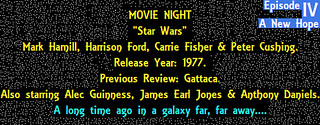
Mark Hamill (Luke Skywalker), Harrison Ford (Han Solo), Carrie Fisher (Princess Leia Organa), Peter Cushing (Grand Moff Tarkin), Alec Guinness (Obi-Wan Kenobi), David Prowse (Darth Vader (voiced by James Earl Jones), Anthony Daniels (C-3PO), Kenny Baker (R2-D2), Peter Mayhew (Chewbacca), Phil Brown (Owen Lars), Shelagh Fraser (Beru Lars), Jack Purvis (Chief Jawa), Denis Lawson (Wedge Antilles), and Garrick Hagon (Biggs Darklighter) Directed by George Lucas.

Review
In my original review (#113 - March 30, 2012), I had given the movie a 10/10 rating, and while I stand by the rating, I regretted not saying more about the movie. I barely mentioned the acting at all, among other aspects that I should have talked more about. Because of this, I decided to finally make a Redux Review (which I had done for A Christmas Story, Halloween, Licence to Kill, and On Her Majesty's Secret Service). Enjoy this "Special Edition" version, if you will. 

Star Wars (also referred to as A New Hope) is a mythical tale that has entertained audiences all around the world for over 40 years, and the scope of its influence on cinema (and filmmakers) can't be understated. It's interesting how a space opera like this had been influenced by other movies such as The Hidden Fortress and Flash Gordon serials, but also works by Edgar Rice Burroughs. Star Wars at its heart is a fairy tale with the mythical nature of the characters, legends in an epic that is not set in the beginning, but rather the middle. You don't have to watch the prequels before seeing this because this film s manages to introduce itself and its story extremely well, right from the opening crawl. I remember watching this when I was around 13 years old, and I can recall that I didn't know much about Star Wars at the time (aside from the name), but the Battle of Yavin (amidst other scenes) managed to stick out the most in my head, even years later. Perhaps it was the memorability of the characters, or the music (by John Williams) being so in tune to the movie, with Binary Sunset being especially memorable, but other music works extremely well to the atmosphere of the film (Cantina Band) or with adventure with the Yavin sequence at the end.

The characters are interesting to watch interact with each other (particularly our main trio), which is more interesting than the actual acting with regards to the dialogue. While admittedly Hamill can come across as slightly whiny, the progression of his character throughout the trilogy means that it is worth it in the end. Ford is a charming rouge who (along with Chewbacca) manage to be entertaining from the first scene they are in, primarily because of the sheer magnetism of the duo. Fisher also does a fine job, alongside Cushing and Guinness (both already well-established actors of film), who are both memorable in their own ways. Cushing is the perfect actor to play a role that really is the main enemy of the film (as he is the one that commands the Death Star, orders the destruction of Alderaan), even with a Sith Lord at his side. Guinness manages to seal the mysterious wise aspects of an old warrior in his first few scenes while putting Luke onto the path of adventure (even if what he says is true from a certain point of view) and realizing what he must do to play his part in trying to bring down the Empire. It's interesting how David Prowse plays the physical aspects of Darth Vader, and he sure fits the imposing frame of a villain perfectly, with James Earl Jones' voice being quintessential for the character.

Even though the movie has had fixes over the years (most notably the "Special Edition" version), the effects are still impressive to me in the sense that I love the effort it must have taken to get the look and action right, such as the TIE fighter attack and how it was based off of dog fights from World War II. The fun isn't in the themes or the dialogue, but in the adventure that ensues, and how it satisfies you by just being a charming movie that doesn't need slogs of backstory to be enjoyable. You can watch this first instead of the prequels and still not be too confused because it isn't one to try and fill background information, rather it is one that has a story of its own with a mythos that would only get expanded upon in future installments.

Next up on the Redux Review / Special Edition: The sequel that many argue is one of the best sequels of all time...

Overall, I give it 10 out of 10 stars.

May 18, 2012

Movie Night: American Graffiti.

Review #141: American Graffiti.

Cast
Richard Dreyfuss (Curt Henderson), Ron Howard (Steve Bolander), Paul Le Mat (John Milner), Charles Martin Smith (Terry "The Toad" Fields), Cindy Williams (Laurie Henderson), Candy Clark (Debbie Dunham), Mackenzie Phillips (Carol Morrison), Wolfman Jack (Himself), Bo Hopkins (Joe Young), Manuel Padilla, Jr (Carlos), Beau Gentry (Ants), and Harrison Ford (Bob Falfa) Directed by George Lucas (#113 - Star Wars)

Review
This film is cool, pure and simple. This film is nostalgic, but not in the way that only people from the 60's can enjoy it. Anyone can feel for these characters and all the fun they do in one night. The acting's good, especially from Dreyfuss. The characters are memorable, the cars are memorable. I must mention Harrison Ford and his performance as this would begin a partnership of roles for him with Lucas. This film may not be perfect in the sense that this could film could easily be forgotten without this cast, but this is still a classic film that takes you back to when you had a load of fun all in one night.

The Countdown to 150 continues...10, 9...

Overall, I give it 9 out of 10 stars.