Showing posts with label Oliver Reed. Show all posts

October 3, 2025

The Two Faces of Dr. Jekyll.

Review #2430: The Two Faces of Dr. Jekyll.

Cast: 
Paul Massie (Dr. Henry Jekyll/Mr. Edward Hyde), Dawn Addams (Kitty Jekyll), Christopher Lee (Paul Allen), David Kossoff (Dr. Littauer), Francis de Wolff (Inspector), Norma Marla (Maria), Magda Miller (Sphinx Girl), Oliver Reed (nightclub bouncer), and William Kendall (clubman)


Review: 
I guess Terence Fisher really was the everyman for anything related to horror or mystery. From Frankenstein to Dracula to mummies to werewolves to black magic to Sherlock Holmes to, well, I guess it makes sense to say Hammer went with Fisher for their attempt at Robert Louis Stevenson's Strange Case of Dr Jekyll and Mr Hyde......okay actually it was their second attempt. For whatever reason, in 1959, Hammer did a comic adaptation of the book and called it The Ugly Duckling with Bernard Breeslaw playing the key Jekyll (tough luck clouded the movie anyway, it apparently is not available on home video and may very well be lost). Now, here we are with a serious attempt at it for 1960. It had been a while since there was a serious attempt at it anyway, as the previous decade had a litany of variations on the story (whether it be a Son in 1951, a comedy parody in 1953, a Daughter in 1957, or, well, comedy stuff: previously, I watched two adaptations of the material with 1920 and 1931). The movie was written by Wolf Mankowitz (a writer of novels and films probably best known for A Kid for Two Farhings [1953]), and the distribution was two-fold: Columbia Pictures released it in the United Kingdom while American International Pictures distributed it in the States in 1961 as "House of Fright" that cut out eight minutes (which defeats the whole damn point of watching a horror movie, particularly one that runs at only 88 minutes for the modern age anyway); neither release was particularly successful (also good god that US title is horrible), but well, people kept making Hyde films: Hammer themselves did a variation with Dr. Jekyll and Sister Hyde in 1971 while the current rendition of Hammer distributed Doctor Jekyll in 2023. And, well, Christopher Lee ended up playing a rendition of the Jekyll tale with I, Monster (1971) a few years later.

It didn't get much interest six decades ago, but it would fit pretty well for those who are willing to watch a lurid slow-burn. Sure, it isn't much of an adaptation of the material (hell, most of them aren't going to use the framing device of the novella that one doesn't know if Jekyll is actually Hyde for a time), most notably that Jekyll is depicted with a beard while Hyde is the "handsome" one with no beard (I guess the hair just retracts like clicking a pen over and over). So you get a movie that plays the Victorian times against each other to justify someone deciding to explore just what the "id" and the man is. Sure, he may not go around getting into fights, but Hyde sets up a person to get killed by a snake and basically leads to the death of two women (one by lovely fall and the other by straight up murder) while Jekyll just ages. It may interest you to know that Massie was more of a teacher than an actor. The Canadian (from St. Catharines, Ontario) acted in the late 1950s but changed his attention to being a theater professor for the University of South Florida that dealt with productions for over two decades. His performance here might be a bit too artificial to really accomplish the mental duel of someone who really should've not tried to touch matters of the soul, but he does at least maneuver some entertainment in making the differences between Hyde and Jekyll clear (Hyde isn't exactly unstoppable, for one). Fundamentally though, Lee does shine well in a role that he apparently thought was one of his favorites. Playing a cad that requires him to just be suave without needing to lurch in makeup does sound entertaining, and he does make an interesting partner to Addams in dastardly things (gasp: an affair). You get the spiel of authority stuff from Kossoff and de Wolff while Marla slithers through a bit of material standardly enough. In general, the movie having little gruesome content likely didn't give it many favors, but there are those who might find an interesting movie to be had here, one that has plenty of color and artificial nature to maybe get over the finish line for casual interest. I think it is fine enough to serve well for a Hammer marathon, so inquire for yourself.

Overall, I give it 7 out of 10 stars.

November 3, 2024

The Curse of the Werewolf.

Review #2307: The Curse of the Werewolf.

Cast: 
Clifford Evans (Don Alfredo Corledo), Oliver Reed (Leon Corledo; Justin Walters as Young Leon Corledo), Yvonne Romain (servant girl; Loraine Carvana as young servant girl), Catherine Feller (Christina Fernando), Anthony Dawson (Marques Siniestro), Josephine Llewelyn (Marquesa Siniestro), Richard Wordsworth (Beggar), Hira Talfrey (Teresa), John Gabriel (Priest), Warren Mitchell (Pepe Valiente), and Anne Blake (Rosa Valiente)


Review: 
I figure that you need at least one werewolf movie every so often to remind oneself about how fresh werewolf tales are for films, since the first few came out in the 1910s before the first definivite one came with Universal's Werewolf of London (1935). Hammer ended up making just one werewolf film. Anthony Hinds produced and wrote the screenplay for this film, which cites the novel The Werewolf of Paris (as written by Guy Endore in 1941, having already co-written film scripts such as 1935's Mark of the Vampire and Mad Love), which happens to have its own interesting idea about werewolves: a person born in awful circumstances, which differs from book to film: the book featured a baby born on Christmas Eve after the rape of a girl by a priest hat is set around the time of the Franco-Prussian War (1870), while the film depicts a servant girl raped by a beggar born on Christmas Day that is set in 18th century Spain. The sets were done at Bray Studios that took the place of their intended use for a "Spanish Inquisition" film that did not go forward due to objections (probably doesn't help the working title was "The Rape of Sabena"). It is the first werewolf film in color. The movie was directed by the same filmmaker that had directed Hammer to success with The Curse of Frankenstein (1957), Dracula (1958) and The Mummy (1959) in Terence Fisher, although the result was not nearly as successful, mostly because of censors that saw the movie trimmed down (to one with barely any attacks, apparently). Legend of the Werewolf, as made by Tyburn Film Productions in 1975 as an attempt to serve as a successor to Hammer, was written by Hinds, with inspiration taken from the Endore novel (without credit given to Endore this time around).

So, you get a movie depicting the war between one's "soul" and "spirit" that basically has a guy cursed from the very moment he is born...and a film that doesn't really show its wolf for about an hour into its 90-minute runtime. You basically have three threads loosely connected into each other for a movie that is clearly not Hammer's best film but might be up your alley in terms of mediocre fun. It has less use of the makeup (as designed by Roy Ashton that might remind one of Jack Pierce's work on The Wolf Man) that you might expect to go with a fairly decent look to it all in cinematography for a movie that basically goes all in on the idea of trying to confront the terror of werewolves with love, with bleak results. One basically has three plot outlines to go through in succession that sort of tie together: the story of a beggar and his eventual descent into ravaging (after a drawn-out scene of a Marques), the birth and growing up of young Leon (complete with "dreams") and then Leon in adulthood seeing love and lust collide. It is a strange way to collude things together. This was the first leading role for Reed, who had appeared in a number of bit parts since the mid-1950s, which included appearances in Hammer's The Two Faces of Dr. Jekyll (1960) and Sword of Sherwood Forest (1960). He may not get as much time to grab the screen, but he ends up being the highlight of the film anyway, portraying the inner war of spirit and soul with worthwhile timing to make for suspenseful interest. The clash of what makes up a man when confronted with love and lust in a burgeoning adulthood is at least something worth thinking of beyond just labeling it as just a Lon Chaney impersonation. It pretty much overshadows Evans, who is fine if not exactly remarkable (Welshmen playing a "Don Alfredo" is not as silly as it could be). Feller is adequate for a role that doesn't even give her a final shot at the end. Dawson and his scene-chewing in such a short time will be hit or miss for some, but I'm totally fine with it in terms of unsettling strangeness in a land not too strange to us. The movie works just enough for those with the patience to go with its variation on the tragic figure in the werewolf that has a worthwhile performance to lead the way and make things at least end on a solemn note worth noting. As a whole, the movie doesn't compare greatly with the prior work of Fisher, but for a film that has some interesting conflict once it gets good (at least when the censors weren't busy), it might prove enough to win out in the end, depending on one's patience for the overall construction that comes out here.

Overall, I give it 7 out of 10 stars.
Next up: 30 years later, Mary Shelley's Frankenstein.

April 19, 2024

The Return of the Musketeers.

Review #2200: The Return of the Musketeers.

Cast: 
Michael York (d'Artagnan), Oliver Reed (Athos), Frank Finlay (Porthos), Richard Chamberlain (Aramis), C. Thomas Howell (Raoul), Geraldine Chaplin (Anne of Austria), Kim Cattrall (Justine de Winter), Philippe Noiret (Cardinal Mazarin), Christopher Lee (the Comte de Rochefort), Roy Kinnear (Planchet), Eusebio Lázaro (the Duke of Beaufort), Jean-Pierre Cassel (Cyrano de Bergerac), Alan Howard (Oliver Cromwell), David Birkin (Louis XIV), and Bill Paterson (Charles I) Directed by Richard Lester (#541 - A Hard Day's Night, #594 - A Funny Thing Happened on the Way to the Forum, #785 - Superman II, #786 - Superman III, #972 - The Three Musketeers, #976 - The Four Musketeersand #1939 - Help!)

Review: 
“I really won’t talk about The Return of the Musketeers, I never have and I won’t now. But I think you can draw your own conclusions.”

On April 19, 1989, The Return of the Musketeers was released into European theaters. Let us refresh ourselves by going back a few years. In 1844, the adventure novel The Three Musketeers [Les Trois Mousquetaires] was first serialized, as written by Alexandre Dumas and his collaborator Auguste Maquet, which was the first of three Musketeer novels between 1844 and 1847 (Twenty Years After and The Vicomte of Bragelonne: Ten Years Later); Dumas had been inspired by Gatien de Courtilz de Sandras and his memoirs of Charles de Batz de Castelmore d'Artagnan, an actual captain of the Musketeers of the Guard in the 1600s. Films have been done of the Musketeers since the early days of film, albeit mostly of the first book. At any rate, the Salkinds (Alexander and Ilya) had an initial idea of getting the Beatles to play the roles of the Musketeers for a film. Years went by (and, well, no Beatles to play the roles) before the Salkinds asked Richard Lester to do the film, who had not directed a film since The Bed Sitting Room (1969); noted novelist George MacDonald Fraser was hired to do the script. The Three Musketeers (1973) was filmed so heavily, that, well, clearly the Salkinds thought to pull a quick one and eventually tell the actors of the impending The Four Musketeers (1974) rather than having to strain hard to make one long film. So, now in 1989, was a return for Lester after his previous film had been Finders Keepers (1984). The Salkinds were not behind the production (in fact, they wouldn't let any old footage be used here), but Pierre Spengler, a producer involved with the previous two films, was there to produce this one; Fraser returned to do the script and a handful of cast members from the previous two films were there (even William Hobbs, who was behind the stage combat for the previous two films, returned). Lester has not been particularly keen on talking about the film too much in the 35 years since the release of this film, one that was both a trying production along with one that did not even get a proper American release (it was put on cable in 1991 for the States). Lester did one more project as a director with the 1991 concert film Get Back before essentially retiring (this was also the last screenplay written by Fraser).

The nature of Twenty Years Later basically entails that you won't really see all of the core of York, Reed, Finlay, and Chamberlain at once (the latter is credited as "special appearance by") all together at once. In fact, this was the last film to feature Kinnear, also returning from the previous two films (alongside Lee, Chaplin, and Cassel). On September 19, 1988, he suffered a horrific accident while on a horse that saw him fall off that saw him fracture his pelvis (while also having internal bleeding). The next day, he died from a heart attack while in the hospital. As such, seeing what a mix of him alongside stand-in shots (and a soundalike in parts) will probably be a bit jarring. The whole film is a jumble when it all comes down to assessment, but I would venture to say that a decent romp of yesteryear is more ideal to sit through once than not at all. They may be aged and may not be as big in star power as they were fifteen years ago, but it is hard to resist the qualities that come through most in York (if someone is compelled to do a voiceover, might as well be him) and Reed (when he is on, he is right there...), although at least Howell and Cattrall make for adequate newcomers to the smile game of adventure (one can't match Faye Dunaway exactly, but Cattrall at least seems to to be having fun trying). Finlay may be tired, but at least he has bits and pieces to contribute that go further than the "here is a scene there and here is one for the climax because I can" of Chamberlain or particularly Chaplin (you might say Lee is all too brief, but we* adore Lee being there at all). I particularly like the sequence involving a litany of traps within a rough-and-tumble fight that sees it go all the way to the foundation (literally). The clash of trying to play faithfulness to the source material goes to a point (for one thing, the threat was actually de Winter's illegitimate son, but even if this was a hit, would you have expected, say, another of these films where the Musketeers all die?), because there are moments where the strain of trying to keep up with its structure makes it nearly crash into pieces. As a whole, the 102-minute runtime makes for a fairly sustainable feature that deserved better than to be shuffled away as just a lower-release film or Lester's last hurrah, if only because there is something worth seeing with that spark of familiar wonder and chuckles. 

Overall, I give it 7 out of 10 stars.

*"we" being me, myself, and I

September 2, 2020

Gladiator (2000).


Review #1524: Gladiator.

Cast: 
Russell Crowe (Maximus Decimus Meridius), Joaquin Phoenix (Commodus), Connie Nielsen (Lucilla), Oliver Reed (Antonius Proximo), Derek Jacobi (Senator Gracchus), Djimon Hounsou (Juba), Richard Harris (Marcus Aurelius), Ralf Möller (Hagen), Tommy Flanagan (Cicero), David Schofield (Senator Falco), John Shrapnel (Senator Gaius), Tomas Arana (General Quintus), Spencer Treat Clark (Lucius Verus), and David Hemmings (Cassius) Directed by Ridley Scott (#100 - Blade Runner, #530 - Alien, #739 - The Martian, and #1076 Thelma & Louise)

Review: 
"I'm a yarnteller. My job is to engage you as much as I can and as often as I can. I love the process and still continue to adore the process, actually. I don't get attached to anything. I'm like a good antique dealer. I'm prepared to sell my most valuable table."

A director of many trades in genre can be a valuable voice worth seeing their vision. In the case of Ridley Scott, he has managed to do a variety of interesting films within science fiction, adventure, and drama. After all, Scott started with a historical drama in The Duellists (1977), a culmination of having spent years making television commercials in his native United Kingdom and graduation from the Royal College of Art (where he made his only short in 1965 in Boy and Bicycle). One surely must hope to find inspiration in paintings when it comes to creating something of their own. In this case, it was the painting Pollice Verso (Gérôme) by Jean-Léon Gérôme that was shown by producers to Scott that inspired him to do the film before they even handed him a script, as he felt that image spoke to him of the glory and evil of the Roman Empire that interested him in its duality of grace and savagery. There were three writers credited for the film, with David Franzoni having the initial pitch that became the first draft of the script done in 1998, which was inspired by Daniel P. Mannix's 1958 novel Those About to Die alongside reading history about Roman emperors while doing travelling across the world. Scott and Franzoni looked into films besides the traditional "sword and sandal" movies of the past, such as All Quiet on the Western Front (1930) while citing Ben-Hur (1959) and Spartacus (1960) as influences on his youth Numerous re-writes would be done during the production, with even cast members providing input. A second writer was brought in with John Logan that dealt mostly with the first act and increasing Maximus' motivation through the death of his family. William Nicholson was brought in a little later on in order to make the main character more diplomatic.

There is a mix of history and fiction as one could expect from an epic that wants to stick out from previous films of its kind like The Fall of the Roman Empire (1964). For example, Maximus is fictional but is inspired by several figures of history. Commodus really was a loon who actually fought in the arena, although his end was strangulation by Narcissus (which was the name the first draft used for its lead). Of course it still quibbled enough with clothing and weaponry that one historical consultant hired for the film quit. I guess for me it is like Titanic (1997), with its attempts at sweeping away quibbles of history with intensity and ambition, which may work better or worse depending on one's preference for sword combat over romance (which is the case for me). The Colosseum is shown here as a mix of fragmented reconstruction of the first tier of the famed building for filming in Malta while using CGI (as done by The Mill) to finish the rest. Other effects to note involve composited tigers on bluescreen, mixing real and CGI for crowds, and a digital body double for Reed after his death in May of 1999 (at the age of 61) before his scenes were all finished.

Sure, Crowe (known previously for rising roles in Australia and abroad) may have had his trials and tribulations with handling a main role that requires brooding intensity and a tough hand without an immediately satisfactory script to start. But he manages to do well here, hefting the film along with dignity that commands our curiosity in resonating stature that handles a sword and others quite well as a noble warrior. Phoenix delivers a great intensity on the other side of things, one hungry for power and love with the talent required to make his presence quite convincing in all that is needed, particularly when it comes to the final battle between the two of them. Nielsen accompanies the proceedings with decent results in what is needed when doing a double act of protector and advocate with care. Reed does well with a crucial segmented role, capturing gravitas with appropriate gruffness required. Jacobi and Hounsou each lend a bit of measured interest to the proceedings within bureaucracy and combat, while Harris lends momentary experience suited for the first quarter of the film.

Undeniably, this could have been a long slog at 155 minutes with a lesser director (while also perhaps being thought of as a worse Braveheart (1995), as opposed to just being thought of as at least close to its level). But with Scott here, he manages to cultivate a tale of vengeance and what it means to be a man of the people in the time of mob rule that generally hits the mark fine. What we have is a film that blazes through brutality and spectacle without too many stumbles in plot detailing, where the experience of believing one to be entertained or wincing in feeling like one is in Rome is likely enough to win over a few narrative stumbles. On the whole, I quite enjoyed the film for what it aspired to do in a sword-and-sandal epic with capturing excitement and the terror that could come from making a mythic tale of Rome. Scott and the cast do well enough with capable effects and music to back them up enough to inspire further films in the decade. If it doesn't quite reach the peaks of the great sword films of the past, it at least does its part in setting a new century on a good start for film with worthwhile ambition.

Overall, I give it 8 out of 10 stars.

Here we are again, the ninth edition of Tribute to the Decades. We welcome the 21st century with 30 films for the month, which I hope you will enjoy.

February 16, 2019

Gor.


Review #1189: Gor.

Cast: 
Urbano Barberini (Tarl Cabot), Rebecca Ferratti (Talena), Jack Palance (Xenos), Paul L. Smith (Surbus), Oliver Reed (Sarm), Larry Taylor (King Marlenus), Graham Clarke (Drusus), and Janine Denison (Brandy) Directed by Fritz Kiersch.

Review: 
You may be wondering what exactly is Gor? Well, it refers a planet on the other side of Earth's orbit from the Earth that serves as the setting for sword and planet adventure novels written by John Norman, the pen name of John Frederick Lange, Jr (who serves as a professor of philosophy. Since writing the first installment of the series with Tarnsman of Gor in 1966, there have been 34 books that Norman has written and had published. In a decade with fantasy films like Conan the Barbarian, Willow, and several others, this manages to be just as laughable as one would expect from something that manages to make Red Sonja (1985) seem tolerable by comparison. Simply put, this is a miserable little movie to sit through, flailing around with ridiculous production value and actors that aren't too particularly interesting to follow along with, particularly with its lead. This is especially apparent in the first scene with a cheap-looking ring that serves important to the plot (for the beginning and ending, anyway) while having a socially awkward professor make his way to Gor by a car crash and lightning strike. Barberini would at first seem like the kind of guy suited more for action sequences than anything dealing with plot. This is erased by the fact that no one really is too particularly good with making convincing (or at least interesting) fight scenes. The character type of him having to learn to become a hero is done pretty silly, since he gets his training in one quick sequence. I barely noticed that he was supposed to have chemistry with Ferratti, honestly. The only one worth looking at is Reed, who mostly understates his lines (for better or worse) while having to wear a ridiculously framed costume that doesn't help him at all; his flailing for his death scene with an arrow to the neck is amusing, and he's the only sort of highlight in this clunker. Palance is given a high billing despite being in the film for less than five minutes in an attempt at sequel-bait (there was a sequel the following year named Outlaw of Gor released on video). The screenplay from Rick Marx and Harry Alan Towers (under the pseudonym Peter Welbeck) never feels epic in any sort of way, particularly when faced with a low budget and locations in South Africa that has a bunch of sand to it and not much else. It has the cliches from other, better movies, but it is a tiresome kind of movie that makes one aspire for any other kind of film, whether released by Cannon Films or someone else.

You would actually be better off watching plastic sword fighting in the neighborhood jungle gym (complete with sand doubling as fire) with a bunch of random music blaring in the background than this. There are movies that can use a low budget or modest cast to make an interesting adventure, but this is not one of them. It fails people looking for fantasy and it fails people looking for something daring with adventure.

Overall, I give it 3 out of 10 stars.

July 27, 2017

The Four Musketeers (1974).


Review #976: The Four Musketeers.

Cast:
Michael York (d'Artagnan), Oliver Reed (Athos), Frank Finlay (Porthos / O'Reilly), Richard Chamberlain (Aramis), Jean-Pierre Cassel (Louis XIII), Geraldine Chaplin (Anne of Austria), Charlton Heston (Cardinal Richelieu), Faye Dunaway (Milady de Winter), Christopher Lee (The Count De Rochefort), Raquel Welch (Constance Bonacieux), Roy Kinnear (Planchet), Michael Gothard (Felton), and Nicole Calfan (Kitty) Directed by Richard Lester (#541 - A Hard Day's Night, #594 - A Funny Thing Happened on the Way to the Forum, #785 - Superman II, #786 - Superman III, and #972 - The Three Musketeers)

Review:
As I mentioned in my review of The Three Musketeers last week, the original plan to make an epic of The Three Musketeers that would last around three hours (including an intermission). However, these plans were scuttled by the producers, instead splitting it into two features. I had forgotten to mention that the two films also had a subtitle applied to them, with the first film's being The Queen's Diamonds and the second one being Milady's Revenge. Due to the first film having been released in February of 1974 in the United States and the United Kingdom, this film was released first in West Germany on October 31, 1974 before being released in the US and UK in February of the following year.

It feels unusual to cover this due to how similar it seems to the first film, although this one is a bit darker along with the charm and laughs that were fine enough once and give out fair returns the second time around. It's not easy to express a lot of thoughts on the film other than saying that it is a decent movie. If the first film was a decent piece of art (or a song), the second film could be considered a print (or a cover) of that same piece, albeit with some differences. The costumes and style of the film shines once again; York and Reed stand out among the four musketeers, and it is nice to see Dunaway having a bigger role this time around (taking advantage of it quite well). The plot is a bit muddled in the sense that it doesn't seem as compelling as the action scenes; there are stakes, but it never really takes off into tension level. The film isn't empty, but there doesn't seem to be as much substance this time around. Its climax is fair and efficient in the right places as you would expect. This is a slick feature that obviously works well with the first film, but it's easy to say that it isn't as good as the original; the spirit from the first film is present, even if it is slightly diminished. It's not hard to recommend it for people who enjoyed the previous film or are looking for another Musketeer film to hang their hat around.

Overall, I give it 7 out of 10 stars.

July 20, 2017

The Three Musketeers (1973).


Review #972: The Three Musketeers.

Cast: 
Michael York (d'Artagnan), Oliver Reed (Athos), Frank Finlay (Porthos / O'Reilly), Richard Chamberlain (Aramis), Jean-Pierre Cassel (King Louis XIII of France), Geraldine Chaplin (Anne of Austria), Charlton Heston (Cardinal Richelieu), Faye Dunaway (Milady de Winter), Christopher Lee (The Count De Rochefort), Simon Ward (the Duke of Buckingham), Raquel Welch (Constance Bonacieux), Spike Milligan (M. Bonacieux), Roy Kinnear (Planchet), and Nicole Calfan (Kitty) Directed by Richard Lester (#541 - A Hard Day's Night, #594 - A Funny Thing Happened on the Way to the Forum, #785 - Superman II, and #786 - Superman III)

Review: 
Based off the novel of the same name by Alexandre Dumas, the story has been adapted to film numerous times over the past century, but this one is often hailed as one of the better versions of the tale, and it's easy to see why. Everything from the cast to the action scenes is studded with great spectacle and entertainment. The fighting sequences (arranged by William Hobbs) are quite riveting, having an energy and execution to them that is incredible to see throughout the movie, made in a time without the possibility of using computer effects nor shortcuts; the cinematography by David Watkin is also fairly decent. York is engaging to watch on screen, being quite personable and fitting for the film. As you would probably expect from Lester's prior filmography, there is an injection of some comic humor within the film that doesn't manage to distract from the other parts of the film. There is a fine look to the film (filmed in Spain and France) that certainly helps give the film some atmosphere. The trio of Reed, Finlay and Chamberlain are fairly fine together, certainly going well together when dealing with the action scenes. Cassel and Chaplin are fine, but Heston (along with Lee) are interesting adversaries that certainly lend themselves to some fine moments, such as when York and Kinnear encounter Lee's character near the climax, having a fight scene without much light. Dunaway and Welch are fairly memorable, and they serve the climax pretty well with a scene for their own fight, and Milligan and Kinnear are fine comic relief. The best part of the film is seeing the action scenes play out with all of these characters, without giving too much thought to the story (which in itself is fine), instead its the way the film operates that makes for an exciting time. Of interest is that the original plan was to make a long epic that would run around three hours, but it was decided to separate it into two films (without telling the cast), with a trailer for the next film (The Four Muskateers) playing at the end of this film. This inspired the Screen Actor's Guild to make a stipulation that future contracts say how many films are being made. In any case, this is a fine adventure that sets out for enjoyment and succeeds with ease.

Overall, I give it 8 out of 10 stars.

January 1, 2015

Movie Night: Tommy.


Review #687: Tommy.

Cast
Roger Daltrey (Tommy Walker), Oliver Reed (Frank Hobbs), Ann-Margret (Nora Walker), Elton John (The Pinball Wizard), Eric Clapton (The Preacher), Tina Turner (Acid Queen), Keith Moon (Uncle Ernie), Jack Nicholson (The Specialist), Paul Nicholas (Cousin Kevin), and Robert Powell (Captain Walker) Directed by Ken Russell.

Review
After I saw the movie, I didn't know if I liked it, and if I did, how much. So I decided to listen to the rock opera of the same name the movie was based off of. I had already listened to Pinball Wizard beforehand, and I liked it. As for the rock opera itself...it's pretty awesome. The Overture is one of my favorite parts, right next to Pinball Wizard. Now then, the movie. It does take a few liberties with the opera (such as the period it is set in and the shuffling a few songs), and it has the actors sing the songs instead of album dubbing over them. Not only that, it's directed by Ken Russell, in his first time being reviewed on this show. So now you're wondering if I actually do like the movie, for all of its quirks. Yes, pretty much. It's about weird as is gets, but it is also really cool to watch along with being a weird and enjoyable movie. The movie is good looking to watch in all of its quirks and uniqueness, such as Elton John as the Pinball Wizard...in big boots. It may be odd to see Oliver Reed (or Jack Nicholson, for that matter) sing, but I find his way of singing the words out oddly effective. It just feels perfectly awkward enough in a role perfectly awkward. The songs are enjoyable, Margret and Daltrey are the most enjoyable and the most fun to watch. While it may take a while to get into this movie, once you're interested, it never lets go and it makes for good entertainment. There really isn't much of a supporting cast, more like cameos in one scene only, making it seem like a bunch of scenes compiled to make a movie. But I do enjoy Jack Nicholson and his strange stare, and I also enjoy Elton John as the Pinball Wizard, and his rendition of the song being just fine (both versions are good, so take your pick). The movie is what is: a weird, rambunctious, strange, occasionally thought-provoking, hypnotic, and rebellious movie. Both the opera and the movie are well made, so I would recommend both and keeping the opera in mind when watching this.  Welcome to 2015, everyone, now go play some pinball.

Overall, I give it 8 out of 10 stars.

July 1, 2014

Movie Night: Tomorrow Never Comes.

Review #608: Tomorrow Never Comes.

Cast
Oliver Reed (Jim Wilson), Susan George (Janie), Raymond Burr (Burke), John Ireland (Captain), Stephen McHattie (Frank), Donald Pleasence (Dr. Todd), Paul Koslo (Willy), John Osborne (Robert L. Lyne), Cec Linder (Milton), and Richard Donat (Ray) Directed by Peter Collinson.

Review
One of my favorite scenes from this movie is when Oliver Reed's character randomly asks for a table and some beer in the middle of a hostage situation, and at one point, he's just sitting in the shade, taking his time as tourists watch him. I don't know why, but it's just hilarious, maybe it's the random nature of the scene, or the fact that Reed's just sitting there outside as a hostage situation goes on. Anyway, this is the second part of the Canadian double feature, and this was a Canadian-UK production, with a few Canadian actors (Burr, Ireland, McHattie) and a few British actors (Reed, George, Pleasence), in the cast, along with a rare acting appearance by playwright John Osborne. The movie was at filmed in Quebec, with the majority of the movie taking place in a hotel, or near a hotel for that matter. The movie has its moments of tension and actual suspense, and the real fun is wondering what will happen next, or who'll appear next. I was actually surprised Pleasence was in this movie, but he is, briefly and he is at least entertaining. Reed is fun to watch, he looks like a kid who didn't get a toy he wanted 40 years ago and just remembered the event, especially with those glasses (but I'm the last person who should make jokes about wearing glasses). He is enjoyable though, and the rest of the cast (save for Paul Koslo, who comes off as a thrill-seeking dunce) work well, especially McHattie, who is good at delivering tension. The movie is well made, and surprisingly dark especially at the end, but it is overall a good movie that is recommended for a day like this. 

Happy Canada Day, northern neighbor.

Overall, I give it 8 out of 10 stars.

original image: 


June 14, 2014

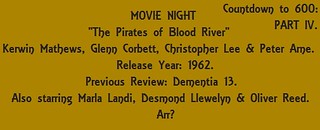
Movie Night: The Pirates of Blood River.


Review #593: The Pirates of Blood River.

Cast
Kerwin Mathews (Jonathon Standing), Glenn Corbett (Henry), Christopher Lee (Captain LaRoche), Peter Arne (Hench), Marla Landi (Bess Standing), Desmond Llewelyn (Tom Blackthorne), Oliver Reed (Brocaire), Andrew Keir (Jason Standing), and Michael Ripper (Mack) Directed by John Gilling.

Review
Christopher Lee (a regular occurring actor on this show) as the villain in a Hammer pirate movie? What could go wrong? As it turns out, a few things. The biggest problem is that the film is so dull. It feels so standard, like it's fulfilling a checklist of stuff without much excitement to it. The movie has one sword fight, and it's at the end of the movie, but by the time you get to the end you'll either be asleep or won't care. The actors are just okay, it's a shame that Lee is wasted in this movie, stuck in a ridiculous haircut that makes him look like Moe from the Three Stooges and an eye patch from your local dollar store. The pirates are the most interesting characters as our main character is just boring, and so is the rest of the non pirate cast. The action is sparse, but there sure is a good deal of dialogue. They do have a sword fight between two pirates...blindfolded, which sounds fun for about 2 minutes. This is just a mediocre/boring film that is just a disappointment. Stick to better pirate movies. Countdown to 600: 10, 9, 8, 7...

Overall, I give it 5 out of 10 stars.