Showing posts with label Flea. Show all posts

April 25, 2024

Suburbia (1983).

Review #2201: Suburbia.

Cast: 
Bill Coyne (Evan Johnson), Chris Pedersen (Jack Diddley), Jennifer Clay (Sheila), Timothy Eric O'Brien (Skinner), Wade Walston (Joe Schmo), Flea (Razzle), André Boutilier (Peg Leg), Grant Miner (Keef), Christina Beck (T'resa), Maggie Ehrig (Mattie), Lee Frederick (Jim Tripplett), Jeff Prettyman (Bob Skokes), Don Allen (Officer Bill Rennard), Andrew Pece (Ethan Johnson), and J. Dinan Myrtetus (Sheila's father) Written and Directed by Penelope Spheeris (#238 - The Little Rascals, #806 - Wayne's World, #1019 - Dudes, #1657 - The Decline of Western Civilization, #1821 - The Decline of Western Civilization Part II: The Metal Years, and #1986 - The Decline of Western Civilization Part III)

Review: 
"It’s an example of the kind of movies I should have been making for my whole career and I wasn’t able to."

Yes, The Decline of Western Civilization (1981) is a punk rock documentary that one can find plenty to appreciate for its look within the punk rock scene and the documentation done by someone with the guts to just let it all hang out in Penelope Spheeris, but it was not the kind of film that screamed audience favorite. So, she set out to make a punk narrative feature, one that would take inspiration from various stories she had seen and heard, whether that involved roaming dogs or a house abandoned (apparently it was like that because the housing tract had been seized through eminent domain in order to help build a freeway). The film came about at the hands of a guy name Bert L. Dragin that apparently wanted to make movies (such as the one as presented to him by Spheeris when showing the script) because he had made considerable money as a furniture chain owner, albeit one that would like a partner to help cover the costs of making a fairly cheap movie. Naturally, this led to Roger Corman, who agreed to help with financing. Of course, because it was made with Corman as a producer, he was behind some of the ideas present in the film when it comes to what Spheeris defined as having to "either have sex or violence every 10 minutes". Interestingly, Dragin would become a director for two films of his own with Summer Camp Nightmare (1987) and Twice Dead (1988), with Spheeris co-writing the script with Dragin for the former. The film did not get much of a release besides a few festivals, but Spheeris maintains pride in the film, even once stating that she would be happy if one remembered her for this film (as opposed to Wayne's World); her next film after this was The Boys Next Door (1985).

The cast (with a few exceptions) were basically a collection of street youths and punk musicians that Spheeris recruited under the belief that it was better to try and get them to have them there and try to act rather than cast a bunch of actors and try to make them sound like punks. Perhaps not surprisingly, you can hear a few bits of live punk rock music throughout the film from bands such as D.I., T.S.O.L., and the Vandals (and yes, that is indeed Flea as a cast member in the same year he became a founding member of Red Hot Chili Peppers, although he is present in the film mostly involving rats - apparently people). Oh sure, it's not hard to find movies about wayward youths that find their own sense of family within others around them. But you sure won't find many films that ride the line of shock value and interest in the behavior of those that are shaped by the thing that surrounds them in suburbia that might as well be the second level of hell. The 1980s might have been a prosperous time for some, but it sure wasn't the easiest time for those who were left adrift and scattered in the streets to fend away. It isn't a case of judging a book by its cover, because, well, they are no angels, it is merely a case of trying to figure out how the hell the book got to be the way that it was in the first place. One is not there to watch a cry of sympathy of the punks but instead a lament for the circumstances that drew them there in the first place that happens to have a few moments to grimace or chuckle with along the way as the makeshift family hurtles towards inevitability. There are the rejected punks and the rejected when it comes to those with supposed "values" that like to discuss plans in a strip club or shoot at stray dogs (time flies when calling it in the name of "citizens against crime"). Some of the acting is hit and miss, such as with Coyne, who basically is lost in the shuffle once it gets to the group, although Clay is fairly decent. Of course, it really is a movie straight for the vibes as opposed to a collection of strong acting, and only Pedersen really strikes it best when it comes the contradictions that arise from calling oneself "The Rejected": one that would rather be around punks than his stepfather...cop. Allen in that regard, as the one sane adult figure (namely in recognizing the wasteland that folks around the suburb are wallowing in), is efficient in that regard to contrast the simple threat presented by Frederick and Prettyman that are stock but on point. If you squint hard enough, one might find a bit of The Wild One (1953) when it comes to rebels that, well, nobody tells them what to do, which in one memorable sequence involves trying to attend a funeral of one of their fallen that ends with a rough-and-tumble when the truth hits a bit too close. As a whole, it is a messy movie in the ways only a punk rock movie would make sense to be messy that doesn't try to play easy sympathy for its lead figures but instead looks at the wasteland and the ones that arise from suburbs turning from an idea of haven into a mirage. Its a rough film that rides on vibes for quite the curious experience.

Overall, I give it 8 out of 10 stars.

March 16, 2023

The Decline of Western Civilization Part III.

Review #1986: The Decline of Western Civilization Part III.

Cast: 
Featuring performers Final Conflict, Litmus Green, Naked Aggression, and The Resistance, with interviews of Keith Morris, Rick Wilder (The Mau-Mau's), Flea, among others.

Directed by Penelope Spheeris (#238 - The Little Rascals, #806 - Wayne's World, #1019 - Dudes, #1657 - The Decline of Western Civilization, #1821 - The Decline of Western Civilization Part II: The Metal Years)

Review: 
"I feel that a documentarian has an obligation to tell the truth as he or she interprets it. And what I mean by that is that documentarians don't necessarily have the same sort of obligations that a journalist might have. A journalist might be called upon to be objective, whereas a documentarian is sort of forced to take sides."

Penelope Spheeris has stated that the three Decline films are what she would like to define her career. However, the road to the third film came in a distinct manner different from the last two films. Spheeris has stated that the three Decline films are what she would like to define her career. However, the road to the third film came in a distinct manner different from the last two films. The release of Wayne's World (1992) was both a hit for Spheeris and a future regret. Studios that had perceived her as not being able to do comedy now shifted to believing she wasn't there for serious material, and a rift with a star on that film meant she was not on for the sequel (as such, she has stated she would "probably not have done" that film if she had a second shot). A trip to Burning Man made her come to a revelation to come back and do a third film in the Decline series. Her aim at trying to look at the punk scene in commercialization in the years that followed would soon turn into one about the gutterpunks that were living on the streets of Los Angeles. A reminder that it is the efforts of Anna Fox (the daughter of Spheeris) who helped spur efforts to get Spheeris to get around to re-releasing these films, which is certainly better to see in a boxset rather than bootlegs. It inspired Spheeris, who acquired a license to become a foster parent in 2013. In fact, she met her future boyfriend during the production of the film (one who was homeless for years that is affected with schizophrenia). Spheeris (who had her most recent documentary with We Sold Our Souls for Rock 'n Roll (2001) suffer delays for years because of rights issues, incidentally) has been on the record about apparently working on a fourth film involving music, but whether it will reach completion is unknown. Everything has basically come full circle in the weirdest of ways. Each film has an opening with the bands being recorded about being at this show means one is consenting to being photographed and each one involves a handful of bands being shown on and off the stage in their perspectives. Keith Morris of Black Flag returns from his appearance in the first film, with his enduring line being about how he never wanted to be a rock star. One of the first questions asked in the film is about punks who saw the first film. So yes, the punk scene has moved into a different place from before, where you now see punks living on the streets making due with what they have and the people that they choose to associate with, whether that involves people named "Filth" or with people who claim they can suck an Icee through their nose. There are a handful of people shown in interviews, whether in a booth or live on the street, with such names including "Filth, Spinner, Why-Me, Spoon, Darius, Little Tommy, Troll, and Nate". The one defining characteristic that comes through is the conviction that these people have for who they are in the moment. 

There are other perspectives besides the gutterpunks, because there is still some music shown through the film, and one probably isn't surprised to hear from a cop as well. Honestly, the music is mainly just fine, with the perspectives of the groups probably being more distinct to look into (one of the groups in The Resistance basically practices in an abandoned building), but the film in general is more one of casual decay more than anything. People are reduced to asking folks on the street or taking photos for money ("not begging, asking" being the key here). It has gotten to a point where these punks are the outcasts of society that believe the best way forward is to be who they are in that moment, which mainly involves being away from their family and the use of substances. I think nearly every punk asked in the film admits to a regular habit of drinking alcohol (because if punk is any one thing, it is what you are not). Forget what they look like (like the one with a pen tube) and instead listen to them for who they are beyond appearances, whether that involves them talking about the upbringing they had before they became who they are (namely abuse, which is recounted by every single one of them) or their short-term plans for the future because of how much they believe they will die soon anyway. The shock isn't the fact that there is homeless people who wander the streets every day trying to make a living, the shock is instead the fact that this is even that big of a problem to begin with (one that goes beyond punk music of course, but Spheeris clearly cares about what she is filming by the way she asks her questions on screen). 

The film (which runs for 86 minutes) closes on numerous shots: first a scene a group of the punks walking together on the street (while a title card states that profits of the film will go to charities for the homeless and abused children) before it cuts to shots from the music scene (as one could see from certain moments of the previous two films) and a final blurb detailing the death of "Squid" (who died on July 19, 1997) from stab wounds alongside the arrest and eventual trial of "Spoon" (an account of the two in terms of a separate person shooting photographs and the apparent fate of Spoon can be found in this blog here). The film never got a proper chance to be seen by the public for years. It did make a premiere on the festival circuit (starting with the 1998 Sundance Film Festival), but the demand for a film with its tone were middling, and any offer that came had a stipulation that she refused to take: handing over the rights to the first two films. At any rate, it is hard to believe it has been 25 years since the release of this film, which manages to continue the road set out by the two previous Decline films in showing the nature of what it means to be a person in punk in the realm of oneself and in music. Each film has their own great highlights in terms of perspective and music (for which I say the first is the best in that regard), but you cannot go wrong with any of the films that were done by Spheeris and company. Check them out for yourself to see just why Spheeris holds them dear to her heart and why you may find them really worthwhile in the history of documentaries.

Overall, I give it 9 out of 10 stars.

Next Time: Smithereens (1982).

December 4, 2017

Dudes (1987).


Review #1019: Dudes.

Cast: 
Jon Cryer (Grant), Daniel Roebuck (Biscuit), Catherine Mary Stewart (Jessie), Flea (Milo), Lee Ving (Missoula), Billy Ray Sharkey (Blix), Glenn Withrow (Wes), Michael Melvin (Logan), Marc Rude (Sonny), Pamela Gidley (Elyse), Calvin Bartlett (Witherspoon), and Pete Willcox (Daredelvis) Directed by Penelope Spheeris (#238 - The Little Rascals and #806 - Wayne's World)

Review: 
Admittedly, I didn't really have any expectations for this film. How can one have expectations for a movie involving punk rockers becoming vigilantes that hunt bikers in the Southwest after one of them is killed by the group? Especially one that has not only a metal soundtrack, but also a Daredevil Elvis impersonator and ghostly cowboys? Actually, that sounds pretty interesting in writing, and this is a film that somehow works more often than not. Obviously this is an offbeat kind of movie, complete with aspects of a Western along with adventure and comedy, even with subject matter such as this. Cryer and Roebuck prove to be a decent enough duo together, neither becoming too clownish nor anything too unreal. Stewart is fairly charming, especially when teaching Cryer how to fire a weapon, and Ving proves to be fairly rough but fairly satisfying villain. As mentioned, there is a Daredevil Elvis impersonator (played by Willcox), and I will say that he provides amusement in the brief amount of time he is on screen. At 90 minutes, the movie is never boring, and I can at least say that the movie keeps you watching no matter what happens on screen, for better or for worse. The movie itself really isn't that special, but there is just something about the movie rolls itself together, becoming something that is satisfying in its entertainment while having a useful plot that doesn't veer into hard vigilantism nor hard absurdity. Would I recommend it? If you have a chance to find the film, I suppose that it is worth one watch, preferably late at night, where the odd bits really make an impression in darkness. There is no one real genre to classify this as, but that is likely why this deserves the label of a "cult classic", for better or for worse.

Overall, I give it 7 out of 10 stars.

July 18, 2017

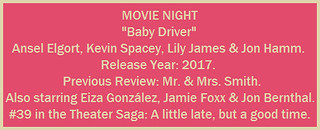
Baby Driver.


Review #971: Baby Driver.

Cast: 
Ansel Elgort (Baby), Kevin Spacey (Doc), Lily James (Debora), Jon Hamm (Buddy), Eiza González (Darling), Jamie Foxx (Bats), Jon Bernthal (Griff), Flea (Eddie "No-Nose"), Lanny Joon (JD), and CJ Jones (Joseph) Directed by Edgar Wright.

Review: 
Admittedly, I took some time before getting to see this film (roughly three weeks after its release), but I figured that it would be worth the wait. This is a fairly cohesive action flick that is fast and efficient in its style and pacing, with the characters and music corresponding to that. It has a level of mayhem and excitement that is undeniably interesting to watch, taking elements from other heist flicks and making them feel fresh and reliable to see carried out on screen. It has its shares of thrills, but it also is a movie that doesn't sacrifice the plot to get to the highs that it rises to, with fine editing from Paul Machliss and Jonathan Amos and cinematography from Bill Pope as well. It's a movie that can have some nice blend of music (like "Brighton Rock" by Queen, for example) but also have some nice scenes with Elgort and Jones in sign language. Elgort certainly fits in line with the movie, having a cool but careful demeanor that certainly makes him easy to watch, and his chemistry with James reflects that, with their scenes together working fairly well. The other core four (Spacey, Hamm, González and Foxx) are also pretty good together, with Spacey and Hamm having their own kind of arcs that have payoffs that the movie earns. Foxx does a fine job with this unhinged but always watchable character, and Gonzalez does a fine job with her role as well. The climax of the film is like a roller coaster, having a few twists and turns (much like other good flicks of its genre) that manage to keep one on their toes at what happens next. There is a good amount of flash to the film, but it has a substance of reality and reliability that makes it shine as an acceptable and unique action flick with enough wit and class to spare.

Overall, I give it 9 out of 10 stars.

October 21, 2015

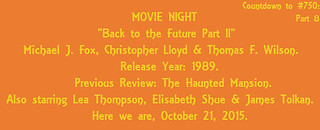
Back to the Future Part II.


Review #747: Back to the Future Part II.

Cast
Michael J. Fox (Marty McFly, Marty Jr, and Marlene McFly), Christopher Lloyd (Doc Brown), Thomas F. Wilson (Biff Tannen and Griff Tannen), Lea Thompson (Lorraine Baines-McFly), Elisabeth Shue (Jennifer Parker), James Tolkan (Mr. Strickland), Jeffrey Weissman (George McFly), and Flea (Needles) Directed by Robert Zemeckis (#317 - The Polar Express, #352 - Who Framed Roger Rabbit, #581 - Forrest Gump, #648 - Beowulf, and #701 - Back to the Future)

Review
Ah yes, October 21, 2015. The FUTURE. Welp, not now anyway, because today is actually the day that the DeLorean time machine arrived (with Doc, Marty and Jennifer) at the beginning of this film, so I figured that it would be appropriate to review this today, what with our hoverboards and our self lacing shoes...and Jaws 19. Let's recap the first movie, shall we? Or not, because I can just say it quite simply: It's a fun movie. Go see it, if you haven't already. But how is the second movie? It's enjoyable, but maybe not as much as the first one. The characters are enjoyable and about what you'd expect, though I didn't notice that Fox played Marlene McFly, mainly because of the makeup, mainly used for the 2015 scenes, which look pretty good.

Crisipin Glover is one of the two actors (with Shue replacing Wells as Jennifer) from the first film who doesn't return for the sequel, either because of pay issues or (according to him, anyway) his problems with the moral of the story (specifically his belief that the money is the reward that leads to happiness), but he would technically be in it, due to footage from the first film being used and Weissman (in prosthetics) playing him, which led to a lawsuit.

Fox and Lloyd shine again, especially when Doc is explaining the new alternate timeline. It's a bit strange to see Marty try to sneak a Sports Almanac from the future to try and make some money back in 1985, especially considering him and his family are already doing pretty well, what with the new truck for Marty and all at the end of the first film. But to be fair, at least Marty learns a lesson by the end of the film (mainly to make sure that when you get rid of something, you really get rid of it thoroughly). The gag of him dropping everything when someone calls him "chicken" is a bit annoying, though it at least is addressed a bit more in the next film. Wilson still does good at being a bully, even when he's playing an aged bully...who still waxes cars. The hoverboard action in 2015 is certainly a highlight to watch, as fun as the skateboard chase in the first film. The movie certainly likes going back to the first film, and it is a little fun watching Marty try to avoid himself while getting to see events again. It's a movie that certainly works as a sequel, and while it isn't quite up to the first film, it is at least a worthy sequel...that leads itself to a sequel of its own.

Countdown to #750: 10, 9, 8, 7, 6, 5, 4, 3...

Overall, I give it 8 out of 10 stars.