Showing posts with label Dorothy Arzner. Show all posts

March 31, 2026

Honor Among Lovers.

Review #2522: Honor Among Lovers.

Cast:
Claudette Colbert (Julia Traynor), Fredric March (Jerry Stafford), Monroe Owsley (Philip Craig), Charles Ruggles (Monty Dunn), Ginger Rogers (Doris Brown), Avonne Taylor (Maybelle Worthington), Pat J. O'Brien (Conroy), Janet McLeary (Margaret Newton), and Ralph Morgan (Riggs) Directed by Dorothy Arzner (#1648 - Sarah and Son, #1810 - Working Girls, #1992 - The Wild Party, #2187 - Christopher Strong, #2362 - Anybody's Woman)

I suppose the best way to start talking about the film is to let Arzner's words (conducted in the 1970s) about the movie: "I collaborated in the writing of Honor Among Lovers, which I made for Paramount in New York. As audiences were ready for more sophistication, it was considered the smartest high comedy at the time. No, there was no pressure regarding the script, I had very little interference with my pictures. Sometimes there were differences in casting, sets, or costumes, but usually I had my way. You see I was not dependent on the movies for my living, so I was always ready to give the picture over to some other director if I couldn’t make it the way I saw it. Right or wrong, I believe this was why I sustained so long––twenty years." This was the 8th credited feature film for Arzner as a director, right between Anybody's Woman (1930) and Working Girls (1931). There were apparently a few working titles with "Sex in Business", "Strictly Business", and "Another Man's Wife". This was the second pairing of Colbert and March, who first appeared together in Manslaughter (1930) (they appeared again with The Sign of the Cross [1932] and Tonight is Ours [1933]).

Okay, sure, an office triangle movie with a couple of future Academy Award winning actors involved*. It sounds like a pretty casual affair, particularly with a runtime of 75 minutes that basically coasts on just how much you yearn to see how one woman's choices create so many ripples for all involved. It's the type of movie that has its own little quirks for modern audiences, of course, mainly because the boss in the film is, well, a boss trying to strike up a romance with his secretary that decides that the best course of action after she gets married is to fire her. But at least he seems normal when compared to the other man in the triangle in Owsley, who was a stock theater troupe man before he got onto film (in the last days of silent film) that acted all the way until his death...at 36 in 1937 (from a heart attack, of all things). One can enjoy a little bit of ham-handedness (especially when representing the underrated aspect of a love triangle story: a guy who isn't actually that good at wooing). One thing comes to another and boom, suddenly you have folks trying to throw their significant other down the river for their foolishness. At least the movie isn't completely judgmental over the decisions made by its one key feminine presence (because if it was, the movie probably would hit the rails into melodrama to chuckle at). Colbert and March prove fairly dependable and have a bit of chemistry together to where it at least isn't too hard to see where they would actually grow up and want the other. As a whole, it's a decent movie that comes and goes with the relative craftsmanship that Arzner had honed down in less than five years as a director that just rolls with useful sophistication and perspective for human nature.

Overall, I give it 7 out of 10 stars.

*March won his first Academy Award with his performance in Dr. Jekyll and Mr. Hyde (1931) while Colbert won her award with It Happened One Night (1934), and if you pay attention to the supporting roles, you'll see the future winner for Kitty Foyle (1940) in Ginger Rogers

Apologies, I forgot to include a song of the day for the previous review. So enjoy two: 

March 26, 2025

Anybody's Woman.

Review #2362: Anybody's Woman.

Cast: 
Ruth Chatterton (Pansy Gray), Clive Brook (Neil Dunlap), Paul Lukas (Gustave Saxon), Huntley Gordon (Grant Crosby), Virginia Hammond (Katherine Malcolm), Tom Patricola (Eddie Calcio), Juliette Compton (Ellen), and Cecil Cunningham (Dot) Directed by Dorothy Arzner (#1648 - Sarah and Son, #1810 - Working Girls, #1992 - The Wild Party, #2187 - Christopher Strong)

Review: 
Well, there are quite a few movies about drunken marriages, so it isn't too surprising to see it here with Dorothy Arzner's 7th credited feature film as a director. The movie is based on the short story "The Better Wife" that had been written by Gouverneur Morris (evidently, the movie was going to be released under that title but went with the other title instead); Zoe Akins and Doris Anderson wrote the screenplay adaptation. Admittedly, Chatterton probably has slipped under the radar as an actress. But hey, she had a busy life beyond the acting life, which apparently began when her friends challenged her to become a stage actress when she criticized the acting when seeing a play in Washington. After a decade-and-a-half of stage work (including Broadway), she scored a contract with Paramount in 1928. Her work in Madame X (1929) and Sarah and Son (1930, as directed by Arzner) got her Academy Award nominations. She stopped acting in films by 1938 at the age of 45, although she would appear from time to time in stage and later in television. She even wrote a handful of novels in the 1950s and did I mention the part where she was an aviator that flew solo across the States a few times? While this movie isn't particularly noted among audiences of the time, one can at least be satisfied with its restoration in recent times by the UCLA Film & Television Archive. This was the third film Arzner had released in 1930, having been involved (alongside ten other directors) in the all-star revue Paramount on Parade (1930), which was released in April of 1930 (the aforementioned Sarah film had come out first in March), with this movie coming out in August; Colbert (who also had been featured in the Parade film) returned to star in the next Arzner movie alongside Fredric March with Honor Among Lovers (1931).

To say that the film is fine is not a particularly hard thing to say. Its 80-minute runtime is pretty routine when it comes to, well a 95-year-old movie that comes and goes in the scenario and executing it. Some of that is more successful than other times, particularly since this is the kind of movie where it wraps up in a "tidy bow" in the last few minutes that you either will accept or just sigh down the road as you wonder what sounds best to watch next.* For Arzner, it is about as competent and involving as one already has seen in her earlier films in trying to depict the general challenge that comes with being a woman where everybody has some sort of opinion of "who they are to somebody". Sure, the outsider view is taken with the eventual realization that one does in fact need someone, particularly someone who at least looks like they understand who they are on the outside beyond just being a clinging post in the dark of night. In that sense, Chatterton does relatively fine in maneuvering the waters of perception and actual action that is snappy enough to elicit enough charm to at least give the movie the fighting chance it needs. Sure, Brook is not given too much to really do besides being the soused up one of the "odd couple", but he plays it with dogged interest to at least seem like he isn't totally on autopilot. Lukas was the dependable supporting presence that you could find for a variety of movies (big or small) in his time, so he plays the "man with foreign-sounding name" with serviceable commitment to at least make a capable triangle seem plausible. As a whole, the movie presents a capable woman trying to make the best of things of a life that has to adjust the upheaval in routines that is more than just being an anybody but instead being a somebody, one who can live within places rather than apart from it all. It might not be a great "Pre-Code" movie, but it might just prove worthwhile enough for those interested in a decent time with Arzner at the helm.

Overall, I give it 7 out of 10 stars.
*Sorry for the delay. On occasion, I find inspiration for a review is split over the course of several days because I somehow get distracted in the most absurd of ways, which either involves rest or searching up old sports stuff. I recently managed to score a free trial of a newspaper archive and on a lark looked up box-scores of the 1968 ABA Playoffs for fun. You would be surprised what gets covered and doesn't find its way into telling a sports story.

March 20, 2024

Christopher Strong.

Review #2187: Christopher Strong.

Cast: 
Katharine Hepburn (Lady Cynthia Darrington), Colin Clive (Sir Christopher Strong), Billie Burke (Lady Elaine Strong), Helen Chandler (Monica Strong), Ralph Forbes (Harry Rawlinson), Irene Browne (Carrie Valentine), Jack La Rue (Carlo), and Desmond Roberts (Bryce Mercer) Directed by Dorothy Arzner (#1648 - Sarah and Son, #1810 - Working Girls, #1992 - The Wild Party)

Review: 
Technically, the focus should be on Arzner, because she was the one key regular female director in the sound era (there were others too such as Dorothy Davenport, but I think you know what I mean). But 1933 was also the year of Katharine Hepburn, so why not a few words here. She had early ideas of being an actress, but it was not until she graduated Bryn Mawr College in 1928 that had her on the road to professional acting, which started in the theater. She appeared in a handful of roles that ranged from understudy to being let go, but her performance in 1932's The Warrior's Husband got her notice in Hollywood from a scout. George Cukor vouched for her in casting for what became A Bill of Divorcement, released in the fall of 1932. 1933 saw her star in three films: Christopher Strong, Morning Glory, and Little Women (it was for the middle film that saw her win her first Academy Award). Hepburn came into the picture after Ann Harding had contractual problems, with this being a production under David O. Selznick at RKO. Strong was based off the 1932 novel of the same name, as written by Gilbert Frankau (it only seems apt that he wrote a novel about a Member of Parliament, Frankau apparently had a desire to serve in politics but a conservative man with his history in divorces did not test well for the times). The screenplay was written by Zoe Akins (who had written for Arzner's Sarah and Son), a future Pulitzer Prize winner as a playwright; the profession was changed from the book, which was about a woman racecar driver. Tommy Atkins apparently served as an assistant director. Hepburn reflected on the film in her autobiography and said that she enjoyed her time making the film (along with noting that each wore pants). It was Arzner who apparently modeled Hepburn's character off Amy Johnson, the first woman pilot (well, the word is "aviatrix") to fly solo from England to Australia (there was a mix of newsreel footage for parades and flights included as well). 

It wasn't a huge success at the time, but it certainly stands as a curious film that happened to be made just a year before the enforcement of the Production Code. Of course, the film isn't really about the one in the title as it is about, well, the woman experiencing her first love affair and how it affects her when it comes to the clashes of caution and danger-seekers. Courage, death, love, well, it all comes together in a crash of emotion that really could only come in that Pre-Code era. Hepburn just has that straight-to-the-point personality that exudes confidence with a knowing aura that moves leaps and bounds over anyone she interacts with, which is curious when wrapped with the idea of being in love for the first time - to a stuffy one, no less. Clive is put in the interesting position of being the stodgiest person in a film where he is playing the title character that at one point gets to look upon a woman wearing an outfit that reminds one of a moth. It is a clammy tightrope to walk in terms of "dignity" (he's playing a character that did enough to be called "Sir", remember) when it comes to trying to maintain the idea of normalcy when facing someone with similar features in single-minded goals. All the while, one sees Burke and Chandler from time to time in that engagement of trying to cope with the predicament that comes in love for one with an "occupied" status. Apparently, Arzner paid significant attention to getting something out of Burke when it came to performance along with stating that her interest really fell to Clive's character, which she described as "a man on the cross". Interpret that any way you wish, but each of them do fairly well anyway. As a whole, the film rests on how much one will go with that ending, which, well, rather than face the prospect of an illegitimate child (as one reads between the lines) and wreak havoc on the lives of people she cares about, a decision is made to fly high into the sky with a plan to never see them again. At 78 minutes, it is a decent experience for the curiosity alone.

Overall, I give it 7 out of 10 stars.

March 27, 2023

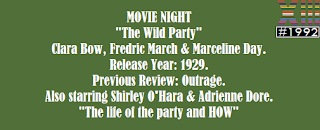
The Wild Party (1929)

Review #1992: The Wild Party.

Cast: 
Clara Bow (Stella Ames), Fredric March (James 'Gil' Gilmore), Marceline Day (Faith Morgan), Shirley O'Hara (Helen Owens), Adrienne Dore (Babs), Joyce Compton (Eva Tutt), Jack Oakie (Al), Jack Luden (George), and Phillips Holmes (Phil) Directed by Dorothy Arzner (#1648 - Sarah and Son and #1810 - Working Girls)

Review: 
There are three things to note with this film: it is the earliest surviving film in the career of Dorothy Arzner, as each of her first four works (Fashions for Women (1927), Ten Modern Commandments (1927), Get Your Man (1927), Manhattan Cocktail (1928)) are lost, save for select parts in two of the four. It is also the first "talkie" film featuring the Brooklyn native Clara Bow, who was considered the "it girl" of the 1920s, specifically within silent films. The 1930s would bring more sound films than silents, but Bow (never a fan of the sound process despite receiving reasonable reviews) appeared in just ten more films before retiring in 1933. Malcolm St. Clair was originally slated to be director for the film, but disagreements with Paramount led to the hiring of Arzner, who had directed Bow earlier with Get Your Man. It is also one of the first starring roles for Fredric March, who had been appearing in small roles for various years (while making his Broadway debut in 1926) before making his star turn in films such as this, which was the first of four appearances in an Arzner film. For theaters without sound capabilities, a silent version was constructed (this is also the case for Bow's next film in 1929 with The Saturday Night Kid). There were various writers involved: Samuel Hopkins Adams, known as an investigative writer, wrote the story under the pseudonym Warner Fabian (he also wrote a handful of novels featuring young women in the Jazz Age). E. Lloyd Sheldon was credited with "adaptation", while George Marion Jr and Sheldon wrote the titles and John V.A. Weaver was left uncredited. Apparently Bow was quite nervous when it came to filming in sound, to the point where a microphone exploded on the first day of filming. To help Bow out, Arzner tied a microphone in a fishpole, which basically makes this the first movie with a boom mic. 

The movie is a pretty decent one. It may seem to be a carefree movie about young women having fun, but there is a question that comes through in just what it means to see people treat life like one wild party, seemingly aiming for nothing but cheap sensation. But it is a useful 77-minute feature filled with energy and zip from Bow that goes well with an unconventional romance set by Arzner and company for a decent time with mild laughs and a semi-interesting romance. Reviews of the time were varied on the film, but they all generally focused on the sound of Bow and her voice, but she does quite well here, probably since she doesn't seem constrained to stiff habits that would doom a lesser early sound film. She seems engaging and compelling to view in charm in art of wandering youth. The space created by Arzner of these youthful women works out to reasonable sequences that invite the viewer into the proceeding by stringing them along to what might happen next without chattering time away. They make for a quality group of bad behavior (read: 1929), whether that means the light O'Hara or the feisty Compton. As for March, he makes a bemused counterpart to the action, one where you can see how he might become a bigger name in movies, which mostly means he has a useful growing rapport with Bow, whether that involves a friendly rescue of the latter (with fists, obviously). As a whole, it is a mostly carefree film about the joys of finding a party worth having with people, whether that means in romance or on the wild side. When it comes to viewing Arzner the director or Bow the star, you can't really go wrong here.

Overall, I give it 7 out of 10 stars.
Next Time: Where Are My Children?


March 4, 2022

Working Girls.

Review #1810: Working Girls.

Cast: 
Judith Wood (June Thorpe), Dorothy Hall (Mae Thorpe), Charles "Buddy" Rogers (Boyd Wheeler), Paul Lukas (Dr. Joseph Von Schrader), Stuart Erwin (Pat Kelly), Frances Dee (Louise Adams), Mary Forbes (Mrs. Johnstone), Claire Dodd (Jane), Dorothy Stickney (Loretta), Alberta Vaughn (Violet), and Claude King (Mr. Adams) Directed by Dorothy Arzner (#1648 - Sarah and Son)

Review: 
Working Girls was the ninth feature effort from Dorothy Arzner (with two uncredited contributions), who as we all know deserved better when it comes to appraising one of the most prolific women directors of the first half of the 20th century, if not still one of the most prolific of the now. The film is adapted from the 1930 play Blind Mice, which had been written by Vera Caspary and Winifred Lenihan; Caspary was a novelist who is best known for her novel Laura (that was turned into a hit movie), while Lenihan was an actress mostly involved in the theater and her one defining role as the title role in the 1923-24 American production of Saint Joan. It was a re-working of Caspary's novel Music in the Street, which used undercover work at a rooming house by her. However, the play was actually not much of a success, since she was not experienced in writing plays (to the point where the producers did re-writes) that resulted in two weeks of life on the stage. Zoe Akins served as the screenwriter for the film, as she did for a number of Arzner's early films.

I'm sure you are familiar with the classic structure of two women trying to make it while working in the city. Well, don't forget about the joys of pre-marital relations and making light of marriage. Actually, Arzner described the film as one of her favorites, but Paramount Pictures gave it a limited release - keep in mind, this was the Pre-Code era too. A deal by Universal Pictures to acquire a number of films from Paramount's library from 1929-1948 would also bury the movie in obscurity for years without a home video release. Of course, prints do exist that were screened for occasions such as 2015 for UCLA or for bootlegs. Of course, one might not exactly be quite familiar with the stars besides Lukas (well, him and Erwin were both future Academy Award nominees, though). It was the last starring role for Hall, and Wood had her peak (in terms of roles) in this year, while Rogers had a few years of being known as "America's Boy Friend" who dabbled in music. The reason I am spending a bit of time with history window-dressing is to give a little credit to the actual result generated by Arzner when it comes to making a solid Pre-Code comedy that can be interpreted as a useful feminist work with its ruminations about marriage that make for a fairly interesting 77 minutes. Sure, there were a handful of films that aimed to capture the reality of folks trying to mingle the realities of city life with love life with regard to what expectations are held to them, but this time with a truly feminine perspective. While the structure of the film doesn't exactly yield to too many unpredictable closing marks, it does manage to have a charm and efficiency to make things seem worth it without being absorbed in audience-safe fears (with a little bit of editing charm to go alongside it). Wood and Hall pair fairly decently when it comes to showing the associations that comes with free-spirited young people that will either take advantage of situations presented to them or be swept away by it (or both), which results in a few laughs. Rogers proves adequate in flighty charisma, but Lukas is the more distinct presence in terms of measured interest while Erwin makes a casual foil to seal the puzzle of distinct personalities playing against the leads. While its ending nearly shakes with too much offbeat nature (i.e. a gun-induced marriage proposal), the movie is generally riveting enough with showing perspective in the right places that means it still shows relevance among its peers after nine decades, one that is cheery and earthy enough to recommend.

Overall, I give it 8 out of 10 stars.

Next Time: Not Wanted (1949).

March 8, 2021

Sarah and Son.

Review #1648: Sarah and Son.

Cast: 
Ruth Chatterton (Sarah Storm), Fredric March (Howard Vanning), Fuller Mellish Jr (Jim Grey), Gilbert Emery (John Ashmore), Doris Lloyd (Mrs. Ashmore), William Stack (Cyril Belloc), and Philippe De Lacy (Bobby) Directed by Dorothy Arzner.

Review: 
"When I went to work in a studio, I took my pride and made a nice little ball of it and threw it right out the window."

When it comes to the history of women in cinema, one name that should come up in consideration is Dorothy Arzner. There were a selection of female directors  in the first years of the 20th century, although the pioneer in the field was Alice Guy-Blaché, who produced and directed for Gaumont Film Company beginning in 1896 for France. She would later take credit for giving a start to another pioneer with Lois Weber, who would direct and write her own films in the advent of the silent era. The shift to sound alongside the consequences of further focus on commercial interests led to less opportunities for women filmmakers, but one director that found a place within the silent and sound eras was Dorothy Arzner. The California native grew up around the times of actors because her father owned a restaurant near a theatre that would attract various actors to dine. She initially wanted to become a doctor, having studied at the University of Southern California. However, she would shift her interests upon spending a few months with a surgeon's office. The passing of World War I alongside a flu epidemic meant that folks were needed for work, and Arnzer found her chance with Famous Players-Lasky Corporation (now known as Paramount Pictures) and William DeMille. Seeing the units of the studio work led to inspiration, as seeing the unit of Cecil DeMille in directing interested her with his drive of telling folks what to do on set. She would start as a typist before moving to script writing and eventually editing (in a span of six months); she would edit by her estimate 52 films in such a short time that ranged from Blood and Sand (1922) to The Covered Wagon (1923) while observing a variety of directors that ranged from James Cruze to Fred Niblo. In 1927, she was planning to leave for Columbia Pictures to write/direct, but a chance encounter with Walter Wanger (a production head in New York that she encountered upon wanting to say goodbye to anyone before leaving). She would get her chance to direct with Fashions for Women (starring star of the time Esther Ralston), which proved to be a wise choice. She would become noted for directing famed silent actress Clara Bow to her first talkie with The Wild Party (1929), with her idea to create a flexible microphone to help a nervous Bow (essentially creating one of the first boom mics). Among the early films of Arzner, it is the only one of her first five to survive intact. Sarah and Son (1930) is her sixth of eighteen overall films she would direct, with her films at Paramount generally having little interference before she shifted to freelance work by 1933. In that decade, there were only three women who directed a film: Dorothy Davenport, Wanda Tuchock, and Arzner. Her career would last for two decades, marching to the 1940s with First Comes Courage (1943). She would retire after the release of the film (owing to a bout of pneumonia that weakened her right before production ended), although she would work with a variety of professions relating to acting such as the Women's Army Corps with wartime training films, the Pasadena Playhouse, and teaching at the UCLA Film School.

Although her films languished in obscurity for years, there certainly is time still to look upon her perspective of filmmaking. This would be one of the first films that starred Ruth Chatterton, who was known for her stage work at the time (along with, I kid you not, side work as aviator), with successes like this film soon leading to a nickname of "The First Lady of the Screen." (Madame X (1929) and this film would each garner Academy Award nominations) and this was also the second of four films that Arnzer would direct Fredric March (this was the year before his first big role with Dr. Jekyll and Mr. Hyde). The film is an adaptation of the novel of the same name by Timothy Shea, with playwright Zoe Akins writing the adaptation. It is the classic melodrama for 86 minutes, involving lost kids, weird spouses, and dangerous peril leading to dramatic last shots. In other words, it's a decent little movie that obviously works on just how much one rolls with the punches of its story in keeping their eyes open. We are talking about a movie that has someone try to fool a mother with a deaf mute kid as their actual son, after all. It's an okay time, since 86 minutes isn't too long to see through to its inevitability and its one key performance. Chatterton does quite well in her range to carry the film within its two segments (1915/1918 and 1928) with patience and interest for playing to dramatic flair without hamming it up for a role requiring some banter and singing. March follows along with some fair charm, playing second fiddle within an okay romance that can only go so far (i.e. finding the child seems more important to think about). This was the third and last role for Mellish Jr, who died a month before release of a hemorrhage at the age of 32. The performance is okay, subdued in those moments spent in the first half that comes and goes quickly. Emery and Lloyd serve as the foils with varying results of middling okay quality. No one is overacting or struggling too much with speaking to the microphone. There are moments here and there that work fine, such as the reunion between mother and son that override sillier moments (the entire segment involving a family believing someone is nuts for thinking their son is totally not adopted) that makes a passable effort. The world didn't really need a dozen of films like this one, but it doesn't hurt to see the perspective of Arzner when it comes to useful melodrama from a time long ago - take it or leave it.

Overall, I give it 7 out of 10 stars.

I will admit that I wanted to take some time off, so taking eight days off seemed like a good time to take (I also had to/still am dealing with Blu-Ray player issues). Admittedly, one themed month is usually not enough. March happens to be Women's History Month (and today incidentally is International Women's Day), so the time has come for a trove of films with female directors. Guesses can be made about what is to come, but there certainly will be at least ten films to cover over the month, which I hope will be a good one in terms of varying perspectives.

Next Time: Mädchen in Uniform (1931).