Showing posts with label F. Murray Abraham. Show all posts

August 31, 2026

Redux: Last Action Hero.

Redux #576: Last Action Hero.

Cast: 
Arnold Schwarzenegger (Detective Jack Slater / Arnold Schwarzenegger), Austin O'Brien (Danny Madigan), Charles Dance (Mr. Benedict), Robert Prosky (Nick), Tom Noonan (the Ripper / Tom Noonan), Frank McRae (Lieutenant Dekker), Anthony Quinn (Tony Vivaldi), Bridgette Wilson (Whitney Slater / Meredith Caprice), F. Murray Abraham (John Practice), Mercedes Ruehl (Irene Madigan), Art Carney (Frank Slater), Professor Toru Tanaka ("Tough Asian Man"), Ryan Todd (Andrew Slater), Jeffrey Braer (Skeezy), and Bobbie Brown (Video Babe) Directed by John McTiernan (#014 - Die Hard, #018 - Die Hard with a Vengeance, #080 - The Hunt for Red October, #325 - Predator)

Review: 
"Initially, it was a wonderful Cinderella story with a nine-year-old boy. We had a pretty good script by Bill Goldman, charming. And this ludicrous hype machine got hold of it, and it got buried under bullshit. It was so overwhelmed with baggage. And then it was whipped out unedited, practically assembled right out of the camera. It was in the theater five or six weeks after I finished shooting. It was kamikaze, stupid, no good reason for it. And then to open the week after Jurassic Park—God! To get to the depth of bad judgment involved in that, you'd need a snorkel."

It is sometimes fun to go back to the (perceived) hits and misfires of the old favorites, particularly when it comes to Arnold Schwarzenegger. Honestly, the fact that he was enough of an action star to warrant curiosity all these years later is a curious one, at least when you consider that he was originally a bodybuilder that listed Steve Reeves as among his idols. There was a long road between being dubbed in his debut with Hercules in New York (1970) to the bodybuilding documentary Pumping Iron (1977) to Conan the Barbarian (1982) to being in movies that were boldly proclaimed to be the "big ticket of '93". Of course, Last Action Hero started and ended in completely different fashion from what anyone expected, but hey. Zak Penn and Adam Leff had met when taking a film appreciation course at Wesleyan University; later on, with a shared love of action movies and their cliches, they did a draft with "Extremely Violent" that basically was a flip of The Purple Rose of Cairo [1985] (in which a movie-star idol walks of the screen and joins the real world from time to time). Through a bit of puffery, they attracted an agent with Chris Moore and it eventually bore fruit where Columbia Pictures bought it, albeit so they could then get their own folks (credited folks and uncredited script doctors such as William Goldman) to do re-writes. For example, the Hamlet moment came from Penn & Leff, while the glass-eyed Mr. Bendict character was a Goldman idea, and the caper of disposing of a dynamite-stuffed gangster corpse (inspired by a book) came from Black and Arnott (in general, the original draft didn't even have the golden ticket). The result was Penn and Leff were given credit for the story while Shane Black and David Arnott (who basically thought of it as having the chance to do the "Wizard of Oz of action movies") were given credit for the screenplay. Filming was hectic enough that the studio basically released the movie as it was (i.e. ignoring test screening reactions) in order to beat the timed-release date of June 18, 1993 (one week after Jurassic Park) with a budget of $85 million, the movie made less than double of its budget back.

To be honest, this is basically a "Hudson Hawk" moment for me where I realize, you know, this is funny action worth appreciating. Eighteen-year-old me thought it was better as an action movie that wasn't as funny as it could be. Looking back, I think I just appreciate the cozy world that comes with a litany of action cliches and just going with the frenzied attention. It really is a cynical riff on The Wizard of Oz that makes me appreciate when I see on the screen and chuckle along with it. Incidentally, Penn and Leff actually did write it with Schwarzenegger in mind because of his "self-mocking personality" and being the biggest & exciting of the overblown action guys (evidently, you can read a draft here). Sure, they envisioned it as a divide between a smart real kid and a one-dimensional celluloid character rather than the wisecracking present in the latter, and sure, a lesson in not projecting himself into action movies is kind of lost in the moviemaking by committee. But goddamn it, I did enjoy seeing the pairing of Schwarzenegger and O'Brien in the long run. I once thought O'Brien "easily disposable if he wasn't our main character", which certainly seems to sell him short. O'Brien actually had made his film debut with The Lawnmower Man (1993) after apparently being impressive in a TV commercial. There is something to how the two work with each other that does have enough charm to help get the movie over most of the bumps in the 131-minute journey. Schwarzenegger just happens to be the type of guy who can make an action sequence look all the more entertaining with that certain cadence and it does work in his favor to have a little bit of fun in the freewheeling film world. It's messy and decidedly a guilty pleasure type of movie that clearly gave McTiernan problems that he at least stages with a few entertaining action sequences. Dance makes for a fun enough adversary in slowly eating the scenery in menace that seems to be having fun, and that goes doubly for the blustery McRae (not exactly as much for Prosky or Carney, but at least the latter has the excuse of playing the "poor tragic second cousin"). The best gag might be our hero reading a few cards that count down to one because, wait for it, there's a bomb. The litany of cameos and in jokes are basically hit and miss (I suppose Planet Hollywood was a big deal at one point, but a cartoon cat? A reference to Amadeus [1984]?) and being compared to Who Framed Roger Rabbit (1988) probably did it no favors, but I enjoyed what I saw to make an argument that the movie is sorely underrated. Life isn't just what you see in a movie because at the end, it's what you make of it: it can be adventurous, it can be full of itself, it can be charming, whatever. You just have to actually show up for it. In that sense, Last Action Hero might just be up your alley.

Overall, I give it 7 out of 10 stars.


One more in the chamber, a non-redux this time: The Shadow

May 12, 2025

Slipstream (1989).

Review #2379: Slipstream (1989).

Cast: 
Mark Hamill (Will Tasker), Kitty Aldridge (Belitski), Bill Paxton (Matt Owens), Bob Peck (Byron), Eleanor David (Ariel), with Robbie Coltrane (Montclaire), Ben Kingsley (Avatar), and F. Murray Abraham (Cornelius) Directed by Steven Lisberger (#098 - Tron)

Review:

What's in a name? You may or may not wonder just what exactly this movie is, particularly with a poster that bills itself as from the "producer of Star Wars and the director of Tron". Famously, Gary Kurtz had worked with George Lucas on American Graffiti (1973), Star Wars (1977), and The Empire Strikes Back (1980) before he split with Lucas to do his own ventures. He served as co-producer alongside Jim Henson on The Dark Crystal (1982), which was a mild hit with audiences. He got involved for a time in producing the American production side of trying to make a film of Little Nemo in Slumberland that he left after it went nowhere, but Kurtz served as an executive producer with Return to Oz (1985), a movie considered a flop at the time*. And then there was this movie. Apparently, the original script was written by Charles Edward Pogue in the wake of the success of Mad Max (1979). Kurtz liked the basic idea but found it "far too violent" and "heavily exploitation oriented". Enter Steven Lisberger. Fresh off Animalympics, a sports comedy TV movie that spoofed the Olympics but with animals that came out in 1980, Lisberger followed that with Tron (1982), an idea he had developed for years. The movie received better notices in the years to come, and Lisberger would return to direct five years later with Hot Pursuit (1987), a movie that came and went with, well, some money made? He was hired in Autumn of 1987 to help reshape the script, which he described as: "based on an outline from another producer’s ramblings back in the early ’80s. Pogue worked from a Huckleberry Finn travelogue base—a 14-year-old’s encounter with an android as he journeyed in the future, a coming-of-age saga mixed with sci-fi. But Mark Twain’s brand of narrative sarcasm was missing.” Lisberger called it in simple terms as "a futuristic western". Tony Kayden was hired to shore up the script and apparently had issues getting the script through the demands of both producers and Kurtz, who seemed to tussle over what they wanted in the script. Apparently, the movie was supposed to be more violent to help make the movie more coherent, but these scenes were not shot. Bill Bauer was credited for "based on story material" while Pogue either asked for or did not receive credit. Made for a budget of $15 million for "Entertainment Film" in February 1989...no one saw the movie. It received a brief release in the United Kingdom and Australia while managing the dubious distinction of having name actors for a movie that never was released in the USA and leading Kurtz to apparently go bankrupt; he produced two other movies in his lifetime that are even more obscure than this one. Lisberger has never directed another movie since this one (but you can read scripts of his on the Internet), which you can apparently find anywhere on the Web, along with a "making of video".**

Let's be real here: This is not a cult movie. There is no trumpeting for this movie to be re-discovered as some sort of sneaky good movie or one that has scenes worth looking into again. This is the kind of movie you find at the bottom of the barrel with nothing better to do that just happens to have a couple of familiar names involved...and man, that is sad. Really sad. The biggest sin of this movie is that for all the tropes the movie aims for as a wannabee sci-fi movie that might as well have cribbed elements of the Western while they are churning in desperation...it is boring. Sure, there are bits and pieces that are interesting to see in its execution (good or bad), but as a whole, there is not enough here to make one want to see it again or even show it to others. It died a quiet death in theaters because nobody could justify saying more than 50 words on why you would want to show it to a group of people. Lisberger can say the movie grows complex with the whole "android goes to Christ figure" thing, but it seems to be more a movie that you would only like if you have never seen a plane in your life. Slipstream doesn't even sound like a sci-fi title, it sounds like a name you would reject for a minor league team. The territory never feels tough enough to justify the tension, and you might as well call it a precursor to a bigger budgeted flop of the future in wannabee post apocalyptic films such as Waterworld. 

Now, let's get this out of the way: I like Bill Paxton, he was a good character presence in a handful of movies people love now and then...he gets the short stick here. Sure, it is nice to see his attempts at charm in a role that might as well have been ripped out of the dime-store Han Solo / Jack Burton playbook, but there is not nearly enough here to justify the eventual road set out by the climax. It just isn't as involving as it sounds to follow him in a movie that yearns to be a road movie but meanders. Feasible or not, it just seems like the role was meant for someone younger, but then maybe I just have, say, A Boy and His Dog on the mind. Peck was actually best known for his work in television such as Edge of Darkness (1985). And to be fair, his performance here is fairly interesting enough to make things watchable beyond just calling it a wannabee wanderer type. There are flashes of curiosity and yearning for someone who is adrift and, well, the movie really does have you thinking he is an android before it wants too. At least you can say Hamill tried. Hell, he apparently believed that if the movie was a hit, he could use it to play a Bond villain rather than doing stuff that was basically a take on Luke Skywalker. Ironically, Hamill ended up playing more noted villains in the form of voiceover work than stuff like this, and I can see why: it just isn't an interesting role to chew on. Sure, a good villain can involve folks that believe they are in the right, and we have a self-righteous person that wouldn't be too off from The Searchers, but, well, it just isn't a compelling threat to really watch. Its a pursuit movie where he just shows up and then boom, he's off for a bit. The climax screws him over. One minute he and Peck are in the plane fighting over control of it, then he's trying to quote the works of Byron to, well, the guy mistakenly referred to as Byron, then he seems to be hopeful the plane can make it out of turbulence, and then, boom, he's dead. Hell, Byron I guess is just one of those "explosion-proof androids", so he just moseys on out, as if barely anything's happened. Aldridge and David equally have little to really do to make anyone want to go forward with adventuring, suffice to say; rounding it out, the cameos from Coltrane (and two Academy Award winners with Abraham and Kingsley!) are, well, short and not exactly helpful for a film bereft of actual edge. As a whole, Slipstream aimed to be an adventure, but instead it flounders to the ground with a whimper. You might find something here with the names involved or just groan at the missed opportunities. 

Overall, I give it 5 out of 10 stars.

*Well, if you want to call a movie "too dark", you might need a head check. Hell, they apparently said that (in lighter numbers) with The Dark Crystal, but eh, people like that movie too.

July 15, 2020

Amadeus.

Review #1473: Amadeus.

Cast:
F. Murray Abraham (Antonio Salieri), Tom Hulce (Wolfgang Amadeus Mozart), Elizabeth Berridge (Constanze Mozart), Roy Dotrice (Leopold Mozart), Simon Callow (Emanuel Schikaneder), Christine Ebersole (Caterina Cavalieri), Jeffrey Jones (Emperor Joseph II), Charles Kay (Count Orsini-Rosenberg), Kenneth McMillan (Michael Schlumberg), Kenny Baker (Parody Commendatore), Lisabeth Bartlett (Papagena), and Richard Frank (Father Vogler) Directed by Miloš Forman (#1164 - One Flew Over the Cuckoo's Nest)

Review:
"Director is little bit of everything, little bit of the writer, little bit of an actor, little bit of an editor, little bit of a costume designer. Good director is the director who chooses for this profession people who are better than he is."

Milos Forman directed twelve films (and one documentary segment) in his life, one comprised of life in Czechoslovakia and abroad in the United States, recieving stature in both places through his interesting films, which started with Black Peter (1964) after years spent studying at the Film and TV School of the Academy of Performing Arts in Prague alongside writing work in Czech comedies, which served as his genre for the three films he made in his native country (with The Firemen's Ball (1967), the last before he left the country, being considered a key piece of the Czechoslovak New Wave) before he left in 1968 due to changes in the country. His films in America were a mix of adaptations of numerous media or biographical in nature (with measured success), which resulted in successes such as One Flew Over the Cuckoo's Nest (1975), this film, and Man on the Moon (1999).

The film is adapted from the play of the same name by Peter Shaffer (an English playwright behind works such as Equus that served as writer for the film), which had first been performed in 1979 in London (with a Broadway production in 1980). The play took artistic licence in its depiction of Mozart and Salieri, describing the work as "fantasia on the theme of Mozart and Salieri". This was not the first play to push forward the myth (or to be more blunt, a lie) involving Salieri having a hand in the death of his supposed rival Mozart (with one key point of anger being at Mozart's boorish behavior while being a genius), with famed Russian poet Alexander Pushkin having composed the play Mozart and Salieri in 1830 (with an opera being done by Nikolai Rimsky-Korsakov 67 years later). The idea that the two composers were such rivals to the point that one of them may very well have wanted to kill the other is absurd, full stop (I am not a history buff by any means, but anything that resembles the reek of conspiracy theory is suspicious). This fundamental point is the first and really only hurdle that stops it from being considered a great film for me. It does have a great design to it in terms of costume design, alongside a great appreciation for music (with Neville Marriner serving as music conductor and supervisor for the Academy of St Martin in the Fields orchestra) and a fairly well-rounded cast to go alongside everything (including natural light and location shooting in Prague, most notably in the Count Nositz Theatre, where Mozart had performed in) that is delivered with precision by Forman to make a mostly successful curiousity on the nature of talent and genius. There exists two versions of the film: the original 161 minute film (rated PG) and a three hour (R-rated) version released in 2002 as a Director's Cut that restored scenes cut originally due to not wanting to test the audience's patience too far in run-time (for a project that was hard enough to finance about a period drama).

It proves fitting to have Abraham and Hulce as the leads (as opposed to any of the stars from the play adaptations, which included Ian McKellen and Tim Curry - Forman wanted American leads for the two roles), since they each had experience in the theater just as much as in film. Abraham proves a tremendous presence, one wracked with desire and regret as a self-described "patron saint of mediocrity" that we can all see a little bit in ourselves that makes the most of his time count with gravitas. Hulce (and his occasional dreadful laugh) does just fine with capturing the complciated essence of a troubled genius, eccentric but captivating to see in a pursuit of greatness with tinges of hedonism along the way. Berridge (who won the role after Meg Tilly injured her way out) makes for a quietly driving force to follow along with at times with Hulce with bright spirit. The others in the cast, such as Doctrice and Jones, make for fair impressions in rounding out a period drama with a good deal of importance and distinct pleasure that retains one's attention just as much as when not on Salieri and Mozart alone. On the whole, the film moves at a careful pace within a curious starting point to generate a fairly interesting look upon music and human nature (namely, ambition) that will keep attention for what is needed with music and a game cast and design to make a mix of history and fiction that makes a solid film for its time of over three decades.

Overall, I give it 9 out of 10 stars.

July 11, 2020

Scarface (1983)

Review #1471: Scarface.

Cast: 
Al Pacino (Tony Montana), Steven Bauer (Manny Ray), Michelle Pfeiffer (Elvira), Mary Elizabeth Mastrantonio (Gina), Robert Loggia (Frank Lopez), Miriam Colon (Mama Montana), F. Murray Abraham (Omar), Paul Shenar (Alejandro Sosa), Harris Yulin (Bernstein), and Angel Salazar (Chi Chi) Directed by Brian De Palma (#801 - Mission: Impossible and #1230 - Carrie)

Review:
"I have a reputation as an action director because I know how to kill, how to shoot people, how to spill blood."

For such a popular film of its era, there are two things that stick out really particularly well about it to note. The first is the fact that the inspiration for the film came from the desire of Al Pacino to want to do a remake of the original Scarface (1932), which Pacino loved as a "model for all gangster pictures." He approached his manager and producer Martin Bregman to do a film and had asked Oliver Stone (who had just won an Academy Award for his screenplay in Midnight Express in 1978) to do the screenplay, although he initially rejected doing it (noting his dislike of the original). An eventual shift from doing a period piece to one set in the present day led to Sidney Lumet being brought in as director. It was he would suggested that it would be set in Miami, with the region having seen a mass emigration of Cubans just three years prior (referred to as the Mariel boatlift). Stone found this premise intriguing enough to sign on to write the film, although Lumet would soon bow out due to creative differences. The director brought in to take on the film was Brian De Palma, a director associated as a figure of the New Hollywood movement of the previous decade that had gone from being inspired to do films in college to doing his own modest works in the late 1960s to his first prime hit in Carrie (1976). Influenced by directors such as Alfred Hitchcock, De Palma is known for his highly stylized films that typically fall within the suspense and crime genres.

What's the second fact you might ask? This was actually not well-liked upon original release. It proved a lightning rod for critics of those who found it excessive in violence and language (you don't say?) or too stereotypical (it isn't like there was a disclaimer at the end about the "dedication, vitality, and enterprise" of Cuban Americans - oops, never mind), and there was a considerable fight over the rating (which was deemed to be X by the MPAA before eventually being rated R). To that I say: what the hell did you expect, a walk in the park with gangsters who deal in cocaine? Loud, provocative, and unrelenting in what it wants to be in content, it deserves its reputation of respect as a film for that era of weird excess with no problem as an imperfect show for its makers. It is a film that intimidates you with excess to the limit because it knows exactly what it is doing about its tale of the dark side of the American Dream that attracted a great deal of people that liked what they saw play out on screen (such as with hip hop and countless references and imitations of quotes from the film). It shouldn't prove surprising that I found the film pretty well done as a film of excess that looks upon the abyss of what it means to rise to the top and the pitfalls that come in trying to stay there. De Palma makes the best of his cast and scope of 170 minutes in delivering entertainment that shocks its viewer with a tremendous burst of energy. Pacino shines with energy, raw and focused in his pursuits and appetites like a lion that make a captivating watch, with plenty of scenes one could highlight, such as the dinner sequence about "saying goodnight to the bad guy" or the tense would-be assassination scene, or the climax (involving that often repeated line involving a "little friend") and so on. Bauer follows along with just as well as a figure along for the ride of mayhem with charm, while Pfeiffer (in a breakthrough part) proves just as alluring in curiosity in her presence. The rest prove just as well in presence, such as a dedicated Mastrantonio and Colon or a smarmy Loggia and refined sleaze in Shenar. Regardless of how much one knows about the film or its lines, one will find themselves in for quite a ride with this film, a stroke of excess and sleaze to make a interesting crime film for its age that lands most of its punches and earns its reputation with stature.

Overall, I give it 9 out of 10 stars.

September 28, 2016

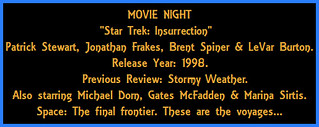
Star Trek: Insurrection.


Review #842: Star Trek: Insurrection.

Cast
Patrick Stewart (Captain Jean-Luc Picard), Jonathan Frakes (William Riker), Brent Spiner (Data), LeVar Burton (Geordi La Forge), Michael Dorn (Worf), Gates McFadden (Dr. Beverly Crusher), Marina Sirtis (Deanna Troi), F. Murray Abraham (Ru'afo), Donna Murphy (Anij), Anthony Zerbe (Admiral Dougherty), Gregg Henry (Gallatin), Daniel Hugh Kelly (Sojef), Michael Welch (Artim) Directed by Jonathan Frakes (#840 - Star Trek: First Contact)

Review
Given that I did First Contact on the 50th Anniversary of the original series, I decided to mark the anniversary of the first episode of Star Trek: The Next Generation (September 28, 1987) with the third installment in the Next Generation film series, Insurrection.

After the success (and tone) of First Contact, a decision was made to try and make the next film of the franchise lighter in tone, much like Star Trek IV: The Voyage Home (#492) had been, with its unconventional kind of story (that also had no villain to it). But all that Insurrection proves to be is a middle-of-the-road kind of Star Trek film that doesn't really have much to it. It is tough to say what is the main root of necessarily why it isn't all that enjoyable, because it feels more like splinters of why it manages to bungle itself. Perhaps the big splinter is the plot, with the crew fighting the Federation (read: an Admiral) over the forced migration of immortals (of 600, named the Ba'ku) from the planet (with immortalizing rings) they are on. But really, the dilemma of whether they should be moved or not in order to potentially save millions isn't presented as interestingly as it could have been. Instead of agreeing/disagreeing with the view presented by the movie, one is more likely to not really care about the people affected.

The Ba'ku aren't really presented with much characterization other than "we don't use technology", aside from Murphy, whose scenes with Stewart is fine, but they don't do the movie much in terms of enjoyment. Sure, the deal between the Federation and the Son'a  may have been a bit rash (in not asking them, even making a holodeck village in preparation), but I can't imagine this being unsuccessful for millions if it had been presented differently. Had it not been for the climax (and the "twist"), one could full-heartily be for the counterpoint and the people for it and not for the Ba'ku. Abraham (as the villain) is fine, but he only gets interesting around the climax, when he starts trying to destroy everyone, even if he is killed in a mild manner. The effects are fine, but not really anything noteworthy. As weird it may seem, I wish the Ba'ku had some makeup to them, to make them a bit more interesting looking. The Son'a are interesting, with their rubbery look fitting well with their characterization. The main cast is fine, even if they don't really seem to have as much presence with each other compared the other two films with the cast. In a way, it really does feel like a two-parter of the show, just not as good. At 103 minutes, it feels a bit too short, but at least it isn't too much of a slog. Compared to First Contact, it is a disappointment, but it's not like there isn't other things to watch (Like Descent, for example). Some might find the dilemma posed by the movie to more compelling than I did, but for me it just didn't work enough.

Coming soon by the end of the year: An explanation guide for the star ratings on this blog.

Overall, I give it 5 out of 10 stars.