Showing posts with label Neville Brand. Show all posts

October 17, 2024

Eaten Alive.

Review #2281: Eaten Alive.

Cast: 
Neville Brand (Judd), Mel Ferrer (Harvey Wood), Carolyn Jones (Miss Hattie), Marilyn Burns (Faye), William Finley (Roy), Stuart Whitman (Sheriff Martin), Roberta Collins (Clara Wood), Kyle Richards (Angie), Robert Englund (Buck), Janus Blythe (Lynette), and Crystin Sinclaire (Libby Wood) Directed by Tobe Hooper (#348 - Poltergeist, #1297 - The Texas Chain Saw Massacre, #1909 - The Texas Chainsaw Massacre 2, #2134 - Lifeforce)

Review: 
"I like the unknown and strange, bizarre things. It's really weird because I've had people ask me about making these films. Do they scare you when you're making them? No, it's not at all scary. When you shoot these things and you see that they work, you're laughing, and it becomes a comedy to you."

It sure is weird to get a runaway classic on your second try as a director. In 1974, Tobe Hooper and Kim Henkel wrote the screenplay to The Texas Chain Saw Massacre, which you already know would be Hooper's crowning achievement. However, less people might know of his next effort with this film, one that was written by Henkel, this time co-writing it with Alvin L. Fast and Mardi Rustam. The movie apparently took inspiration from the serial killer Joe Ball, who killed at least two people in the 1930s and had an alligator pit (he apparently didn't throw people in there, but "Alligator Man" was one nickname applied to him anyway) in his place in Texas. The film apparently has had several alternate titles (probably because Mars Productions didn't exactly make a killing on original release), such as "Death Trap", "Horror Hotel", and "Starlight Slaughter". Incidentally, Hooper grew up to a family that operated their own theater. Hooper had a few disagreements with producers (supposedly leaving the production before it finished), with the money that had come to do the film apparently only coming with the stipulation that he would do the film, which had a bit of handwringing in writing. However, he would keep busy in the next couple of years, directing a TV miniseries of Salem's Lot in 1979 before he got his first prominent studio film with The Funhouse (1981).

It's funny, if you make a hokey little movie with some commitment to gore or at least one energetic performance, you have my attention. Of course, this is a movie that decides to start itself off with a hooker rejecting the advances of a man trying to get behind for his services, so one has a feel that this is going to be a weird one. With a film filled with a key eccentric performance and a few sticking points of would-be and known names to go along with one strange set piece, you have the stage for a curious bit of low budget sleaze hokum. I actually kind of like this ridiculous movie. The whole film was shot on a sound stage at Raleigh Studios in Hollywood, complete with a large pool that doubled for the swamp. Hooper aimed for a "surrealistic, twilight world" with the hotel in terms of lighting, which is amusing to see play out for such a delightful exploitative film that would be right at home for people who liked, say, Two Thousand Maniacs! (1964), complete with little to really say about the characters beyond mayhem. Brand went through the gamut of acting as a heavy (Western or otherwise), tough-guy roles and the occasional lead for film and plenty of TV. Here he clearly was given the light to just go nuts and have fun, complete with getting to use a scythe at one point. He makes for a capable unstable monster worth following along with, a terror in his own square of squalor that seems to like his space and his gator. The movie isn't really that big on showing the alligator, showing it only for scenes involving, well, the body count, but I don't mind too much (others might be weirded out by one pet death, but, well....). You have your mix of actors of varying experience of familiarity like Burns (returning to work with Hooper in probably her second most known film role), Jones (in her penultimate film role), Ferrer (a career vet on the mend), and Englund and Richards (in the horror film before each became more well known, although Englund did work with Hooper twice more with Night Terrors [1993] and The Mangler [1995]). Burns probably comes out the best when it comes to reacting to terror, although there is something amusing about seeing Englund play a sleazeball with ease (Jones is more a cameo than anything). The 91-minute runtime might not be the easiest sit for everybody when it comes to weird and alluring sleaze, but there is something curious about the whole affair that keeps me going even when it just looks like a vehicle for death, mostly because that hotel set really is quite striking to get stuck looking into. As a whole, Hooper was a curious director that used his fascination with the strange and murky things to make a film that works for a specific kind of interested horror fan that goes in knowing Hooper was more than just a one-trick pony. In that sense, it might be for you.

Overall, I give it 7 out of 10 stars.

April 10, 2020

Stalag 17.

Review #1384: Stalag 17.

Cast: 
William Holden (J.J. Sefton), Don Taylor (Lieutenant James Dunbar), Otto Preminger (Colonel von Scherbach), Robert Strauss (Stanislas "Animal" Kuzawa), Harvey Lembeck (Harry Shapiro), Peter Graves (Price), Sig Ruman (Sergeant Johann Sebastian Schulz), Neville Brand (Duke), Richard Erdman ("Hoffy" Hoffman), Michael Moore (Manfredi), Peter Baldwin (Johnson), Robinson Stone (Joey), Robert Shawley ("Blondie" Peterson), William Pierson (Marko the Mailman), and Gil Stratton (Clarence Harvey "Cookie" Cook / Narrator) Produced and Directed by Billy Wilder (#106 - Some Like It Hot, #194 - Ace in the Hole, #422 - The Fortune Cookie, #641 - The Apartment, and #809 - Sunset Boulevard)

Review: 
"Trust your own instinct. Your mistakes might as well be your own, instead of someone else's."

Nobody could quite as versatile as Billy Wilder for film. Born in Austria-Hungary, he found himself wanting to become a journalist from viewing a newsreel (as opposed to prelaw in college or the family business in cakes). He worked for magazines and newspapers in both Austria and Germany, but he eventually found himself wanting to be a screenwriter, with his first credit being for The Daredevil Reporter (1929). During his time in Germany, one notable film he wrote for was People on Sunday (1930), which had notable collaborators such as Edgar G. Ulmer. However, he left the country in 1933 for Paris after the rise of the Nazis. He had his directorial debut with his collaboration with Alexander Esway in Mauvaise Graine (1934) before deciding to leave for America. Over the next few years, he would find himself collaborating on film scripts that gradually found attention, most notably with Charles Brackett. For over a decade, the two would write scripts together (with a few occasions having an additional writer), with the first major hits coming in 1939 with Midnight and Ninotchka. Anxious at the idea of directing and not being confined with just writing, Wilder was given a chance with The Major and the Minor (1942). It was here that he met another important figure in honing the craft in editor Doane Harrison, who had edited Wilder and Brackett's Hold Back the Dawn the previous year. With Harrison on set, Wilder credited him for helping him in technical knowledge in terms of cutting so that there wouldn't be excess footage to deal with. The two would work together for the next two decades. Over the course of the next four decades, Wilder would direct and write plenty of noted successes in genres from noir to comedy drama, such as Double Indemnity (1944), The Lost Weekend (1945), and Sabrina (1954). In his career, he would win six Academy Awards on 21 nominations, with three of them being for screenplay, two for direction, and one for Best Picture.

The film is an adaptation of the Broadway play of the same name by Donald Bevan and Edmund Trzcinski, who had based it on their experiences in a prison camp named Stalag 17B in Austria. When it comes to a war film about prisoners, there certainly wasn't anything like this film before it came out, one that balances dark humor with suspense alongside a claustrophobic atmosphere that makes for a compelling two hour viewing. One key star that was part of some of Wilder's successes for the decade was William Holden, who appeared in three of his features (with one more years later in Fedora). It was the result of these films that elevated him to prime star status, with this being his one Academy Award winning performance of three nominations, although he felt that he didn't deserve to win (instead favoring Burt Lancaster in From Here to Eternity). In fact, he actually disagreed with the characterization of the role (which had Charlton Heston and Kirk Douglas thought of before Holden), since he felt it was selfish and he wanted Wilder to make him nicer, which was rejected. In any case, one finds plenty to draw themselves into Holden and his world, a heel-hero with smarmy complex charm beyond the usual expectations for a film with suspense like this one, which plays to the film's favor in drawing out its traitor twist (kept under wraps by filming in sequential order) through subtlety in both Holden and the camera movement. The rest of the cast keep up with him in establishing the close-knit and hard-driven members contrast with the menace and bluster on the other end. In that sense, the ones who shine best are Strauss, Graves, Brand, Ruman, and Preminger, each delivering a distinct layer that makes the film operate as well as it does without feeling monotonous. There is a key balance of drama and humor that earns the film key moments that can go from a sequence involving a telescope on friendly Russian women to the discovery of the traitor to the whole group. In the long run, this is an entertaining film in a long line of Billy Wilder achievements that merits a watch as a key piece for the decade in balancing drama and humor without too much trouble.

Overall, I give it 9 out of 10 stars.

April 8, 2020

Kansas City Confidential.


Review #1381: Kansas City Confidential.

Cast: 
John Payne (Joe Rolfe), Coleen Gray (Helen Foster), Preston Foster (Tim Foster), Neville Brand (Boyd Kane), Lee Van Cleef (Tony Romano), Jack Elam (Pete Harris), Dona Drake (Teresa), and Mario Siletti (Tomaso) Directed by Phil Karlson.

Review: 
"This was so far ahead of itself that I say these pictures have been copied and recopied so many times. Unfortunately Phil Karlson never got the credit for it because I've never been a publicity hound. I come from the school where what we want to be judged by is up on the screen, not by how well I know so-and-so or so-and-so."

One can always find themselves in the mood for a hardboiled noir, whether it has a budget behind it or stars to look forward to. This falls right into the alley for producer Edward Small, who had a lengthy career of 53 years from his first Who's Your Neighbor? (1917) to The Christine Jorgensen Story (1970). Small produced a variety of genres and worked with various studios in his time through his production company, such as Eagle-Lion Films with Raw Deal (1948) and United Artists with films such as Witness for the Prosecution (1957). One particular director that worked with Small was Phil Karlson, with this being one of eight films that the two worked on together. Karlson worked on a variety of small films for a various group of studios from his start at Monogram Pictures to Columbia Pictures that worked for a variety of actors, such as John Payne, Elvis Presley, Dean Martin, and Joe Don Baker in a career of 31 years that had standouts such as The Phenix City Story (1955), The Silencers (1966), and Walking Tall (1973). Three further films were made with the Confidential title in New York Confidential (1955), Chicago Confidential (1957), and Hong Kong Confidential (1958), all of which were produced by Small.

One can see the makings of an interesting little film with its semi-documentary look and a composed pace of 99 minutes that generates a neat noir worthy of consideration from the public domain. One film that seems to have taken some inspiration from this was Reservoir Dogs (1992) with its aspects of the robbery. The screenplay was done by George Bruce and Harry Essex, while Harold Greene and Rowland Brown did the story. Payne (known for his musical and noir roles) does a fine job in his weary urgency, capable of throwing a punch alongside casual criminal conversation. Gray accompanies the film once the film jumps to its real setting (Mexico, filmed in California), and she makes for a fair innocent presence in a film with plenty of shade around her. Foster proves to be a sharp careful presence as the film's big bad, one that differs from the usual in being a good cop gone bad. Brand, Van Cleef, and Elam make for adequate heavies to view alongside the blunt nature of the film, comprised of the perfect caper and the attempts to escape its consequences. It follows plenty of noir aspects to a T with its own blunt edge that overcomes some of its low-budget limitations. Sure, it is the kind of film that you can see coming with its endgame, but it is all in the chase that really matters in the long run, where darkness has a little light at the end of the tunnel. In that regard, this is a fair experience to behold, one with plenty of punches to pack in its little cynical world without becoming a parody of itself, filled with a carefully picked cast and capable directing to make a fair gem worth thinking about at least once.

Overall, I give it 7 out of 10 stars.

January 9, 2014

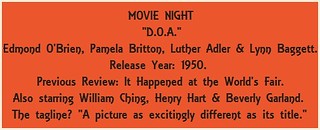
Movie Night: D.O.A. (1950).


Review #524: D.O.A.

Cast
Edmond O'Brien (Frank Bigelow), Pamela Britton (Paula Gibson), Luther Adler (Majak), Lynn Baggett (Mrs. Phillips), William Ching (Halliday), Henry Hart (Stanley Phillips), Beverly Garland (Miss Foster), and Neville Brand (Chester) Directed by Rudolph Maté.

Review
D.O.A. is certainly unique in its approach and also relatively easy to find due to it being in the public domain (Examples of movies in the public domain being Night of the Living Dead, Carnival of Souls and most notably, It's a Wonderful Life), and also being short to watch that also makes it a hidden gem. The actors do a fine job in a film noir that takes its own approach to entertain and bewilder, the mystery isn't inherently obvious nor overly complicated, it stands in the middle and it pays off relatively well. O'Brien stands out well, and Mate directs nicely enough. The movie has moments of brilliance (Such as O'Brien's character going to the Police station and reporting his own murder or when he finds out why he is even involved in this), and it certainly does not die on arrival.

Overall, I give it 8 out of 10 stars.