
Showing posts with label Art Evans. Show all posts

October 19, 2025

Fright Night (1985).

Review #2446: Fright Night.

Cast: 
Chris Sarandon (Jerry Dandrige), William Ragsdale (Charley Brewster), Roddy McDowall (Peter Vincent), Amanda Bearse (Amy Peterson), Stephen Geoffreys (Edward "Evil Ed" Thompson), Jonathan Stark (Billy Cole), Dorothy Fielding (Judy Brewster), Art Evans (Detective Lennox), Stewart Stern (Cook), Robert Corff (Jonathan), and Pamela Brown (Miss Nina) Written and Directed by Tom Holland (#614 - Thinner, #1003 - Child's Play)

Review: 

Sure, let's feature a Tom Holland movie. As one might wonder, the Poughkeepsie native attended Northwestern University for theater before going to and later graduating from UCLA. He wasn't too keen on acting but took the time to train at the Actors Studio and appeared in a handful of guest roles on TV and film. Around that time, he became friends with Stewart Stern, who influenced him to try writing. He went back to UCLA to study law but found the itch from writing to be too much to bear. His first screenwriting credit was the TV film "The Initiation of Sarah" in 1978 before becoming a film writer with the adaptation of The Beast Within in 1982. Other scripts followed, such as the story for Class of 1984 (1982), which was then followed with being hired to write Psycho II (1983), and lastly was Cloak & Dagger (1984)*. The premise that became Fright Night arose during the writer of Cloak that became tempting to direct himself when he saw the results of Michael Winner's direction for his script Scream for Help (1984). Despite not having a completely wide release from Columbia Pictures in August 1985, the movie was a qualified success with audiences. In total, Holland directed five further movies as a director, although because he was busy with Child's Play (1988), he could not be involved with Fright Night Part 2 (1988), which had Ragsdale and McDowall return to their roles. A remake of Fright Night (which relocated it to Las Vegas with a stage magician that may be an expert on vampires) came around in 2011.

There was a sea of vampire movies in its era that ranged from The Hunger (1983) to Lifeforce (1985) to, well, The Lost Boys (1987), but Fright Night does manage to stick out for itself pretty well because of its enthusiasm. Sure, the slasher was making the rounds for what audiences were going with in its time, but it didn't mean you were going to be lacking at least one movie to cut straight from the heart in playing to familiar comforts. The playful rendition of "Boy Who Played Wolf", combined with some worthwhile effects, does make for a pretty good time for those in the mood for it. You get vampires that can deal in wolf form and/or mist to go with the general tone of menace in baring fangs but in the suburbs to go along with having a vampire killer that actually isn't just the usual authority on the matter. It takes time for Ragsdale to get comfortable in the role, but he does spring a few bits of humor in what comes from actually being right in what his eyes see rather than just cloying, although it helps to have chuckles when paired with Bearse or Geoffreys. It is interesting that the part played by McDowell was basically a homage to the great Vincent Price, mostly because I would assume there was tiny bit of influence in Boris Karloff (okay well the character is also named after Peter Cushing, the vampire hunter actor for all time), who actually did host a TV show about horror (specifically, Thriller back in 1960-62)*. But McDowall aimed to played it as if the character was an old ham actor rather than just being a pastiche of Price (who while approached for the role was winding down from taking horror roles). He basically becomes the heart of the movie with the humor that comes from playing it to the ego required of flipping the usual authority with engaging conviction. Sarandon does make for a solid adversary though, managing to draw the power necessary in icy charm that could swoop in and out from sight in a suburb without becoming a hammy threat to wash away. The sequence near the climax involving him, Ragsdale and Bearse has a special curiosity to it in just seeing how seriously Holland wants to make the plight of someone being correct about vampires being among people and being powerless in that moment. The effects (as led by the team that had just done Ghostbusters [1984]) benefit the film particularly well in reminding one of just how entertaining it can be to look at vampires out in the open. As a whole, the movie eventually finds its footing by the time its 106-minute runtime is over due to its various charms that come off as affectionate rather than just being a failed homage. To put it mildly, it has the vibes worth watching for the spooky season.

Overall, I give it 8 out of 10 stars.

*Incidentally, Cloak and Dagger was inspired by the short story "The Boy Cried Murder", which had been adapted into a film a few times over.
*I wonder if there is a tiny bit of inspiration that was cribbed from Targets (1968), a movie where Karloff plays a disillusioned horror actor who actually gets confronted with real terror and, well, strikes it down.

February 26, 2024

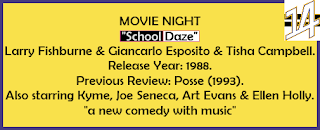
School Daze.

Review #2181: School Daze.

Cast: 
Laurence Fishburne (Vaughn "Dap" Dunlap), Giancarlo Esposito (Julian "Dean Big Brother Almighty" Eaves), Tisha Campbell (Jane Toussaint), Kyme (Rachel Meadows), Joe Seneca (President Harold McPherson), Ellen Holly (Odrie McPherson), Art Evans (Cedar Cloud), Ossie Davis (Coach Odom), Bill Nunn (Grady), Branford Marsalis (Jordan), Kadeem Hardison (Edge), Spike Lee (Darrell "Half-Pint" Dunlap), Darryl M. Bell (Big Brother X-Ray Vision), Joie Lee (Lizzie Life), Alva Rogers (Doris Witherspoon), Jasmine Guy (Dina), and Samuel L. Jackson (Leeds) Produced, Written, and Directed by Spike Lee (#1255 - Do the Right Thing, #1543 - Inside Man, #1643 - Malcolm X, and #1976 - She's Gotta Have It)

Review: 
I don't pretend to know the legacy of certain films, but I do have an interest in the film that comes after one makes their debut feature, particularly if it happens to be one from a director as prominent in black cinema as Spike Lee. School Daze (1988) is curious not only as one released two years after She's Gotta Have It (his formal debut after his student films and shorts, remember) that was followed almost immediately by his third effort in Do the Right Thing one year later. This film was shaped by his experiences that he had when attending Morehouse College (a historically black college in Atlanta) in the late 1970s. Island Pictures, which had distributed Lee's first film, had planned on doing this film as well, but wavering issues in the budget (which finished above $6 million) eventually led to Columbia Pictures acquiring it. Strangely, a movie that talks about sororities and fraternities had a bit of a tough task in finding a place to shoot the film, which included Morehouse (irony?) before Atlanta University was utilized. Apparently, the film had different housing for certain groups of the cast, which led to an unscripted (and filmed) confrontation at a "stepping show". The movie was a modest hit with audiences.

Every so often I have to remember that films of a certain age could actually talk lightly about issues that mattered that seem distinct from now, which starts pretty quickly with a film that starts with someone trying to do a protest about divesting from South Africa. Of course, what really matters for this film is how people treat each other in the facets that come in... colleges and dorms. Within the divides that comes from people of the same color and distinct privileges is a film that also happens to have a few music numbers. I personally don't have any experience with fraternities, but I think we can understand that divides between certain groups and classes is not always black and white as it might seem. Of course, it seems like a fable one tells to try and get people to wake up (almost as if they were in a... daze) to the issues that are mired in the muck beyond arguments over hair. One can say progress has been made in a certain place, but how much of what we say is progress as opposed to being lip service? I liked the movie fine, even though its 121 minute runtime does tend to make one desire the tiniest bit more from its ending, which almost seems to be direct but brief as possibly can be. Fishburne has all the confidence required in a film surrounded by apathy that isn't merely played as a martyr but one with his own biases and charms. The musical numbers are executed with varying effectiveness, but probably the best sequences of the film are in smaller moments. I especially like one scene involving Fishburne and his group going out into town to eat only to confront some locals (which is where Jackson appears briefly) that resent them in their own privileges, because if there is one thing to say about people, it is that there are people who will just look down on anyone who want better for themselves, even to the point of calling them a certain word and say that they'll be like them "just like us". Esposito makes an ideal wannabee with a total absence of awareness for anything but his own group for a distinct act of the public. His narrowmindedness strikes most of all, even with Campbell (and accompanying status in loyalty) right there on the divide of hair and sororities. Amusement is here and there in those selection of scenes for a movie not focused on showing the classroom (Davis having a scene in trying to motivate his football team is a real chuckler). At the end of the day, the black experience is one that cannot be thought as just simple to pin down for easy stereotypes, regardless if one is a college man or not. Living in apathy that just thinks about wallowing in where they are or just being content with a small piece of the action is just not enough when one could also wake up to what's around them. The film is mildly effective in its approach as a whole due to a game cast that makes Lee's second effort at least a useful curiosity to seek out on its own terms.

Overall, I give it 7 out of 10 stars.

December 14, 2022

Ruthless People.

Review #1938: Ruthless People.

Cast: 
Danny DeVito (Sam Stone), Bette Midler (Barbara Stone), Judge Reinhold (Ken Kessler), Helen Slater (Sandy Kessler), Anita Morris (Carol Dodsworth), Bill Pullman (Earl Mott), William G. Schilling (Police Chief Henry Benton), Art Evans (Lt. Bender), Clarence Felder (Lt. Walters), and J. E. Freeman (Bedroom Killer) Directed by David Zucker (#585 - Top Secret!, #664 - Airplane!, #699 - The Naked Gun: From the Files of Police Squad!, #821: The Naked Gun 2½: The Smell of Fear), Jim Abrahams (#028 - Hot Shots!, #375 - Hot Shots! Part Deux, #585, #664), Jerry Zucker (#585, #664, #1274 - First Knight, #1626 - Ghost, #1714 - Rat Race)

Review: 
This is an interesting film to cover. Oh sure, the filmmaking trio of Jim Abrahams and the Zucker brothers (Jerry and David) did plenty of comedy material back to their days with their own small theater in their native Wisconsin, but this one was certainly interesting to consider among the rest. For one, it is the only time that the trio directed a film together that they did not write themselves. The film was written by Dale Launer, who took inspiration from the kidnapping of Patricia Hearst; when asked about the similarities between the film and "The Ransom of Red Chief" (a story about a kid so annoying his kidnappers to where they pay the father to take him back), he said it was just a coincidence. He later wrote for films such as Dirty Rotten Scoundrels (1988) and My Cousin Vinny (1992). This was the third of three films that the trio directed together (after Airplane! and Top Secret), as from that point on, they would direct their own solo projects. The reason for their split was because they simply were ready to move in different directions alongside the fact that they did not see as much financial success as they believed they would from this (due to studio accounting, since the directing salary was split three ways with them). So yes, David Zucker would direct the first two Naked Gun films while also writing it with his brother and Abrahams, and each respective director went their own way in comedy.

So yes, here is a comedy with a premise built on a kidnapping that spirals into silliness when the hostage situation is really a one-way street, complete with mistaken identities, an unrelated serial killer, and a climax on a pier. It may be the odd film in their features, but it is a still a pretty good experience, one with plenty of amusement as a farce with fun misanthropes, complete with a look and style perfectly decadent for the era of the 1980s. With such a cheery dark premise, the key to making it all work is to have folks with enough energy to carry the material with the edge required. What we have is a key quartet ready to handle it together: DeVito, Midler, Reinhold, and Slater. DeVito shows great passion within a role designed with slime in mind: who else but him could play such an earnest villain? He has such confidence in the role, one that can sell the opening monologue with gusto, whereas a lesser actor would make it sound like an exposition-dump. Comeuppance or not, it is satisfying to see him engage as the master of the shit-eating grin in ways that other actors could only dream to get down the way he does. Midler (an actor when not singing on a regular basis) is the perfect type of abrasive: confident in her abilities and roaringly amusing, one who gets on the nerves with righteous timing and no sense of inordinate irritation. Reinhold and Slater play the kidnapping duo with resourceful timing as the nicest folks of the whole film (playing to the irony of them being the only folks we see commit a crime) as beleaguered and shy folks that we like just as much as the folks designed as being ones loved in hating. Morris and Pullman (in his first film role) are the other key group to the puzzle, with the former being good in the conniving side-person to the over-the-top hilarity and the latter being quite amusing as the dimwit. Probably the best representation of the film in its dark glee is an exchange between DeVito and Reinhold in which the latter is trying to lower the price down in the hostage giveaway only to find that the former is practically daring them to send the hostage to the morgue (they would know, because they just came from there!). As a comedy of misunderstandings filled with odd little people, it works out pretty well for 94 minutes, presenting its ever-growing odd situations with useful execution by pros in a useful curiosity: a dynamite script without their intervention that they handle just as well as their other films. Crude but unapologetic, Ruthless People is a neat little gem worth looking into.

Overall, I give it 9 out of 10 stars.

December 23, 2010

Movie Night: Die Hard 2.

Review #016: Die Hard 2.

Cast
Bruce Willis (John McClane), Bonnie Bedelia (Holly Gennero-McClane), William Sadler (Colonel Stuart), Art Evans (Leslie Barnes), William Atherton (Dick Thornburg), Franco Nero (General Ramon Esperanza), Dennis Franz (Captain Carmine Lorenzo), Fred Thompson (Ed Trudeau), John Amos (Major Grant), and Reginald VelJohnson (Al Powell) Directed by Renny Harlin.

Review
This film brings out all the stops of action and story with alright performances that are almost better then the first one (even if you go to watch the action). Although not directed by the first Director (John McTiernan), Harlin manages to make a movie with a bit of the tone from the first one but not too much like it. The plot is decent, but out of the four Die Hard films as of 2010, this one is probably the least remembered even for a sequel because it isn't as fun as the others, but is still a decent film.

Overall, I give it 8 out of 10 stars.