October 13, 2024
Rabid (1977).
October 8, 2024
Creepshow 2.
January 14, 2021
Shivers.
Cast:
Paul Hampton (Roger St. Luc), Joe Silver (Rollo Linsky), Lynn Lowry (Nurse Forsythe), Alan Migicovsky (Nicholas Tudor), Susan Petrie (Janine Tudor), Barbara Steele (Betts), Ronald Mlodzik (Merrick), Barry Boldero (Det. Heller), Camil Ducharme (Mr. Guilbault), Hanka Posnanska (Mrs. Guilbault), Wally Martin (Doorman), Vlasta Vrána (Kresimer Sviben), and Silvie Debois (Benda Sviben) Written and Directed by David Cronenberg (#816 - Crimes of the Future, #1127 - eXistenZ, #1220 - A History of Violence, and #1239 - Stereo)
Review:
"If you admit to the possibilities of the most horrific things, then maybe they won't happen. It's what I do when I make movies. You're hoping it's going to stay on the screen and not come into your life."
There have been a variety of important directors in cinema that came from the nation of Canada, but David Cronenberg most certainly is one of the most transgressive to help shape the course of cinema in body horror with films that provoke just as much interpretation as they inspire squeamish feeling. They inspire confrontation as much as they do chills because they involve qualities of life that are not easy to face in clear comfort, as he aspires to take the audience on a journey to ask questions without needing clear answers. The Toronto native had an interest as a child in reading from a young age (owing to his parents, a journalist and a musician in their interests), ranging from science fiction to comic books to EC Comics, and his initial interest was to become a novelist. While he was an avid cinemagoer (ranging from Westerns to Bambi to The Blue Lagoon), it was the screening of Winter Kept Us Warm (1966) by fellow University of Toronto classmate David Secter that sparked him to get into filmmaking, which he started with experimental work in 1966 that led to two shorts and two arthouse features. Cronenberg approached Cinepix with his script first. The company, if one did not know, had been started in 1962 under the leadership of John Dunning and Andre Link, and Cronenberg would note them as crucial influences on him (the former for filmmaking and the latter on the finance side). The Montreal-based company went from distributing films in Canada and the United States to eventually doing their own with Valerie (1969). They had wanted to tap into the independent market with horror (as was the case with Roger Corman and his films at the time) instead of just sensual-tinged work (the company persists on to the day, although you might recognize them under their current name as Lionsgate Films). Cronenberg had just two films to his output at the time (which were basically like underground work), and Cinepix desired to buy his script without having him direct. Cronenberg was not willing to let his script be filmed without him, and he was close to approaching the lower budget-minded studios in Hollywood and doing the film there before funding was found, with the Canadian Film Development Corporation (now known as Telefilm Canada) helping to allocate funds. Ivan Reitman (co-founder of the Toronto Film Co-op with Cronenberg) served as producer for the film (alongside music supervisor), and he would work with Cronenberg and Cinefix again with his next film in Rabid two years later alongside his own breakthrough venture with Meatballs (1979). The film was shot for $185,000 over the course of 15 days. Joe Blasco was the effects man for the film, and it certainly goes to show the state of the Canadian industry to see this as one of the first serious horror films in the nation.
There were numerous titles that came before and after production occurred, with the initial working title being "Orgy of the Blood Parasites", while the title done for filming was "The Parasite Murders", and in America it was released as "They Came from Within". The funny thing is that the uproar over the film nearly overshadowed the fact that the film was a success from the start with audiences. Since it had been funded in part by the government, there was a bit of commotion done about its merits, most notably with an article in Saturday Night magazine, in which it was felt that Canada shouldn't have a film industry if films like this needed to be made to have an industry; reportedly, the article delayed production of Cronenberg's next film with Rabid (1977) in terms of setting up funding. Obviously time has proven Cronenberg infinitely correct in this regard, since Shivers serves as an important shift in the director's career as his first triumph that serves as a creeping gem. I readily enjoyed the film in its low-budget creeping chills, one that that shows a degree of dark humor within a somewhat familiar premise that works over its limitations for interesting entertainment. We are talking about a movie involving hedonistic zombies that desire pleasure while creeping into your body, after all. Cronenberg has noted that some of the elements might seem familiar when compare to Alien (1979). Think about it: we have a creature that go around a location through someone's orifices and lurk within the stomach that happen to burn acid if in contact with someone's face (Cronenberg once noted that if free love really was true, would this not be what it actually looked like?) - interpret it for yourself, since the writer of that film (Dan O'Bannon) noted that he didn't steal the idea from anybody, he stole it "from everybody!" The effects were done through a combination of condoms, tubing, bottles, and coat hangers that helped move the parasite around to simulate being in the body or being outside, and while the wires might be visible at certain times (like the shot involving it going across the grass), I found it fascinating in its gruesomeness, unsettling with its gooey movement, one that will certainly fit for these monsters of lust.
The acting is okay, showing a mix of somewhat familiar faces and voices with more obscure ones. Hampton for example was more known as a singer and composer, although he did spots on film and TV. He does alright here, even if he seems more indifferent that readily concerned with the growing trend of craven creatures desiring each other's flesh. Silver was noted for his deep voice and roughly a thousand appearances on television alongside occasional appearances in film. He certainly makes a useful impression in terms of moving the plot forward, and he even gets in on the parasite action near the end for effect. Lowry is known for her horror appearances (such as The Crazies), and she proves the best performance for the film, one with captivating spirit that seems out of place with the growing weirdness, and it is her scene in the climax that proves quite fascinating about desire and dreams. Migicovsky and Petrie don't have as much lasting effect, with the former being used more for the stomach (with a creature inside) and the latter to react to all that (plus a scene with Betts), which is okay but not as interesting as the others (Petrie apparently needed to have Cronenberg slap her really hard in order for her to cry when the cameras needed her to cry). Steele doesn't have as much to do, but at least the scene spent in the tub is squirmy enough. Mlodzik is the branch from the previous Cronenberg films, with this being the third of four appearances, and he plays the smarmy manager just fine. The 87 minutes go by with some shivers at what we see play out through a film not afraid of limitations or taboos that strikes a chord with its perversions of the flesh that is entertaining without becoming a lynchpin for weirdness without some sort of interest to keep coming back to where it wants to go. For a director that would only hone his craft further with interesting films involving the body and horror, this is certainly a good starting point to go with Cronenberg and his dazzling display of terror within us. It is a nasty one that might not hit everyone's mark, but I got a kick out of where it wanted to go in unsettling nature to make it count.
Overall, I give it 8 out of 10 stars.
March 26, 2018
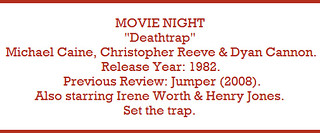
Deathtrap.

Review #1065: Deathtrap.
Cast:
Michael Caine (Sidney Bruhl), Christopher Reeve (Clifford Anderson), Dyan Cannon (Myra Bruhl), Irene Worth (Helga Ten Dorp), Henry Jones (Porter Milgrim), and Joe Silver (Seymour Starger) Directed by Sidney Lumet (#035 - 12 Angry Men, #036 - Network, and #404 - The Anderson Tapes)
Review:
Deathtrap was adapted from the play of the same name by Ira Levin, which had run from 1978 to 1982 on Broadway, holding the record for the longest running comedy-thriller on Broadway. The original play comprised of two acts with one set and five characters. and it is easy to say that the transition to film went smoothly, with the only thing added being scenes set in the theater that bookend the movie - along with a few other small changes. Quite simply, this is an effective comedy-thriller, balancing its elements handily along with having a fine pair in Caine and Reeve. The film takes its time to get interesting, but it never comes off as boring nor stale, although I find that the second half of the movie is where it really gets itself into gear. Caine excels in his role, having the right kind of frantic and resourceful nature that makes him fun to watch on screen, particularly with the snappy dialogue that works with his dry tone. Reeve delivers an entertaining performance, managing to balance a boyish charm and unpredictability quite nicely. Cannon is the weak link in the main cast, coming off a bit annoying at points, with her shrieking being a bit tiresome to hear, although she can come off as endearing for others. Worth is fairly amusing in the parts that she is in, playing her eccentric nature with the right kind of conviction and energy that never rattles too much off the deep end. The movie doesn't elicit too much in terms of scares, but it does manage to elicit excitement from its main two actors in the finale to make up for it. The movie has often been compared to Sleuth (1972), which also featured Caine; I can't say how my opinion would've changed had I seen the other film before this one, but I would hope that the viewing experience for either film isn't bent too much because of any kind of comparison-making. The movie manages to run itself fairly well at 116 minutes, never becoming tedious with its twists nor lengthening itself to ridiculous heights, having fun with the ways it moves the pieces of its jigsaw puzzle kind of plot (which you should see for yourself) handily. This is a fine gem that has some dark humor to go along with its clever nature that works in the places it needs to the most with its cast and arrangements that is interesting enough to recommend.
Overall, I give it 8 out of 10 stars.
July 1, 2013
Movie Night: The Apprenticeship of Duddy Kravitz.
Cast
Richard Dreyfuss (Duddy Kravitz), Micheline Lanctôt (Yvette), Jack Warden (Max Kravitz), Randy Quaid (Virgil Roseboro and Lenny Kravitz), Joseph Wiseman (Benjy Kravitz), Denholm Elliott (Peter Friar), Henry Ramer (Dingleman), Joe Silver (Farber), and Zvee Scooler (Grandfather) Directed by Ted Kotcheff (#025 - First Blood)
Review
To close out Canada Day, I decided to review this film from 1974 (have decided that reviewing Prom Night [1980] would be nonsensical), with familiar actor Richard Dreyfuss as the main lead. I already have watched Dreyfuss in American Graffiti and Close Encounters of the Third Kind, which were both good. This film is where Dreyfuss gets to shine even more, perfectly acting a character who (at least I hope) is perfectly unlikable (though ironically, he believed his performance was terrible), in someways a parallel to Goin' Down the Road, both films cover the spirit of people trying to succeed in a cold-hearted world, with its small benefits and its disasters. Lanctot is alright, but Randy Quaid (Who I last saw in Independence Day, which wasn't exactly good) is better, he manages to blend well into the film, not going over the top, a subdued but fine performances as two characters. The rest of the cast are good, and it is always nice to see Denholm Elliott, no matter what he does. This is a well-made film that manages to have really good scenery but even better filmmaking, a sad film that has biting comedy at times, but it does not veer from its course, keeping itself in check, and managing to be an excellent film.
Overall, I give it 9 out of 10 stars.