

Review #1515: Titanic.
Cast:
Leonardo DiCaprio (Jack Dawson), Kate Winslet (Rose Dewitt Bukater), Billy Zane (Cal Hockley), Kathy Bates (Molly Brown), Frances Fisher (Ruth Dewitt Bukater), Gloria Stuart (Old Rose), Bill Paxton (Brock Lovett), Bernard Hill (Captain Smith), David Warner (Spicer Lovejoy), Victor Garber (Thomas Andrews), Jonathan Hyde (J. Bruce Ismay), Suzy Amis (Lizzy Calvert), Lewis Abernathy (Lewis Bodine), Nicholas Cascone (Bobby Buell), and Anatoly M. Sagalevitch (Anatoly Milkailavich) Written and Directed by James Cameron (#001 - Terminator 2: Judgement Day, #063 - The Terminator, #388 - Avatar, #574 - Aliens, and #606 - True Lies)
Review:
"People call me a perfectionist, but I'm not. I'm a rightist. I do something until it's right, and then I move on to the next thing."
Having particular interests and a particular way of wanting to do them can prove for a resilient director, and James Cameron certainly has proved one of the more memorably resilient directors in ambition. While growing up in Chippewa, Cameron had an interest in building things and in art, although he later expressed interest in doing 8mm home movies after seeing 2001: A Space Odyssey (1968). He had an interest in building and physics in his brief time in Fullerton College, but he moved on to small-time jobs such as truck driving with writing on the side. However, he decided to get himself into films because of the excitement of seeing Star Wars (1977). The following year, he raised funds to do a short film in Xenogenesis (1978). Over the next few years, he worked on a few films in effects and assistant work (such as Battle Beyond the Stars and Galaxy of Terror) before being hired to direct for the first time with Piranha II: The Spawning (1982). Although it was a flop, his next film brought him into prominence within science fiction entertainment with The Terminator (1984). Cameron has ventured beyond filmmaking in subsequent years, such as sea exploring and documentary filmmaking alongside activist work.
What can one expect from a film that is actually longer than the sinking of the ship the film is named after? Director/writer/co-producer/co-editor Cameron spent a great deal of time in research while pitching it as "Romeo & Juliet on the Titanic" to 20th Century Fox, with Cameron taking numerous diving trips with a miniature remotely operated vessels to view the wreckage of the Titanic. The film was a tremendous financial venture, with 20th Century Fox handling the international rights while Paramount Pictures handled the North America distribution for a total $200 million budget upon release...and you know the rest. What's there to say that isn't already known or stated already by someone else? It certainly handles itself well in spectacle and trappings of the period in detail. Once it gets to the wreck, you can't stop the freight train of chaos. Of course the film also quibbles itself with a mediocre love story that bloats itself in woodenness that will either inspire fluster in its audience or snickers at just being a slightly-better version of The Poseidon Adventure (1972) while somehow not being as rewarding as Cameron's previous works. One can make two billion dollars with a movie and still come out of it feeling like they only got 80 cents on the dollar, I suppose.
There proves to be an interesting mix of acting, trying their best in a period drama that also has to not become lost within effects and occasional stilted moments. DiCaprio certainly has an instinctive everyman quality to him, certainly proving idea in resonating charm out of simple things, whether that means first seeing the ship for the first time or his high society dinner act with others. Winslet proves just as resounding, wrapped with resourceful grace that makes the star-crossed romance come across without too many obstacles. They click well and likely prove enough in interest to make the inevitability all the more bittersweet to see play out in a climax effects ride. Zane proves quite enjoyable as the default adversary of the film, surprisingly enough. He is quite hammy in the right places needed when it comes to arrogance and anti-chemistry with Winslet that chews scenery quite handily, and the only quibble I have is that his fate is told to us rather than being shown, because one does need one more hammy last moments with Zane, honestly. Bates proves ready in small moments when it comes to clear-cut contrast with stuffier companions. Fisher comes and goes with inevitable parental conflict over romance that is decent for those fleeting moments needed. Stuart and Paxton bridge the beginning and end with proper fitting in clear perspectives when it comes to the ship and the story that is weaved from it.
For all the expense spared in making one feel like they really are on the Titanic, there are still little details that inevitably spring up. Was it really so hard to depict a mix of fictional and real-life characters without tarnishing reputation? What is the point of perpetuating the myth and lie that J. Bruce Ismay was a coward? While he had his part in the reduction of lifeboats on the ship (which could have had sixty but had barely a third of that), he most certainly did not force the ship to go faster. Perceptions can be everything, and press coverage of Ismay was extremely negative to the point that subsequent film adaptations (including the famed A Night to Remember (1958), which the film apparently shares a few moments of similarity with in terms of arrangement) included this in their portrayals of him (this can be said in a different light about Captain Smith in regards to how history recorded him and his actions before going down with the ship). One depiction was controversial enough to literally inspire an apology to the relatives of William Murdoch (first officer), who is depicted shooting two people before dying himself (the circumstances of his death are disputed, and his body was never found). The enjoyment comes from the obvious for me: the great and wonderfully re-created ship that makes one really experience this ship and the time that comes from it with finesse - and then of course the splitting of said ship that goes from growing waters to panicky escape attempts. This was a pure technical winner for those involved, with Academy Awards ranging from cinematography to visual effects to costume design to other awards like music (score and song) while Cameron would win three Academy Awards. Perhaps this really is just a film that people just love because they love the emotions it can inspire, particularly in crying. If one really wants to judge movies on how well they make you cry, all power to you, but crying at something isn't exactly my thing, and the idea of crying at this almost seems hysterical. To some, it is a great experience, capable of inspiring tears and quotable moments, while others might find it as pure pablum. I recognize its scope and semi-effective touch as enough to win me over on a casual level, where I may roll my eyes at some of its moments while knowing full well it still ranks as good enough to be worth it.
Overall, I give it 8 out of 10 stars.

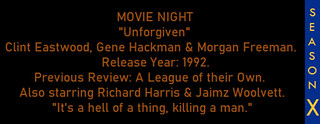 Review #1501: Unforgiven.