Showing posts with label Leonard Rossiter. Show all posts

January 22, 2022

This Sporting Life.

Review #1792: This Sporting Life.

Cast: 
Richard Harris (Frank Machin), Rachel Roberts (Margaret Hammond), Alan Badel (Gerald Weaver), William Hartnell ("Dad" Johnson), Colin Blakely (Maurice Braithwaite), Vanda Godsell (Mrs. Anne Weaver), Anne Cunningham (Judith), Jack Watson (Len Miller), Arthur Lowe (Charles Slomer), Harry Markham (Wade), George Sewell (Jeff), and Leonard Rossiter (Phillips, Sports writer) Directed by Lindsay Anderson.

Review: 
"I suppose I'm the boy who stood on the burning deck whence all about he had fled. The trouble is I don't know whether the boy was a hero or a bloody idiot."

The British New Wave may have been just another style of films released in the 1960s reflecting its country, but it surely merits interest for the directors and stars that came out of its brief wake. Sure, it had similarities to the French New Wave (features imitating documentaries trying to capture a form of real life not seen in prior films in its country), but there is still something worth looking into when talking about British voices, particularly Lindsay Anderson. Anderson was born in British India in 1923. He had a scholarship for classic studies at Wadham College, Oxford before he took service in the Army as a member of the 60th King's Royal Rifle Corps and as a cryptographer. He returned to Oxford after the War and shifted his studies to English before graduating in 1948. He took up writing around this period, which included founding a magazine dedicated to film journalism in Sequence alongside people such as Karel Reisz. In the next decade, he would develop a philosophy of cinema that is referred to as "Free Cinema", in which they advocated for a British cinema that focused on being free from the constraints of demands for documentary filmmaking of the time (i.e. one that aimed for the working class to be seen on screen). From 1948 to 1967, he directed a handful of documentary short films (through funding from sources like Ford of Britain), and his earliest noticed short was Thursday's Children (1954), which he did with Guy Brenton about deaf children and their education. The two were awarded an Academy Award for Best Documentary Short. He also started doing work in the theatre in 1957, which he would do on-and-off for the next three decades. Anderson had his feature directorial debut with this film, and he would follow it up with six further features and two documentaries before his death in 1994.

You have to understand that the film wasn't exactly a roaring success upon release, since producers saw that people likely preferred escapism more so than gritty or bleak realism movies. This New Wave wasn't exactly long for the world, starting with stuff like Room at the Top (1959) and ending with this film and Billy Liar (1963), all with their varying levels of "kitchen-sink realism". Of course, the British New Wave just happened to come around in the time of "Angry young men" era of playwrighting (well, sort of, since that term was coined to promote John Osborne's 1956 play Look Back in Anger). The movie is adapted from the 1960 novel of the same name, with its author David Storey (generally considered one of the writers in the "Angry young men" group) serving as screenwriter. Storey was a former rugby player before he became a novelist and playwright (incidentally, Harris was also a rugby union player in his native Ireland). Consider it like this: "kitchen sink realism" might not have rocked all of British cinema, but it did influence future directors over the next couple of decades, most notably with Ken Loach. The movie is essentially the story of a blunt instrument more than of a man. We are talking of someone who tries to express feelings with sensitivity yet can only respond with a punch for anything. It doesn't compromise at any point in its 134-minute run-time because anything else would seem like a great lie, particularly since it wants to capture what it means to see such raw emotion pour out on screen, whether on or off the rugby pitch (being familiar with football before seeing rugby being played is interesting though). It captures such a unique dynamic between Harris and Roberts, one that teeters between stormy and clumsy when it comes to the idea of togetherness. Harris (who in later life stated once that he would trade all his accolades to play with a senior team back home in Ireland) fits the bill for everything that Anderson wants from him in terms of a brute that is always fascinating to view in his attempts in bravado or even when he is clenched when singing in public (it is easy to see why he moved from supporting roles to star with this performance). He tries to move in romance like he does on the pitch in terms of force, if only because the pitch is the only place where he is in control of himself (working class or not, this is something one can see quite clear). Roberts and her balance between melancholy and abrasive when one sees her on screen against Harris, one made quite clear in the dinner scene when it comes to seeing just who they are in public. Badel and the other castmates are fairly effective in their contrast to the main two, if only because one isn't watching a movie bound to only to the rugby pitch or bound to sentimentality (Hartnell is the warmest of the folks, and it was this role that helped cast him for his most famous role in Doctor Who). The editing by Peter Taylor and cinematography by Denys Coop help in making such a starkly effective film come through in all the layers required, one that is bleak but always on the level in worthwhile entertainment. Dour or not, the best thing that can be said for this film is that it has managed to endure so well for itself in how it doesn't flinch at looking within misery that makes a winning feature film after a half century.

Overall, I give it 10 out of 10 stars.
Next Time: Putney Swope (1969).

May 30, 2018

Redux: 2001: A Space Odyssey.


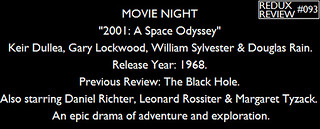
Redux Review #093: 2001: A Space Odyssey.

Cast: 
Keir Dullea (Dr. David Bowman), Gary Lockwood (Dr. Frank Poole), William Sylvester (Dr. Heywood Floyd), Douglas Rain (HAL 9000), Daniel Richter (Moonwatcher), Leonard Rossiter (Dr. Andrei Smyslov), Margaret Tyzack (Elena), Robert Beatty (Dr. Ralph Halvorsen), and Sean Sullivan (Dr. Roy Michaels) Directed by Stanley Kubrick (#044 - Full Metal Jacket and #065 - The Shining)

Review: 
Greetings. The original review was 188 words long, which is the easiest thing to state why a Redux Review for this classic is in order, even after over six years since I wrote the review back in Season 2. In addition, it is the 50th Anniversary year of this film's release. I intended to make a review fitting of the scope of the film, which if you appreciate reviews of mine that go on the long side, this is for you. Enjoy.

Stanley Kubrick wanted to make a kind of science fiction film that dealt with extraterrestrial life and its possibilities that strove to not just be a good science fiction movie, but a well-known one. He started his vision to make that sort of film in 1964, soon finding a collaborator in Arthur C. Clarke. Together, over the next four years, the two collaborated together, writing the screenplay simultaneously with the novel. Kubrick and Clarke used a short story that the latter had written in 1948 named "The Sentinel", which was used an inspiration for the story of the film, along with using ideas from other stories. When it came time for credit on the screenplay, they shared the credit, while Clarke received author credit for the novel (which had elements cut out from the film), which was published after the release of the film. The novel provided elements to the story that the film did not cover, providing more details that you would likely expect, with one big difference being the planet that the characters take a journey to (Saturn in the book, Jupiter in the film), which occurred due to the effects crew could not render convincing rings for Saturn. Clarke would later write three additional novels: 2010: Odyssey Two (1982), 2061: Odyssey Three (1987), and 3001: The Final Odyssey (1997), with 2010 being the only one that was adapted into a film.

In any case, what can one say of 2001: A Space Odyssey? More importantly, what can one examine from something such as this? The best answer lies within what you see from it. There is a certain beauty in its scope of what it does in its 142 minute run-time, being something that clearly stood out among other science fiction films of the time in its style and execution. That's not to say that this film made other films of its genre look bad, it just means that this film sets a high bar for what a science film can strive to be, which you could also argue with regard to Planet of the Apes from that same year. The movie attempted to make an visual experience that connects with its audience like a painting, where you gaze upon what it says with what it doesn't. In an interview for the film in 1968, Kubrick stated this about trying to interpret the film: "You're free to speculate as you wish about the philosophical and allegorical meaning of the film—and such speculation is one indication that it has succeeded in gripping the audience at a deep level—but I don't want to spell out a verbal road map for 2001 that every viewer will feel obligated to pursue or else fear he's missed the point." Nothing in that statement is incorrect, in part because the movie succeeds in making an smart and well made experience that manages to create discussion and wonder after half of a century. It's interesting to watch something that tries to challenge the viewer with something that says something about the nature of man without being too indulgent in its tone. The pacing may prove to be a bit slow for some, but if you have enough patience to let the film sink itself in, you will get some fine entertainment and also something to think about. The Stargate sequence is one of the more notable scenes that endures from the film, done through slit-scan photography of high-contrast images while using landscape shots of places such as Monument Valley. It is a disturbing but breathtaking scene to look at, whether to look at its variety of color or to ponder over what it means. For effects such as these (along with others involving front projection), the film won the Academy Award for Best Visual Effects that year, although due to Academy rules at the time (where only three people could be nominated for their work), Kubrick was nominated (and subsequently won) for the award over the four effects contributors credited in the film (Douglas Trumbull, Tom Howard, Con Pederson, and Wally Veevers).

In a movie filled with visual and audio beauty, the people that act within the film aren't as prominent (particularly with some of the dialogue), but they deliver the kind of performances that you would expect from a Kubrick film in that he controls what you receive with the lines, where people are not going to just deliver random one-liners or overtly ominous lines without warning. The main three actors of Dullea, Lockwood, and Sylvester prove to be fine every-man type of people that do what they are meant to do without much fanfare, with Dullea being useful enough to watch as our face for the second half. Prior to this film, Rain was known mostly for his stage work and his narration for the 1960 documentary Universe that showcased animation of a voyage through space that Kubrick viewed, garnering the help of some of the makers of the film, including Rain. As such, he does a fine job in making the voice of HAL9000 seem to come alive, not being overtly mechanical or too broad for Kubrick's intent; it can even be argued that Rain makes this character seem more human than the other actors, with the sequence at the end involving "Daisy Bell" being a key standout. Before he was hired for the "Dawn of Man" sequence, Richter worked as a street mime for a troupe in England, and he was instrumental in choreographing the sequence with the other actors playing ape-men, and he does a standout job in making the effect click - particularly the push cut involving the bone-club and satellite. The film utilizes classical music, which was innovative for the time as compared to the usual tradition of having a film score by a composer. The movie had a music score commissioned for it by Kubrick that was done by Alex North, who had composed music for films such as A Streetcar Named Desire (1951), Spartacus (1960), and Who's Afraid of Virginia Woolf? (1966). However, Kubrick decided to use the pieces that he had designated as "guide pieces" for the soundtrack instead of North's score. It's hard to disagree with the choice, particularly with pieces such as "Also sprach Zarathustra" (utilized in the opening credits) or "The Blue Danube" during the docking and landing sequences, or "Requiem for Soprano, Mezzo-Soprano, 2 Mixed Choirs and Orchestra" by György Ligeti (with "Atmosphères" also being utilized for the climatic sequence), a haunting piece that is just right for the scenes it is used in.

Simply put, there is nothing quite like watching 2001: A Space Odyssey, a film that stands out on a cosmic scale of its own in the realm of the science fiction genre that still stands out of a hallmark of great film-making. The way that it shows its technology of what people thought 2001 would look like is intriguing  to think about, aside from the other points to think about. It is a demanding movie on an intellectual level, but it isn't something that can only be appreciated by elitists only. It won't be the perfect film for everyone, but it certainly is a monument of some kind to telling an epic story of man that is ultimately worth it. This film has numerous iconic images and moments that have endured in the years that have followed its release, whether involving its music score, the monolith sequences, HAL9000 itself or the aforementioned Stargate sequence that make this movie live on in the eyes of viewers all across the world.

Overall, I give it 10 out of 10 stars.