Showing posts with label Jeff Daniels. Show all posts

October 13, 2020

Looper.

Review #1563: Looper.

Cast:
Joseph Gordon-Levitt (Joe), Bruce Willis (Old Joe), Emily Blunt (Sara), Paul Dano (Seth), Noah Segan (Kid Blue), Piper Perabo (Suzie), Jeff Daniels (Abe), Pierce Gagnon (Cid), Summer Qing (Joe's Wife), and Tracie Thoms (Beatrix) Written and Directed by Rian Johnson (#1027 - Star Wars: The Last Jedi and #1306 - Knives Out)

Review:
"For Looper, I very much wanted it to be a more character-based movie that is more about how these characters dealt with the situation time travel has brought about. So the biggest challenge was figuring out how to not spend the whole movie explaining the rules and figure out how to put it out there in a way that made sense on some intuitive level for the audience; then get past it and deal with the real meat of the story."

As long as there is a good story somewhere in the margins and people involved enough to keep it useful for entertainment or notice to keep attention, you can't go wrong. Born in Maryland but raised primarily in California, Rian Johnson had an developed an interest in film from a young age (noting inspirations such as Martin Scorsese and Annie Hall), graduating from the University of Southern California and its School of Cinematic Arts in 1996 (his first film was a short called Evil Demon Golf Ball From Hell!!!, a low-budget psychological thriller inspired by The Tell-Tale Heart). He would spend years developing and pitching what eventually turned out to be his first feature film in Brick (2005), which proved successful on a budget of less than $500,000. He has continued to keep himself invested in doing distinct movie as director and writer that tell stories in familiar genres that utilize the expectation of the audience at part of the storytelling, which have resulted in five feature films alongside work in television such as Breaking Bad that have been met with fair success.

What, a time travel movie that relies on character-based drama and not so much on time travel as a whole from the 2010s? Granted, Safety Not Guaranteed is a dubious film to compare this to, but the easiest thing that can be said about Looper is that it is an entertaining movie that maintains consistency and entertainment with dutiful direction and cast without shambling into cliché. It certainly seems familiar to those who who have seen the films that proved an inspiration to this feature that ranged from The Terminator (1984) to Witness (1985) to Akira (1988). It loops itself together with enough suitable enjoyment for where the story could unfold next that comes from making a living killing others from a time you have yet to see and then your future ends right by your own hand. It makes a suitable movie about the future and what can come from decisions made or ones that have yet to be made with interesting atmosphere that treats its sci-fi aspects equally with its drama that makes the challenge more about seeing two actors play the same person and how they play off with themselves and others. Gordon-Levitt (wearing make-up to more closely resemble Willis) does a pretty good job here, wry and efficient that comes off with similarity to a youthful Willis without becoming mere imitation, which goes well in tension with Blunt. Willis is given the task of doing his part to play without as much dialogue in general, but he does fairly well regardless, showing the anguish and efficiency that comes from a lifetime that required the latter but didn't see the former coming, and the diner scene where they confront each other (involving a clever way to get around detailing how time travel works without needing exposition) is the best scene with the two in general that lends an edge to the nature of what we're dealing with for a hunter/hunted kind of film. Blunt does well with her gradual role, showing conviction and care as the last key adult piece to the puzzle, going with Gagnon as an interesting family to see play out on screen that gravitates well to our attention from their first few moments on screen. Dano and the other supporting members (including a big-bearded Daniels) do well in lending out the layers of the world the film wants to show involving making a living through a hard and cheap life in the not-too distant future. On the whole what we have here is an intelligent film that rounds its bases with an interesting handle on human nature within time travel that utilizes its expectations from the audience into an engaging time with its own welcome surprises and efficient acting to make for an excellent time to go through 113 minutes with.

Overall, I give it 9 out of 10 stars.

September 18, 2020

Good Night, and Good Luck.

Review #1539: Good Night, and Good Luck.

Cast: 
David Strathairn (Edward R. Murrow), George Clooney (Fred W. Friendly), Robert Downey, Jr (Joseph Wershba), Patricia Clarkson (Shirley Wershba), Frank Langella (William Paley), Jeff Daniels (Sig Mickelson), Tate Donovan (Jesse Zousmer), Ray Wise (Don Hollenbeck), Alex Borstein (Natalie), Thomas McCarthy (Palmer Williams), Rose Abdoo (Mili Lerner), Reed Diamond (John Aaron), Matt Ross (Eddie Scott), Grant Heslov (Don Hewitt), featuring archive footage of Joseph McCarthy, Liberace, Roy Cohn, and Dwight D. Eisenhower. Directed by George Clooney (#851 - The Monuments Men, #1187 - Leatherheads)

Review: 
"I'm not a snob, I like entertaining films as well. But when you do a film like this, or like Three Kings - films that get you in a bit of trouble - it's fun to open up a debate." - George Clooney

It helps to make a message movie if you have enough talent or know-how to get it done right, so it figures that George Clooney wanted to add directing to his foray in addition to acting. The Kentucky-born Clooney attended Northern Kentucky University and the University of Cincinnati (studying broadcast journalism with the former) before dropping out and doing odd jobs like selling shoes before being inspired to take up acting, which resulted in him getting a variety of small roles on TV and film beginning in 1984 that included stints on shows like The Facts of Life (1985-87) and Roseanne (1988-91) before hitting a breakthrough with ER (1994-99) and subsequent film work with From Dusk till Dawn (1996). This is the second film that Clooney was director for, with his debut having been Confessions of a Dangerous Mind (2002). Clooney also served as a co-writer with Grant Heslov (who also served as producer of the film) while being paid $1 each for acting, producing, and writing in order to help with the budget.

In theory, this could make for a pretty good civics lesson in terms of film quality. It yearns to cover a subject probably not too familiar to younger audiences in the Edward Murrow/Joseph McCarthy conflict in regard to journalism and fear in a different time for belief when it comes to the Red Scare. Granted, I am familiar with it in part because of a recent television episode I saw this year depicting McCarthy on American Experience (the one and only show on PBS currently running that I would keep with me on an island), but here we are. What we ultimately have here is an effort that looks the part and surely could teach the part...but just isn't quite as great as it really could be. I applaud the use of black-and-white (filmed in a greyscale set while done through desaturation after production for release on B&W print stock), in that it does make a modest attempt at period piece drama without looking like a desperate attempt at emulating 1950s/60s films like 12 Angry Men (1957), this much is for sure. But if I really desired a throwback to an older era in terms of style or substance, by goodness I would just watch those films in how they constructed their story instead. It yearns so desperately to be thought of as a film to ponder discussion about fear and ethics within the workplace and beyond, but it just seems lacking in fulfilling all of its desires beyond platitudes that seem too hagiographic to actually say something about Murrow beyond the obvious (which will surely rank differently with either admirers or detractors of him).

It is the idea that it could bring about holding one to honesty and being careful about what is told to us in media that is more attractive than what really gets shown, and the style + acting is the thing that braces things from collapse. Strathairn practically blends himself perfectly into the role, deftly doing well with what is given to him in capturing succinct dignity that carry the re-creation of words from the past without trouble, albeit with one significant quibble. Technically speaking, everyone else is fine, but they all fall into the same trap with Strathairn: in following along with its singular focus on its subject matter without much else room for context, the lives of the folks we are following seem practically empty in comparison, as if these people didn't have lives beyond the news. For example, Downey Jr and Clarkson's little chemistry involving them having to hide their marriage from work is an interesting one with a few little "cute" moments, but they as a whole don't contribute much else besides that to the film in terms of charm or substance. Clooney follows along the action with Strathairn fine, but there's always that sinking feeling that he will just blend into the background and you wouldn't even notice/care, as the nuance slowly morphs into something else. Langella is interesting to view, but he seems more deserving of further substance beyond carefully cut moments. Others provide jumble words about come and go fine, but one is begging for a longer focus or at least something to draw upon that doesn't feel like a point-by-point film of events.

The historical quality can prove interesting (for better or worse) to view in the classroom, particularly with its usage of vintage footage of McCarthy (which is better in some way than having an actor try to replicate him). Of course, the whole part about See It Now being reduced from its regular weekly slot happened in 1955, not immediately after the McCarthy episode (which was attributed to its low ratings in prime-time, including a loss in a primary sponsor in Alcoa, as compared to his "lite fare" Person to Person, which lasted longer). The film even starts with an inaccuracy involving listing Murrow's accomplishments before he starts his speech to the Radio and Television News Directors Association in 1958 by listing "Harvest of Shame" - which wouldn't air for two more years (dramatic effect staging is one thing, but it really is a bit dubious when trying to stage Murrow's speech about "wires in a box" with date misremembering). The See It Now show (broadcast March 9) probably hastened McCarthy's demise, but one bigger key would be something more indirect - ABC's decision to air the hearings of McCarthy vs the U.S. Army live gavel-to-gavel beginning in April (with that key moment of asking about "having no sense of decency" being in June - if one goes by records of polling of McCarthy however, he reached his peak of opinion approval in January of 50% before dropping negative by April). 

Again though, it all depends on how much one can really cover of the perspectives of that time and place. In this sense, what we have here is a film that runs way too short at 93 minutes, as if the footage involving depth and awareness ran off a cliff. This isn't so much a period classic as it is one that desperately requires citations and books to run parallel with it. This is an example of a film that will either stick in one's minds as something to ponder on with worthwhile discussion on the merits that land or one that will fester in the frustration of what didn't land. Call me an iconoclast or stubborn, but this film just didn't work enough for me in freeing my quibbles with its deluge of style over substance and scope that make it any better than if one simply picked a different way to experience history and the discussion that comes with it.

Overall, I give it 6 out of 10 stars.

July 11, 2020

Terms of Endearment.

Review #1470: Terms of Endearment.

Cast:
Shirley MacLaine (Aurora Greenway), Debra Winger (Emma Greenway-Horton), Jack Nicholson (Garrett Breedlove), Danny DeVito (Vernon Dalhart), Jeff Daniels (Flap Horton), John Lithgow (Sam Burns), Lisa Hart Carroll (Patsy Clark), Huckleberry Fox (Ted "Teddy" Horton), and Troy Bishop (Tom "Tommy" Horton) Directed by James L. Brooks.

Review: 
"While you're doing it, it is sort of a lonely kind of feeing, even though you are surrounded by so many people giving beyond the call. That's generally true of movies, there's a sense of urgency, people risking their tail, people woking past exhaustion. That's what moviemaking is."

Some films just have all the right pieces go into the right places, one where talented people can be led by talented directors to make a talented comedy-drama, which is proven tremendously so with this film. At the helm at director was James L. Brooks, who would serve as producer and adapted the screenplay from the 1975 novel of the same name by Larry McMurty (who you may recognize as the writer of novels such as Horseman, Pass By and The Last Picture Show), which was the first of two novels involving the character of Aurora (with The Evening Star turned into a film of its own thirteen years later). It was the first film for the 43-year old Brooks, who had forged a long road from a rough childhood to work at CBS as a host-turned-copywriter to work in television writing. through the help of Allan Burns. It was in 1969 that he helped create his first television series - the groundbreaking Room 222, one of the first shows with a black lead character (played by Lloyd Haynes). The following year proved just as beneficial, since Brooks and Burns were brought on by Grant Tinker to help develop a show for Tinker's wife, which resulted in the enormous hit The Mary Tyler Moore Show and subsequent spinoff classics in Rhoda and Lou Grant, and he soon added film to his lineup with writing and co-producing in Starting Over (1978). The chance to do a film of his own came not long after, although it would take a few years to develop into full. The original actress intended for the main role of Aurora was Jennifer Jones, since she and her husband had the rights to the book and had sent the book to Brooks as a vehicle for her. However, while he liked the book, he wanted to do on his terms without it being a vehicle for a certain actress, which led to him getting Paramount to get involved and do the film themselves. MacLaine was picked because Brooks felt that she was the only one who saw it as a comedy, while Sissy Spacek soon left for Winger to enter. The third key piece to the film is Nicholson, who came into the film because of the rejection of another actor for a role that was written into the film independent of the book: Burt Reynolds (an actor I love to see in films that unfortunately honored his commitment to Stroker Ace). Sure, others did decline the role before Nicholson signed on (including Paul Newman), but I think we both know how much a tremendous presence Nicholson proved to be, who wanted to play a middle-aged character without the requisite crisis that came with it for those type of character while taking inspiration from an astronaut friend and a relative of his.

It is evident pretty quickly how the film operates as a comedy-drama: a curious movie with a balnce of laughs and tears that earns most of its moments on screen in coming to terms about what family means as things continually change for both parent and child. We care to see these characters because we believe in these folks and their struggle - whether it involves fussy squabbles or squabbles of the heart. It is smart enough to maintain its 132 minute pace with meaningful foundation and sentiment without becoming a manipulated parody of itself, since there is so much great chemistry between its main trio that never seems sacrificed for any sort of cheap joke or sob-story moment (alongside the fact that I don't take manipulation arguments seriously for films like this that are too competent to be labeled as such). MacLaine and Winger might've had a strange time filming together, but they sure make for a great mother-daughter team on screen. MacLaine bursts with a great understanding of what is needed from the material, hovering over things with pathos and attention to all that matters in chemistry with her on-screen daughter and her on-screen lover with Nicholson, which serves well for inquisitive excitement. Winger proves just as well in delivering a captivating performance filled with smart independent charm and timing for interaction with the situations that require it, evolving with the times in how she is with others like Daniels (a good immature performance for someone in their second film role). If the film just had those two, that would probably be enough, but having Nicholson in the mix pushes it into the stratosphere with his presence, because he is such a force of nature even when having just a portion of time to really spring your attention for his interesting appetite for life. Others, like DeVito, Daniels, and Lithgow prove well in filling in the counterparts to the main duo when it comes to trying to define some sort of "love". On the whole, the film moves from place to place that makes the time go by carefully while getting to its wrenching climax with focus.

For the fourth time in the history of the Academy Awards, a director would win an award for their directorial debut (Delbert Mann, Jerome Robbins, and Robert Redford), and Brooks gained a further distinction as one of a select group of folks (twelve as of 2020) to win three Oscars for one film, since the film also won for Best Picture and Best Adapted Screenplay. It is evident to see why the film attracted so much attention, because it is a tremendously well-made film that tugs at the heart with wit and tragedy that make for a prime film to watch of its era for its stars and direction.

Overall, I give it 9 out of 10 stars.

July 4, 2019

Gettysburg (1993).

Review #1242: Gettysburg.

Cast: 
Tom Berenger (Lieutenant General James Longstreet), Jeff Daniels (Colonel Joshua Chamberlain), Martin Sheen (General Robert E. Lee), Sam Elliott (Brigadier General John Buford), Stephen Lang (Major General George Pickett), Maxwell Caulfield (Colonel Strong Vincent), Kevin Conway (Sergeant Buster Kilrain), C. Thomas Howell (Lieutenant Thomas Chamberlain), Richard Jordan (Brigadier General Lewis A. "Lo" Armistead), James Lancaster (Lieutenant Colonel Arthur Fremantle), Richard Anderson (Major General George Meade), Royce D. Applegate (Brigadier General James L. Kemper), John Diehl (Private Joseph Bucklin), Joshua D. Maurer (Colonel James Clay Rice), Patrick Gorman (Major General John Bell Hood), Cooper Huckabee (Henry Thomas Harrison), and Brian Mallon (Major General Winfield Scott Hancock), with narration by W. Morgan Sheppard. Directed by Ronald F. Maxwell.

Review: 
How does one do proper justice to a film such as this? It is a film that runs at 254 minutes (with 17 additional minutes added for the Director's Cut), making it one of the longest films released by an American studio. The original intent was to broadcast this as a miniseries for TNT, after ABC turned down backing the project earlier in the decade. However, it was felt by network namesake and famed media mogul Ted Turner that the rushes coming in were good enough to release in theaters. The film did indeed get shown on TNT the following year, shown on two nights to a viewership of over 20 million; it did not prove to be a major success at the box office, making back only twelve million on a $20 million budget owing to a limited release of less than 300 theaters at its peak distributed by Turner-owned New Line Cinema and being limited to few screenings per day (due to the length, naturally), but it did prove to be a hit on the video market, with its attention to authenticity ensuring that it would have a place with any history or Civil War buff. This is a film that had been sitting on my shelf for over a decade, and I had wondered exactly how to approach this over the years (alongside the question of exactly how many times my father must have put the film on to watch, with its disc having to be flipped over to experience both parts), but I find that at long last it needs to have its day in the spotlight. One must admire the courage to try and make a film like this, adapted from the 1975 historical novel The Killer Angels by Michael Shaara (awarded the Pulitzer Prize for Fiction for his novel) with adaptation by director/screenwriter Maxwell that used many writings from the book; it is a sprawling spectacle that was filmed on location in Pennsylvania, including scenes recreated on the actual battlefield (allowed by the National Park Service), with plenty of Civil War reenactors to go around to contribute the scale that this movie wishes to show at times through the three-day battle.

What is a film about a battle if not one with a detailed ensemble cast such as this, headlined by Berenger, Daniels, and Sheen most terrifically. Berenger (the first in a line of actors with some sort of big facial hair) shines amiably, having plenty of moments to give credence to such a key role with careful tenacity, which helps carry the first half and chunks of the second well. Daniels plays his side of the coin quite well for himself, showing plenty of humanity and courage that also crucially carries well for the first half. Sheen is just as efficient, blending right in with such a key figure that makes his appearance count without struggle, thoughtful and determined as per the expectation. The rest of the cast make certain they stick out whenever they show on screen, whether it is from the beginning or midway in, acting to the standard one could expect in filling into men long gone but infused into the legend of Gettysburg. People such as Elliott, Conway, Howell, and Huckabee make it count for that first half (the first two hours at least), while others such as Lang, Jordan, and Lancaster accompany what they can in the latter half. It can be easy to see why a project like this was made in the first place, and it does become apparent that this did indeed belong on a movie screen, where the full weight of battle and drama can come out for all to see again and again through the hours.

I will admit that the first half does tend to run a bit better than its second, building its time and characters with a bit more handling than the second half, although the film never has a moment when it all crashes down or feels too out of depth. It is patience and appreciation that carries the tide rather than boredom or confusion. It yearns to cover ground on both sides of the conflict, not devolving itself into one easy corner - it may be about a battle, but it sure makes time to show besides the battle, of these men who have fought other men of their country, a war of freedom and rebellion (or whatever view one has historically) that raged for four years. Despite the war persisting on for two more years after Gettysburg, this proved to be a key fight, and the film makes sure to never lose focus on earning its moments, and the jewel is the execution of the grand battles and accompanying music from Randy Edelman. It isn't a perfect films by any means, and it certainly isn't the easiest one to stick through, but the curious ones at heart who love their history or ones deeply invested in long sweeping spectacles will (and have) find much to appreciate and care for here. Craftsmanship and hard driving work from all involved rule the day here, showing great care and authenticity for such an important event with balance and honor.

Happy Independence Day, folks. I sure hope you enjoyed this unique double-header and I hope you enjoy the 4th and all that comes with it - there are plenty of things to try and cover this month, and a little bit of patriotism helps along the way in getting there. I'll be happy to see where the Independence Day Feature takes me for next year and beyond.

Overall, I give it 9 out of 10 stars.

April 29, 2019

2 Days in the Valley.


Review #1212: 2 Days in the Valley.

Cast: 
Danny Aiello (Dosmo Pizzo), Greg Cruttwell (Allan Hopper), Jeff Daniels (Alvin Strayer), Teri Hatcher (Becky Foxx), Glenne Headly (Susan Parish), Peter Horton (Roy Foxx), Marsha Mason (Audrey Hopper), Paul Mazursky (Teddy Peppers), James Spader (Lee Woods), Eric Stoltz (Wes Taylor), Charlize Theron (Helga Svelgen), and Keith Carradine (Detective Creighton) Directed by John Herzfeld.

Review: 
Sometimes you just need a crime movie about people who share in common the fact that they are just a bunch of weirdos - whether you have seen this type of movie before or not. They aren't exactly winners, but they have some sort of "unrealized potential" (as described by writer/director Herzfeld) - and it all comes together to make an okay film. Herzfeld's previous experience with direction of films was primarily television specials and movies (such as his two works with ABC Afterschool Special in 1980 and 1981), with one theatrical release with Two of a Kind in 1983. Admittedly, the cast listing is likely to prove more interesting, since you have a movie that can say it has scenes with key highlight stars such as Aiello, Headly, Mazursky, Spader, Stoltz, and Theron making for a feature that probably should have been better. It won't serve as anyone's favorite film to watch for anyone's marathon, but at least there is enough here in terms of charm and occasional action to make it a fair use of 105 minutes. It sure tries to move itself swiftly with tricks and twists, some of which that work and others that mostly feel like a tap on the door rather than a big blast. It is at least sometimes present with a sense of dark humor that rolls alongside a plot connecting its dots together across people in the San Fernando Valley, which goes well enough. Its the interactions that can come from it that make this roll through the bumps, such as Aiello and Headly, or Mazursky (a director who can't go through ending it all in a cemetery because his yapping dog is with him) with Mason. Easily, the one who I revel in watching is Spader, who walks right through playing a slimy creep like this without struggle, whether acting with Aiello and a clock or with Theron. Aiello is also pretty fun to be with, wry and useful to be around with, such as when having to interact with these other nuts (including the one he thought would work fine as his other hitman partner). The time spent with Daniels and Stoltz isn't too particularly long, but it is fine to see how they act within the lines of the cop angle of the film - one with cynicism, one with ambition. Hatcher falls as the weak point, not being as interesting to follow with, minus one fight with Theron that actually is pretty amusing to see go down. Cruttwell is somewhat amusing, but he doesn't really have much to do for the second half. The best that can be said for the film is that it doesn't overstay its welcome, bookending itself with some charm and decent entertainment (with a worthy enough climax) - it isn't perfect, but there is something here worth curiosity, due to its assembled cast and where they go from there. It is a movie that finds itself on a road going 76 on a 70 limit, having a bit of movement without going off the rails or all the way still.

Overall, I give it 7 out of 10 stars.

July 30, 2018

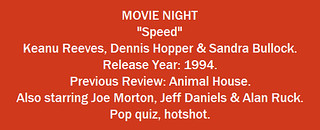
Speed (1994).


Review #1115: Speed.

Cast: 
Keanu Reeves (Officer Jack Traven), Dennis Hopper (Howard Payne), Sandra Bullock (Annie Porter), Joe Morton (Lt. "Mac" McMahon), Jeff Daniels (Officer Harry Temple), Alan Ruck (Doug Stephens), Carlos Carrasco (Ortiz), Glenn Plummer (Jaguar owner), and Richard Lineback (Sgt. Norwood) Directed by Jan de Bont (#812 - Twister)

Review: 
At long last, Speed. I never intended for the Upcoming Features to have the film listed for so long (roughly a year or so), but it took a while to find time to do this one. Hope you enjoy.

Speed is an accomplishment in its execution of action and energetic nature that has numerous assets to achieving its goal as a popcorn thriller. This was the directorial debut of de Bont, a Dutch cinematographer who was responsible for numerous films such as Die Hard (1988), The Hunt for Red October (1990) and Basic Instinct (1992). Graham Yost, who had written for television shows such as Hey Dude prior to this movie, was inspired by his father Elwy telling him about Runaway Train (1985), which was about a train speeding out a control that had been based on an idea by Akira Kurosawa. Yost's original script was set entirely on the bus, with the sequence involving the bus looping around being at the parking lot of Dodgers Stadium instead of an aiport. Josh Whedon was brought in to do (un-credited) work prior to main production beginning, with Yost stating that most of the dialogue was written by Whedon, adding "We were very much in sync, it's just that I didn't write the dialogue as well as he did." In any case, having the film not having all of its time on the bus, such as the elevator sequence or parts involving the police (such as Daniels) outside the bus do make the action come off well in not being overwhelming nor sluggish in its 116 minute run-time.

The main three of Reeves, Hopper, and Bullock all manage to stand out well, doing great in their own ways. Reeves proves to be a capable lead hero, having an edge of vulnerability alongside an air of resourceful nature that makes him interesting to watch, whether when jumping a bus or trying to adapt to the situation of the plot. Hopper makes for an entertaining villain, having the right sense of timing with his lines that carry weight with the motivations written without resorting to being generically evil or chewing too much of the scenery, having a sardonic charm to him. Bullock holds her own well, proving to be a capable one to pair off with the action and Reeves, for which they have a fair amount of chemistry with each other. The others also do fine in their time on screen, such as Daniels, Morton, or Ruck, who both pull off their respective mannerisms and motivations well. The bus members don't have too much particular time to really shine, but they are believable people who don't come off as too annoying or too painfully generic.

The movie is a thrill ride from start to finish, having a consistency to what it wants to execute on screen that rewards the eyes without assaulting it. It isn't the kind of movie that wants to challenge the viewer too heavily, but it sure will give them something to behold in terms of what could and what does happen without being insulting to their intelligence or pushing things too far, having its share of fun moments. Arguably the most notable moment of the film is the bus jump scene. California Interstates 105 and 110 were used for a majority of the freeway sequences in the film, and while de Bont was scouting the area he noticed that there were missing sections and was inspired to add the sequence. Not to spoil too much about the stunt itself (or the feasibility of doing said stunt), but the sequence as a whole is breathtaking to watch, having a certain excitement that never falls prey to feeling too unbelievable. On the whole, the film works on a level of consistency that can be appreciated and aspire to after over two decades. It is the kind of movie you can appreciate on a technical level, where it even received Academy Awards for Best Sound Editing and Best Sound Mixing. There is enough suspense to make for an incredible time for viewers, especially ones with action in mind.

Overall, I give it 8 out of 10 stars.

October 2, 2015

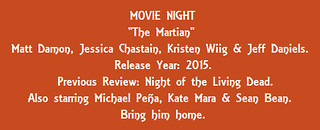
The Martian.


Review #739: The Martian.

Cast
Matt Damon (Mark Watney), Jessica Chastain (Melissa Lewis), Kristen Wiig (Annie Montrose), Jeff Daniels (Teddy Sanders), Michael Peña (Rick Martinez), Kate Mara (Beth Johanssen), Sean Bean (Mitch Henderson), Sebastian Stan (Chris Beck), Aksel Hennie (Alex Vogel), Chiwetel Ejiofor (Vincent Kapoor), Donald Glover (Rich Purnell), Benedict Wong (Bruce Ng), and Mackenzie Davis (Mindy Park) Directed by Ridley Scott (#100 - Blade Runner and #530 - Alien)

Review
This is the 13th movie from the local movie theater, and what better way to cap the lucky number with a science-fiction movie? Quite well, I'd say. Talk about a fun movie. Without getting much in the way, I recommend seeing it. Why? Because it's a tremendous way to spend two hours in an adventure that manages to be more than the sum of its parts, while also managing to treat its audience with respect. The movie (based off the novel of the same name by Andy Weir) is not about the isolation of a man trapped in a planet all on his own as one would guess, but about how he adapts with his personality also playing a factor. Damon can be funny, but his main performance is excellent because you believe that this man is trying and doing everything to stay alive. The movie never wavers, balancing the scenes on Earth and the scenes with Damon on Mars nicely. The rest of the cast is also excellent, managing to be convincing while also likable. Chastain makes an effort to resemble a Commander, acting with grace and authority that never comes off as fake sounding. Her crew are also pretty good, especially in the last half, where it really is fun to see them all come up with a plan. Daniels, Wiig & Ejiofor also do a good job, having some quick chemistry. Lastly, Glover (though not in the movie much) is memorable and a good kind of quirky that adds a little more charm to the movie, while also being helpful, so that's another plus. It's certainly an interesting movie to listen with regards to science, and it's always nice to remind me about the Mars Pathfinder and make me want to know a little more about hexadecimals. The effects and sets are wonderful, never looking fake at all, as we instead are gazing at the beauty of it all. Mars is certainly an interesting planet to think (and watch) about, and that's why it matters when we discover something new, or about any planet, really. Yes, we live on Earth, but that doesn't mean we should shun ourselves of hearing about attempts to discover something new or learn new things, while keeping an open mind. Enjoy the movie, and enjoy every day on this planet.

Overall, I give it 9 out of 10 stars.

September 4, 2011

Movie Night: Cheaters.

Review #066: Cheaters.

Cast
Jeff Daniels (Dr. Gerard Plecki), Jena Malone (Jolie Fitch), Paul Sorvino (Constantine Kiamos), Luke Edwards (Darius Bettus), Blake Heron (Matt Kur), and Dov Tiefenbach (Irwin Flickas) Directed by John Stockwell.

Review
This film is actually really good. The premise is a true story based on the 94-95 Steinmetz cheating scandal in which a student got the test answers and the team used it to cheat their way to first, before it all came down. The acting is genuine good, considering that most of the cast are just teens. Jeff Daniels plays his role, making you almost sympathetic to the cheaters because..well Whitney Young (the rival school) has won so many consecutive State championships (nine years), and yet they've gotten the better funding and everything. The movie offers the question: Is cheating wrong? And under any circumstances, is it right to cheat? The film does it all, making it a good film.

Overall, I give it 8 out of 10 stars.