Showing posts with label Kim Basinger. Show all posts

June 18, 2022

Redux: Batman (1989).

Redux #040: Batman (1989)

Cast: 
Jack Nicholson (Jack Napier / The Joker), Michael Keaton (Bruce Wayne / Batman), Kim Basinger (Vicki Vale), Robert Wuhl (Alexander Knox), Pat Hingle (Commissioner Gordon), Billy Dee Williams (Harvey Dent), Michael Gough (Alfred Pennyworth), Jack Palance (Carl Grissom), Jerry Hall (Alicia Hunt), Tracey Walter (Bob the Goon), Lee Wallace (Mayor Borg), and William Hootkins (Lt. Max Eckhardt) Directed by Tim Burton.

Review: 
"I liked parts of it, but the whole movie is mainly boring to me. It's OK, but it was more of a cultural phenomenon than a great movie." - Tim Burton

If you remember correctly, 1989's Batman took the world by storm when it was released in June of 1989 in ways that have not been forgotten when it comes to blockbusters and comic book movies. Michael E. Uslan, inspired by reading Batman comics as a kid, had a desire to make the definitive version of Batman that had been envisioned by artist Bob Kane and writer Bill Finger when they created the character in 1939. Uslan was a fan of the main character alongside the family of villains, and he even taught a class about comic books at Indiana University. Of course, when Uslan first approached DC Comics about making a movie, they thought it was a crazy idea, because the character's popularity had diminished in the years that followed the cancellation of the 1966 television series, which certainly was still in the public consciousness for the character (which makes sense, as the Adam West interpretation certainly matched the era to a T). Uslan cultivated his movie credentials by working at United Artists (after graduating law school), and he credit DC head Sol Harrison as a mentor in getting the process to a good start - the rights to Batman were bought by Uslan and Benjamin Melniker in 1979, aligning with producers Jon Peters and Peter Guber (it should be noted that Guber and Peters, hairdresser-turned producer and possible scumbag,  manipulated their way to be main producers in getting a deal with Warner Brothers that sent Uslan and Melniker to executive producers with only "net profits"). Uslan even wrote a script with a friend to try and give people an idea of what he wanted to make to counteract the preconceived idea from doubtful skeptics along with a "creative blueprint" memo, complete with having Jack Nicholson in mind for the Joker. Warner Bros. decided to serve as the studio to produce Batman in 1980, but their attempts to have a script by Tom Mankiewicz (contributor on the Superman movie in 1978) did not go well. At any rate, pre-production stalled until 1986. Warner executive Bonni Lee got Burton to join in on the project, helped by the success seen in his work on Pee-wee's Big Adventure (1985) for the studio, although the success with Beetlejuice (1988) gave the formal greenlight in 1988. Burton, at the suggestion of Peters, picked Keaton to play Batman because of their work together on the latter film, one that he felt would have the audience suspend its belief and take the actor seriously. He also stated that the locale of Gotham City had to be just as important a character for the movie to work. Steve Englehart and Julie Hickson each wrote film treatments before a screenwriter was hired. Sam Hamm wrote the story (alongside side work done by Burton, without credit), but the screenplay was done by Hamm and Warren Skaaren. Rewrites were done by Skaaren with others, excluding Hamm due to a strike by the Writers Guild of America. Influences included stories such as Alan Moore & Brian Bolland's The Killing Joke (a story that Burton personally loved in understanding the mythology) and Frank Miller's The Dark Knight Returns. Bob Kane worked as a consultant on the film (coincidentally, he credited Finger, who died in 1974, as a "contributing force", although Finger was not given proper credit until 2015). Peters tried to mold Burton in his image when it came to making a Batman that he didn't want to be thought of (in his words) "Wussman", complete with making suggestions for the climax, which originally involved a different character meeting their end, and he actually commissioned a 38-foot model of a cathedral for the characters to be for said climax. At any rate, Peters and Guber did not return to produce the sequel, but they reaped the benefits of being behind one of the biggest blockbusters of its time; as his third feature film, Burton described the filming process as "torture", but he returned for the sequel in 1992.

When I saw this film originally in 2011, I was a fourteen-year-old trying to write quickly and write what I liked on the spot with a movie. Long story short, those reviews aren't great, so a redux movement is slowly building up steam by me to get as many redux-es possible for reviews I feel deserve better. This one, even with 200 words for what was somehow called a 10/10 movie, seemed very ripe for a second look. Actually, it is a third look, because I did watch this movie a couple of years later to try and refresh my memory, which didn't exactly help this movie too much. The third time around has basically confirmed that the best memories about a movie are sometimes left to younger eyes. Burton thought that the best way to approach the movie is to see Batman and Joker as essentially two of a kind in odd freaks that are intertwined in origin. Anton Furst and Peter Young designed the sets for the film, which shows an Art Deco style that makes Gotham seem reminiscent of something like The Cabinet of Dr. Caligari (1920) or noir. You have to understand that people actually thought that casting Keaton was going to make it seem like a comedy because of his work on stuff like Mr. Mom (1983). It is interesting to consider that because of the fact that Keaton approaches the material with righteous timing and balance required, even if one seems to think that he is overshadowed by you-know-who - him going "you wanna get nuts?!" is an interesting highlight when thinking of the fair blend of seeing the deeper-voiced Batman and the unassuming Bruce Wayne. Of course, the high-priced and high-billed Nicholson steals the show, because playing an agent of chaos that grins his way through the proceedings is a role to dream for that he stretches right to form. This isn't to say that it is a hammy performance as it is just one that controls the mood of the movie that might as well make it his movie more than Keaton's movie. Basinger does fine with the balance between the battle of freaks, bewildered but not washed out; the scene where she waltzes into the Batcave doesn't exactly help. Apparently, Wuhl's character was meant to die in the climax, but the filmmakers liked him so much they let him live. That is probably the best compliment I can find when talking about him in this film, because the less said about him, the better. Hingle and Gough don't have too much to particularly do, but at least one takes them seriously for what is needed. Williams in theory should be really interesting, but since there would be no more Williams as the character of Dent, it comes off as ridiculous to have him cast but not actually do anything (besides, Walter is the amusing quiet man in the group). 

Maybe there is an argument that the movie might be a bit too dark for younger folks. This is ridiculous, since I doubt that one will really have this much trouble with a PG-13 rated movie like this in just letting the visuals play out on screen; one could also just stick with the West version of Batman, since it also holds up well, incidentally. Danny Elfman, best known for his work with the band Oingo Boingo alongside Burton's previous two features, did the music, albeit with Prince composing and writing songs as well. The music score ends up sticking better than the songs, because one clearly won't forget the main theme. As a whole, the 126 minutes does go by with loose construction, one that tries hard to ride on style rather than substance, which only can go so far before falling all the way off the offbeat wayside. Seeing the origin for the Joker is far more interesting than the eventual reveal of the Wayne murder, because it makes things too convenient to have two characters create the origin for each other (i.e., having a random guy being the killer is far more tragic than just finding out it is the guy you happen to be going off to face and probably take down). I think the fact that the success of the movie inspired the development of an animated series for television probably is more of a point in the favor of the legacy of the film in what it impacted rather than the overall content of the film itself (the series, premiering in 1992, is arguably the best portrayal of Batman outside of the comics). It is a roaring adventure that builds a mystery with fair success for haunted spectacle with Burton's sensibilities clashing with other visions to make a strange concoction that lives and dies in the time it was made. It is the movie that tried to top the heights raised by Superman (1978), pure and simple. Of course, whether the movie works or not in its execution is up to you. 

Overall, I give it 8 out of 10 stars.

December 7, 2020

Wayne's World 2.

Review #1608: Wayne's World 2.

Cast: 

Mike Myers (Wayne Campbell), Dana Carvey (Garth Algar), Tia Carrere (Cassandra Wong), Christopher Walken (Robert G. "Bobby" Cahn), Kevin Pollak (Jerry Segel), Ralph Brown (Del Preston), James Hong (Jeff Wong), Kim Basinger (Honey Hornée), Chris Farley (Milton), Michael A. Nickles (Jim Morrison), Larry Sellers (The Weird Naked Indian), with Ed O'Neill (Glen), Gavin Grazer (Scott), and Aerosmith. Directed by Stephen Surjik.

Review: 

It did not take long for folks to realize that Wayne's World was a success. To recap, Wayne's World began twofold: Mike Myers came up with the idea of Wayne that appeared in sketches for Citytv's City Limits and CBC Television's It's Only Rock & Roll in the mid 1980s before Myers joined Saturday Night Live in 1989 and starred in segments for the show with Dana Carvey that were featured from time to time for the next five years. The 1992 film of the same name, doubted by Paramount Pictures to be much of a hit, made nine times its $20 million budget, ranking as the most popular film based on a SNL sketch (which it still holds today). The sequel retains the main duo alongside a selection of cast members from the original alongside a sprinkling of cameo appearances (both musical and not), with Myers writing the film again with Bonnie and Terry Turner. However, the road to making a script for a sequel proved quite tough, in that the original idea by Myers wouldn't end up being used, which involved inspiration taken directly from Passport to Pimlico (1949), where the main duo would end up making their own country. Weeks before production was to start, this inspiration was pointed out by studio executives (who did not have enough time to negotiate the rights to the script and were thus incensed, with one threatening Myers personally) and they made Myers write an entirely new script. Conflicts between Myers and Penelope Spheeris over editing in the first film led to consideration of a new director in Stephen Surjik, who was known for his direction of segments for The Kids in the Hall (1990-1993). 

The film was not quite a hit like the original, but it was a marginal hit with audiences as the last hurrah for these characters. When it comes to comedies, it is a mediocre follow-up that will nevertheless please those who seek another ride of goofy charm with hit-and-miss pace. Those who weren't really fans of the original won't exactly be swayed here, because sometimes it really does feel like a bit of a rehash from before - truly, it is the take-or-leave-it film for the comedy season. Myers and Carvey prove up to the task of creating some amusing moments, whether spent with themselves or playing against others; in the case of Myers, it namely involves a vision of Jim Morrison as some sort of spiritual journey (inspired by Myers and his own journey that he took upon the death of his father) that leads to a few interesting moments to those who don't see the Morrison bits as just a bit. Actually, the "fight" (involving dubbing) between Myers and Hong is kind of funny, too. For Carvey, the moments spent with Basinger playing a femme fatale prove quite involving (along with seeming tacked there to give him something to do besides linger with the look-alike played by Olivia d'Abo). The segment showing Myers and Carvey talk about "The Leprechaun" is a decent highlight to look at for a minute, in the sense that it is probably better done than the actual film made fun of. It is nice to see Carrere, even if her part seems like a re-hash from before (in other words, trying to do music in the face of slimy producers), but the highlight is the re-creation of a particular sequence from The Graduate (1967) near the ending. Walken does well with straight-laced slime that nevertheless can grab a chuckle (or be used for better work involving straight-laced humor). Pollak is used for a bit involving eyes that goes over fine, but it is Brown that takes up the supporting reins in pairing with Myers/Carvey, which he does in a take off the eccentric character he played in Withnail and I (1987). There are various cameo appearances throughout the film, ranging from Rip Taylor to Aerosmith to Charlton Heston, with some proving better than others (Charlton Heston over Jay Leno? Shock, shock, shock. Actually, I take it back, TV sentimental favorite Ed O'Neill's brief moment as the oddball Glen is the better one). In other words, 95 minutes is just enough to handle a few decent moments and a mostly-original run-through for a follow-up film that will fit just fine for what one desires to see in entertainment without being too disappointed. In other words, one can party on just fine with this film without hurling too much back at the screen.

Overall, I give it 7 out of 10 stars.

December 12, 2017

8 Mile.


Review #1023: 8 Mile.

Cast: 
Eminem (Jimmy "B-Rabbit" Smith, Jr), Kim Basinger (Stephanie), Brittany Murphy (Alex Latourno), Mekhi Phifer (Future), Anthony Mackie ("Papa Doc"), Michael Shannon (Greg Buehl), Eugene Byrd ("Wink"), Evan Jones ("Cheddar Bob"), Omar Benson Miller ("Sol George"), De'Angelo Wilson ("DJ Iz"), Taryn Manning (Janeane), and Proof ("Lil' Tic") Directed by Curtis Hanson.

Review: 
Admittedly, I don't listen to much hip hop or rap music, so I wondered if that would play a role in what I thought of this movie, which was released 15 years ago last month. The idea of a singer playing a version of themselves in their own film isn't a new thing, but 8 Mile manages to be an entertaining and engaging movie. It pulls from familiar elements, but it utilizes those things along with some fine performances in order to make something worthwhile. This happens to be the first and only performance for rapper Eminem as a leading actor, and he does a pretty good job for the climate of the film, which was based on his upbringing (while set in 1995), although the film isn't merely a biopic. He just reels you into caring about his progression throughout the movie and how gritty that road can prove itself to be. Naturally, his singing performance is pretty good as well, with some engaging (and crude but effective) rhymes. One of my favorite scenes is a sequence at his workplace near a lunch truck, where we see rapping from some of the workers, with the last one coming from Eminem, which is pretty amusing, actually. The climax with the rap battles is also pretty good as well, particularly the final one with a good sense of honesty to it.

This is a movie with a raw honesty to it that lends itself to not being a rags-to-riches story nor fall to pandering tactics. The fact that it was filmed mostly on location in Detroit helps give the movie a look that seems authentic and fitting. Sure, the film may be somewhat depressing and bleak at times, but at its heart the film has honesty to drive itself forward. Phifer pulls off a fairly engaging performance as well; the rest of the group of friends that are shown through the film at times (Jones, Benson Miller, Wilson) are pretty interesting standouts as well, giving a bit of levity to the drama that the movie pushes fairly well. Murphy pulls off her role with a sense of vulnerability along with passion that clicks pretty well with Eminem in the time she has on screen. Basinger pulls off a capable performance as well, with the right sense of watchability and care that you'd expect for a movie that is down-to-earth as this one is. The rest of the cast is fairly acceptable as well. The music in the film is pretty decent, and "Lose Yourself" is a key standout that is engaging to listen to. In fact, Eminem won the Academy Award for Best Original Song for the song, becoming the first hip hop artist to receive the award. In any case, this is a movie that does not allow itself to become too familiar or too easy to pigeon-hole with other musical dramas while being a good piece of entertainment.

Overall, I give it 8 out of 10 stars.

June 16, 2014

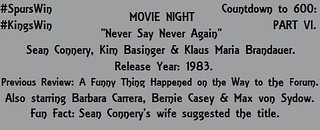
Movie Night: Never Say Never Again.


Review #595: Never Say Never Again.

Cast
Sean Connery (James Bond), Kim Basinger (Domino Petachi), Klaus Maria Brandauer (Maximillian Largo), Barbara Carrera (Fatima Blush), Bernie Casey (Felix Leiter), Max von Sydow (Ernst Stavro Blofeld), Edward Fox (M), Rowan Atkinson (Nigel Small-Fawcett), Gavan O'Herlihy (Jack Petachi), and Alec McCowen (Q) Directed by Irvin Kershner (#004 - RoboCop 2 and #114 - The Empire Strikes Back)

Review
Due to Kevin McClory's lawsuit over the rights of the novel Thunderball, he gained the filming rights of the novel, even after the movie was released, despite EON's attempts to stop it, and McClory would help produce a new version on the Thunderball story, with Lorenzo Semple, Jr (notable for developing the 1960's Batman TV show and Flash Gordon - #215) writing the screenplay. Connery was brought to play the role 12 years after he last played Bond in the spectacular disaster of a film Diamonds Are Forever (#280). The film was released 4 months after Octopussy (#360), the other Bond film from 1983. So which one is better? It's hard to discuss this movie. Of the six Bond films in the 1980's, this isn't the worst one, but it also isn't the best. Connery does good in his return to Bond, a little aged but a little more defined, and refined. The supporting cast isn't bad (though Atkinson is an exception), it's certainly better than Thunderball's cast, especially with Felix Leiter, who is more interesting to watch this time around. Basinger does well, she has at least some chemistry with Connery, and the dance scene is at least watchable. The villain is ever more interesting because he leaves an impression on you, though admittedly the scene where he plays against Bond in a video game is either an odd inclusion or just surprising, but then again the other Bond movie had Bond dress up as a clown, so pick your poison. The aquatic action isn't as annoying due to not there being as much of it, which is refreshing. The movie is actually pretty decent, not too bad, and it's a good way for Connery to have one last hurrah. There, I've reviewed all the Bond films, even the unofficial ones...for now.

Overall, I give it 8 out of 10 stars.

May 22, 2013

Movie Night: The Natural.


Review #383: The Natural.

Cast
Robert Redford (Roy Hobbs), Robert Duvall (Max Mercy), Glenn Close (Iris Gaines), Kim Basinger (Memo Paris), Wilford Brimley (Pop Fisher), Barbara Hershey (Harriet Bird), Robert Prosky (The Judge), Richard Farnsworth (Red Blow), and Joe Don Baker (The Whammer) Directed by Barry Levinson.

Review
While this is the first time I've reviewed a film with Robert Redford, this is not the first time I've mentioned him (#252 - Quiz Show), as he directed that, and I said this about it: "The film is nail-gripping in its drama, being very well delivered, all thanks to the direction by Robert Redford." This time, he's the main star and not behind the camera, but does this film work well either way is the question. And...I like it. While at times the film sounds a bit much in idolizing its main character sometimes, it does have heart and the baseball action goes well with it. Redford does a pretty good job, essentially a "natural" at this. Duvall is fine, and Close does a noticeable, but good job. The rest of the cast, especially Brimley, do good as well, and the film goes along without much flaws. It has its moments and it goes along well in a decent 137 minute pace. Films like these don't come along too much, but when they do they have good merit to it.

Overall, I give it 10 out of 10 stars.