Showing posts with label Martin Kove. Show all posts

April 22, 2026

The Karate Kid Part III.

Review #2526: The Karate Kid Part III.

Cast: 
Ralph Macchio (Daniel LaRusso), Pat Morita (Mr. Miyagi), Thomas Ian Griffith (Terry Silver), Robyn Lively (Jessica Andrews), Sean Kanan (Mike Barnes), William Christopher Ford (Dennis de Guzman), Jonathan Avildsen (Snake), Martin Kove (John Kreese), with Randee Heller (Lucille LaRusso), Pat E. Johnson (Referee), Rick Hurst (Announcer), and Frances Bay (Mrs. Milo) Directed by John G. Avildsen (#003 - Rocky, #895 - Rocky V, #1689 - W.W. and the Dixie Dancekings, #1759 - The Karate Kid, #2203 - The Karate Kid Part II)

Review: 
I suppose The Karate Kid could only go so long. You might remember that the second movie was a moderately entertaining movie, albeit one that basically only worked on the thinnest of ideas: exploring Mr. Miyagi and why anybody would want to depart Okinawa Island (okay and Miyagi defended himself against Kreese before giving him a honk on the nose) that was made purely for crowd-pleasing. You might remember Robert Mark Kamen had written the first two films and was totally fine with writing a third film...albeit with a twist. He actually envisioned a film that would be set as a flashback (read: a dream) to "16th century China" that basically would've aimed to be a Hong Kong kung fu movie, complete with wanting a woman cast as the lead. But the producers did not want to do this, and Kamen initially rejected writing the script. However, when the producers couldn't find people to do a proper draft, Kamen was lured into doing it for a boatload of money. The plans to focus on Kove's character went down the tubes because Kove was busy with the TV show Hard Time on Planet Earth, which necessitated the character of Silver. With a middling script but with a mostly intact crew* that included John G. Avildsen directing and serving as co-editor again, the movie was a moderate success with audiences but not nearly as much as the last two films for everyone involved, with Avildsen later calling it a "horrible imitation of the original" (ironic coming from the director of Rocky V, no?). Truly, there were never any more Karate Kid movies again. Until they did a "Next" one in 1994 with just Morita returning. Or a remake in 2010. Or whatever the hell "Cobra Kai" was in 2018*. Or a "Legends" movie in 2025 with Macchio. But hey.

The real disappointment is that the movie is 111 minutes long. The best parts of the movie don't come from its lead actors, the best parts come from laughing at the sheer ridiculousness that is displayed on screen. The dynamic between Lively and Macchio basically was dynamited from the get-go of the fact that Macchio was, well, 27 at the time of filming and that Lively was, well, eleven years younger (incidentally, Macchio is four months older than Griffith, who is meant to be a buddy of Kove's character...from the Vietnam War). You might say, hey, a platonic relationship might be interesting to explore besides the usual fare of action dramas. Unfortunately, neither look like they want to be anywhere near each other, as if one was watching mannequins. Macchio looks like he is ready to be on the beach or anywhere else besides doing karate, but I will say that Morita has the more thankless role of basically getting nothing to grab onto besides the same song-and-dance of defending himself in karate situations. The old man you see at the supermarket probably is more invested in what he is doing than Morita, arguably. Griffith basically gets the chance to ham it up and accelerates it to levels you could only dream to do, which unfortunately doesn't help when you realize that Kanan doesn't really make for a suitable force to face Macchio (all they can think of is to have the character straight up commit crimes like to hold him hostage on a cliff). You've got a lead that basically talks like he attended the Rocky Balboa School of Dialogue to go along with basically nothing for Morita to do besides talking in platitudes and then Griffith shows up to ham up the screen. It's not enough that Griffith is playing the buddy of Kove (sent to Tahiti), he comes up with the most ridiculously complicated scheme to get revenge for his compadre*: He gets Daniel to want to compete at the All-Valley Tournament (remember that this is set one year after the first film) by hiring a dude to go around harassing Daniel into wanting to fight while Miyagi is focused on the bonsai shop (don't ask). Then he ingratiates himself with Daniel in order to train him that basically leads to him torturing Daniel in the regimen. Finally, after revealing his ruse when Daniel wises up...that is when Miyagi decides to help train Daniel at the tournament all along (conveniently, the "defending champion" only has to do one match). Did I mention that Silver's character is also an evil businessman? At least you know what is going to happen in the end, but the karate is just what you saw before, although I will say it is amusing that the movie straight up just ends after the final match, as if they knew that there was nowhere to go up or down from. As a whole, you get a movie that satisfies nobody, does nothing particularly interesting, and satisfies only the most bored of completionist people imaginable. It's a middle of the road movie in the most insulting of ways possible.

Overall, I give it 5 out of 10 stars.

 
*Cinematographer James Crabe, who shot the last two films, had to withdraw due to being severely ill due to AIDS, which he passed away from in 1989.
*I heard that Cobra Kai has Kreese and Silver get into a fight to the death? What?
*Go Padres?

July 22, 2024

Death Race 2000.

Review #2231: Death Race 2000.

Cast: 
David Carradine ("Frankenstein"), Simone Griffeth (Annie Smith), Sylvester Stallone (Joe "Machine Gun" Viterbo), Mary Woronov (Jane "Calamity Jane" Kelly), Roberta Collins (Matilda "The Hun"), Martin Kove (Ray "Nero the Hero" Lonagan), Louisa Moritz (Myra), Don Steele (Junior Bruce), Joyce Jameson (Grace Pander), Carle Bensen (Harold), Sandy McCallum (Mr. President), Paul Laurence (Special Agent), and Harriet Medin (Thomasina Paine) Directed by Paul Bartel (#955 - Eating Raoul)

Review: 
"Most of my guilty pleasures in this film were ripped out by the roots by Roger Corman before the film ever saw the light of day and substituted with crushed heads and blood squibs. Nevertheless, there is a joke about the French wrecking our economy and telephone system that I still find amusing. And I am pleased by the scene introducing the Girl Fan (played very effectively by my sister Wendy) who is to sacrifice herself beneath the wheels of David Carradine's race car and wants to meet him so that the gesture will have 'meaning'."

Okay, so you have managed to encounter a Roger Corman-related production. Gratuitous and all around weird is what one might expect from a film that was inspired by the publicity that came for the film Rollerball, which was slated for release in June of 1975. Corman found a short story to crib for an adaptation with Ib Melchior's "The Racer", which actually had been inspired by the revulsion Melchior seemingly had when he saw a death at a motor race. Script troubles meant that the film had a prolonged production schedule, which initially had a script written by Robert Thom before re-writes were done by Charles B. Griffith and its eventual director (Corman would play influence when it came to looking over tone, naturally). At director was Paul Bartel, who had made his first noted film with the short The Secret Cinema in 1968 (after several years of shorts, which included work for the United States Information Agency) before becoming a feature director with the horror-comedy film Private Parts (1972), which was produced by Gene Corman; the following year, Bartel did second unit work on Big Bad Mama. Interestingly, Carradine wanted to pick a movie to help his film career after spending three seasons as the star of Kung Fu, the television show he is perhaps most famous for (having seen the show, this is probably true), and the film was released one day after the final show airing; he came around after Peter Fonda was approached and had declined (of course, there was a moment in time during the turbulent production that had Bartel thinking about replacing Carradine with Lee Majors (!), but the two eventually bonded). The film was a hit in the general sense; Bartel's next film was Cannonball (1976), which had Carradine as star that aimed for comedy within its inspiration based on a real race (as you might know). In 1978, Corman, having a contract with Carradine, spearheaded a push for another vehicle-related film with motorcycles that that eventually became Deathsport (as directed by Allan Arkush and Nicholas Niciphor), which was not particularly successful. In 2008, a remake of the film was done by Paul W. S. Anderson, which was the first of five "Death Race" films that were either follow-ups to the 2008 film or in the case of Death Race 2050 (2017, as produced by Corman), a sequel to the original.

So, here is how the future is envisioned by 1975 standards: to pacify the population under a tough regime dealing within crisis comes the "Transcontinental Road Race" that has seen twenty years of violence and gore because of combat of cars and, well, people. You get to see the gauntlet of just who would do these kinds of races: people who dress up like gangsters...and Nazis. In the land of B-movies, it really can come down to just how much fun one sees on screen when it comes to execution and commitment. This is aa pretty neat one that surely delivered a tiny bit of inspiration for Mad Max (1979). The conflict of nudity and gore with the attempts at comedy (the latter was favored by Bartel and Carradine to an extent) makes for a curious experiment that may have a random viewer wondering just what the hell they are supposed to think about its 80-minute runtime of lean and mean nature. That strange casual blend (in of itself a "Frankenstein" creation of Corman and Bartel) of guts and the occasional chuckle that arises from people watching the violence of car-on-man (or in the case of point-seeking to the extreme, the elderly) is a feeling that one always hopes to find in an exploitation film. I particularly like hearing from Bensen and his mimicking of Howard Cosell when it comes to being a voice from the crowd (alongside other "journalists"). Carradine just has a natural charm to him that attracts one's curiosity in what is left said and unsaid within that everyman nature that comes out for a role that if played by a lesser talent would've been just a film with less interesting impact in terms of (pun intended) drive. He has the gumption to roll with the inane goofiness that is apparent even with the real assertion one could argue about just how much curiosity people really have about violence (in living color). It's interesting that two of the early roles for Stallone before Rocky (1976) were Corman productions, with this and Capone being released in 1975 (the same year that he got the inspiration for, well, Rocky). He provides a few good heel chuckles in a cast that is mostly fine in those silly one-note mannerisms (which ranges from the aforementioned Nazi helmeted person to, uh, bits of nudity). There is just a mayhem and energy here that works so well in making light of the obsession that arises from violence in terms of the spectator or opportunistic journalists that is hard to match. The climax is pretty neat in one lasting chuckle that really does prove Bartel had the right idea in mind (Corman wanted to film an ending where the FBI shoots an annoying reporter rather than, well...) in making a film with useful timing in manic commitment without having to be broad about it. In the long run, it is a neatly cheap movie with the idea of conveying what people seem to think about seeing violence play out right in front of them that goes with the entertainment value of the film: fun on the run.

Overall, I give it 8 out of 10 stars.

November 2, 2023

The Last House on the Left (1972).

Review #2135: The Last House on the Left.

Cast: 
Sandra Peabody (Mari Collingwood), Lucy Grantham (Phyllis Stone), David A. Hess (Krug Stillo), Fred Lincoln (Fred 'Weasel' Podowski), Jeramie Rain (Sadie), Marc Sheffler (Junior Stillo), Eleanor Shaw (Estelle Collingwood), Richard Towers (Dr. John Collingwood), Marshall Anker (Sheriff), and Martin Kove (Deputy Harry) Written and Directed by Wes Craven (#474 - A Nightmare on Elm Street, #558 - Scream, #633 - Red Eye, #939 - Swamp Thing, #1156 - Wes Craven's New Nightmare)

Review: 
"We were seeing Buñuel and Fellini and Truffaut and all of these guys who were making these imaginative, wonderful films, and that’s where I fell in love with it. And it was just a matter of a certain point, my department chairman saying “Stop goofing around with cameras in student-film class. I want you to either get your Ph.D. or you’re fired.” And I quit on the spot. Finished out my term, but that’s when I started going to New York to get into films. And I was kind of clueless about that kind of horror film. I just fell in love with film itself. I think all that shows in the original Last House." - Wes Craven

Sometimes I think people are just a bit ridiculous when it comes to reacting to violence shown on screen. But hey, what do I know, I've never been influenced by a film when it comes to committing violence, so here we are. It's weird to consider this film as a starting point for two horror film people. Sean S. Cunningham had been born in New York City but raised in Connecticut before working in theater and documentary companies before being a director. He had actually started his directorial career with The Art of Marriage (1970), an "educational" type of nudie film. The money he made from that led to the sex mockumentary with Marilyn Chambers as star in Together (1971), which attracted the interest of Wes Craven. Born in Cleveland to a strict Baptist family, he had made his first short films after studying in college for philosophy and psychology (he even was a professor for a brief time). Apparently, he was involved in the X-rated world of filmmaking. At any rate, he was hired by Cunningham to serve as assistant editor while helping with the dailies from the reshoots on this film. The resulting success led to an offer to do another film to the company if they wrote them a check, which led to this. Craven would serve as writer, editor, and director while Cunningham would produce (his wife did the costume design). Craven based his film (made for roughly $90,000) on Ingmar Bergman's The Virgin Spring (1960) while expecting it to only have appeal for the group of theater owners in Boston that the film was sold for, which apparently went from ideas of being a "hardcore" film to something more in horror. A mix of "guerrilla-style" shots came with stuff shot in New York City, Long Island, and Westport, Connecticut alongside effects that had to be done with condoms and sand. There were a handful of titles thought of before the one they went with: "Sex Crime of the Century", "Night of Vengeance", "Grim Company", and "Krug and Company". Somehow, the one they used seems better. There was never a sequel made despite ideas to, but a handful of castmates such as Peabody and Lincoln returned with Cunningham for the sexploitation comedy Case of the Full Moon Murders (1973). In 2009, Craven and Cunnigham served as producers on a remake of The Last House on the Left.

There were various edits made to the point that a separate editing room had to be set up by Craven and company to repair prints that were cut out by people. Craven had to wait five years to direct his next feature with The Hills Have Eyes (1977) while stating that there was a feeling over the years of "a definite progression or arc from feeling guilty about what I had done" with this one. Peabody dominates our focus for a time as the lead in a way not generally seen when you consider her last scene. She did not have a positive time making the film, probably because in addition to a lack of confidence, one of the killer characters was being played a method actor, and at one point to help with getting the right sort of "level of desperation", an actor put her right by a cliff and suggested to her face to throw her off if she messed up the take. Needless to say, her fear is one shared by the person watching it, because I can picture that fear of being in the wrong place for the worst time all over her face. Hess plays the lead killer role along with contributing to the music (with some singing also done by Steve Chapin) that is a mix of folk rock and bluegrass. I actually think the music works to the film's advantage in terms of strange unsettlement, since we are talking about a movie that doesn't go the usual way in spooky scares. He also proves a good reason for why he would be present in a handful adversarial roles over the years as a chilling threat. The semi-attempt at documentary feel can only go so far, because the attempts at playing with us by having scenes shot with comic relief (such as say, two cops that try to make their way at one point by getting on a van with an overload of chickens) only work to the cheapest of imitations. Maybe that's the point, only the violent scenes carry some sort of attention to us, particularly when the climax operates on the idea that even the most normal standing of folks will go to extremes when pushed. I especially find the sequence of the killer group finding their way to the parents' place while presenting as salesman and lounging around the bed of the woman they just killed as particularly unsettling. Lincoln and his writhing display gets the best result possible: being told to follow orders even when it means death. Shaw and Towers make a suitbalr parential duo going from staid to horrific in a flash (if someone tells you to tie them up and unzip, well, it doesn't leave much to the imagination of how this might have started as a skin flick first). Of course, the scene where a victim is told to pee themselves is also infused in terror, but again, your milage will vary on how effective the film is regardless of its crude filming and execution for 84 minutes. As a whole, this is the kind of film that will prove one's mettle in viewing horror films for what they are when it comes to violence because, well, some people respond to this film for what it is better than others. I'm inclined to call it horrifically good.

Overall, I give it 8 out of 10 stars.
Halloween The Week After, Year Five continues with The Blob 1988 remake.

November 18, 2021

The Karate Kid (1984)

Review #1759: The Karate Kid.

Cast: 
Ralph Macchio (Daniel LaRusso), Pat Morita (Mr. Miyagi), Elisabeth Shue (Ali Mills), Martin Kove (John Kreese), Randee Heller (Lucille LaRusso), William Zabka (Johnny Lawrence), Chad McQueen (Dutch), Ron Thomas (Bobby Brown), Rob Garrison (Tommy), and Tony O'Dell (Jimmy) Directed by John G. Avildsen (#003 - Rocky, #895 - Rocky V, #1689 - W.W. and the Dixie Dancekings)

Review: 
Sure, you could make the connection that a director best known for a film about fighting in John G. Avildsen might have wanted to make a hit that was reminiscent of Rocky (1976) for the 1980s (the one song associated with this film coincidentally was meant for Rocky III). Of course, the actual inspiration for this film came with its writer in Robert Mark Kamen. The New York native was actually a student of karate, having studied it after he was beaten up at the 1964 New York World's Fair (note that one of the characters is actually named after a famed martial artist, for which Kamen trained under a sensei that had learned from said martial artist). Kamen eventually became a screenwriter (with his first collaboration being with Taps in 1981), but the story for this film actually came from Kamen being asked if he could make a story around an article that had been optioned by a producer that involved a kid taking up karate to deal with neighborhood bullies. The funny thing is that the main two roles had widely divergent options before settling with Macchio and Morita; Nicolas Cage was one consideration, while the other role was really meant for a perceived serious actor...Toshiro Mifune was actually considered for the role, but he wasn't chosen because he did not actually speak English (I would like to point the irony that Kamen learned karate from a master that didn't speak English). Instead, it went to the actor that Avildsen fought for: Noriyuki "Pat" Morita, who was more known as a comic than a serious actor (I suppose folks really weren't convinced that comedic actors can do useful serious performances); the best scene in the whole film with him was one that nearly got cut because of requests by Columbia, but Avildsen managed to keep it in the film (of course, martial artist Fumio Demura has also been cited as source of inspiration for Morita, complete with stunt doubling for him in parts).

Look, we're talking about a movie where someone learns to basically be a black belt in two months. If one can take that carefully enough, I'm pretty sure you can handle two hours of material that could have teetered over the saccharine line and yet manages to be a riveting experience with a game cast that proves up to the task of capable entertainment. The karate passes enough to keep one interested (unless one is really, really into accuracy) without diverting all the attention from the routines the story has to stretch to get where it needs to go without becoming the "why doesn't the main character call the cops on these weirdo karate punks?" kind of movie. Macchio proves adept with cultivating a likable lead focus with enthusiasm and sense of timing that makes the journey worth taking without seeming like a hokey TV special (i.e in the overall message involving not just learning something just to enact violence on them). The support around him always will circle to Morita first when it comes to this film - for good reason. Leave it to Avildsen to pick an unlikely name for an intriguing role that worked out exactly to what is needed to essentially serve as the counterpart for Macchio without turning the role into a diet of clichés and tired lines. In short, he makes a worthy presence of soothing interest that serves the film well in patience (although the sequences involving him training the lead seem reminiscent of the training done in Rocky (1976), it has a different touch). It was his most notable role, one that would earn him an Academy Award nomination for Best Supporting Actor: the scene that likely helped sell it involves him opening up about his past with who he loved and lost, for which the chemistry between Macchio and Morita helps a poignant bond seem only more fitting. Of course, the others in the cast keep up just fine: Shue makes a fair pairing with Macchio, while Kove absolutely makes for a worthy foil that is accompanied by Zabka and his wavering intimidation that makes a useful contrast to focus on from time to time. The film sells its moments with balance that never seeps into camp value, whether for overt seriousness or veering all the way into comedy, maneuvering its way through with pride to go along with a few quotable lines (for which I'm sure you've heard someone wax on or wax off before). Oh sure, there is quite an enduring legacy to the film, which believe it or not was actually a surprise hit to a good number of the cast and crew. Part II (1986) and Part III (1989) were both directed by Avildsen while featuring Macchio, Morita, and Kove (and Kamen as writer), while The Next Karate Kid (1994) featured only Morita. A remake of the original film was done in 2010. A web television series sequel followed with Cobra Kai (2018-present), featuring both Macchio and Zabka as star. If that is not enough, there are even plans for a musical on Broadway. At any rate, The Karate Kid (1984) has endured for so long because of how it managed to put all the right moves together at the right time with the right cast and right folks behind it to make a fun movie and a worthy piece of the capsule of good stuff from the 1980s without becoming gripped as a relic of the time. Sincere without sickening, it doesn't take long to become gripped by its charm, for which I would say is a useful accomplishment worth checking out.

Overall, I give it 8 out of 10 stars.

Next Time: Turkey Week looms. With a week to Thanksgiving, it is almost time for Movie Night: Turkey Week Two, which will take place from November 21 to November 27 (i.e. the week of Thanksgiving, like last year) while focusing on films that are thought of as "turkeys", if you will; last year featured eight films from different decades that went from The Terror of Tiny Town to Freddy Got Fingered, and the approach will continue.

July 4, 2016

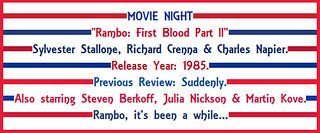
Rambo: First Blood Part II.


Review #818: Rambo: First Blood Part II.

Cast
Sylvester Stallone (John Rambo), Richard Crenna (Col. Samuel Trautman), Charles Napier (Marshall Murdock), Steven Berkoff (Lt. Col. Podovsky), Julia Nickson (Co-Bao), Martin Kove (Ericson), George Cheung (Lt. Tay), and Andy Wood (Banks) Directed by George P. Cosmatos.

Review
It really has been a long time since I reviewed a Rambo movie (#025 - First Blood), hasn't it? It wasn't entirely intentional, it just got lost in the shuffle over nearly 6 years and over 700 reviews later, but here it is, to end this Independence Day doubleheader. The movie was written by James Cameron, though Stallone also provided significant input as well. In a nutshell, it's a movie that for me is moderately entertaining, but not as good as the first film. It's an action movie without much in the way of developed characters, but it satisfies anybody looking for some action, while not insulting their intelligence too much. There is some sort of fun in seeing specialized arrows blowing up stuff. Rambo is Rambo, with Stallone excelling as the action hero he was in the 80's, purely simple. There isn't too much for the supporting cast to do, but Crenna and Stallone do have some good brief scenes with each other, along with him and Nickson. I really can't complain all too much about a movie that is simple, but to the point in its intentions, with Rambo having a little monologue at the end that does at least bookend the movie well enough. It's not a bad 7/10 movie, and I'm sure others enjoy it more than I do (which I can respect), so take it for what it's worth.

I hope you enjoyed this doubleheader for Independence Day, as I did watching these movies and writing these reviews.

Overall, I give it 7 out of 10 stars.