Showing posts with label Harvey Keitel. Show all posts

October 15, 2022

From Dusk till Dawn.

Review #1903: From Dusk till Dawn.

Cast: 
Harvey Keitel (Jacob Fuller), George Clooney (Seth Gecko), Quentin Tarantino (Richard 'Richie' Gecko), Juliette Lewis (Katherine 'Kate' Fuller), Ernest Liu (Scott Fuller), Salma Hayek (Santanico Pandemonium), Cheech Marin (Border Guard / Chet Pussy / Carlos), Tom Savini (Sex Machine), Fred Williamson (Frost), Michael Parks (Texas Ranger Earl McGraw), Kelly Preston (Newscaster Kelly Houge), John Saxon (FBI Agent Stanley Chase), Danny Trejo (Razor Charlie), Brenda Hillhouse (Hostage Gloria Hill), and Marc Lawrence (Old Timer Motel Owner) Directed by Robert Rodriguez (#1193 - Alita: Battle Angel)

Review: 
The vampire movie has many forms besides Dracula, but I am sure you already have figured that out. You could look at it from a number of ways, particularly in the 1990s, which saw films by Francis Ford Coppola (you know, that mediocre Dracula adaptation) and John Carpenter (Vampires). So yes, an action horror movie with Robert Rodriguez is certainly an interesting idea. This was the third feature film by Rodriguez as a director, who made his feature debut with El Mariachi (1992) that led into more success with Desperado (1995). The story was done by Robert Kurtzman (a co-creator of the KNB EFX Group, which was behind the effects of this film) while the screenplay was done by Quentin Tarantino (the third and last film he wrote without directing after True Romance (1993) and Natural Born Killers (1994)). Rodriguez and Tarantino, best friends since the 1990s, would collaborate with each other eleven years after the release of this film with the double-feature Grindhouse (Planet Terror / Death Proof). The film was followed by two direct-to-video sequels that were produced by Rodriguez, and he would develop a television series based on the feature in 2014.

Admittedly, the enjoyment of the film will depend on how big one is in a film that tries to blend action and horror with measured patience - it is action all the way, but at least the horror is fun. The first hour is all about the set-up in what you might see coming from the action cliches that Tarantino clearly has an interest in (he likened the film to The Desperate Hours (1955) but with a supernatural twist), complete with having a core group of characters that have useful rapport with each other. Watching a movie with killers that have a bit of charm does seem a bit familiar if you've seen some of Tarantino's work, but of course it also probably goes hand in hand with Rodriguez in terms of kinetic enjoyment (like many of his films, he served as editor). So yes, it is essentially like having a sandwich of two favorable elements packed together (say, peanut butter and jelly), if it works well for you, go right on ahead, because it will satisfy the B-movie dreams one could go for, complete with green blood splatter. It may be a movie of the macabre, but it is one with a good-natured smirk to things, which works just enough in trying to make one believe in the horror of a bar that offers both pretty women and vampires. This was the first major film role for Clooney, previously best known for his run on the TV series ER. He does pretty well here, wrapped in plenty of confidence and devilish charm that is interesting to see play out against both the action element and the eventual horror that clearly would suit him for future films. Tarantino must have been interested in following the tradition of other director-turned-actors like John Huston when it came to playing a role opposite Clooney. They share a decent rapport together in brotherly cohesion that holds enough weight to make him more than just being the lesser of the key quartet. Keitel makes it worth his while in reserved dignity in religious dilemma, but Lewis is the quiet leader in her offbeat charms that proves quite natural for all the turns required. The small moments with others is fun for those who like recognizable faces and names, such as Trejo (Rodriguez's second cousin), Savini & Williamson or with the triple cameos by Marin, which all have charm that invite a bit of imagination of their stories besides this one, and Hayek makes the most of her time on stage with allure - so yes, it is a fun little time for those into its spirit (oh, there are others who come and go like Liu or Saxon, which is whatever, and that is a sad thing from someone who digs Saxon but still thinks the movie is fine). The mayhem is plentiful that makes the 108-minute run-time go with clear enjoyment for making schlock to enjoy taking the cliches from the book and putting them in the grinder. You have a movie where a gun is on a man's crotch to go with brains being stabbed by a pencil and kids getting chomped by vampires - it all works out. As a whole, the action and horror elements done by Rodriguez and company make an interesting result, serving as a slightly more expensive B-movie that could please both genre lovers if in the right mindset for it.

Overall, I give it 8 out of 10 stars.

September 24, 2019

Mean Streets.


Review #1276: Mean Streets.

Cast: 
Harvey Keitel (Charlie Cappa), Robert De Niro (John "Johnny Boy" Civello), David Proval (Tony DeVienazo), Amy Robinson (Teresa Ronchelli), Richard Romanus (Michael Longo), Cesare Danova (Giovanni Cappa), George Memmoli (Joey), Martin Scorsese (Jimmy Shorts), David Carradine (Drunk) Directed by Martin Scorsese (#990 - Taxi Driver and #992 - The King of Comedy)

Review: 
"You don't make up for your sins in Church; you do it on the street; the rest is bullshit and you know it."

It is amazing sometimes to see where a director can go in their path from turning ambition (or someone else's ambition) into something worth being on screen. Scorsese developed a love for cinema from childhood while growing up in Little Italy in Manhattan (with his experiences living there inspiring this film's story), and he subsequently attended  New York University's Tisch School of the Arts, making a few short films before making his debut feature film with Who's That Knocking at My Door (1967), starring Zina Bethune and Keitel in his film debut, which dealt with Catholic guilt. This film also deals with guilt through the lens of a crime film. After serving as one of the editors for the acclaimed documentary Woodstock in 1970, he directed his second film Boxcar Bertha with producer Roger Corman two years later, he was encouraged by actor/director John Cassavetes to make something based on his own ideas, which led to this film (with Scorsese doing the story and co-writing the screenplay with Mardik Martin). Mean Streets was done in a period of 26 days, with Los Angeles being the primary location for all but six of those days (spent where the film was primarily set, New York). Incidentally, Corman offered to fund the film (which ultimately was made for around $500,000) at one point, albeit with an all-black cast. Scorsese found funding with tour producer Jonathan Taplin and eventual distribution from Warner Bros that meant he could do the film as he wanted.

Ultimately, this film is a testament to how someone can really make a film come alive with the right sense of passion and a dynamic cast behind it. It has endured for over four decades in part because of how much it still resonates as a crime drama with its dealings of guilt and sin in the streets. It surpasses its small budget in most areas alongside its surroundings to be something quite captivating in its style that captures plenty of grime through its 112 minute run-time without becoming overwhelming. It moves at its own pace with plenty of control that one could expect from a capable director who wants to make a story come alive without having distractions in the way. With Keitel and De Niro, one can't help but be interested in what happens next, both having an aura that is magnetic whenever either is on screen, the case being especially strong for the former. You can really see the conflict with Keitel pop out on screen without having to be spoonfed direction, where his ambitions and feelings hit their own sort of crossroads. De Niro is a wild fire that burns just as fast whenever he makes his impression, such as reacting to being called a "mook" in the middle of a friendly transaction that evolves into a friendly fistfight. The rest of the cast does just as well, with Robinson having a careful slice of chemistry with Keitel while also being quite watchable, and Proval and Romanus make for a good team with the others. In a film that doesn't have or need a clear hero or villain, the film more around with its own aims and aspirations, where the fights are more inward than anything (although its fistfight is pretty well done) and the spectacle is in how all the drama plays out. There are plenty of crime films to go around, but it doesn't mean that they can't still seem fresh to follow with, with this one seeming like a template for other films to follow (particularly with its use of period rock music). The film ends when and where it needs to end up while leaving its audience entertained and interested in discussing what they saw. It does fine with living up to expectations that one could expect from a director like Scorsese with his first major breakthrough, hitting most of its marks just fine. It aims for the real side of a life in the streets racked with guilt and crime and succeeds without compromise.

Overall, I give it 9 out of 10 stars.

May 13, 2019

Pulp Fiction.

Review #1218: Pulp Fiction.

Cast: 
John Travolta (Vincent Vega), Samuel L. Jackson (Jules Winnfield), Uma Thurman (Mia Wallace), Harvey Keitel (Winston Wolfe), Tim Roth (Ringo/"Pumpkin"), Amanda Plummer (Yolanda/"Honey Bunny"), Maria de Medeiros (Fabienne), Ving Rhames (Marsellus Wallace), Eric Stoltz (Lance), Rosanna Arquette (Jody), Christopher Walken (Captain Koons), Bruce Willis (Butch Coolidge), Bronagh Gallagher (Trudi) Directed by Quentin Tarantino (#638 - Kill Bill: Volume 1, #639 - Kill Bill: Volume 2, and #1180 - Reservoir Dogs)

Review: 
It isn't hard to say that this is a wonderful film. 25 years since its release, Pulp Fiction is a wonderful exercise in film-making and storytelling, managing to be entertaining from start to finish with the stories and characters weaved through the story work of Tarantino and Roger Avary. It has its share of violence and vulgarity, but it is a fun kind of movie that also has its share of humor and people that roll with what is going on that seem like it is culled from an older time without choking on its own homages and references. In an interview talking about inspiration for the idea in the film, Tarantino stated that these were "...ones you’ve seen a zillion times—the boxer who’s supposed to throw a fight and doesn’t, the Mob guy who’s supposed to take the boss’s wife out for the evening, the two hit men who come and kill these guys.” Tarantino knows where to go with his movie in part because of his love for them, knowing the best way to go isn't so much a straight line but a circle. This love is pretty apparent with the scene in the restaurant, having people dressed up as film stars and others and having plenty of posters around (such as Attack of the 50 Foot Woman). Travolta and Jackson shine brightest whenever on screen, eliciting plenty of interest and chuckles when in conversation, such as when talking about the way they survived as a sort of miracle or about Royales with cheese. Travolta in particular is wonderful, casual yet inviting - highlighted when he dances with Thurman, for example. Jackson isn't hard to forget, however, and it's the closing sequence involving him trying to make a way out of his current path and onto something else that makes the whole film complete, selling the whole exchange with Roth without hesitation. Thurman plays well with her gun moll type character, having plenty of spry charm with her time on screen. Keitel is efficient in his brief time on screen, controlling the room with intimidation that fits just right for his scene. Roth and Plummer are quite effective with their roles when needed. Rhames does quite well with his role, rough and compelling even when just shown with just the back of his head. Walken has one scene in the film, but he sure makes it one worth viewing, telling his story without fail. Willis plays a familiar character type with raw charm and effectiveness one would expect from him without having to say too much. With a run-time of 154 minutes, it never proves to be overlong or plodding in one story too much without purpose. Even when it makes references, it never feels like it is being done just because one could, and there's plenty of depth to go around. It is quite the accomplishment for a film made on a budget of $8 million and a quality cast to go with it. At the Academy Awards ceremony months after release, the film recieved plenty of nominations to go around, three of them for its leads alongside Best Original Screenplay and Best Picture. While the film lost in six of its categories (most notably losing to Forest Gump for the latter category), Tarantino and Avary received an Oscar for their screenplay, which is certainly well warranted by the film's result - a modern masterpiece for the ages. You could highlight at least five scenes to show someone how the film is and still wonder if you could add another to say how much fun it can be.

Overall, I give it 10 out of 10 stars.

February 27, 2019

Saturn 3.


Review #1194: Saturn 3.

Cast: 
Farrah Fawcett (Alex), Kirk Douglas (Adam), Harvey Keitel (Captain Benson; voiced by Roy Dotrice), and Ed Bishop (Harding) Directed by Stanley Donen (#137 - Bedazzled (1967), #227 - Singin' in the Rain, #346 - On the Town, and #1029 - Charade)

Review: 
Whether a film is good or not, even the terrible ones can have an interesting story to tell about how it came to be. John Barry was a production designer for hit films in the 1970s such as A Clockwork Orange (1971), Star Wars (1977), and Superman (1978). He had expressed an interest in making a film of his own, and he approached Stanley Donan with an idea that would be presented as a Gothic sci-fi thriller. Although Donan was not interested in directing the feature due to not having much interest in science fiction, he encouraged Barry to develop an outline, which he developed into a draft that he showed to Donan. He felt that the idea could work for Barry's directorial debut, albeit with a need for help with developing the screenplay. Martin Amis (writer of novels such as Dead Babies but who had no prior experience with screenplays) was enlisted to develop a draft, which was presented by Donan to Lord Lew Grade (producer of shows such as Thunderbirds and The Prisoner) in 1978 for consideration. While having the script in his possession on an airplane trip, Grade happened to be seated next to Fawcett and her representative; he showed her the script (under the working title The Helper), and she expressed interest, which led to her making a deal with Grade to be in the project. After signing Douglas and Keitel, the film had their prime trio and began production in late January 1979. Donen described the film at one point as “...both sensuous and sensual, full of chills, fright and horror. It’s science fiction, but not ‘comic strip’ SF....It’s something of a Frankenstein story, and meant to frighten audiences in a very unusual way.” Colin Chilvers dealt with the construction of the robot, which cost over $1 million to make, while Stuart Craig was charged with production design, such as the interior of the Titan research station - it should be noted that the Saturn 3 set took over four months to build while running a distance of 280 feet for a film with a final budget of $10 million, with production overruns from Raise the Titanic (ITC Entertainment's other big production at the time) resulting in cutbacks for this film.

As much I do not like to emphasize age when it comes to a film, it certainly is a bit odd to see Fawcett and Douglas as a couple, in part because of the 30 year age difference between the two. Originally the idea was to have Sean Connery cast in the role of the older male lead, but plans fell through for that, leading to Douglas being cast. Douglas had strife with Barry, whose time as director proved short. Two weeks into production, he left the production, with Donan stepping in as director. Donan stated that Barry's departure was due to Barry's lack of experience on a film set in dealing with actors and staging scenes (as said by Donan, while calling him a "terrific talent"). It should be noted that the film has a run-time of 88 minutes; at least fifteen minutes were cut out of the movie (reportedly due to Grade's objection to them), with one notable scene being cut out involving a dream sequence of Adam killing Benson after the two try some sort of space pill. It should be mentioned that there also existed a television cut of the film that was 96 minutes long that included extensions and additions while toning done some of the film's violence. The final little nugget of weirdness came when Keitel refused to post-synch his dialogue, leading to a re-dubbing of his character by Roy Doctrice. Imagine making a film relying on three main characters and having one of them not even use their own voice the whole time - it sure is a strange thing.

With all of that background, it is no wonder that this did not turn out to be a great film. It is a tremendous exercise in ridiculousness for the science fiction genre, having a hodgepodge of cliches that make the movie seem like a strange blend of numerous movies, such as Alien (1979), Forbidden Planet (1956), but also Demon Seed (1977) while being worse than all three. It is a strange little movie, having no real sense of tension or wonder while having one of the stranger love pursuits - this time with a nutty creep and his lumbering Frankenstein robot (powered by baby brains). It is pretty evident that this script must have gone through numerous revisions, which reminds me of the Infinite monkey theorem (a monkey hitting keys at random on a typewriter keyboard for an infinite amount of time will almost surely type any given text) and if it was like that, but with script doctors. How can anyone make dialogue such as "Your body is very beautiful. I'd like to use it" or scenes such as Douglas (wearing no clothes) choking out Keitel work without making someone cringe (or giggle)? Fawcett seems to come out of it with the least lost, in part because her warmth and charm works just fine that fits the horror type okay. Douglas is simply not the right guy for the part, but at least he is hammy enough to enjoy in his attempts to have chemistry with Fawcett. Keitel (or more specifically, Doctrice) is creepy, but he isn't too particularly interesting to go along with, not having enough menace to really make this seem worthy of chills. By the time the film tries to pull a shocker for a climax (at least I assume its supposed to be surprising), the film already has run out of air. At least the robot seems interesting, but it seems as if they really wanted to make something different involving this robot as some sort of innocent Frankenstein's monster type, but really it is not much more than a killer robot that inhabits passion for Fawcett. The effects are decent, and the sprawling set is interesting - but it can't elevate the movie and its material to anything captivating. What we have here is a movie that is occasionally weird to point and look at while perhaps having a laugh, but what we don't have is something that is actually any good. It is a middle-of-the-road kind of film that can't be trashed as all-around terrible (despite some efforts on the part of the film) nor one that merits much of a following. It could be worth it as a curiosity for someone looking for a ridiculous failure piece - or some groans.

Next Review - Raise the Titanic.
 
Overall, I give it 5 out of 10 stars.

January 14, 2019

Reservoir Dogs.


Review #1180: Reservoir Dogs.

Cast: 
Harvey Keitel (Mr. White/Larry), Tim Roth (Mr. Orange/Freddy), Michael Madsen (Mr. Blonde/Vic Vega), Chris Penn ("Nice Guy" Eddie Cabot), Steve Buscemi (Mr. Pink), Lawrence Tierney (Joe Cabot), Randy Brooks (Holdaway), Kirk Baltz (Marvin Nash), Edward Bunker (Mr. Blue), Quentin Tarantino (Mr. Brown), and Steven Wright (K-Billy DJ) Directed by Quentin Tarantino (#638 - Kill Bill: Volume 1 and #639 - Kill Bill: Volume 2)

Review: 
Reservoir Dogs is the first major motion picture directed by Quentin Tarantino, who also wrote and co-starred in it. Tarantino had done a select amount of jobs beforehand, such as working at a video store or production assistant for an Dolph Lundgren exercise video. It was his meeting with producer Lawrence Bender in 1990 that helped elevate Tarantino to making this film on a much higher scale; Bender gave the script to his acting teacher, whose wife was a friend of Harvey Keitel. The signing of Keitel (who also serves as co-producer) helped in raising the budget for the film from the original intended amount of $30,000 to $1.5 million. There were a few films that influenced Tarantino, such as The Killing (1956) and Kansas City Confidental (1952), and it's not hard to see his love of films, which certainly comes through in a heist movie that is fairly entertaining in how it conducts itself, holding itself well enough through its dynamite cast. Keitel, Roth, Madsen & Buscemi are the main group that we follow throughout a film that utilizes plenty of snappy dialogue and choice use of violence that sprinkles itself throughout its 99 minute run-time, conducting itself out of order (without showing the heist itself) without feeling disjointed or too much like a chore to reach, never really having a period of sluggishness. It doesn't ever feel like a movie bogged down by heist cliches, but rather one that rolls with what it is without focusing too hard on falling in line with expectations. It may be a bit much for some with its style/violence, but there is still a valid amount of substance involved to make it work. Keitel shines the best, having a hard-edge to his character of a career criminal that is instantly one we can follow without reluctance, and he has some entertaining moments with the other members of the group. Roth finds time to shine with ease, and Buscemi is snappy but worthwhile when on screen. Madsen plays his role with a fine bit of ruthlessness and unpredictability that sticks out in various ways. Penn and Tierney (known for his previous portrayal of mobsters and tough guys in films prior) round out the main cast, and each play their respective parts handily without trouble. The film clicks itself pretty early with its opening sequence, inviting you into a look of these folks through an amusing conversation and music choices that work to give the movie some flavor. The film works out enough to not go off the rails in its climax because it keeps a fine level of thrills and tension going that make for a worthwhile debut for Tarantino.

Overall, I give it 8 out of 10 stars.

April 25, 2018

Thelma & Louise.


Review #1076: Thelma & Louise.

Cast: 
Susan Sarandon (Louise Sawyer), Geena Davis (Thelma Dickinson), Harvey Keitel (Detective Hal Slocumb), Michael Madsen (Jimmy Lennox), Christopher McDonald (Darryl Dickinson), Stephen Tobolowsky (Max), Brad Pitt (J.D.), and Timothy Carhart (Harlan Puckett) Directed by Ridley Scott (#100 - Blade Runner, #530 - Alien, and #739 - The Martian)

Review: 
Thelma & Louise is an engaging road movie that has its shares of laughs and tough moments that belies itself on the strength of its two main characters. It manages to serve as great entertainment full of self-discovery and sharp honestly that resonates even after over two decades since its release. Sarandon and Davis make for a capable duo in part because of how their distinct personalities mix and match. Sarandon plays her role with a roughly honest type of viewpoint that never seems too cynical nor too out-of-place in any scene. Davis does a great job in making her dependably energetic character seem the perfect match to play with Sarandon, and her chemistry with Pitt is fairly well-done if not quick. Pitt has a slinky hustler charm to him that makes him watchable each scene that he is in, having a magnetic pull that served to be his breakthrough role. Keitel does a good job, evoking honestly in his authority role that never comes off as distracting. Madsen sells his casual rocker role fairly adeptly, quick to charm and care. McDonald plays his character with the right sense of control and inflated self-importance that fits the movie pretty well. The film has numerous particularly emotions in its scenes, whether shocking or amusing, and it manages to never veer itself too much in one direction that would come off as distracting. The screenplay by Callie Khouri is a tightly packed one that was rewarded with Academy Award and Golden Globe honors. The film has a controlled look that feels fairly authentic, having an execution to it that is surely captivating - particularly since it doesn't betray its principles. It doesn't ever comes off as just a road movie without much substance, with these main characters becoming memorable ones to follow. It has some turns and cliches that seem par for the course for this type of genre, but it doesn't detract from its value as an adventure too much. Even at 129 minutes, this is a film that never feels like it is wasting any moment with these characters and the tale that it is weaving. The movie has an ending that certainly serves as a symbolic and memorable capstone to something that clicks at the right times with the right kind of people behind and in front of the camera. It makes a leap for entertainment - and it succeeds at that quite well.

Overall, I give it 9 out of 10 stars.

September 15, 2017

Taxi Driver.


Review #990: Taxi Driver.

Cast: 
Robert De Niro (Travis Bickle), Jodie Foster (Iris "Easy" Steensma), Harvey Keitel (Matthew "Sport" Higgins), Cybill Shepherd (Betsy), Albert Brooks (Tom), Leonard Harris (Senator Charles Palantine), Peter Boyle (Wizard), Harry Northup (Doughboy), and Norman Matlock (Charlie T) Directed by Martin Scorsese.

Review: 
It seems odd that it has taken so much time to cover a Martin Scorsese film, but it seems fitting to cover this one (his fifth overall movie), which has quite the reputation (it was awarded the Palme d'Or at the Cannes Film Festival while also being nominated for four Academy Awards), and it is easy for me to see why. The way that the film shows a look into the dark elements that make up New York (for the time it was made) along with the lonely world of an alienated (but always compelling to watch) main character played expertly by De Niro. There is just something about the way he speaks and his mannerisms that make him a character one could relate to, or at least be invested in his story, which always manages to be compelling, with numerous highlights (such as the famous "You talkin' to me?" scene, which serves to feed into how lonely this character is that still endures in pop culture to this day). Foster is quite effective in her role that only serves as part of the nightmare kind of world that this film sets itself in. Keitel is also fairly effective, having a brutal nature that makes the skin crawl without relying on over-the-top moments. Shepherd is probably the most normal character in the film, but she certainly has an important place while also being fairly charming, and her scenes with De Niro are fine. Brooks and Harris don't have much screen-time, but they certainly do make for an entertaining impression. The rest of the cast (including a short scene with Scorsese himself) do fairly effective jobs. The use of slow motion in some parts of the film certainly contributes to making this movie stand out amidst the grime and a good musical score by Bernard Herrmann (who had finished the music score the day before his death on December 24, 1975). The climax of the film (and the end scene that follows it) is the pinnacle of an already exceptional movie, with a look and feel that is as rapid as it is effective, with an ending that certainly lends itself to discussion. In any case, this is a capable thriller that certainly still endures even after forty years since its release.

As dedicated readers can tell, we are in the final stages of the countdown to the big pinnacle for Movie Night. Get ready for the rest of the batch to come soon.

Overall, I give it 10 out of 10 stars.

January 3, 2014

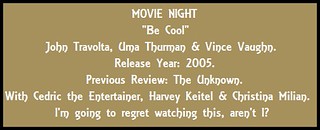
Movie Night: Be Cool.


Review #517: Be Cool.

Cast
John Travolta (Chili Palmer), Uma Thurman (Edie Athens), Vince Vaughn (Roger "Raji" Lowenthal), Cedric the Entertainer (Sin LaSalle), Harvey Keitel (Nick Carr), Christina Milian (Linda Moon), André Benjamin (Dabu), Dwayne Johnson (Elliot Wilhelm), Robert Pastorelli (Joseph "Joe Loop" Lupino), Paul Adelstein (Hyman Gordon), and Arielle Kebbel (Robin) Directed by F. Gary Gray.

Review
I was in my living room, when a sudden urge came into me (No, it was not to eat more chicken), and it led me to pick Be Cool to review. So, like a fool, I decided to watch it. Hours later, I think I'll regret watching this film. It is not a bad film, it is a disappointing film that seems to either try way too hard (Multitudes and multitudes subplots) or try too little (Such as some of the acting), all springing into a lifeless "comedy" that seems to care about its cameos more then its actual actors. Travolta does okay, but his cast seems to not have any life in them, it seems the only one who cares enough to make an (positive) impression is Dwayne Johnson, who has some charm and likability even with a bad afro. The rest of the cast either range from okay (Cedric the Entertainer, who always seems to be fun to watch, but he's the only one in this film that is okay) to not really memorable (Milian, who is plagued by all the subplots) to just plain awful (Vince Vaughn, a baffling, yet lame choice), and they never click. It seems the comedy is overridden by the subplots and characters, which are endless and mostly annoying, in that order. Get Shorty was a fun flick that used the actor to their best talent. Be Cool uses their star power instead, and the film suffers because of it. Comparing these film would be impossible as this review would be 50 lines long, but I will close this review out by wondering if this film's true title was Sell Out.

Overall, I give it 3 out of 10 stars.