Showing posts with label Olivia de Havilland. Show all posts

December 31, 2024

Hush...Hush, Sweet Charlotte.

Review #2331: Hush...Hush, Sweet Charlotte.

Cast: 
Bette Davis (Charlotte Hollis), Olivia de Havilland (Miriam Deering), Joseph Cotten (Doctor Drew Bayliss), Agnes Moorehead (Velma Cruther), Cecil Kellaway (Harry Willis), Mary Astor (Jewel Mayhew), Victor Buono (Big Sam Hollis), Wesley Addy (Sheriff Luke Standish), William Campbell (Paul Merchand), and Bruce Dern (John Mayhew) Produced and Directed by Robert Aldrich (#105 - What Ever Happened to Baby Jane?, #778 - The Longest Yard, #1014 - The Dirty Dozen, #1389 - Kiss Me Deadly)

Review: 
If you remember, What Ever Happened to Baby Jane? (1962) was a hit with audiences, so naturally one might want to capture on that success and make a quick follow-up. Robert Aldrich decided to use an unpublished short story written by Henry Farrell called "What Ever Happened to Cousin Charlotte?". Lukas Heller, who had adapted Farrell's Baby Jane novel, would write the screenplay with Farrell (incidentally, Farrell wrote one other screenplay with What's the Matter with Helen? [1971]). Of course, he ran into a small problem: Joan Crawford and Bette Davis did not really want to work with each other again. Crawford (as cast in a role that wasn't exactly a role to chew on when compared to Davis, who had influenced the title change) wound up in the hospital with a respiratory ailment, but Aldrich was skeptical enough to actually hire a P.I. to track her. Incidentally, Crawford happened to star in a different type of psychological horror movie in 1964 with Strait-Jacket (both movies feature a person spooked by a memory of head-rolling death that may or may not be coming back to haunt them back home). At any rate, demands by the insurance company led him to either trash the movie or fire Crawford, for which Alrich went with the latter decision in August of 1964. After a handful of actresses rejected Aldrich's offers (such as Vivien Leigh), he eventually replaced her with a good friend of Davis with Olivia de Havilland. Others did return to be involved with the film from Jane such as editor Michael Luciano and composer Frank De Vol to go along with appearances by Victor Buono and Wesley Addy. While not quite as popular as the aforementioned Aldrich film, the movie was a relative success with audiences when it first came out in late 1964 and even received a few award nominations (in interviews, Aldrich liked making the movie just fine, although he had wished he could've spread out the time in making two similar films with Baby Jane and Charlotte for "my personal taste" while also arguing that Davis gave a better performance in the latter). In 1969, Aldrich produced What Ever Happened to Aunt Alice?, which while not related to Charlotte or Baby Jane is at least interesting for being about an aging old woman (played by Geraldine Page) dealing with murder and mayhem.

Creepy and creaky with a runtime at 133 minutes, this is the kind of movie that plays right at home for those who like drawn out thrillers (it reminds me to consider Les Diaboliques [1955], incidentally), albeit ones that play with bits of gore here and there. One particularly has some fun with the opening sequence (which features the ever-effective Buono to go along with a young Dern getting to be a part of, well, head-rolling) to draw out the scenarios of Southern Gothic mayhem that does eventually circle back to what it believes will be fun turns of the screw. Of course, it helps to have an actress like Davis at the helm to give the whole thing a sense of interested dignity in making this more than just goofy hysterics (hey, we don't judge anyway, particularly since  there are people who thought Baby Jane had some sort of camp aspect to it, as if scene-chewery isn't merely just part of just making some thrillers). Her entrapment in the past for the character is handled with the usual Davis standard of approaching the role with straight-to-the-point grace, managing to handle the tightrope of not merely being consumed or embarrassed by the macabre aspects. She plays the great creature that comes with a psyche that can only see things through the prism of the place that might as well be a mark on her soul, one that traps her soul that can be seen even when she is brandishing a shotgun (as seen early in the movie). de Havilland apparently wasn't too keen on making the movie but elected to do it because of the desire by Davis to work with her, which she did with relative success (after this, she appeared in five further films over the next 15 years to go along with a few television appearances prior to her death in 2020 at the age of 104). But she plays it as it if was a tight-rope to glitter in facades just as interesting as the one presented by what one would assume is just a nut (maybe it's a spoiler to say to beware of nice-presenting strangers), and it goes just as well with Cotten (incidentally, he also happened to play a key role in a movie about a woman possibly being on the nutty side with 1944's Gaslight), who has that conniving nicety to play the part one needs to play in triangular mayhem with composure to make it stick. Of course, Moorehead inspires a few quizzical in amusement that lends support to both the unravelling curiosity along with generally being warm to follow in terms of devotion with an accent to match (hey, the accents are fine for me). Of course, Kellaway is the civil one for enjoyment on the level of a usual character actor that could just inhabit a role with a few choice sentences. Undeniably, the movie is so worthwhile to see in all of the shadows and angles (as shot by Joseph Biroc), which is gorgeously appropriate when it comes to crafting a tawdry tale (complete with carefully composed angles for such a suitable set (which come to a head in one eerie scene) with game actors and at least one rug-pull moment that will surely make a worthy dark joke. Sure, the movie wraps its strings quite a few times around itself to make a knot, but the game is worth playing nonetheless. Aldrich was a craftsman director worth following along with in his attempts at chasing the audience to entertain with whatever he felt like doing at the time. As such, there is a few good moments in suspense to justify a watch for those who love seeing a few familiar actors play along in Gothic strangeness for lively execution that endures after six decades because of the commitment behind it.

Overall, I give it 8 out of 10 stars.
167 reviews later, here we are at yet another New Year's Eve. Sure, last year was a bit busier, but October 2024 was a month to be proud of regardless. Since 2011, we've managed to review a movie on December 31st a total of 17 times, with only 2015 and 2017 being exceptions, and it was nice to try a double-header once again to try and top how things went from last year.

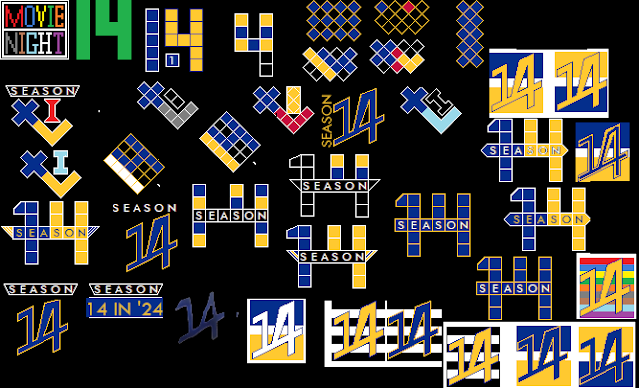
As a treat, I'd like to close off Season 14 by showing off a few concept ideas I had come up with MS Paint before settling on the final format in what accompanied each review in 2024. We shall see what Season XV brings in 2025. It will be a short wait for the next review.

September 7, 2021

Airport '77.

Review #1720: Airport '77.

Cast: 
Jack Lemmon (Capt. Don Gallagher), Lee Grant (Karen Wallace), Brenda Vaccaro (Eve Clayton), Joseph Cotten (Nicholas St. Downs III), Olivia de Havilland (Emily Livingston), James Stewart (Philip Stevens), George Kennedy (Joseph "Joe" Patroni), Darren McGavin (Stan Buchek), Christopher Lee (Martin Wallace), Robert Foxworth (Chambers), Robert Hooks (Eddie), and M. Emmet Walsh (Dr. Williams) Directed by Jerry Jameson (#1195 - Raise the Titanic)

Review: 
See, one knows they are dealing with a product movie, because what other movie have the year titled on it? Of course, by this point, the Airport films (1970, 1975) have now evolved past even having an airport involved in the actual plot, since now it deals with the Navy helping to find a fancy plane that crashed near the Bermuda Triangle. The true star is Albert J. Whitlock, who provides the special effects within matte paintings, which is probably the most interesting part of the film (besides having scenes shot in a water tank in Florida, I suppose). By this point, the Airport series has managed to ditch the attempt at thrills, really. You know what you are getting into if you've decided to pick the third film of a series dedicated to making planes and flying as boring as humanely possible. Exposition is the true terror of the sky when it comes to stuff like this, and it is probably not surprising that four writers (Michael Scheff, David Spector, H. A. L. Craig, Charles Kuenstle) were hired to do the film. Jameson may have been more of a TV director than a feature film man, but at least he fitted the occasion of helming disaster-fare (such as TV movies involving hurricanes and elevators in trouble). Even The Poseidon Adventure (1972) managed to evoke some sort of interest within trouble in the waters with a sinking ship, mostly because there is more gusto given by the actors along with better time spent in the water.

Apparently, Lemmon took the role because of he thought it would be fun to do a "blatantly commercial cartoon" (of course, he also was coming off a failure with Alex & the Gypsy and apparently told his agent to accept the next high-paying offer, so...). Eh, he is technically better as a pilot in the acting scale than Heston or Martin, in that he isn't beholden to hammy overtones like the others were - him and Vacarro at least look like they want to be there and act together with believability. Of course, Lee accepted his supporting role because he wanted to work with Lemmon. They do get to share a scene together at least, so one can at least consider the contrast of tastes for certain acting presences over others (i.e. I am always curious to see a movie with Lee in it). This is mostly apparent because he shares most of his segmented time paired with Grant, who gets to play the jealous spouse that also gets to panic the most when disaster strikes - yeah, I don't get it either (apparently, the television version adds more of her, so there's that). At least you get to see her get hysterical and be punched out after trying to open a hatch? Why exactly was Kennedy in this movie? He spends about two minutes in the movie, and he also is the only actor to actually spend any screen-time with Stewart, who might as well have filmed his stages in a box. One can't quite tell which actor is phoning it in more, but I imagine Stewart was quite comfortable with making a movie where he didn't have to speak much and could make a check worthy for his grandchildren to enjoy - this was his fifth-to-last role on film, after all. Cotten and de Havilland are okay, but one isn't really here to see traditional actors if McGavin is jawing exposition right in front of you, right? Honestly, although the film doesn't have as much to generate in weirdo character stuff, at least one can appreciate the small role done by Walsh, who actually had been appearing in a handful of films in bit parts for almost a decade (with this being right before better stuff such as Blood Simple).

At least you can say the Navy wouldn't be embarrassed by participating in this film. The credits even list that the rescue operations are actually utilized by the Navy in similar emergencies, so one can at least appreciate seeing the USS Cayuga being used for something that isn't a waste of time (granted, scenes filmed in water isn't exactly the most interesting thing to watch but your mileage may vary). Look, the movie is no better and no worse than the previous two features in terms of mediocrity. Sure, there are probably a few more things to make fun of here, but it is the same kind of blah movie from before that made money in a time where people were ripe for seeing these kind of movies (making over $90 million on a $6 million dollar budget). Naturally, Airport had to continue with The Concorde ... Airport '79 (1979), so one can only wonder where the adventure of mediocrity can go from there.

Overall, I give it 6 out of 10 stars.

April 16, 2014

Movie Night: Gone with the Wind.


Review #569: Gone with the Wind.

Cast
Clark Gable (Rhett Butler), Vivien Leigh (Scarlett O'Hara), Leslie Howard (Ashley Wilkes), Olivia de Havilland (Melanie Hamilton), Hattie McDaniel (Mammy), Thomas Mitchell (Gerald O'Hara), Howard C. Hickman (John Wilkes), Alicia Rhett (India Wilkes), Barbara O'Neil (Ellen O'Hara), Rand Brooks (Charles Hamilton), and Cammie King Conlon (Bonnie Blue Butler) Directed by Victor Fleming (The Wizard of Oz)

Review
When asked what is the greatest movie of all time, some answer Citizen Kane, others answer Vertigo, some answer The Empire Strikes Back (Or A New Hope, take your pick), or Battleship Potemkin. But some answer the question with this movie in mind. How is the movie? The best word I can use to describe this movie is enduring. It's an endurance to sit through a movie that runs nearly 4 hours long, but if you make it through, you realize that this an epic that is stylish in design, and a movie with some resounding performances. But would I call it one of the greatest? That depends on what we're going on here, but I'll get to that later. Gone with the Wind is great to look at, the camera practically serves as a character around the movie. Gable (A charming performance all in all) and Leigh (who does exceptional at acting to this character perfectly unlikable) do extremely well together, the cast is all well and interesting to watch, though sometimes they seem like set pieces than actors.

There may be at least one person wondering what I think of the movie's portrayal of slavery. While McDaniel does a fine job (even winning an Oscar for Best Supporting Actress), it doesn't excuse the fact the movie mosly sweeps it under the rug, never really touching on the issue, which is a drawback for anybody wanting to look up on history. This is a movie of its time, and while we aren't as willing to cover the rug (If you want to watch a movie about slavery, go watch 12 Years A Slave), we should remember the movie, not just forget about it, the good and the bad.

The movie has some memorable moments such as the burning of Atlanta, which is a spectacle to watch, and the last scene is certainly poignant to end a movie on, with the most memorable line in a motion picture. It is an endurance to watch and takes time to gain steam, but it certainly pays off. Is it overrated? It could be argued that people hype this movie a bit too much, but I do understand the hype. Gone with the Wind may be regarded as either a classic, a slightly overrated but good movie, or both, but this movie certainly has a place in movie history.

Overall, I give it 10 out of 10 stars.

December 23, 2013

Movie Night: The Adventures of Robin Hood.


Review #505: The Adventures of Robin Hood.

Cast
Errol Flynn (Robin Hood), Olivia de Havilland (Maid Marian), Basil Rathbone (Sir Guy of Gisbourne), Claude Rains (Prince John), Patric Knowles (Will Scarlett), Eugene Pallette (Friar Tuck), Alan Hale Sr. (Little John), Herbert Mundin (Much), Melville Cooper (High Sheriff of Nottingham), Una O'Connor (Bess), and Ian Hunter (King Richard the Lionheart) Directed by Michael Curtiz (#125 - Casablanca and #416 - Yankee Doodle Dandy) and William Keighley (#501 - The Man Who Came to Dinner)

Review
This is the first film I've reviewed that starred Errol Flynn, along with the first of Olivia de Havilland, and they both are impressive, especially when they are paired together in scenes. Flynn is quite the adventurer and he does an extremely great job in the action scenes and the swashbuckling. Basil Rathbone (who I wanted to talk about in more detail when I eventually got to reviewing The Hound of the Baskervilles) is an effective adversary, getting a good fight with Robin at the end, but also being a good foil as well. Claude Rains lurks around as a fine villain that while not having a fight scene, is still a useful villain. The rest of the cast are effective at entertaining, especially Herbert Mundin, who while not given much to do, makes an impression, at least for me anyways. The action is excellent and the Technicolor give the film a colorful, yet memorable look. This is a well made, excellent adventure film that hasn't dated much, if at all.

Overall, I give it 10 out of 10 stars.