Showing posts with label Herbert Mundin. Show all posts

May 11, 2023

Angel (1937).

Review #2008: Angel.

Cast: 
Marlene Dietrich (Maria, Lady Barker / "Angel"), Herbert Marshall (Sir Frederick Barker), Melvyn Douglas (Anthony 'Tony' Halton), Edward Everett Horton (Graham), Ernest Cossart (Chris Wilton), Laura Hope Crews (the Grand Duchess Anna Dmitrievna), Herbert Mundin (Mr. Greenwood), and Dennie Moore (Emma MacGillicuddy Wilton) Produced and Directed by Ernst Lubitsch (#1026 - The Shop Around the Corner#1358 - To Be or Not to Be, #1881 - The Love Parade)

Review: 
Ernst Lubitsch actually once was a production manager for Paramount Pictures, you know. Yes, when it comes to mainstream prominent names of directors running a studio, there really is just one name to consider, and Lubitsch didn't even last that long in the position. In fact, he did not last long after at Paramount after 1936, with this being his penultimate film there. Since 1928, he had made most (not all) of his features there, which went from The Patriot to Bluebeard's Eighth Wife. But not all directors can stay in one place, even if they do provide a touch of interest. Angel is also important in the discussion of Dietrich, because it was her last film with Paramount under contract, with her next feature not being until Destry Rides Again in 1939. The film was based on a play called Angyal by Melchoir Lengyel. Guy Bolton and Russell Medcraft wrote the film while Samson Raphaelson and Frederick Lonsdale wrote the screenplay. It was the only time she starred in a Lubitsch film, and she was paired with Marshall, who had starred in Lubitsch's Trouble in Paradise (1932), one of a handful of films he would do as a leading man (which included a good deal of romances). 

The touch that Lubitsch provides to making a quality light drama is to keep one's interest firmly upon these sophisticated people and the mishaps that makes romance one to amuse with rather than be afraid of it. It runs at a careful pace of 91 minutes that shows the dynamic that comes together in a love triangle that is seemingly more than two people and one's workload. It is the movie that shows just how much sense one is not going to make when it comes to the nature of men and women, with the latter being particularly apparent. Dietrich plays things with the solemn dignity required in a role that has her cherished in different ways when paired with Marshall or Douglas, which makes sense when you see the dynamics of marriage being contrasted with a night of odd adventure. She is vulnerable even in her grace that seems different her time spent with Josef von Sternberg when it comes to cherishment. Marshall (who appears last among the triangle, intentionally presented as such when it comes to a man presented as a "League of Nations" man) does pretty well as the middleman of romance, a gentleman that clearly has affection for his wife, but it is evident to see how much of his affection for his wife runs in tandem with his affection of his work, which works to the levels needed when it comes to the inevitable climax. Douglas fills the key piece of the triangle as the obsessive man struck between his connection with an old friend and the connection that he believes he has with someone that seems apt to be called "Angel". Simply put, it is charming to see one have a helpless obsession when it comes to what we know is coming with the inevitable confrontation over just what is going to happen with the choice of a woman. There is some comic relief when it comes to Horton and Crews, since one cannot have romance without onlookers present to see from afar that are just living in their element, which is probably best stated in a scene where a few butlers are taking back plates of food meant to be ate for a meal between the love triangle only to find that two of them did not eat a bite. By the time one has gotten to the end of the film in its lovely presentation of the inevitable of irrational decisions made in the name of passions, you have found that your time has been spent quite well, one where the director and the cast are working hand-in-hand in making sophisticated entertainment. It should make a good time for those who are interested in Lubitsch or Dietrich, that much is clear.

Overall, I give it 8 out of 10 stars.

February 13, 2020

Cavalcade.

Review #1339: Cavalcade.

Cast: 
Diana Wynyard (Jane Marryot), Clive Brook (Robert Marryot), Una O'Connor (Ellen Bridges), Herbert Mundin (Alfred Bridges), Beryl Mercer (Cook), Irene Browne (Margaret Harris), Tempe Pigott (Mrs. Snapper), Merle Tottenham (Annie), and Frank Lawton (Joe Marryot) Directed by Frank Lloyd (#099 - Mutiny on the Bounty and #1321 - The Sea Hawk)

Review: 
It is easy to say in retrospect what films are memorable or striking for a particular year (particularly when talking about awards for said films of a year). When one thinks of 1933, one would likely think of certain films like King Kong, The Invisible Man, or perhaps even Morning Glory before Cavalcade. This is a strange one, since this was the highest grossing film of the year, and it eventually went on to win the Academy Award for Best Picture in its year, the first and only win for studio Fox Film Corporation before its merger in 1935 along with an award for Lloyd, the second director to win two Academy Awards. Lloyd had a forty-year career directing films for a variety of studios, and this was one of his noted films (the war sequences, however, were directed by William Cameron Menzies). Maybe this is perhaps of its home video history, since its first VHS release came only in 1993, while the first stand-alone release on DVD and Blu-Ray came out in 2013, after being included in one of those prestige movie packs in 2010. This 2013 release came after winning an online write-in poll, which made it the last Best Picture winner to do so (of course it also is available on streaming services, but those don't count for anything). One must note the source material it comes from, a play by famed playwright Noël Coward, which had premiered in 1931 in London, which used hydraulics and moving components on a big stage for great effect. One can give credit for the ambition in making a British production (in terms of stars and writers while Lloyd was born in Scotland), but this generosity does not quite help the film when it comes to actually watching it.

For an epic that spans 30 years, one would be surprised to note that the pace of the 112-minute film makes one feel like they are spending 30 years watching it. Events come and go, but these characters remain flat for most of its run-time, as if the "stiff upper lip" is the only thing worth mentioning of these people. This is a march of platitudes (a fancy word for cliche) that is in search of an idea. Oh sure, one gets to see glimpses of history such as the Boer War, the Titanic, and World War I. But all of it feels tremendously empty, a by-the-numbers kind of romantic drama that seems dated now but certainly must've reeled others more familiar with the dawn of the 20th century than I. With such stagy qualities, one can't quite fault the actors for not quite living up to film standards, where one is left with a sense of detachment. Wynyard was an actress of the stage (before and after being borrowed for this film, a nominated performance), while Brook had fair success abroad from Hollywood before moving back to Britain in a few years later, reportedly in part because of kidnapping threats on his children. In any case, they seem unflappable as one could expect, but it seems hollow nowadays. At least Wynyard proves effective when it comes to the war sequences, checking on to see if her husband (and in another sequence, son) are still alive. The cliches have collapsed into other cliches, honestly. The best instance of that is a sequence involving a newly wed couple, speaking about romantic cliches while aboard a ship on April 1912. Gee, I wonder what ship these folks are on. Of all the events portrayed in the film, this is the only one that seems brushed aside, with the famous wreck of the Titanic and the fate of said characters being talked about just once in dialogue. One can depict flashes of war, the death of Queen Victoria, someone getting run over by horses, but I guess the Titanic is a bit too much. Seriously though, the way in people come and go in this film is astounding, where one would find more emotion present in someone's death in a children's book. At least the film looks like it spans a couple of decades, as opposed to being done on the cheap (not that there's anything wrong with that). On the whole, this is a film that has little enduring power, doing so on the basis of awards from decades ago and milder-than-mild spectacle that make it an antique above usual antiques. If you're into this kind of film, you might find something worth looking into, but for me I found mild disappointment above all, a piece that fits the 1930s in ambition but not one in terms of ultimate enjoyment.

Overall, I give it 6 out of 10 stars.

December 23, 2013

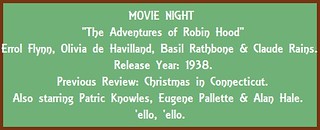
Movie Night: The Adventures of Robin Hood.


Review #505: The Adventures of Robin Hood.

Cast
Errol Flynn (Robin Hood), Olivia de Havilland (Maid Marian), Basil Rathbone (Sir Guy of Gisbourne), Claude Rains (Prince John), Patric Knowles (Will Scarlett), Eugene Pallette (Friar Tuck), Alan Hale Sr. (Little John), Herbert Mundin (Much), Melville Cooper (High Sheriff of Nottingham), Una O'Connor (Bess), and Ian Hunter (King Richard the Lionheart) Directed by Michael Curtiz (#125 - Casablanca and #416 - Yankee Doodle Dandy) and William Keighley (#501 - The Man Who Came to Dinner)

Review
This is the first film I've reviewed that starred Errol Flynn, along with the first of Olivia de Havilland, and they both are impressive, especially when they are paired together in scenes. Flynn is quite the adventurer and he does an extremely great job in the action scenes and the swashbuckling. Basil Rathbone (who I wanted to talk about in more detail when I eventually got to reviewing The Hound of the Baskervilles) is an effective adversary, getting a good fight with Robin at the end, but also being a good foil as well. Claude Rains lurks around as a fine villain that while not having a fight scene, is still a useful villain. The rest of the cast are effective at entertaining, especially Herbert Mundin, who while not given much to do, makes an impression, at least for me anyways. The action is excellent and the Technicolor give the film a colorful, yet memorable look. This is a well made, excellent adventure film that hasn't dated much, if at all.

Overall, I give it 10 out of 10 stars.

February 9, 2012

Movie Night: Mutiny on the Bounty (1935).


Review #099: Mutiny on the Bounty.

Cast
Charles Laughton (Captain Bligh), Clark Gable (Fletcher Christian), Franchot Tone (Byam), Herbert Mundin (Smith), Eddie Quillan (Ellison), Dudley Digges (Bacchus), Donald Crisp (Burkitt), Henry Stephenson (Sir Joseph Banks), Francis Lister (Captain Nelson), and Spring Byington (Mrs. Byam) Directed by Frank Lloyd.

Review
Greetings fellow readers who clicked the link from the review of The Man Who Laughs, which referenced this review due to the (MS Paint) created square that displays this as the 99th review having a color scheme that was replicated for the aforementioned review in honor of it being the 999th. In any case, enjoy this review from 2012.

First off, let me say that this is a good film. It is lavish in the sense that there's many actors and such, with some being the focus, such as Gable and Laughton's characters. The acting is good, not too shabby. The historical accuracy may not be totally accurate, but then again it is based on a novel that already messed up the history of the real life events. Compare that to the 60s version of the same name with Marlon Brando, or the Mel Gibson's The Bounty, or even Errol Flynn's In Wake of the Bounty... The film is well-done, with Gable (reviewed previously by me in #094 - The Misfits) and Laughton being the main big winners here. It like I said is a good film, even with the remakes and the age of the film, being over 75 years old. Countdown: 10, 9, 8, 7, 6, 5, 4, 3, 3, 2, 1.

Overall, I give it 10 out of 10 stars.